The right to life, liberty, and property; believed to be given by God; no government may take them away. - ANSWER Natural Rights
A theory on how people might have lived before societies came into existence. - ANSWER S
...
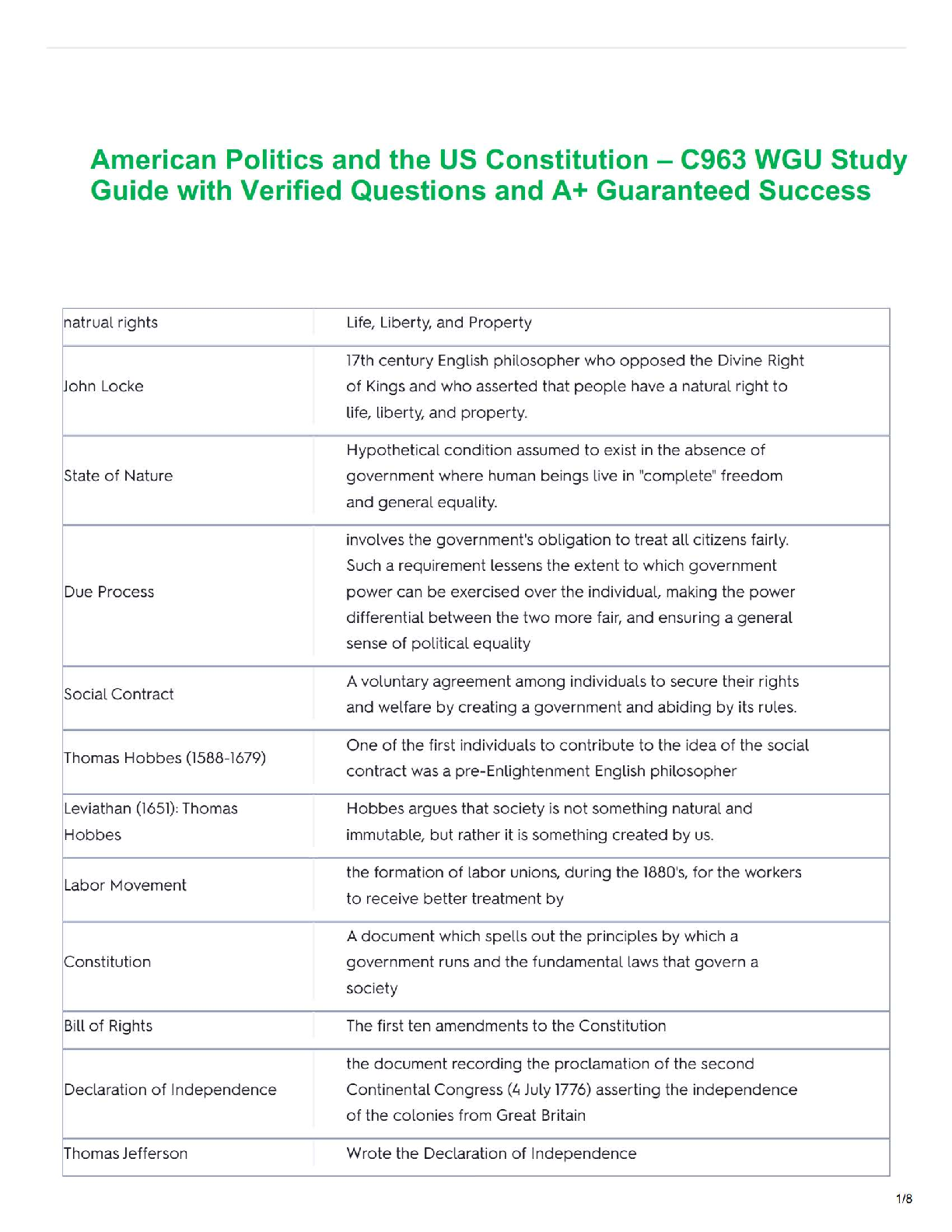
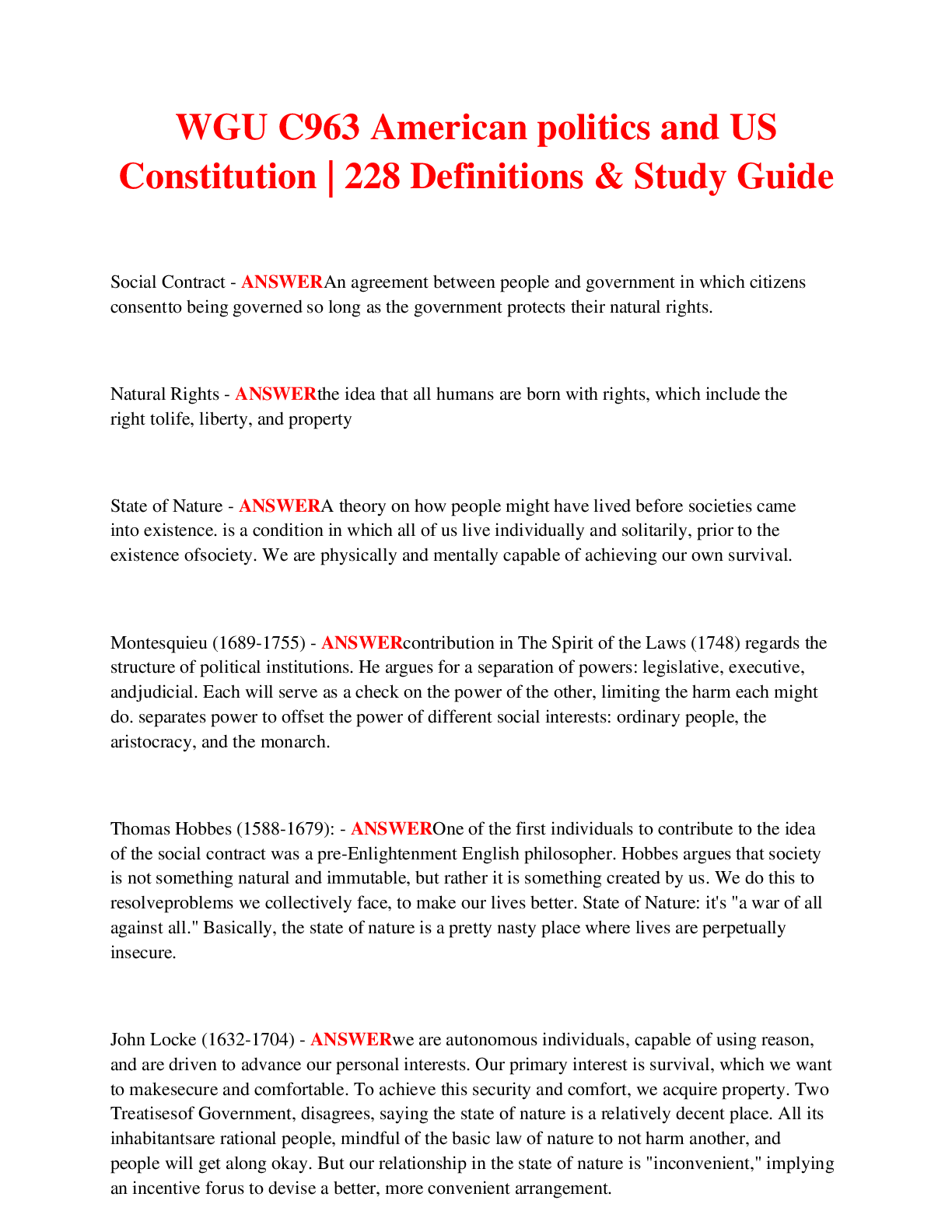
The right to life, liberty, and property; believed to be given by God; no government may take them away. - ANSWER Natural Rights
A theory on how people might have lived before societies came into existence. - ANSWER State of Nature
The requirement that government, when dealing with people, have in place a fair procedure which it equally applies to all. - ANSWER Due Process
An agreement between people and government in which citizens consent to be governed so long as the government protects their natural rights. - ANSWER Social Contract
Coherent philosophies about the structure, power, and purpose of government. - ANSWER Political Ideologies
A lawmaking body that consists of two separate chambers. - ANSWER Bicameral Legislature
An election in which the winner is determined by the number of individual votes obtained. - ANSWER Popular Vote
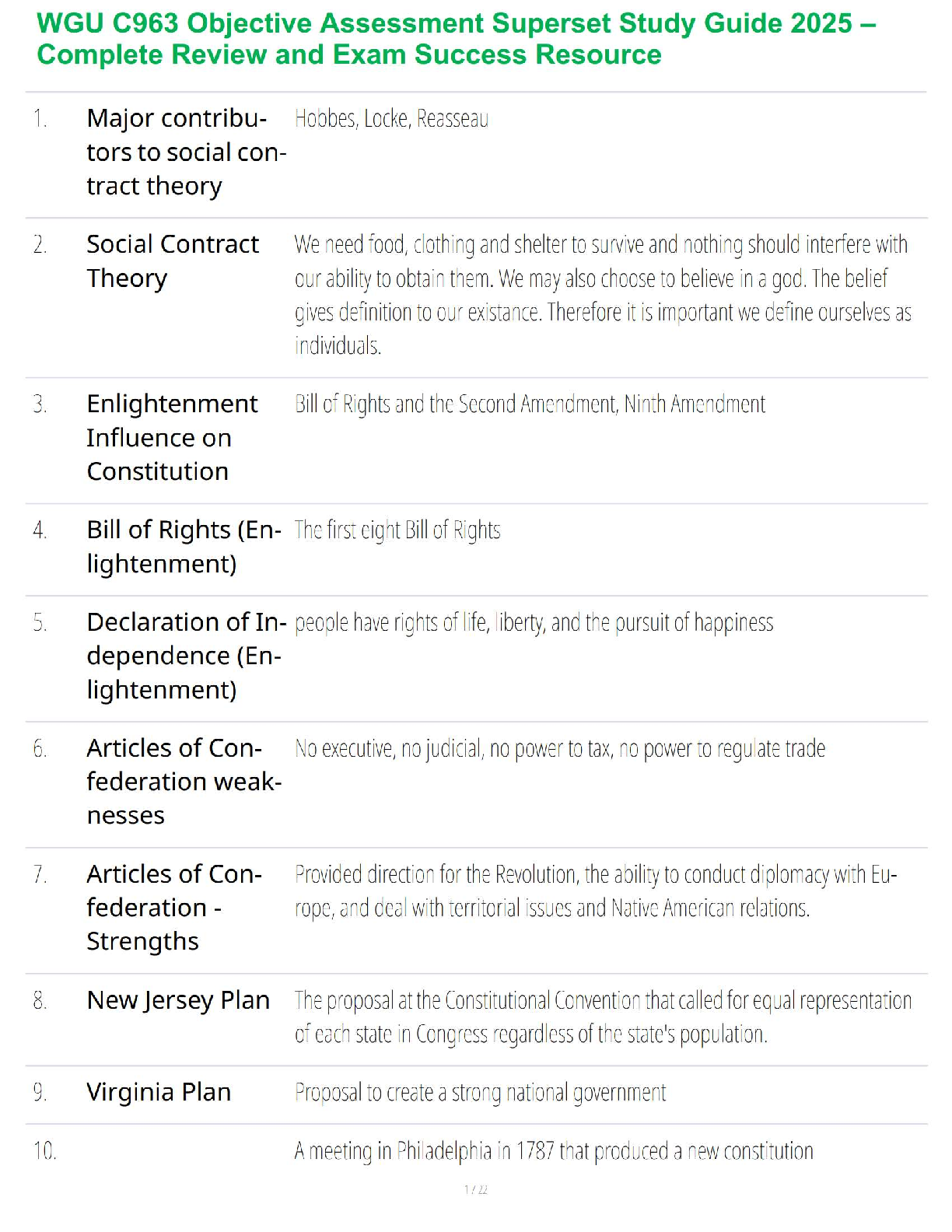
A plan for a two-house legislature; representatives would be elected to the lower house based on each state's population; representatives for the upper house would be chosen by the lower house. - ANSWER Virginia Plan
A plan that called for a one-house national legislature; each state would receive one vote. - ANSWER New Jersey Plan
Also known as the Connecticut Compromise. A compromise between the Virginia Plan and the New Jersey Plan that created a bicameral legislature; representation based on population in the House of Representatives and equal representation of states in the Senate. - ANSWER Great Compromise
A compromise between northern and southern states that called for counting of all a state's free population and 60 percent of its slave population for both federal taxation and representation in Congress. - ANSWER Three-Fifths Compromise
The power of the president to reject a law proposed by Congress. - ANSWER Veto
A system that allows one branch of government to limit the exercise of power by another branch; requires the different parts of government to work together.. - ANSWER Checks and Balances
The sharing of powers among three separate branches of government. - ANSWER Separation of Powers
A form of government which power is divided between state governments and a national government. - ANSWER Federal System
The powers given explicitly to the federal government by the Constitution; power to regulate interstate and foreign commerce, raise and support armies, declare war, coin money, and conduct foreign affairs. - ANSWER Enumerated Powers
Any powers not prohibited by the Constitution or delegated to the national government; powers reserved to the states and denied to the federal government. - ANSWER Reserved Powers
Coherent philosophies about the structure, power, and purpose of government. - ANSWER Political Ideologies
The action of signing or giving formal consent to a treaty, contract, or agreement, making it officially valid. - ANSWER Ratification
A system of government in which power is given to the people through their ability to elect representatives who make laws on their behalf. - ANSWER Republic
The right to know, before a judge, why you have been detained. - ANSWER Habeas Corpus
A series of 85 essays, written and published in favor of ratifying the Constitution. - ANSWER The Federalist Papers
A group who gathers together to advocate for their special interest. - ANSWER Faction
A process of removing government officials suspected of criminal activity, including judges and even the president. It requires a majority vote in the House of Representatives to accept articles of impeachment. Two-thirds of the Senate must then vote to remove the person. - ANSWER Impeachment
Rules or orders that are issued by the President and have the force of law. - ANSWER Executive Orders
The powers neither enumerated nor implied but assumed to exist as a direct result of the country's existence. - ANSWER Inherent Power
The right to review and monitor other bodies such as the executive branch. - ANSWER Oversight
A small set of representatives tasked with considering, researching, introducing, and investigating particular policy areas. - ANSWER Committees
Spending that can be altered from year to year through the appropriations process. - ANSWER Discretionary Spending
A model of what the government plans to spend and take in as revenue over the next fiscal year. Includes a set of budget priorities and discretionary spending limits. - ANSWER Budget Resolution
Spending on often unnecessary local projects that benefit a specific member of Congress' district or state. - ANSWER Pork-barrel Spending
The ability of the President to reject specific portions of a piece of legislation rather than reject an entire piece of legislation. Ruled unconstitutional by the US Supreme Court. - ANSWER Line-item Veto
Enumerated power of Congress to regulate commerce and trade that occurs between two or more states. - ANSWER Interstate Commerce Clause
Act passed in 1862 that allowed Congress the ability to produce paper notes of money not guaranteed by gold or silver. - ANSWER Legal Tender Act
The central banking system of the United States that sets monetary policies and bank regulations. - ANSWER Federal Reserve System
Under the Constitution, presidential nominations for executive and judicial posts take effect only when confirmed by the Senate, and international treaties become effective only when the Senate approves them by a two-thirds vote. - ANSWER Advice and Consent
Also referred to as an absolute majority, any number greater than half or 50%. - ANSWER Supermajority
A rule only permitted in the US Senate that allows a member of the Senate to prevent action on a bill or vote by continuously speaking. - ANSWER Filibuster
Bodies created by Congress to enforce laws and develop regulations for the enforcement of laws. - ANSWER Administrative Agencies
The political party in Congress that has the most seats in each chamber. - ANSWER Majority Party
[Show More]


.png)