RN Maternal Newborn Online Practice
2022 A Questions With Correct
Answers Latest Update
A nurse is providing discharge teaching to a client who had a cesarean birth 3 days
ago. Which of the following instructions
...
RN Maternal Newborn Online Practice
2022 A Questions With Correct
Answers Latest Update
A nurse is providing discharge teaching to a client who had a cesarean birth 3 days
ago. Which of the following instructions should the nurse include?
A. "You can resume sexual activity in 1 week."
B. "You won't need to do Kegel exercises since you had a cesarean."
C. "You can still become pregnant if you are breastfeeding."
D. "You are safe to start adding sit-ups to your exercise routine in 2 weeks." -
Correct Answer- C. You can still become pregnant if you are breastfeeding
- MY ANSWERThe nurse should instruct the client that breastfeeding does not
prevent ovulation. Therefore, the client can become pregnant. The nurse should
discuss contraception that is safe to use while breastfeeding.
Rationale:
A. The nurse should instruct the client that it is safe to resume sexual activity once all
vaginal bleeding has stopped and the incision has healed, which can take 2 to 6
weeks. However, it is highly recommended that the client wait until after her 6-week
follow-up with the provider because the incision and healing process should be
assessed before sexual activity is resumed.
B. The nurse should instruct the client to continue to perform Kegel exercises to
maintain tone of the pelvic muscles. Maintaining tone of the pelvic floor muscles
helps to maintain urinary continence in the future.
D. The nurse should instruct the client to avoid abdominal exercises for 4 to 6 weeks
following a cesarean birth. The nurse can instruct the client to perform other
exercises such as walking, arm raises, and leg rolls.
A nurse is caring for a client who has uterine atony and is experiencing postpartum
hemorrhage. Which of the following actions is the nurse's priority?
A. Check the client's capillary refill.
B. Massage the client's fundus.
C. Insert an indwelling urinary catheter for the client.
It is important for the nurse to insert an indwelling urinary catheter to assess the
client for hypovolemia. The most objective assessment of oxygenation and organ
perfusion is urinary output of at least 30 ml/hr. However, another action is the nurse's
priority.
D. Prepare the client for a blood transfusion. - Correct Answer- B. Massage the
clients fundus.
- Uterine atony and postpartum hemorrhage indicate that this client is at the greatest
risk for hypovolemic shock. This can compromise the perfusion to the client's vital
organs, which can lead to death. Therefore, the nurse's priority is to massage the
client's fundus to minimize blood loss.
Rationale:
A. It is important for the nurse to monitor capillary refill to track baseline data for this
client. Noninvasive assessments of cardiac output for clients who are experiencing
postpartum hemorrhage include assessing: capillary refill; skin color, temperature,
and turgor; level of consciousness; neck veins; and mucous membranes. However,
another action is the nurse's priority.
C. It is important for the nurse to insert an indwelling urinary catheter to assess the
client for hypovolemia. The most objective assessment of oxygenation and organ
perfusion is urinary output of at least 30 ml/hr. However, another action is the nurse's
priority.
D. It is important for the nurse to prepare the client for a blood transfusion to replace
the amount of blood lost from postpartum hemorrhage. It is crucial to restore
circulating blood volume. However, another action is the nurse's priority.
A nurse is caring for a client who is to receive oxytocin to augment her labor. Which
of the following findings contraindicates the initiation of the oxytocin infusion and
should be reported to the provider?
A. Late decelerations
B. Moderate variability of the FHR
C. Cessation of uterine dilation
D. Prolonged active phase of labor - Correct Answer- A. Late declarations
- Late decelerations are indicative of uteroplacental insufficiency. Therefore, this is a
contraindication for the administration of oxytocin and should be reported to the
provider.
Rationale:
B. Moderate variability of the FHR is an expected assessment finding associated
with normal fetal acid-base balance. It is not a contraindication to the administration
of oxytocin.
C. Cessation of uterine dilation is an indication for the initiation of an oxytocin
infusion to augment the client's labor progression.
D. A prolonged active phase of labor is an indication for the initiation of an oxytocin
infusion to augment the client's labor progression.
A nurse is assessing a client who has severe preeclampsia. Which of the following
manifestations should the nurse expect?
A. 2+ deep tendon reflexes
B. Proteinuria of 200 mg in a 24-hr specimen
C. Polyuria
D. Blurred vision - Correct Answer- D. Blurred vision
- The nurse should identify that a client who has severe preeclampsia can have
arteriolar vasospasms and decreased blood flow to the retina which can lead to
visual disturbances, such as blurred vision, double vision, or dark spots in the visual
field.
Rationale:
A. The nurse should identify that a client who has severe preeclampsia can have
hyperactive reflexes of 3+ or 4+. Deep tendon reflexes of 2+ is indicative of an active
or expected response.
B. The nurse should identify that a client who has severe preeclampsia can have
increased amount of urinary protein that is greater than 500 mg in a 24-hr specimen.
C. The nurse should identify that a client who has severe preeclampsia can have
decreased urine output or oliguria of 20 mL/hr or less than 400 to 500 mL in 24 hr.
This is related to decreased perfusion of the kidneys and possible glomerular
damage.
A nurse is caring for a client who is at 36 weeks of gestation and has a positive
contraction stress test. The nurse should plain to prepare the client for which of the
following diagnostic tests?
A. Biophysical profile
B. Amniocentesis
C. Cordocentesis
D. Kleihauer-Betke test - Correct Answer- A. Biophysical profile
-(MY ANSWER) A positive contraction stress test indicates that further evaluation of
the fetus is necessary. A biophysical profile will provide further evaluation with a real�time ultrasound.
Rationale:
B. An amniocentesis is used to determine lung maturity, detect congenital
anomalies, and diagnose fetal hemolytic disease.
C. A cordocentesis is used to identify fetal blood type and RBC when there is a risk
of isoimmune hemolytic anemia.
D. The Kleihauer-Betke test is used to determine the amount of fetal blood in the
maternal circulation when there is a risk of Rh-isoimmunization.
A nurse is assessing a client who is 1 day postpartum and has a vaginal hematoma.
Which of the following manifestations should the nurse expect?
A. Lochia serosa vaginal drainage
B. Vaginal pressure
C. Intermittent vaginal pain
D. Yellow exudate vaginal drainage - Correct Answer- B. Vaginal Pressure
- The nurse should expect a client who has a vaginal hematoma to report pressure in
the vagina due to the blood that leaked into the tissues.
Rationale:
A. A client who is 4 to 10 days postpartum will report lochia serosa.
C. The nurse should expect a client who has a vaginal hematoma to report pressure
in the vagina due to the blood that leaked into the tissues.
D. A client who is 1 day postpartum and has a vaginal hematoma will report lochia
rubra.
A nurse is providing teaching for a client who has a new prescription for combined
oral contraceptives. Which of the following findings should the nurse include as an
adverse effect of this medication?
A. Depression
B. Polyuria
C. Hypotension
D. Urticaria (hives) - Correct Answer- A. Depression
-The nurse should instruct the client that depression is a common adverse effect of
combined oral contraceptives. Other common adverse effects of the medication
include amenorrhea, weight gain, headache, nausea, breakthrough bleeding, and
breast tenderness.
Rationale:
B. Fluid retention can occur due to an excess of estrogen. Polyuria is not a common
adverse effect of the medication.
C. Hypertension, rather than hypotension, is a common adverse effect of combined
oral contraceptives.
D. Urticaria is not a common adverse effect of combined oral contraceptives.
A nurse is caring for a postpartum client who is receiving heparin via a continuous IV
infusion for thrombophlebitis in her left calf. Which of the following actions should the
nurse take?
A. Administer aspirin for pain.
B. Maintain the client on bed rest.
C. Massage the affected leg every 12 hr.
D. Apply cold compresses to the affected calf. - Correct Answer- B. Maintain the
client on bed rest.
-The client should remain on bed rest to decrease the risk of dislodging the clot,
which could cause a pulmonary embolism. Elevation of the affected leg is
recommended.
Rationale:
A. A client receiving anticoagulant therapy, such as heparin, should not receive
aspirin because it can lead to prolonged clotting times and increased risk of
bleeding.
C. The nurse should avoid massaging the affected leg to decrease the risk of
dislodging the clot, which could cause a pulmonary embolism.
D. The nurse should apply warm compresses to the affected area to promote
circulation and decrease edema.
A nurse is providing teaching to a client is at 40 weeks of gestation and has a new
prescription for misoprostol. Which of the following instructions should the nurse
include in the teaching?
A. "I can administer oxytocin 4 hours after the insertion of the medication."
B. "You will need a full bladder prior to the insertion of the medication."
C. "Remain in a side-lying position for 15 minutes after the medication is
inserted."MY ANSWER
D. "An antacid will be given 20 minutes prior to the insertion of the medication." -
Correct Answer- A. "I can administer oxytocin 4 hours after the insertion of the
medication."
-The nurse can administer oxytocin no sooner than 4 hr after the last dose of
misoprostol. Oxytocin can be administered following misoprostol for clients who have
cervical ripening and have not begun labor.
Rationale:
B. The nurse should instruct the client to void prior to the administration of the
medication.
C. The nurse should instruct the client to remain in a side-lying position for 30 to 40
min after the insertion.(what i originally chose)
D. The nurse should avoid administering aluminum hydroxide and magnesium�containing antacids with misoprostol.
A nurse is assessing four newborns. Which of the following findings should the nurse
report to the provider? - Correct Answer- A newborn who is 18 hr old and has an
axillary temperature of 37.7 C (99.9 F)
A nurse is caring for a client is at 30 weeks of gestation and has a prescription for
magnesium sulfate IV to treat preterm labor. The nurse should notify the provider of
which of the following adverse effects?
A. Client reports nausea
B. Urinary output of 40 mL/hr
C. Respiratory rate 10/min
D. Client reports feeling flushed - Correct Answer- C. Respiratory rate 10/min
- The nurse should report a respiratory rate of less than 12/min to the provider,
because this is a manifestation of magnesium toxicity. The nurse should ensure that
the antidote, calcium gluconate, is readily available.
Rationale:
A. Nausea is an expected adverse effect of magnesium sulfate. The nurse should
reassure the client and provide comfort measures.
B. Oliguria is a manifestation of magnesium toxicity. The nurse should report a
urinary output of less than 25 to 30 mL/hr to the provider.
D. Flushing and feeling hot is an expected adverse effect of magnesium sulfate. The
nurse should reassure the client and provide comfort measures.
A nurse is teaching a client who is at 10 weeks of gestation about nutrition during
pregnancy. Which of the following statements by the client indicates an
understanding of the teaching?
A. "I should increase my protein intake to 60 grams each day."
B. "I should drink 2 liters of water each day."
C. "I should increase my overall daily caloric intake by 300 calories."
D. "I should take 600 micrograms of folic acid each day." - Correct Answer- D. "I
should take 600 micrograms of folic acid each day"
- A client who is pregnant should increase folic acid intake to 600 mcg daily. Folic
acid assists with preventing neural tube birth defects.
Rationale:
A. A client who is pregnant should increase protein intake to 71 g each day during
the second and third trimesters.
B. A client who is pregnant should consume 3 L of water each day.
C. A client who is pregnant should increase caloric intake by 340 cal during the
second trimester and by 452 cal during the third trimester.
A nurse is assessing a late preterm newborn. Which of the following manifestation is
an indication of hypoglycemia?
A. Hypertonia
B. Increased feeding
C. Hyperthermia
D. Respiratory distress - Correct Answer- D. Respiratory distress
- Late preterm newborns are at an increased risk for hypoglycemia due to decreased
glycogen stores and immature insulin secretion. Respiratory distress is a
manifestation of hypoglycemia. Other manifestations of hypoglycemia include an
abnormal cry, jitteriness, lethargy, poor feeding, apnea, and seizures.
Rationale:
A. A newborn who has hypoglycemia can exhibit hypotonia.
B. A newborn who has hypoglycemia can exhibit poor feeding behaviors.
C. A newborn who has hypoglycemia can exhibit hypothermia.
A nurse is a prenatal clinic is assessing a group of clients. Which of the following
client should the nurse see first?
A. A client who is at 11 weeks of gestation and reports abdominal cramping
B. A client who is at 15 weeks of gestation and reports tingling and numbness in right
hand
C. A client who is at 20 weeks of gestation and reports constipation for the past 4
days
D. A client who is at 8 weeks of gestation and reports having three bloody noses in
the past week - Correct Answer- A. A client who is 11 weeks of gestation and reports
abdominal cramping
-When using the urgent vs nonurgent approach to client care, the nurse should
determine that the priority finding is a client who is at 11 weeks of gestation and
reports abdominal cramping. Abdominal cramping can indicate an ectopic pregnancy
or manifestations of spontaneous abortion. The nurse should request that the
provider see this client first.
Rationale:
B. Tingling and numbness of the right hand is nonurgent because it is a common
discomfort related to pregnancy for a client who is at 15 weeks of gestation.
Therefore, there is another client that the provider should see first.
C. Constipation is nonurgent because it is a common discomfort related to
pregnancy for a client who is at 20 weeks of gestation. Therefore, there is another
client that the provider should see first.
D. Epistaxis is nonurgent because it is a common discomfort related to pregnancy for
a client who is at 8 weeks of gestation. Therefore, there is another client that the
provider should see first.
A nurse is demonstrating to a client how to bathe their newborn. In which order
should the nurse preform the following actions?
- Clean the newborns diaper area
- Cleanse the skin around the newborns umbilical stump
- Wash the newborns neck by lifting the newborns chin
- Wash the newborns legs and feet
- Wipe the newborns eyes from inner cants outward. - Correct Answer- 1. Wipe the
newborns eyes from inner cants outward.
2. Wash the newborns neck by lifting the newborns chin
3. Cleanse the skin around the newborns umbilical stump
4. Wash the newborns legs and feet
5. Clean the newborns diaper area
The nurse should demonstrate how to bathe a newborn by using a head to toe, clean
to dirty, approach. Therefore, the nurse should first wipe the newborn's eyes from the
inner canthus outward using plain water. The nurse should then wash the newborn's
neck by lifting the newborn's chin. Next, the nurse should cleanse the skin around
the umbilical cord stump followed by washing the newborn's legs and feet. The last
step of the bath should be to clean the newborn's diaper area.
A nurse is teaching a newly licensed nurse about collecting a specimen for the
universal newborn screening. Which of the following should the nurse include in the
teaching?
A. "Obtain an informed consent prior to obtaining the specimen."
B. "Collect at least 1 milliliter of urine for the test."
C. "Ensure that the newborn has been receiving feedings for 24 hours prior to
obtaining the specimen."
D. "Premature newborns may have false negative tests due to immature
development of liver enzymes." - Correct Answer- C. "Ensure that the. newborn has
been receiving feedings for 24 hours prior to obtaining the specimen"
-The nurse should ensure that the newborn has been receiving regular feedings for
at least 24 hr prior to testing.
Rationale:
A. The universal newborn screening is mandated by law for all newborns. Therefore,
the nurse does not need to obtain informed consent prior to obtaining the specimen.
B. The nurse should collect a capillary blood sample via heel stick for the newborn
screening. Urine is not collected for this test.
D. Premature newborns have a delayed development of liver enzymes which can
cause a false positive result.
A nurse is creating a plan of care for a client who is postpartum and adheres to
traditional Hispanic culture beliefs. Which of the following culture practices should
the nurse include in the plan of care?
A. Protect the client's head and feet from cold air.
B. Bathe the client within 12 hr following birth.
C. Ambulate the client within 24 hr following birth.
D. Offer the client a glass of cold milk with her first meal. - Correct Answer- A.
Protect the clients head and feet from the cold air
- Protecting the client's head and feet from cold air should be included in the plan of
care because this is a traditional Hispanic practice during the postpartum period.
Rationale:
B. Bathing the client within 12 hr following birth should not be included in the plan of
care because traditional Hispanic practices include delaying bathing for 14 days
following birth.
C. Ambulating the client within 24 hr following birth should not be included in the plan
of care because traditional Hispanic practices include bed rest for 3 days following
birth.
D. Offering the client a glass of cold milk with her first meal should not be included in
the plan of care because traditional Hispanic practices include drinking warm
beverages following birth.
A nurse is assessing a newborn who was born at 26 weeks of gestation using the
New Ballard Score. Which of the following findings should the nurse expect?
A. Minimal arm recoil
B. Popliteal angle of 90°
C. Creases over the entire foot sole
D. Raised areolas with 3 to 4 mm buds - Correct Answer- A. Minimal arm recoil
- The nurse should expect a newborn who was born at 26 weeks of gestation to have
decreased muscular tone, or minimal arm recoil.
Rationale:
B. A popliteal angle of 90° is an indicator of physical maturity with increasing
gestational age after 26 weeks.
C. Creases over the entire sole of a newborn's foot are an indicator of physical
maturity with increasing gestational age after 26 weeks.
D. Raised areolas with 3 to 4 mm buds is an indicator of physical maturity with
increasing gestational age after 26 weeks.
A nurse is caring for a client who is at 15 weeks of gestation, is Rh-negative, and has
just had an amniocentesis. Which of the following interventions is the nurses priority
following the procedure?
A. Check the client's temperature.
B. Observe for uterine contractions.
C. Administer Rho(D) immune globulin.
D. Monitor the FHR. - Correct Answer- D. Monitor the FHR
- The greatest risk to this client and her fetus is fetal death. Therefore, the priority
nursing intervention is to monitor the FHR following an amniocentesis.
Rationale:
A. The nurse should check the client's temperature to monitor for infection following
an amniocentesis. However, this is not the priority nursing intervention.
B. The nurse should observe for uterine contractions to identify preterm labor
following an amniocentesis. However, this is not the priority nursing intervention.
C. The nurse should administer Rho(D) immune globulin following an amniocentesis
to prevent Rh sensitization. However, this is not the priority nursing intervention.
A nurse is assessing a newborn who is 16 hr old. Which of the following findings
should the nurse report to the provider?
A. Substernal retractions
B. Acrocyanosis
C. Overlapping suture lines
D. Head circumference 33 cm (13 in) - Correct Answer- A. Substernal retractions
- The nurse should identify that substernal retractions, apnea, grunting, nasal flaring,
and tachypnea are manifestations of neonatal infection or respiratory distress in the
newborn. The nurse should report these findings to the provider for immediate
intervention.
Rationale:
B. Acrocyanosis is an expected finding in the newborn for the first 24 hr following
birth.
C. Overlapping suture lines with molding are an expected variation for newborns who
were delivered vaginally.
D. A head circumference of 33 cm is within the expected reference range for a
newborn following birth.
A nurse is performing a physical assessment of a newborn upon admission to the
nursery. Which of the following manifestations should the nurse expect? Select all
that apply.
A. Yellow sclera
B. Acrocyanosis
C. Posterior fontanel larger than the anterior fontanel
D. Positive Babinski reflex
E. Two umbilical arteries visible - Correct Answer- B. Acrocyanosis
D. Positive Babinski reflex
E. Two umbilical arteries visible
Rationale for CORRECT answers:
B. Acrocyanosis is correct. Acrocyanosis is an expected finding for at least the first
24 hr following birth. Poor peripheral perfusion leads to bluish discoloration in the
newborn's hands and feet.
D. Positive Babinski reflex is correct. Newborns should exhibit a positive Babinski
sign following birth. The nurse should stroke the newborn's foot upward from the heel
to the toes. The toes should hyperextend, and dorsal flexion of the big toe should
occur. The absence of this finding requires neurological evaluation. The Babinski
reflex is no longer present after 1 year of age.
E. Two umbilical arteries visible is correct. The nurse should observe two arteries
and one vein in the umbilical cord. The presence of only one artery can indicate a
renal anomaly.
Unexpected findings rationale:
A. Yellow sclera is incorrect. Yellow sclera is an indication of hyperbilirubinemia and
is not an expected manifestation.
B. Posterior fontanel larger than the anterior fontanel is incorrect. The posterior
fontanel is located on the back of the newborn's head and is a small triangular
shape. The anterior fontanel is diamond shaped and approximately 5 cm (2 in) long.
It is located on the top of the newborn's head and is larger than the posterior
fontanel.
A nurse is caring for a client who is experiencing preeclampsia and has a new
prescription for IV magnesium sulfate. Which of the following medications should the
nurse anticipate administering if the client developed magnesium toxicity?
A. Calcium gluconate
B. Hydralazine
C. Medroxyprogesterone acetate
D. Methylergonovine - Correct Answer- A. calcium gluconate
- The nurse should anticipate administering calcium gluconate if the client develops
magnesium toxicity. Calcium gluconate is the antidote.
Rationale:
B. Hydralazine is an antihypertensive medication that can be administered to clients
who have hypertension during pregnancy, rather than functioning as the antidote to
magnesium toxicity.
C. Medroxyprogesterone acetate is an injectable contraceptive hormone, rather than
functioning as the antidote to magnesium toxicity.
D. Methylergonovine is used to treat postpartum hemorrhage, rather than functioning
as the antidote to magnesium toxicity.
A nurse is teaching a client who is at 37 weeks of gestation and has a prescription
for a non stress test. Which of the following instructions should the nurse include?
A. "The test should take 10 to 15 minutes to complete."
B. "You will lay in a supine position throughout the test."
C. "You should not eat or drink for 2 hours before the test."
D. "You should press the handheld button when you feel your baby move." - Correct
Answer- D. "You should press the handheld button when you feel your baby move"
-The nurse should instruct the client to press the handheld button when the fetus
moves. This action will mark the fetal monitor tracing with the client's reports of fetal
movement. This will assist in the interpretation of the nonstress test to determine if it
is reactive or nonreactive.
Rationale:
A. The nurse should instruct the client that the nonstress will take approximately 20
to 30 min, but more time might be required if the fetus is in a sleep state when the
testing begins.
B. The nurse should instruct the client to be positioned in a reclining chair or semi�Fowler's position with a slight lateral tilt to ensure optimal uterine perfusion.
C. The client is not required to be NPO before or during the procedure. The nurse
can suggest the client drink orange juice to increase her blood glucose level which
will stimulate fetal movements.
A nurse is providing education about family binding to parents who recently adopted
a newborn. The nurse should make which of the following suggestions to aid the
family's 7 years old child in accepting the new family member?
A. Allow the sibling to hold the newborn during a bath.
B. Make sure the sibling kisses the newborn each night.
C. Obtain a gift from the newborn to present to the sibling.
D. Switch the sibling's room with the nursery. - Correct Answer- C. Obtain a gift from
the newborn to present to the siblings
- Presenting a gift from the newborn to the sibling is a strategy to facilitate a school�age sibling's acceptance of a new family member. This ensures that the sibling does
not feel left out and that they understand their role in the family.
Rationale:
A. Allowing the sibling to hold the newborn during a bath is not an appropriate
activity for a school-age child because of the safety risk. However, the parents could
let the sibling assist with other things in regard to caring for the newborn.
B. Forcing interactions between the sibling and the adoptive newborn can cause
anger on the part of the sibling. It is more important to allow feelings to evolve
naturally as the family unit bonds.
D. Switching the sibling's room with the newborn's room might cause jealousy of the
newborn or cause the sibling to feel that the newborn is taking their belongings.
A nurse is caring for a client who is at 35 weeks of gestation and is undergoing a non
stress test that reveals a variable deceleration in the FHR. Which of the following
actions should the nurse take?
A. Give the client orange juice.
B. Elevate the client's legs.
C. Have the client change position.
D. Establish IV access. - Correct Answer- C. Have the client change position
- Having the client change position is an appropriate intervention for a variable
deceleration to relieve umbilical cord compression.
Rationale:
A. Giving the client orange juice is not an appropriate intervention for a variable
deceleration in the FHR.
B. Elevating the client's legs is an acceptable intervention for late decelerations
associated with maternal hypotension.
D. Establishing IV access is not indicated at this time.
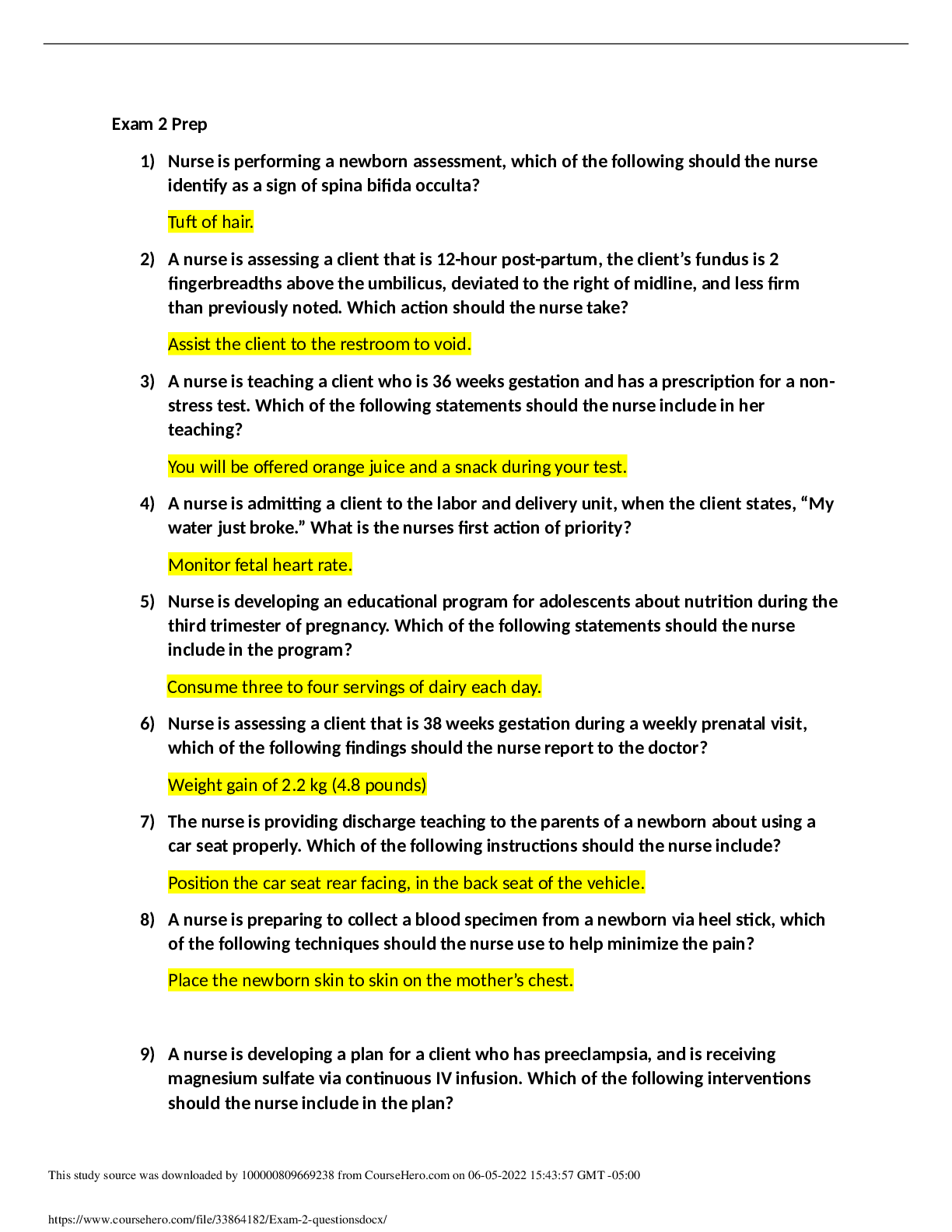
A nurse is assessing a client who is at 38 weeks of gestation during a weekly
prenatal visit. Which of the following findings should the nurse report to the provider?
A. Blood pressure 136/88 mm Hg
B. Report of insomnia
C. Weight gain of 2.2 kg (4.8 lb)
D. Report of Braxton Hicks contractions - Correct Answer- C. Weight gain of 2.2kg
(4.8 lb)
- A weight gain of 2.2 kg (4.8 lb) in a week is above the expected reference range
and could indicate complications. Therefore, this finding should be reported to the
provider.
Rationale:
A. A blood pressure of 136/88 mm Hg is within the expected reference range for a
client who is at 38 weeks of gestation. Therefore, this finding does not need to be
reported to the provider.
B. A regular occurrence of insomnia can be expected for a client who is at 38 weeks
of gestation. Therefore, this finding does not need to be reported to the provider.
D. Braxton Hicks contractions can be expected for a client who is at 38 weeks of
gestation. Therefore, this finding does not need to be reported to the provider.
A nurse is providing teaching for a client who gave birth 2 hr ago about the facility
policy for newborn safety. Which of the following client statements indicates an
understanding of the teaching?
A. "My sister will be able to carry my baby from the nursery to my room when she
arrives."
B. "The nurse will match my wrist band to my baby's crib card when they bring him to
me."
C. "The person who comes to take my baby's pictures will be wearing a photo
identification badge."
D. "My baby doesn't need to wear the electronic security bracelet when he's in my
room." - Correct Answer- C. The person who comes to take my baby's pictures will
be wearing a photo identification badge
-All personnel working on the unit should be wearing a photo identification badge.
The nurse should instruct the parent to never allow anyone who is not wearing an
identification badge to come in contact with the newborn.
Rationale:
A. A newborn should always be transported in a bassinet when outside the parent's
room.
B. The nurse will match the newborn's identification number with the parent's
identification number when they bring the newborn to the parent's room.
D. The newborn should wear the electronic security bracelet at all times. The
bracelet is set to alarm if anyone removes the bracelet or if the newborn is brought
near an exit door.
A nurse is assessing a client who is receiving morphine via IV bolus for pain
following a cesarean birth. The nurse notes a respiratory rate of 8/min. Which of the
following medication should the nurse administer?
A. Fentanyl
B. Butorphanol
C. Naloxone
D. Meperidine - Correct Answer- C. Naloxone
-Morphine is a common opioid analgesic used for postoperative pain management
that can cause central nervous system depression and can cause respiratory
depression. The nurse should administer naloxone, an opioid antagonist, to reverse
the opioid-induced respiratory depression in the client.
Rationale:
A. The nurse should administer fentanyl to the client for the relief of severe,
recurrent, or persistent pain during labor. Fentanyl is most commonly administered
via PCA pump or epidural, alone or with a local anesthetic agent. An adverse effect
of this medication is respiratory depression.
B. The nurse should administer butorphanol to the client for the relief of labor pain
and severe postoperative pain after cesarean birth. An adverse effect of this
medication is respiratory depression.
D. The nurse should administer meperidine to the client for the relief of severe,
persistent pain. An adverse effect of this medication is respiratory depression
A nurse is preforming a routine assessment on a client who is at 18 weeks of
gestation. Which of the following findings should the nurse expect?
A. Deep tendon reflexes 4+
B. Fundal height 14 cm
C. Urine protein 2+
D. FHR 152/min - Correct Answer- D. FHR 152/min
-The expected range for the FHR is 110/min to 160/min. The FHR is higher earlier in
gestation with an average of approximately 160/min at 20 weeks of gestation.
Therefore, this is an expected finding by the nurse.
Rationale:
A. Deep tendon reflexes (DTRs) are an indication of the balance between the
cerebral cortex and spinal cord. The nurse should expect the client's DTR to be 2+.
Therefore, a DTR of 4+ indicates hyperreflexia.
B. From gestational weeks 18 to 32, the height of the fundus is approximately equal
to the number of weeks of gestation plus or minus 2 cm. Therefore, the nurse should
expect the fundal height for this client should be 16 to 20 cm.
C. The nurse should expect the urine protein for this client to be less than 1+. A urine
protein concentration of 2+ is an indication of preeclampsia. Therefore, the nurse
should investigate this finding further.
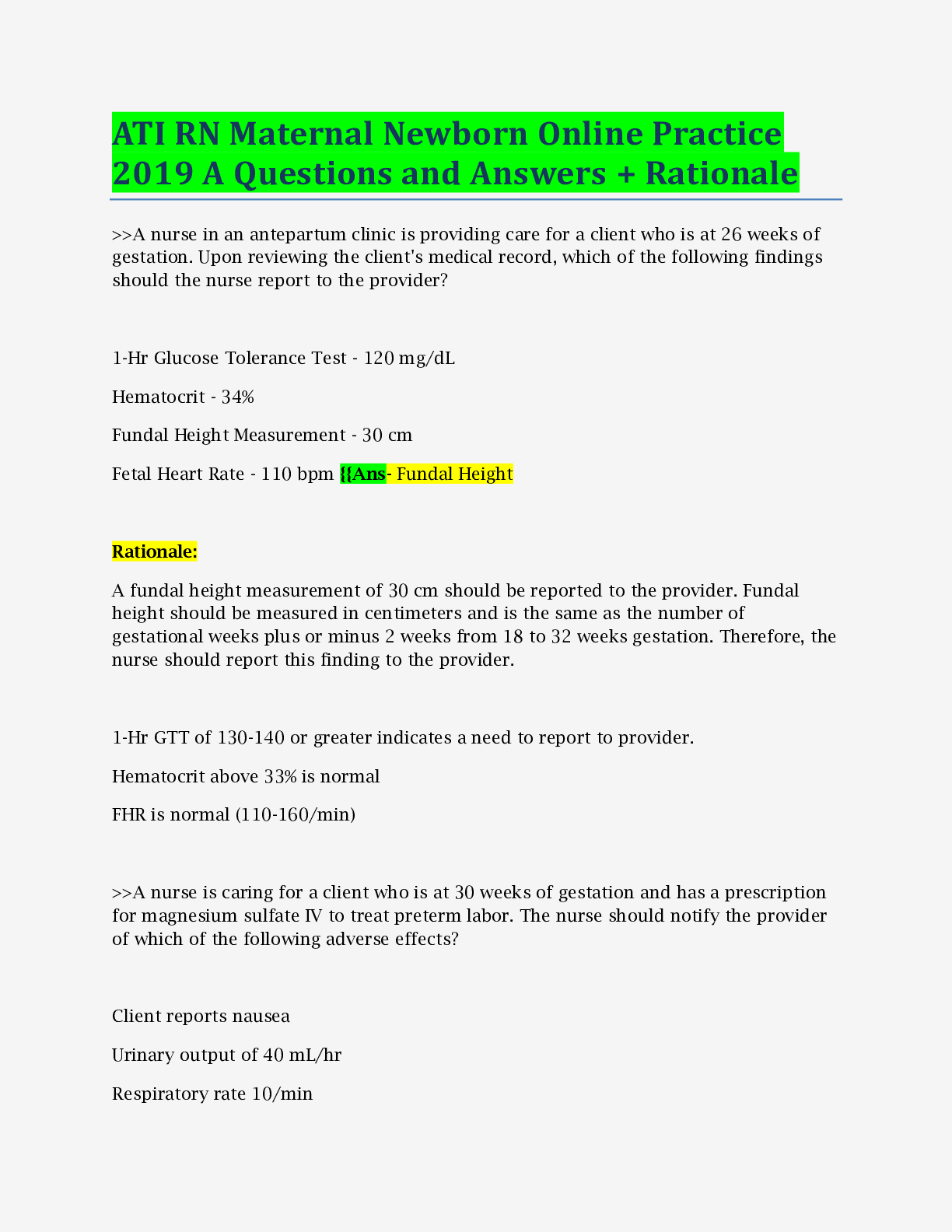
A nurse in an antepartum clinic is providing care for a client who is at 26 weeks of
gestation. Upon reviewing the clients medical records, which of the following
findings. should the nurse report to the provider?
A. 1-hr glucose tolerance test
B. Hematocrit
C. Fundal height measurement
D. Fetal heart rate (FHR)
Blood pressure 130/78 mm Hg
Respiratory rate 20/min
Heart rate 90/min
Hemoglobin 12 g/dL
Hematocrit 34%
1-hr glucose tolerance test 120 mg/dL
Fundal height 30 cm
Good fetal movement
Not experiencing headache, dizziness, blurred vision, or vaginal bleeding
Fetal heart rate 110/min - Correct Answer- C. fundal hight measurement
- A fundal height measurement of 30 cm should be reported to the provider. Fundal
height should be measured in centimeters and is the same as the number of
gestational weeks plus or minus 2 weeks from 18/20 (book answer) to 32 weeks
gestation. Therefore, the nurse should report this finding to the provider
A nurse is developing a plan of care for a newborn who is to undergo phototherapy
for hyperbilirubinemia. Which of the following actions should the nurse include in the
plan?
A. Feed the newborn 1 oz of water every 4 hr.
B. Apply lotion to the newborn's skin three times per day.
C. Remove all clothing from the newborn except the diaper.
D. Discontinue therapy if the newborn develops a rash. - Correct Answer- C.
Remove all clothing from the newborn except the diaper
- The nurse should remove all the newborn's clothing except the diaper while under
phototherapy. Maximum skin exposure to the ultraviolet light is needed to break
down the excess bilirubin.
Rationale:
A. The nurse should not feed the newborn any water or glucose water. Hydration can
be maintained through regular breastfeeding or formula feeding. Water and glucose
water do not increase the excretion rate of bilirubin in the stool or provide nutritional
value.
B. MY ANSWER The nurse should not apply lotion, ointments, or creams to a
newborn who is undergoing phototherapy. Lotions, ointments, and creams can
absorb heat and lead to burns.
D. The nurse should not discontinue phototherapy if the newborn develops a rash. A
temporary, fine rash can occur during therapy. This rash requires no treatment.
A nurse is assessing a newborn who was delivered vaginally and experienced a tight
nuchal cord. Which of the following findings should the nurse expect?
A. Bruising over the buttocks
B. Hard nodules on the roof of the mouth
C. Petechiae over the head
D. Bilateral periauricular papillomas - Correct Answer- C. Petechiae over the head
- Nuchal cord, or the umbilical cord being wrapped tightly around the neck, can
cause bruising and petechiae over the face, head, and neck.
Rationale:
A. MY ANSWER A breech birth can cause bruising over the buttocks and swollen
genitalia.
B. Inclusion cysts, or whitish hard nodules on the gums or roof of the mouth, can be
an expected finding. These are also called Epstein pearls.
D. Bilateral periauricular papillomas are benign skin tags that can be an expected
finding.
A nurse is caring for a client who is 38 weeks of gestation. Which of the following
actions should the nurse take prior to apply an external transducer for fetal
monitoring?
A. Determine progression of dilatation and effacement.
B. Perform Leopold maneuvers.
C. Complete a sterile speculum exam.
D. Prepare a Nitrazine paper test. - Correct Answer- B. Perform Leopold maneuvers
-MY ANSWER The nurse should perform Leopold maneuvers to assess the position
of the fetus to best determine the optimal placement for the external fetal monitoring
transducer.
Rationale:
A. The nurse should determine the client's dilation and effacement prior to applying
an internal monitor. This action is not required prior to applying an external
transducer for fetal monitoring.
C. A sterile speculum examination should be performed by the provider and is not
required prior to applying an external transducer for fetal monitoring.
D. A Nitrazine paper test is performed to assess the components (pH level) of
vaginal fluid to determine if the membranes have ruptured. This action is not required
prior to applying an external transducer for fetal monitoring.
A nurse is assessing a newborn 12 hr after birth. Which of the following
manifestation should the nurse report to the provider?
A. Acrocyanosis
B. Transient strabismus
C. Jaundice
D. Caput succedaneum - Correct Answer- C. Jaundice
- Jaundice occurring within the first 24 hr of birth is associated with ABO
incompatibility, hemolysis, or Rh-isoimmunization. The nurse should report this
manifestation to the provider.
Rationale:
A. Acrocyanosis is a bluish discoloration of the hands and feet and is an expected
finding in a newborn 24 to 48 hr after birth.
B. Transient strabismus is a normal variation in the newborn's eyes that can persist
until the third or fourth month of age.
D. Caput succedaneum is a benign, edematous area of the scalp and is commonly
found on the occiput.
A nurse is transporting a newborn back to the patients room following a procedure.
Which of the following actions should the nurse take?
A. Verify that the parent's identification band matches the newborn's identification
band.
B. Scan the newborn's identification band to verify their identity.
C. Check the newborn's security tag number to ensure it matches the newborn's
medical record.
D. Match the newborn's date and time of birth to the information in the parent's
medical record. - Correct Answer- A. Verify that the parent's identification band
matches the newborn's identification band.
- The nurse should verify the newborn's identity every time the newborn is returned
to the parents. The nurse should match the information on the parent's identification
band to the information on the newborn's identification band.
Other answers' rationale:
B. Scanning the newborn's identification band to verify their identity does not ensure
the newborn is being transferred to the correct parent.
C. Comparing the newborn's security tag number to the newborn's medical record
does not ensure the newborn is being transferred to the correct parent.
D. It is not necessary for the nurse to check the parent's medical record. The nurse
should match the information on the parent's identification band to the information on
the newborn's identification band.
A nurse is caring for a client who is 32 weeks of gestation and has gonorrhea. The
nurse should identify that the client is at an increased risk for which of the following
complications?
A. Excessive bleeding
B. Oligohydramnios
C. Premature rupture of membranes
D. Proteinuria - Correct Answer- C. Premature rupture of membranes
- MY ANSWERThe nurse should identify that a client who is pregnant and has
gonorrhea is at an increased risk for premature rupture of membranes,
chorioamnionitis, preterm birth, neonatal sepsis, and intrauterine growth restriction.
Rationale:
A. A client who is pregnant and has gonorrhea is not at an increased risk for
excessive bleeding.
B. A client who is pregnant and has gonorrhea is not at an increased risk for
oligohydramnios. Oligohydramnios is a decrease in amniotic fluid and is associated
with congenital anomalies such as renal agenesis and intrauterine growth restriction.
D. A client who is pregnant and has gonorrhea is not at an increased risk for
proteinuria. Proteinuria is associated with preeclampsia.
A nurse is reviewing the prenatal laboratory results for a client who it at 12 weeks of
gestation following an initial prenatal visit. Which of the following laboratory findings
should the nurse report to the provider?
A. Hemoglobin 10 g/dL
B. WBC count 10,000/mm3
C. Platelets 250,000/mm3
D. Fasting blood glucose 90 mg/dL - Correct Answer- A. Hemoglobin 10g/dL
-MY ANSWER A hemoglobin of 10 g/dL is below the expected reference range of
greater than 11 g/dL for a client who is pregnant. The nurse should report this finding
to the provider to obtain a prescription for ferrous iron supplementation because of
anemia.
Rationale:
B. This finding is within the expected reference range of 5,000 to 15,000/mm3 and
does not require reporting to the provider.
C. This finding is within the expected reference range of 150,000 to 400,000/mm3
and does not require reporting to the provider.
D. This finding is within the expected reference range of 60 to 105 mg/dL and does
not require reporting to the provider.
A nurse in an antepartum clinic is assessing a client who is at 32 weeks of gestation.
Which of the following findings should the nurse report to the provider?
A. Fundal height 34 cm
B. Report of decreased fetal movement
C. Report of occasional ankle swelling
D. BP 110/80 mm Hg - Correct Answer- B. Report of decreased fetal movement
- MY ANSWER The nurse should identify that a client who reports decreased fetal
movement could be experiencing a complication related to fetal well-being. A
decrease in fetal movement can indicate fetal distress.
Rationale:
A. A client who is at 32 weeks of gestation should have a fundal height about the
same as the number of weeks of gestation, plus or minus 2 cm.
C. The nurse should identify that occasional ankle edema is a common discomfort
associated with a client who is at 32 weeks of gestation.
D. The nurse should identify that during pregnancy the client's blood pressure should
remain the same or be slightly decreased. A blood pressure of 110/80 mm Hg is
within the expected reference range of less than 120 mm Hg systolic and less than
80 mm Hg diastolic.
A nurse is caring for a client who is at 36 weeks of gestation and has a. prescription
for an amniocentesis. For which of the following. reasons should the nurse. prepare
the client for an ultrasound?
A. To estimate the fetal weight
B. To locate a pocket of fluid
C. To determine multiparity
D. To prescreen for fetal anomalies - Correct Answer- B. To locate a pocket of fluid
-MY ANSWER An ultrasound is done to locate a pocket of amniotic fluid and the
placenta prior to an amniocentesis. This decreases the risk of injury to the fetus.
Rationale:
A. This is not an indication for an ultrasound prior to an amniocentesis.
C. This is not an indication for an ultrasound prior to an amniocentesis.
D. This is not an indication for an ultrasound prior to an amniocentesis.
A nurse is caring for a client who is at 26 weeks of gestation and has epilepsy. The
nurse enters the room and observes the client having a seizure. After turning the
clients head to one side, which of the following actions should the nurse take
immediately after the seizure?
A. Monitor the FHR.
B. Assess uterine activity.
C. Administer oxygen via a nonrebreather mask.
D. Start a bolus of IV fluids. - Correct Answer- C. Administer oxygen via a
nonrebreather mask.
- When using the airway, breathing, and circulation approach to client care, the nurse
should place the priority on administering oxygen to the client via a nonrebreather
mask at 10 L/min to ensure adequate oxygenation to the fetus.
Rationale:
A. MY ANSWERThe nurse should monitor the FHR to assess fetal well-being.
However, this is not the action the nurse should take next.
B. The nurse should assess uterine activity for potential complications of the seizure.
However, this is not the action the nurse should take next.
D. The nurse should start IV fluids following the seizure to ensure adequate
hydration. However, this is not the action the nurse should take next.
A nurse is caring for a client who is at 22 weeks of gestation and its HIV positive.
Which of the following actions should the nurse take?
A. Administer penicillin G 2.4 million units IM to the client.
B. Instruct the client to schedule an annual pelvic examination.
C. Tell the client she will start medication for HIV immediately after delivery.
D. Report the client's condition to the local health department - Correct Answer- D.
Report the clients condition to the local health department
-The nurse should report the condition to the local health department. HIV is one of
the conditions on the list of Nationally Notifiable Infectious Conditions that is required
to be reported.
CONTINUES...
[Show More]




, Latest Questions and Answers with Explanations, All Correct Study Guide, Download to Score A.png)