BIOL 133 WEEK 1 CHAPTER 1 – QUESTION AND ANSWER
Part 1 of 1 - 10.0/ 10.0 Points
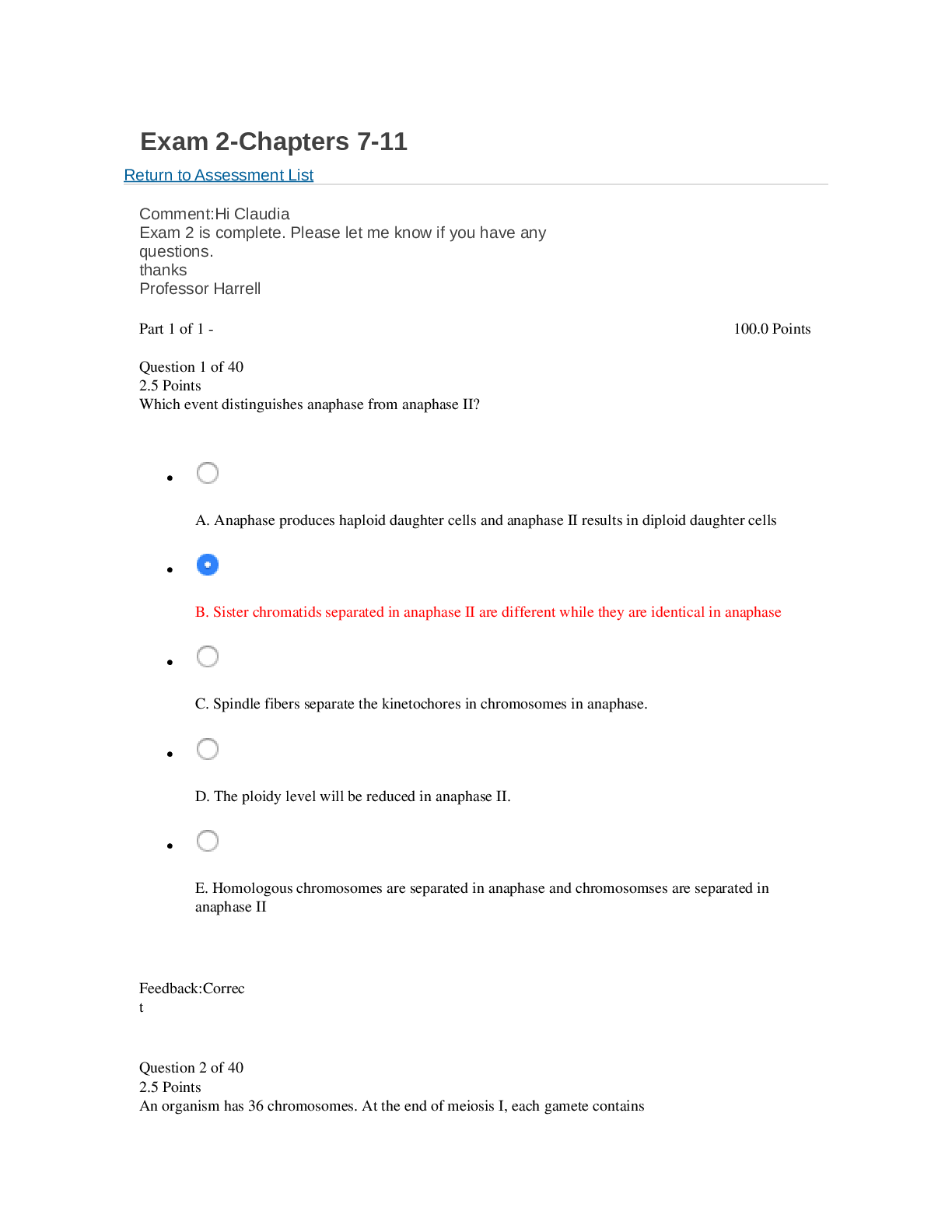
Question 1 of 10 1.0/ 1.0 Points
A decrease in blood water levels is detected in the brain. The brain sends signals to the pituitar
...
BIOL 133 WEEK 1 CHAPTER 1 – QUESTION AND ANSWER
Part 1 of 1 - 10.0/ 10.0 Points
Question 1 of 10 1.0/ 1.0 Points
A decrease in blood water levels is detected in the brain. The brain sends signals to the pituitary gland to release hormones that communicate with the kidney to reabsorb water, which will increase blood water levels. This represents what life property?
A. homeostasis
B. growth
C. regulation
D. reproduction
E. development
Feedback: Correct
Question 2 of 10 1.0/ 1.0 Points
What sequence increases in complexity for levels of biological organization?
A. atoms, cells, tissues, molecules, organs, systems
B. atoms, molecule, cells, tissues, organs, systems
C. systems, organs, tissues, cells, atoms, molecules
D. tissues, cells, atoms, molecules, systems, organs
E. cells, atoms, molecules, organs, systems, tissues
Feedback: Correct
Question 3 of 10 1.0/ 1.0 Points
When the brain, spinal cord and nerves of the body communicate with each other, it represents the _______________ level of organization.
A. cellular
B. organ
C. system
D. community
Feedback: Correct
Question 4 of 10 1.0/ 1.0 Points
When a sperm uses chemical signals to navigate the swim towards the egg, it is positive response. This is a form of
A. homeostasis
B. regulation
C. growth
D. development
E. response
Feedback: Correct
Question 5 of 10 1.0/ 1.0 Points
The integumentary system is composed of skin, hair, nails and glands. The skin contains areolar tissue. Areolar tissue contains fibroblast and macrophage cells. What characteristic of life does this represent?
A. homeostasis
B. regulation
C. growth
D. development
E. organization
Feedback: Correct
Question 6 of 10 1.0/ 1.0 Points
Place the steps of the scientific method in order from beginning to end.
1) Form a hypothesis
2) Analyze the results
3) Perform the experiment
4) Form a conclusion
5) Make an observation
6) Support or reject the hypothesis
A. 1,6,2,5,3,4 B. 5,1,3,2,4,6
C. 6,4,2,3,1,5 D. 4,5,3,2,1,6 Feedback: Correct
Question 7 of 10 1.0/ 1.0 Points
Based on levels of organization, which example represents the broadest level?
A. respiratory system
B. alligator
C. alligators, bass, long-nosed gar
D. Mississippi River
E. School of bass
Feedback: Correct
Question 8 of 10 1.0/ 1.0 Points
Which discipline would one practice if studying the development of zygotes (fertilized eggs) in mammals?
A. paleontologist zoologist
B. herpetologist immunologist
C. microbiologist neurobiologist
D. embryologist mammalogist
E. taxonomist evolutionist
Feedback: Correct
Question 9 of 10 1.0/ 1.0 Points
An experiment tested the health effects of a nutritional supplement by the following procedure: People were asked to choose to join the experimental group or the control group. People in the experimental group were given the supplement added to a pink, strawberry-flavored drink. People in the control group were given a glass of water. One hour later, the people were asked “Do you feel better?”
How would you improve the experimental protocol? (Select all necessary changes.)
A. People should be randomly assigned to one group or the other.
B. The drinks should both look and taste the same.
C. The assessment should instead ask “Do you feel worse?”
D. People in the experimental group should be warned that they are getting a drug
E. The assessment should measure something more specific, such as blood pressure.
F. Sick people should all join the experimental group, so they can benefit from the supplement.
G. Vitamins should also be added to the experimental drinks, to make the health effects stronger.
Feedback: Correct
Question 10 of 10 1.0/ 1.0 Points
Which is an example of a hypothesis that can explain the observation, flashlight does not work?
A. The batteries are dead or the bulb is burned out.
B. Replacing the batteries will make the flashlight work.
C. The batteries are dead.
D. If the bulb is replaced will the flashlight work?
Feedback: Correct
Question 1 of 10 1.0/ 1.0 Points
What functional group allows sugars (CnH2nOn) to be water soluble? Select all that apply.
A. methyl
B. carbonyl
C. hydroxyl
D. amino
E. sulfhydryl
Question 2 of 10 1.0/ 1.0 Points
After 11,200 years, approximately _____________________ carbon-14 would remain in a sample of wood.
A. 75%
B. 50%
C. 25%
D. 12.5%
Question 3 of 10 1.0/ 1.0 Points
Carbon-12, Carbon-13, and Carbon-14 are examples of
A. isomers
B. molecules
C. ions
D. isotopes
E. enantiomers
Question 4 of 10 1.0/ 1.0 Points
Before the battery in the car is jumped, the individuals notice the hook-ups on the battery are corroded by acid. What substance can be used to clean the acid?
A. orange juice B. baking soda
C. urine D. black coffee
E. lemons
Question 5 of 10 0.0/ 1.0 Points
Normal (homeostatic) pH level of blood serum’s pH is around 7.4. Carbonic acid is released in the blood to help maintain a pH when the blood has high hydroxyl levels. This would cause pH to change from
A. basic to acidic
B. basic to neutral
C. neutral to basic
D. acidic to 7.4
E. basic to 7.4
Question 6 of 10 1.0/ 1.0 Points
The equation below represents a(n)____________________.
2NO2 ↔ N2O4
A. irreversible reaction
B. reversible reaction
C. reactant
D. product
E. enzymatic reaction
Question 7 of 10 1.0/ 1.0 Points
In the early years, there were actually multiple ways of graphically representing information about the elements. The scientific community settled on the current one based on Mendeleev’s 1869 periodic table, because it is so useful.
Of the following statements about the periodic table, which one is INCORRECT?
A. The position of an element in the periodic table gives you a quick indication of what properties it has and how it is likely to behave.
B. The horizontal rows of the table, or periods, indicate chemical reactivity. For instance, the bottom row represents the unreactive noble gases.
C. Often the periodic table is color-coded to indicate similar types of elements. For instance, alkali metals, transition metals, nonmetals, or noble gases
D. As you move across the periodic table, it indicates gradual filling of electron shells. When the outer shell is full of electrons, the element is a noble gas.
E. The vertical columns, or groups, indicate elements with similar chemical properties.
Question 8 of 10 0.0/ 1.0 Points incorrect
Chemistry and physics are fall into which field of science? Select all that apply.
A. natural science
B. physical science
C. life science
D. social science
E. hard science
Question 9 of 10 1.0/ 1.0 Points
Carbon represents less than 1% of the Earth’s crust, but is 18% of the composition of living things. Why?
A. Living organisms sequester carbon to lower its toxicity to their cells.
B. Cytoplasm is composed largely of a liquid form of carbon.
C. Cell membranes are composed of layers of graphite.
D. The unique bonding properties of carbon allow it to create a huge variety of biological molecules.
E. This is a measure of waste gases like CO2 and CH4.
Question 10 of 10 1.0/ 1.0 Points
Why does water boil at a higher temperature than butter, which is non-polar?
A. breaking of hydrogen bonds requires a lot of energy
B. removing hydrogen from the liquid requires a lot of energy
C. energy is used to cool the water as it undergoes from liquid to gas
D. energy is consumed to form hydrogen bond
[Show More]