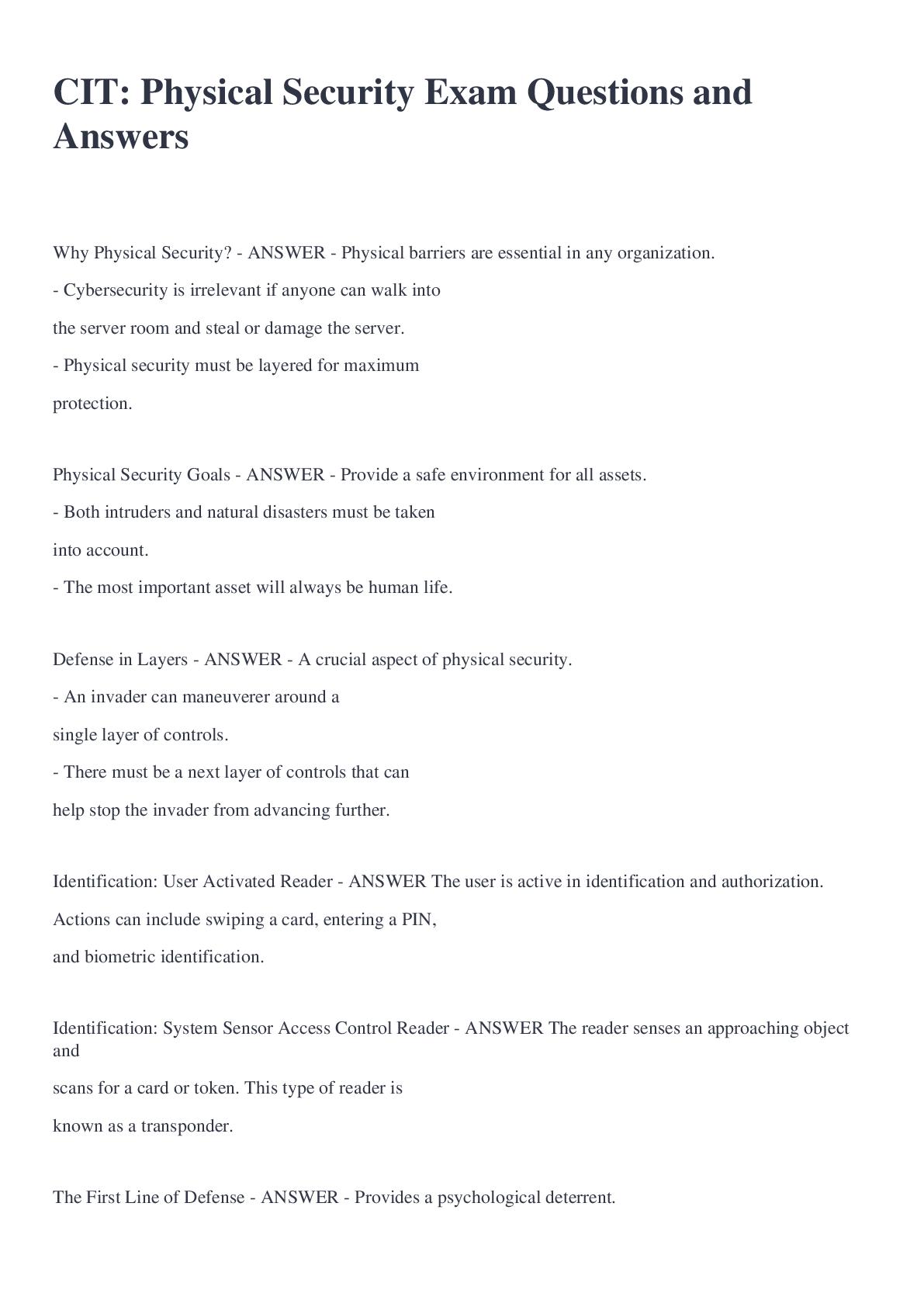
Why Physical Security? - ANSWER - Physical barriers are essential in any organization.
- Cybersecurity is irrelevant if anyone can walk into
the server room and steal or damage the server.
- Physical security must be
...
Why Physical Security? - ANSWER - Physical barriers are essential in any organization.
- Cybersecurity is irrelevant if anyone can walk into
the server room and steal or damage the server.
- Physical security must be layered for maximum
protection.
Physical Security Goals - ANSWER - Provide a safe environment for all assets.
- Both intruders and natural disasters must be taken
into account.
- The most important asset will always be human life.
Defense in Layers - ANSWER - A crucial aspect of physical security.
- An invader can maneuverer around a
single layer of controls.
- There must be a next layer of controls that can
help stop the invader from advancing further.
Identification: User Activated Reader - ANSWER The user is active in identification and authorization.
Actions can include swiping a card, entering a PIN,
and biometric identification.
Identification: System Sensor Access Control Reader - ANSWER The reader senses an approaching object and
scans for a card or token. This type of reader is
known as a transponder.
The First Line of Defense - ANSWER - Provides a psychological deterrent.
- Different gauges and mesh sizes are used
for different levels of security.
smart fence. - ANSWER The Perimeter Intrusion Detection and Assessment
System (PIDAS) fencing.
Bollards - ANSWER - Prevent vehicles from accessing restricted areas
- Placed between a facility and a parking lot or
roads that run close to exterior walls
Lighting - ANSWER - Lights should be installed with overlapping zones.
- More light should be used at entrances, less light
at guard locations.
- Lighting redundancy should be implemented in
case of a power outage.
Motion Detection - ANSWER - Electrical device that detects object motion.
- Alerts staff by triggering alarms (silent or audible).
Facility Access Control: Facilities - ANSWER Should be grouped in segments with each segment
or area having its own purpose and access controls
Facility Access Control: Locks - ANSWER Serve as delaying mechanisms for intruders. They
vary in strength, quality, and functionality.
Administrative Responsibilities - ANSWER - The right type of lock should match its purpose.
- Locks and keys require scheduled maintenance
to prevent deterioration.
Circumventing Locks - ANSWER - Locks can be picked in many ways: raking,
rocking, bumping, zipping, and more.
- Determined intruders may use power tools or
even attempt to dismantle the door.
What Is Surveillance? - ANSWER - Continuous monitoring, and sometimes
physical action, in surveyed areas
- Facilities should remain under surveillance
to ensure swift reaction to intrusions.
CCTV - ANSWER - Detects, follows, and exposes intruders
- Can operate in internal and external facility areas
- Must be integrated with other security controls
CCTV Components - ANSWER Camera, Transmitter, Receiver, Recording
System (DVR), Monitor
What Is a Physical IDS? - ANSWER - A perimeter scanning device.
- Sensitive to changes in the environment.
- Can detect a wide variety of changes.
IDS Types: Electromechanical Systems - ANSWER Detect changes or breaks in a circuit. Can be a magnetic contact switch, pressure plate, etc.
IDS Types: Photoelectric/Photometric Systems - ANSWER Emit beams of light and generate alarms when
the beam is interrupted.
IDS Types: Passive Infrared Systems - ANSWER Monitor room temperature and report when
the temperature rises.
IDS Types: Acoustic Detection Systems - ANSWER Highly sensitive microphones that detect possible
forced entry sounds.
IDS Types: Wave Pattern Motion Detectors - ANSWER Generate wave patterns, transmit them to receivers,
and if the returned pattern is different, an intruder is
likely present.
IDS Types: Proximity/Capacitance Detectors - ANSWER Emit magnetic fields and generate alarms if the
field is disrupted.
Auditing Physical Access: Access Logs - ANSWER - Examined to reveal attempts to breach entry
points in the facility.
- Should be reviewed periodically by the facility
manager.
Auditing Physical Access: Logged Information - ANSWER - Dates and times of attempts to access the facility
- Facility entry point events
- IDs of individuals who attempt to breach the facility
Auditing Physical Access: Auditing Permissions - ANSWER - Roles of personnel change
- Zero trust policy
- Mandatory vacation
Securing the Physical Structure: Natural Access Control - ANSWER - Guiding people to the desired entrance of a
facility via indirect means
- Landscaping, light placement, fences, and doors
indicate where people can and cannot go.
Securing the Physical Structure: Physical Security Plan - ANSWER - Construction Materials
- Power Distribution Systems
- Communication Types
- External Factors
Facility Considerations - ANSWER - Proximity to emergency services.
- Urban and natural camouflage
- Electronic eavesdropping
Securing the Physical Structure: Window Types - ANSWER - Standard windows: Very low level of protection
- Non glass windows (acrylic ): Better protection
- Laminated or wire layer: Best protection
Shoulder Surfing: Drones - ANSWER Drones can be used for shoulder surfing or facility reconnaissance. Mitigation: Use tinted windows.
Shoulder Surfing: Open Space - ANSWER Placing employees in an open space makes them vulnerable to shoulder surfing. Mitigation: Use anti-glare screens.
Access Control: Access Card Duplication - ANSWER Employee cards can be duplicated. Mitigation: Special wallets that block RFID
Access Control: Tailgating/Piggy-backing - ANSWER Following behind an authorized user into a facility
Mitigation: Posting a guard can deter this behavior.
Physical Approach - ANSWER - Connecting a USB device to a computer to run malware
- Connecting a laptop to a switch to gain network access
- Data theft of documents or other valuable assets
[Show More]