MGMT 4513 test one
CHAPTER 2—STRATEGY, ORGANIZATION DESIGN, AND EFFECTIVENESS
MULTIPLE CHOICE
1. When looking for strengths and weaknesses, top management is:
a.
assessing the externa
...
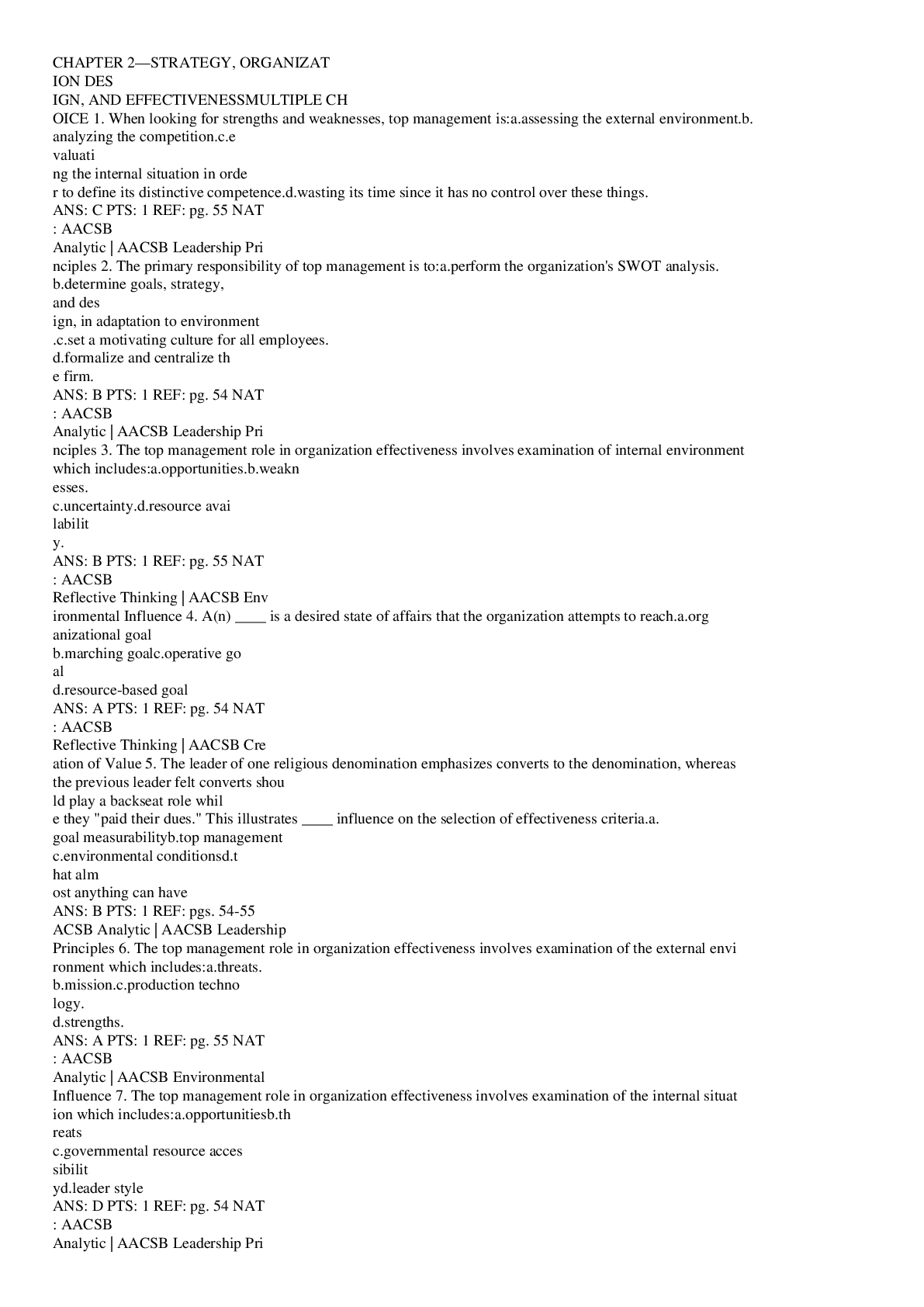
MGMT 4513 test one
CHAPTER 2—STRATEGY, ORGANIZATION DESIGN, AND EFFECTIVENESS
MULTIPLE CHOICE
1. When looking for strengths and weaknesses, top management is:
a.
assessing the external environment.
b.
analyzing the competition.
c.
evaluating the internal situation in order to define its distinctive competence.
d.
wasting its time since it has no control over these things.
ANS: PTS: 1 REF: pg. 55
NAT: AACSB Analytic | AACSB Leadership Principles
2. The primary responsibility of top management is to:
a.
perform the organization's SWOT analysis.
b.
determine goals, strategy, and design, in adaptation to environment.
c.
set a motivating culture for all employees.
d.
formalize and centralize the firm.
ANS: PTS: 1 REF: pg. 54
NAT: AACSB Analytic | AACSB Leadership Principles
3. The top management role in organization effectiveness involves examination of internal environment which includes:
a.
opportunities.
b.
weaknesses.
c.
uncertainty.
d.
resource availability.
ANS: PTS: 1 REF: pg. 55
NAT: AACSB Reflective Thinking | AACSB Environmental Influence
4. A(n) ____ is a desired state of affairs that the organization attempts to reach.
a.
organizational goal
b.
marching goal
c.
operative goal
d.
resource-based goal
ANS: PTS: 1 REF: pg. 54
NAT: AACSB Reflective Thinking | AACSB Creation of Value
5. The leader of one religious denomination emphasizes converts to the denomination, whereas the previous leader felt converts should play a backseat role while they "paid their dues." This illustrates ____ influence on the selection of effectiveness criteria.
a.
goal measurability
b.
top management
c.
environmental conditions
d.
that almost anything can have
ANS: PTS: 1 REF: pgs. 54-55
NAT: AACSB Analytic | AACSB Leadership Principles
6. The top management role in organization effectiveness involves examination of the external environment which includes:
a.
threats.
b.
mission.
c.
production technology.
d.
strengths.
ANS: PTS: 1 REF: pg. 55
NAT: AACSB Analytic | AACSB Environmental Influence
7. The top management role in organization effectiveness involves examination of the internal situation which includes:
a.
opportunities
b.
threats
c.
governmental resource accessibility
d.
leader style
ANS: PTS: 1 REF: pg. 54
NAT: AACSB Analytic | AACSB Leadership Principles
8. The choices top managers make about goals, strategies, and organizational design have a tremendous impact on organizational:
a.
profitability.
b.
efficiency.
c.
effectiveness.
d.
market share.
ANS: PTS: 1 REF: pg. 56
NAT: AACSB Analytic | AACSB Strategy
9. Mission is the same thing as:
a.
operative goals.
b.
decision guidelines.
c.
official goals.
d.
performance standards.
ANS: PTS: 1 REF: pg. 56
NAT: AACSB Reflective Thinking | AACSB Motivation Concepts
10. ____ means that all the organization's energies and resources are directed toward a focused, unifying, and compelling overall goal.
a.
Strategic intent
b.
Resource-based approach
c.
Emergent goals
d.
Stakeholder approach
ANS: PTS: 1 REF: pg. 56
NAT: AACSB Analytic | AACSB Strategy
11. Which of the following describes the organization's shared values and beliefs and its reason for being?
a.
Strategic intent
b.
Mission
c.
Official goals
d.
Organizational goals
ANS: PTS: 1 REF: pg. 56
NAT: AACSB Analytic | AACSB Motivation Concepts
12. ____ refers to what sets the organization apart from others and provides it with a distinctive edge for meeting customer or client needs in the marketplace.
a.
Organizational goals
b.
Strategic intent
c.
Mission
d.
Competitive advantage
ANS: PTS: 1 REF: pg. 57
NAT: AACSB Analytic | AACSB Strategy
13. A company's ____ is something the organization does especially well in comparison to its competitors.
a.
operative goal
b.
organizational goal
c.
core competence
d.
balanced scorecard
ANS: PTS: 1 REF: pg. 58
NAT: AACSB Analytic | AACSB Creation of Value
14. The goal of Short Stop Markets to capture 25% of the convenience market business in Arizona is an example of a(n) ____ goal.
a.
official
b.
operative
c.
generic
d.
legitimacy
ANS: PTS: 1 REF: pgs. 58-59
NAT: AACSB Analytic | AACSB Strategy
15. Which of the following pertains to the acquisition of needed material and financial resources from the environment?
a.
Resource goals
b.
Profitability
c.
Market goals
d.
Productivity goals
ANS: PTS: 1 REF: pg. 59
NAT: AACSB Analytic | AACSB Environmental Influence
16. Which of the following reflects the overall performance of profit organizations?
a.
Efficiency
b.
Profitability
c.
Innovation goals
d.
Productivity
ANS: PTS: 1 REF: pg. 59
NAT: AACSB Reflective Thinking | AACSB Creation of Value
17. ____ pertains to the training, promotion, safety, and growth of employees.
a.
Market share
b.
Innovation
c.
Productivity of the industry
d.
Employee development
ANS: PTS: 1 REF: pg. 60
NAT: AACSB Analytic | AACSB Ethical Responsibilities
18. ____ pertain to internal flexibility and readiness to adapt to unexpected changes in the environment.
a.
Market goals
b.
Profitability goals
c.
Innovation goals
d.
Productivity goals
ANS: PTS: 1 REF: pg. 60
NAT: AACSB Analytic | AACSB Environmental Influence
19. Successful organizations use a carefully balanced set of ____ goals.
a.
operating
b.
innovation
c.
visionary
d.
generic
ANS: PTS: 1 REF: pg. 61
NAT: AACSB Reflective Thinking | AACSB Strategy
20. Official goals provide ____, while operative goals and strategies provide ____.
a.
measurable objectives, legitimacy
b.
legitimacy, employee direction
c.
employee direction, decision guidelines
d.
decision guidelines, legitimacy
ANS: PTS: 1 REF: pg. 61
NAT: AACSB Analytic | AACSB Strategy
21. Models for formulating organizational strategies include:
a.
Perrow's typology and Porter's model.
b.
Daft's model and Pfeiffer's typology.
c.
Porter's model and Miles and Snow's typology.
d.
Bowerman's typology and Miles and Snow's model.
ANS: PTS: 1 REF: pg. 62
NAT: AACSB Analytic | AACSB Strategy
22. A plan for interacting with the competitive environment to achieve organizational goals is referred to as:
a.
strategy.
b.
design.
c.
culture.
d.
structure.
ANS: PTS: 1 REF: pg. 62
NAT: AACSB Reflective Thinking | AACSB Strategy
23. The differentiation strategy:
a.
was developed by Frederic Taylor.
b.
was popularized by Henri Fayol.
c.
is one of Michael Porter's competitive strategies.
d.
is K. D. Bowerman's "Strategy for Empowerment."
ANS: PTS: 1 REF: pg. 62
NAT: AACSB Analytic | AACSB Strategy
24. A ____ strategy can reduce rivalry with competitors and fight off the threat of substitute products because customers are loyal to the company's brand.
a.
low-cost leadership
b.
focused
c.
defensive
d.
differentiation
ANS: PTS: 1 REF: pg. 62
NAT: AACSB Reflective Thinking | AACSB Strategy
25. Which of the following is true about Porter's competitive strategies?
a.
Differentiation strategies address whether the market scope is broad or narrow.
b.
Differentiation can be broken down into low cost or broad scope categories.
c.
An airline using the differentiation strategy would be likely to offer travelers refreshments at a reasonable price, rather than serve bounteous meals.
d.
Apple, Inc. is a company that has benefited from a differentiation strategy and never tried to compete on price because it likes being perceived as an "elite" brand.
ANS: PTS: 1 REF: pg. 62
NAT: AACSB Analytic | AACSB Strategy
26. The slogan, "We're a no-frills business! When we save, you save!" exemplifies the strategy of:
a.
low-cost leadership.
b.
differentiation.
c.
focus.
d.
legitimacy.
ANS: PTS: 1 REF: pgs. 64-66
NAT: AACSB Analytic | AACSB Strategy
27. A(n) ____ strategy is concerned primarily with stability rather than taking risks or seeking new opportunities for innovation and growth.
a.
focused
b.
low-cost leadership
c.
differentiation
d.
intensive
ANS: PTS: 1 REF: pg. 64
NAT: AACSB Reflective Thinking | AACSB Strategy
28. In Miles and Snows's Strategy Typology, the prospector:
a.
attempts to maintain a stable business environment by finding a middle ground between stability and innovation.
b.
most closely resembles Porter's Low-Cost Leadership strategy.
c.
responds to environmental threats in an ad hoc fashion without revealing a clear strategy.
d.
seeks innovation or risk taking and is therefore best suited to the dynamic environment.
ANS: PTS: 1 REF: pg. 66
NAT: AACSB Analytic | AACSB Strategy
29. Miles and Snow's Strategy Typology is based on the notion that:
a.
strategy should correspond to technology.
b.
strategy should be congruent with external environment.
c.
strategy should be based on human resource capability.
d.
strategy should be a "fit" to economic resource base.
ANS: PTS: 1 REF: pg. 66
NAT: AACSB Reflective Thinking | AACSB Environmental Influence
30. The ____ strategy is concerned with stability or retrenchment.
a.
defender
b.
prospector
c.
differentiation
d.
low-cost leadership
ANS: PTS: 1 REF: pg. 67
NAT: AACSB Analytic | AACSB Strategy
31. The ____ strategy tries to maintain a stable business while innovating on the periphery.
a.
reactor
b.
prospector
c.
analyzer
d.
defender
ANS: PTS: 1 REF: pg. 67
NAT: AACSB Reflective Thinking | AACSB Strategy
32. Organization ____ needs to support the firm's competitive approach.
a.
financial standings
b.
design characteristics
c.
informal communication channel
d.
environment for green movement
ANS: PTS: 1 REF: pg. 68
NAT: AACSB Reflective Thinking | AACSB Strategy
33. The extent to which goals are obtained is a traditional definition of the degree of ____ in the organization.
a.
efficiency
b.
scientific management
c.
strategy
d.
effectiveness
ANS: PTS: 1 REF: pg. 71
NAT: AACSB Reflective Thinking | AACSB Strategy
34. Which of the following is true regarding the goal approach?
a.
Full assessment of effectiveness should consider several goals simultaneously because high achievement on one goal may mean low achievement on another.
b.
Priority setting requires that only one goal at a time can be achieved.
c.
There is no place for subjective assessment of goal achievement in organizations today.
d.
The most common goal stated by U.S. corporations today deals with management development.
ANS: PTS: 1 REF: pg. 75
NAT: AACSB Analytic | AACSB Strategy
35. Which approach measures progress toward attainment of those goals?
a.
The open systems approach
b.
The goal approach
c.
The internal process approach
d.
The human relations approach
ANS: PTS: 1 REF: pg. 73
NAT: AACSB Analytic | AACSB Strategy
36. The ____ approach to organizational effectiveness is concerned with the output side and whether the organization achieves its goals in terms of desired levels of output.
a.
goal
b.
resource-based
c.
analytical
d.
internal process
ANS: PTS: 1 REF: pg. 73
NAT: AACSB Analytic | AACSB Strategy
37. When using the goal approach to effectiveness, it is best to use ____ goals.
a.
operational
b.
official
c.
low-level
d.
non-measurable
ANS: PTS: 1 REF: pg. 73
NAT: AACSB Reflective Thinking | AACSB Operations Management
38. The resource-based approach emphasizes the:
a.
Input into an organization.
b.
Output of an organization.
c.
Achievement of profitability.
d.
Amount of inventory left idle by the organization.
ANS: PTS: 1 REF: pg. 75
NAT: AACSB Reflective Thinking | AACSB Operations Management
39. Two comparably sized colleges are located in adjacent towns. The admissions counselors of College A have been telling prospective students that College A is better than College B because their latest freshman class has 150 more students than the freshman class at College B. The admissions counselors of College A are using the ____ effectiveness approach.
a.
resource-based
b.
goal
c.
internal process
d.
competing values
ANS: PTS: 1 REF: pgs. 75-76
NAT: AACSB Analytic | AACSB Strategy
40. One strength of the internal process approach is the fact that it:
a.
Tells management how well the internal processes mesh with the external environment.
b.
Considers human resources and employee-oriented processes.
c.
Emphasizes inputs into the organization.
d.
Emphasizes outputs of the organization.
ANS: PTS: 1 REF: pgs. 76-77
NAT: AACSB Analytic | AACSB HRM
41. If one is measuring work climate, group loyalty, and worker-management communication as a measure of effectiveness, what approach is most likely being used:
a.
Internal process.
b.
Strategic human resources.
c.
Quality control.
d.
Stakeholder approach.
ANS: PTS: 1 REF: pgs. 76-77
NAT: AACSB Communication | AACSB Strategy
42. _____ goals describe specific measurable outcomes and are often concerned with the short run.
a.
Employee development
b.
Market
c.
Operating
d.
Resource
ANS: PTS: 1 REF: pg. 59
NAT: AACSB Analytic | AACSB Strategy
43. _____ goals relate to the market share or market standing desired by the organization.
a.
Employee development
b.
Market
c.
Productivity
d.
Innovation
ANS: PTS: 1 REF: pg. 60
NAT: AACSB Analytic | AACSB Strategy
44. The _____ model tries to balance a concern with various parts of the organization rather than focusing on one part.
a.
internal process
b.
rational goal
c.
open systems
d.
competing values
ANS: PTS: 1 REF: pg. 78
NAT: AACSB Analytic | AACSB Strategy
45. A combination of external focus and flexible structure leads to a(n) _____. Management’s primary goals are growth and resource acquisition.
a.
rational goal emphasis
b.
open systems emphasis
c.
internal process emphasis
d.
human relations emphasis
ANS: PTS: 1 REF: pg. 79
NAT: AACSB Analytic | AACSB Strategy
46. Jason is employed at XYZ Company. At XYZ Company, management’s primary goals are productivity, efficiency, and profit. What emphasis does XYZ Company utilize?
a.
The rational goal emphasis
b.
The open systems emphasis
c.
The internal process emphasis
d.
The human relations emphasis
ANS: PTS: 1 REF: pg. 79
NAT: AACSB Analytic | AACSB Strategy
47. The competing values model was originally developed by:
a.
Robert Quinn and John Rohrbaugh.
b.
Henry Ford and Frederick Taylor.
c.
Raymond Miles.
d.
Michael Porter.
ANS: PTS: 1 REF: pg. 79
NAT: AACSB Analytic | AACSB Strategy
48. The two value dimensions of the competing values model are:
a.
the internal environment of the organization and the external environment of the organziation.
b.
low-cost leadership and differentiation.
c.
focus and structure.
d.
profitability and productivity.
ANS: PTS: 1 REF: pg. 79
NAT: AACSB Analytic | AACSB Strategy
TRUE/FALSE
1. The primary responsibility of top management is to determine an organization's goals, strategy, and design, therein adapting the organization to a changing environment.
ANS: T PTS: 1 REF: pg. 54
NAT: AACSB Analytic | AACSB Environmental Influence
2. Organization direction is the administration and execution of the strategic plan.
ANS: F PTS: 1 REF: pg. 55
NAT: AACSB Analytic | AACSB Strategy
3. Before the mission is defined and goals are set, top management should assess its strengths, weaknesses, opportunities, and threats.
ANS: T PTS: 1 REF: pg. 55
NAT: AACSB Analytic | AACSB Strategy
4. Goals and strategies are usually fixed and remain unchanged once top management agrees upon them.
ANS: F PTS: 1 REF: pg. 55
NAT: AACSB Analytic | AACSB Strategy
5. Strategic intent means that all the organization's energies and resources are directed toward a focused, unifying, and compelling overall goal.
ANS: T PTS: 1 REF: pg. 56
NAT: AACSB Analytic | AACSB Strategy
6. Core competence refers to what sets the organization apart from others and provides it with a distinctive edge for meeting customer or client needs in the marketplace.
ANS: F PTS: 1 REF: pg. 58
NAT: AACSB Analytic | AACSB Strategy
7. A company's core competence is something the organization does especially well in comparison to its competitors.
ANS: T PTS: 1 REF: pg. 58
NAT: AACSB Analytic | AACSB Creation of Value
8. Organizational mission and operational goals are the same thing.
ANS: F PTS: 1 REF: pg. 61
NAT: AACSB Reflective Thinking | AACSB Strategy
9. Operative goals refer to the formally stated definition of business scope and outcomes the organization is trying to achieve.
ANS: F PTS: 1 REF: pg. 56
NAT: AACSB Analytic | AACSB Strategy
10. Growth and output volume are examples of overall performance goals.
ANS: T PTS: 1 REF:
[Show More]








.png)