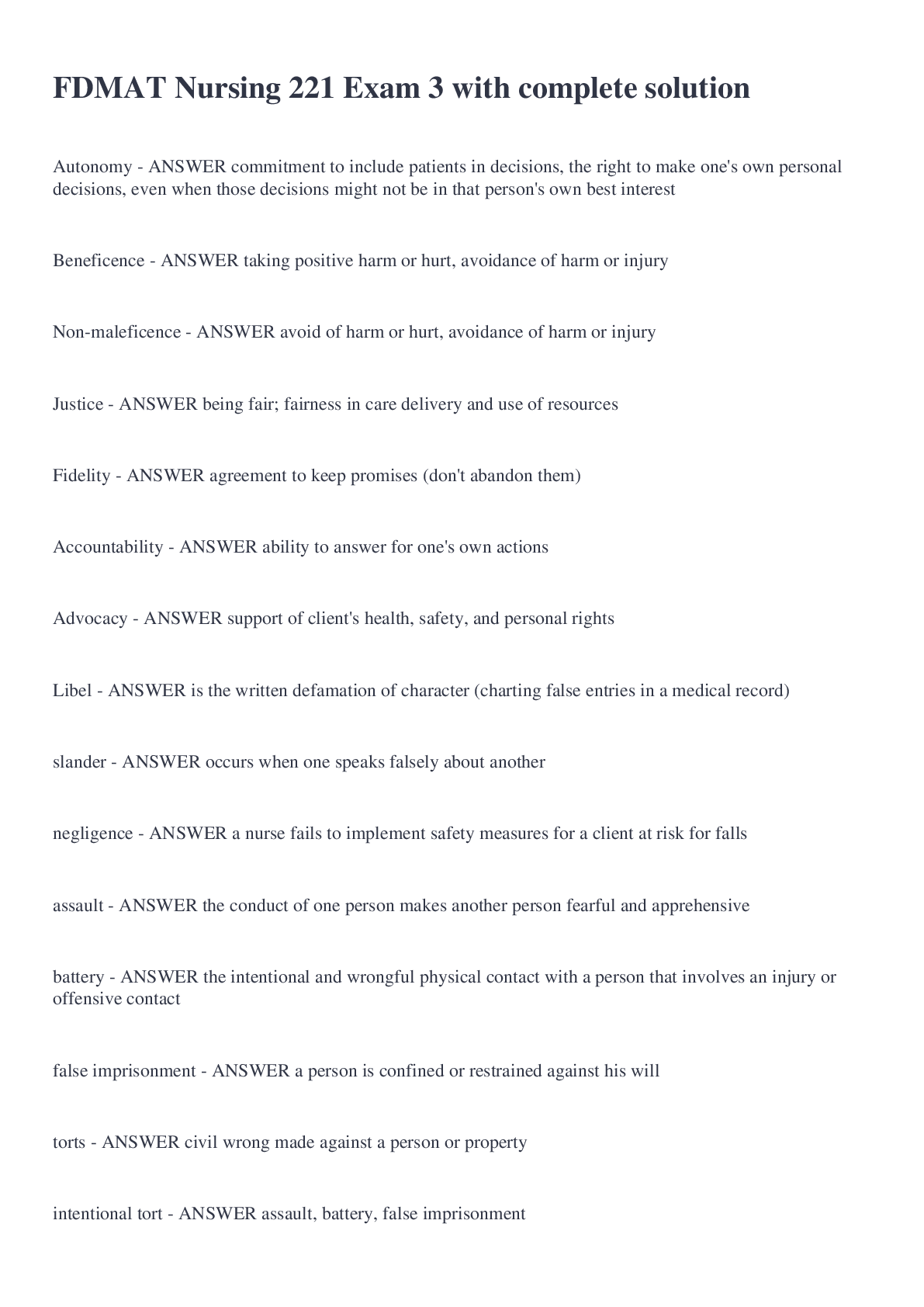
Autonomy - ANSWER commitment to include patients in decisions, the right to make one's own personal decisions, even when those decisions might not be in that person's own best interest
Beneficence - ANSWER taking posi
...
Autonomy - ANSWER commitment to include patients in decisions, the right to make one's own personal decisions, even when those decisions might not be in that person's own best interest
Beneficence - ANSWER taking positive harm or hurt, avoidance of harm or injury
Non-maleficence - ANSWER avoid of harm or hurt, avoidance of harm or injury
Justice - ANSWER being fair; fairness in care delivery and use of resources
Fidelity - ANSWER agreement to keep promises (don't abandon them)
Accountability - ANSWER ability to answer for one's own actions
Advocacy - ANSWER support of client's health, safety, and personal rights
Libel - ANSWER is the written defamation of character (charting false entries in a medical record)
slander - ANSWER occurs when one speaks falsely about another
negligence - ANSWER a nurse fails to implement safety measures for a client at risk for falls
assault - ANSWER the conduct of one person makes another person fearful and apprehensive
battery - ANSWER the intentional and wrongful physical contact with a person that involves an injury or offensive contact
false imprisonment - ANSWER a person is confined or restrained against his will
torts - ANSWER civil wrong made against a person or property
intentional tort - ANSWER assault, battery, false imprisonment
quasi-intentional tort - ANSWER invasion of privacy, malice, slander, libel
unintentional tort - ANSWER negligence, malpractice
living will - ANSWER a legal document that expresses the client's wishes regarding medical treatment in the event the client becomes incapacitated and is facing end of life issues; most state laws include provisions that protect health care providers who follow a living will from liability
durable power of attorney - ANSWER a durable power of attorney for health care is a document in which clients designate a health care proxy to make health care decisions for them if they are unable to do so; the proxy may be any competent adult the client chooses
HIPPA - ANSWER provides portability of insurance and protects employees
Americans with Disabilities act - ANSWER protects civil rights including people who have HIV
Patient self determination act - ANSWER health care institutions must provide written information to clients concerning their rights under the law, including right to refuse treatment and advance directives
connotative meaning - ANSWER is the shade or interpretation of the meaning of a word influenced by the thoughts, feelings, or ideas people have about the word
denotative meaning - ANSWER individuals who use a common language
intonation - ANSWER tone of voice dramatically affects the meaning of a message
pacing - ANSWER conversation is more successful at an appropriate speed or pace
SBAR - ANSWER situation, background, assessment, recommendation, repeat back orders; respond as "that is correct"; this is used to talk to a doctor about an issue with a patient
Intimate zone (0-18 inches) - ANSWER holding a crying infant; performing physical assessment; bathing, grooming, dressing, feeding, and toileting a patient; changing a patient's dressing
Personal zone (18 inches-4 feet) - ANSWER sitting at a patient's bedside; taking a patient's nursing history; teaching an individual patient; exchanging information at change of shift
Social Zone (4-12 feet) - ANSWER making rounds with a physician; sitting at the head of a conference table; teaching a class for patients with diabetes; conducting a family support group
Public Zone (12 feet or greater) - ANSWER speaking at a community forum; testifying at a legislative hearing; lecturing to a class of students
Social touch (permission not needed) - ANSWER hands, arms, shoulders, back
consent zone (permission needed) - ANSWER mouth, wrists, feet
vulnerable zone (special care needed) - ANSWER face, neck, front of body
intimate zone (great sensitivity needed) - ANSWER genitalia, rectum
cognitive learning - ANSWER includes all intellectual behaviors and requires thinking; discussion (one on one or group), lecture, question and answer session, role play, discovery, independent project, field experience
Affective - ANSWER deals with expression of feelings and acceptance of attitudes, opinions, or values; role play, discussion (one on one or group)
[Show More]