Medical-Surgical RN A Prophecy Relias
Updated 2022 Already Passed
1.2 milligrams is equal to how many micrograms? Correct Answer-1200 mcg
Your post-op patient has a Jackson-Pratt (JP) drain in place. How do you ensure
...
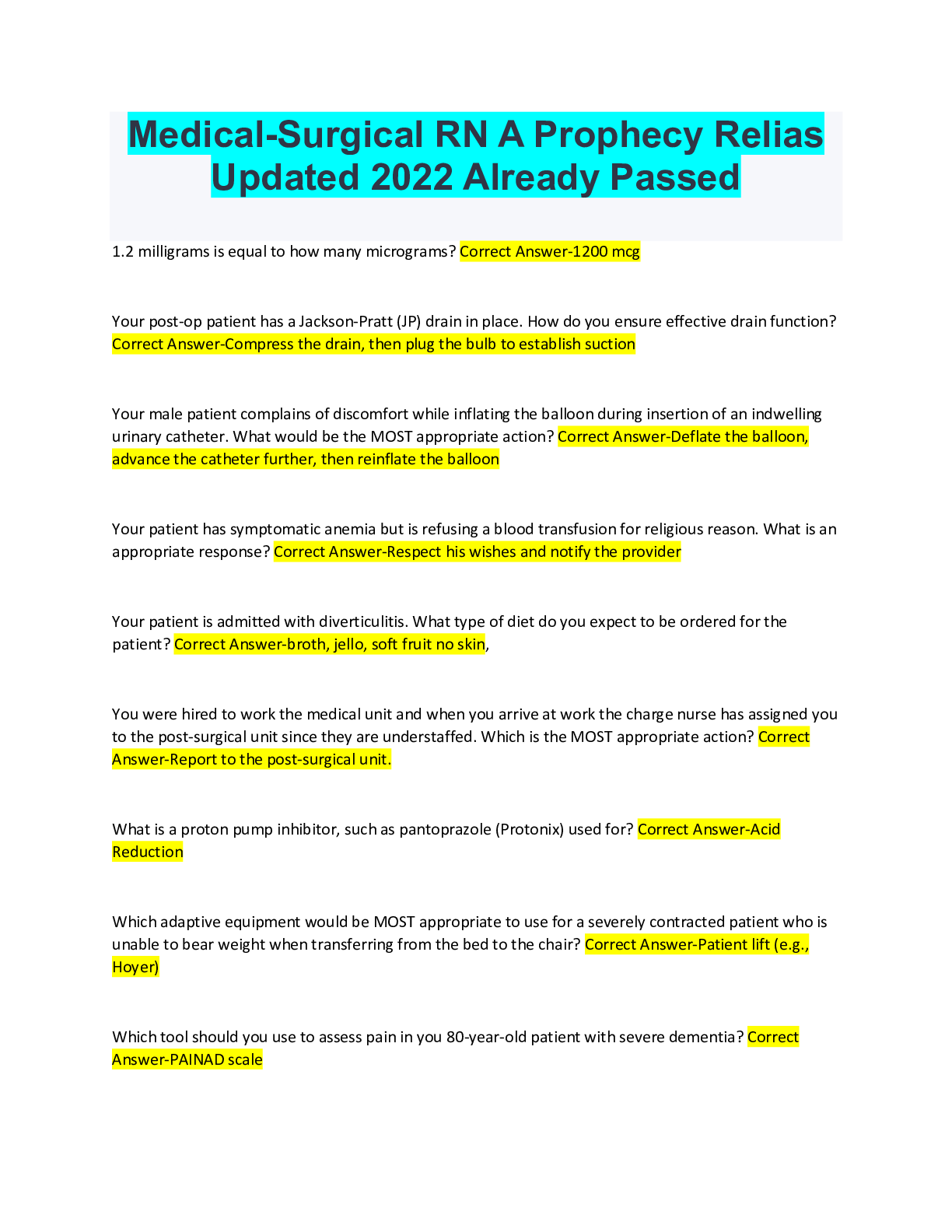
Medical-Surgical RN A Prophecy Relias
Updated 2022 Already Passed
1.2 milligrams is equal to how many micrograms? Correct Answer-1200 mcg
Your post-op patient has a Jackson-Pratt (JP) drain in place. How do you ensure effective drain function?
Correct Answer-Compress the drain, then plug the bulb to establish suction
Your male patient complains of discomfort while inflating the balloon during insertion of an indwelling
urinary catheter. What would be the MOST appropriate action? Correct Answer-Deflate the balloon,
advance the catheter further, then reinflate the balloon
Your patient has symptomatic anemia but is refusing a blood transfusion for religious reason. What is an
appropriate response? Correct Answer-Respect his wishes and notify the provider
Your patient is admitted with diverticulitis. What type of diet do you expect to be ordered for the
patient? Correct Answer-broth, jello, soft fruit no skin,
You were hired to work the medical unit and when you arrive at work the charge nurse has assigned you
to the post-surgical unit since they are understaffed. Which is the MOST appropriate action? Correct
Answer-Report to the post-surgical unit.
What is a proton pump inhibitor, such as pantoprazole (Protonix) used for? Correct Answer-Acid
Reduction
Which adaptive equipment would be MOST appropriate to use for a severely contracted patient who is
unable to bear weight when transferring from the bed to the chair? Correct Answer-Patient lift (e.g.,
Hoyer)
Which tool should you use to assess pain in you 80-year-old patient with severe dementia? Correct
Answer-PAINAD scaleYour patient is admitted from the ED with failure to thrive and advanced dementia. You note he is
extremely underweight, appears unbathed for some time, and has a stage 4 pressure injury to his
coccyx. You were told in report that he lives at home with family members. What should you do?
Correct Answer-Notify the charge nurse and social worker of your concerns.
Your 85-year-old patient with atrial fibrillation fell at home 3 days ago. You notice she has been having
several episodes of acute confusion since being admitted to your unit. What is the MOST important
order you should anticipate from the provider? Correct Answer-Stat CT of head
Your patient has a temp of 102.3 F, HR 122, and has had 15 mL of urine from the indwelling urinary
catheter in the last 2 hours. What is your patient MOST likely experiencing. Correct Answer-Sepsis
What type of personal protective equipment (PPE) is applied prior to entering a room for a patient with
C. diff? Correct Answer-Gown and gloves
Your patient continues to pull at their IV site located in their left forearm despite verbal reminders and
increased observation. The nursing assistant recommends using soft mitt restraints on the patient. What
is your recommendation? Correct Answer-Request an order for soft mitts as they are the least restrictive
Your patient was admitted for a hypertensive crisis and has a history of HTN, Parkinson's disease,
depression, and alcohol use. On his second hospitalized day, you notice he is more anxious and restless
than his baseline. What would be your FIRST nursing intervention? Correct Answer-Ask the patient when
his last drink of alcohol was.
What is the BEST indication of an acute neurological problem? Correct Answer-Change in level of
consciousness
While in a supine position your patient states, "I'm tired and cannot catch my breath." Physical
assessment reveals jugular vein distention and a third heart sound (S3). These symptoms are indicative
of what condition? Correct Answer-Heart failure
Your new admission presents with a cough, unintentional weight loss, frequent night sweats, and bloody
sputum. What type of isolation precautions should you initiate, if any? Correct Answer-Airborne
precautionsPatients with diabetes are at high risk for complications from damage to what body areas? Correct
Answer-Nerve and kidney damage
If your patient with a known history of diabetes is displaying symptoms of diaphoresis, cool skin,
lethargy, and shakiness. What is your first action? Correct Answer-Check the patient's blood glucose
level.
Your patient tells you, "I hope I don't die, but if I do I don't want to be brought back.? You notice on her
chart and wrist band that she is a full code. What would be the MOST appropriate action? Correct
Answer-Discuss code status with the patient and follow up with provider to ensure the medical record
reflects her wishes.
Your coworker posted photos on social media from a birthday party they had for her in the unit
breakroom. What should be your NEXT course of action? Correct Answer-No action is necessary because
no PHI was displayed.
Your new patient understands very limited English. How should you communicate with them when
completing the admission assessment? Correct Answer-Use the organization's interpreter services.
You are caring for a patient with a history of diabetes mellitus. You walk into the room and find the
patient lethargic and diaphoretic. What is your first action? Correct Answer-Obtain capillary blood
glucose level.
Your patient is 4 hours post open appendectomy and has not voided yet. You note his lower abdomen is
distended. What should you do NEXT? Correct Answer-Perform a bladder scan
A patient with peritonitis presents with tachycardia, hypotension, and dehydration. What other
assessment finding would you anticipate as part of your physical assessment? Correct Answer-Severe
abdominal pain or rebound tenderness
What is the EARLIEST sign indicating increased intracranial pressure (ICP)? Correct Answer-Level of
consciousnessIn addition to pain, pallor, and pulselessness, a neurovascular assessment also includes checking for:
Correct Answer-Paresthesia and paralysis
You received a report on a patient that sustained a right hemisphere CVA 48 hours ago. What do you
expect the patient to exhibit? Correct Answer-Left sided weakness of the leg, arm, and face.
You are ordered to give digoxin (Lanoxin). Your patients vital signs are: BP 130/70, Temp 97.9F, HR 52,
RR 16, O2 Sat 100% on room air. What should you do NEXT? Correct Answer-Hold digoxin (Lanoxin) and
call the provider
Upon entry to your patient's room, you find her sitting in High Fowler's position and complaining of
shortness of breath. Her respiratory rate is 34 breaths/min and O2 sat is 84%. Which mode of oxygen
delivery would MOST likely reverse these symptoms? Correct Answer-Non-rebreather mask
Your patient is on contact precautions for active MRSA. What proper PPE should you use before entering
the room? Correct Answer-Gown and gloves
Your patient recently had a G-tube placed and intermittent enteral feedings have been initiated. What
symptoms may indicate intolerance to the feedings? Correct Answer-Vomiting and diarrhea
Upon entering your patient's room, you note that they are having a seizure. What is your FIRST action?
Correct Answer-Position the patient on their side to maintain the airway.
Your 18-year-old female patient was admitted with dehydration secondary to anorexia nervosa. During
your assessment you note she has a flat affect and says, "I just want to die. I'm tired of my life." What
should be your FIRST intervention? Correct Answer-Stay with the patient and ask fi she has a plan to
carry out this wish.
Your patient has a non-productive cough and presence of secretions in his tracheostomy. Prior to
suctioning the patient, what should you do FIRST? Correct Answer-Hyperoxygenate patient.
Your patient takes 5 mg of warfarn (Coumadin/Jantoven) daily and reports having black colored stool
today. What do you most likely suspect? Correct Answer-Gastrointestinal bleedingYour new patient was admitted with blunt force trauma to the abdomen following a motor vehicle
accident (MVA). A NG tube is in place for decompression; however, you note during the assessment that
the stomach is rigid and hard during palpation. What condition do you suspect? Correct AnswerHemorrhage
Which of the following nursing diagnoses is MOST important for a patient with chronic obstructive
pulmonary disease (COPD)? Correct Answer-Impaired gas exchange
You have a patient going for dialysis. Their medications include lisinopril (Prinivil), ondansetron (Zofran),
famotidine (Pepcid), and atorvastatin (Lipitor). Which medication would you possibly hold and seek
clarification? Correct Answer-famotidine (Pepcid)
What is an early symptom that the patient is developing a complication of heart failure? Correct
Answer-Edema in the legs and feet
Black and tarry colored stools are CLASSIC symptoms of what condition? Correct Answer-Bleeding
gastric ulcer
You have 4 patients who have high priority needs. One needs to go to surgery, one needs STAT lab
draws from a PICC line, another has chest pain rated 8/10, and another needs toileting. Which patient
should you tend to FIRST? Correct Answer-The patient with chest pain
Your patient with Hepatitis C exhibits signs of jaundice and a distended abdomen. What procedure
would you anticipate being performed by the provider at the bedside for this patient? Correct AnswerParacentesis
What is clubbing of the fingers MOST likely associated with? Correct Answer-Chronic o
[Show More]


- Test Bank.png)