AP Euro key terms 100% pass
Humanism ✔✔the scholarly interest in the study of classical texts, values and styles of Greece and
Rome. Humanism contributed to the promotion of a liberal arts education based on the study
...
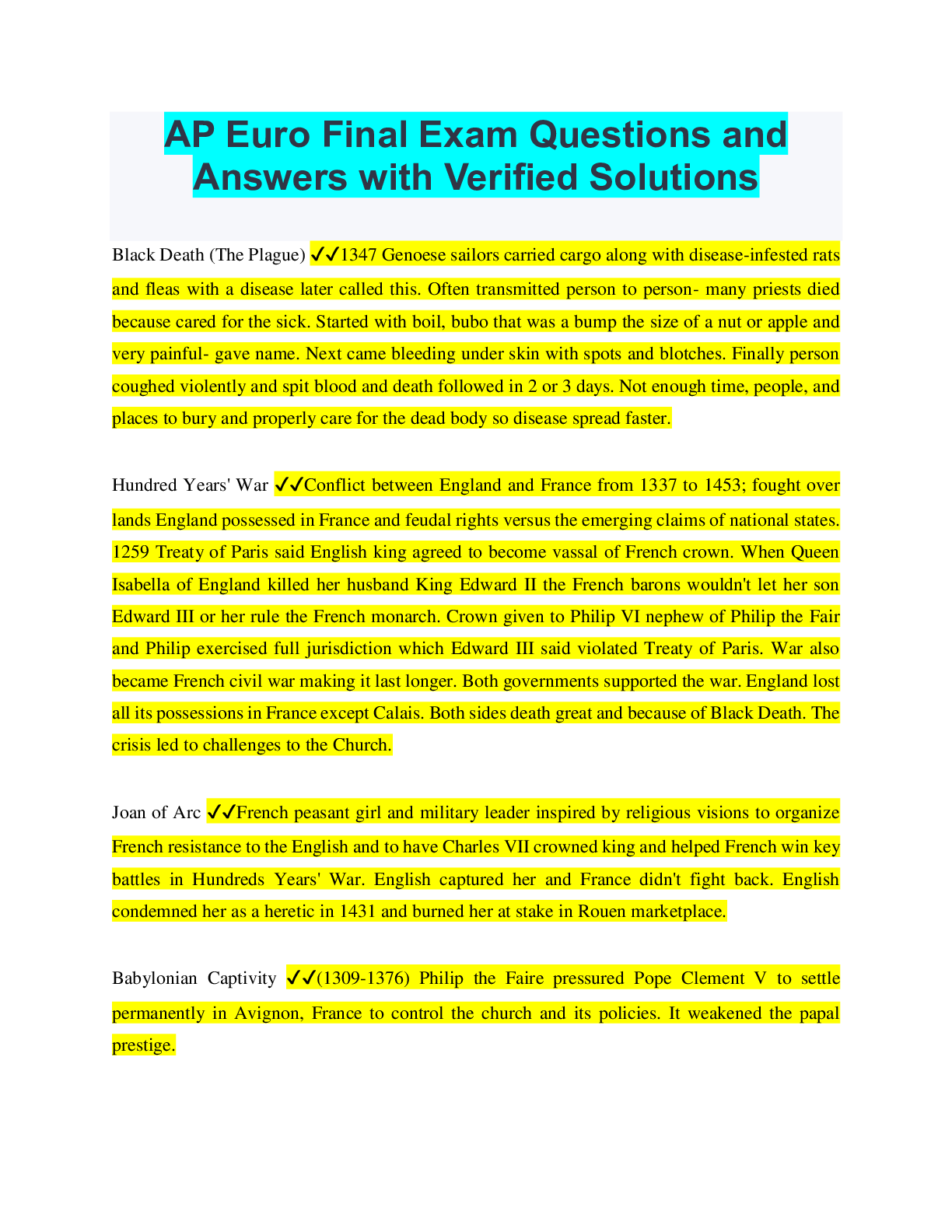
AP Euro key terms 100% pass
Humanism ✔✔the scholarly interest in the study of classical texts, values and styles of Greece and
Rome. Humanism contributed to the promotion of a liberal arts education based on the study of
the classics, rhetoric, and history
Christian Humanism ✔✔Northern European Reniassance. A branch of humanism. Like thier
italian counterparts the christian humanists closely studied classical texts however they also sought
to give it a specifically christian content. Christian humanists like Erasmus were committed to
religious piety and institutional reform
Vernacular ✔✔the everday language of a region or country. Miguel de Cervantes, Geoffrey
Chaucer, Dante, and Martin Luther all encouraged the development of their national languages by
writing in the vernacular. Erasmus however, continued to write in Latin
New Monarchs ✔✔European monarchs who created professional armies and a more centralized
administrative bureaucracy. The new monarchs also negotiated a new relationship with the
Catholic Church. Key new monarchs include Charles VII, Louis XI, Henry VII and
Ferdinand/Isabella
Taille ✔✔direct tax on french peasantry. Key sources of income for french monarchs until the
french revolution
Reconquista ✔✔centuries long "reconquest" of spain from the muslims. The reconquista
culminated in 1492 with the conquest of the last muslim stronghold, granada.
indulgence ✔✔a certificate granted by the pope in return for payment. the certificate stated that
the soul of the dead relative or friend of the purchaser would have his time in purgatory reduced
by many years or cancelled
Anabaptist ✔✔protestants who insisited that only adult baptism conformed to scripture. protestant
and catholic leaders condemned anabaptists for advocating the complete separation of church and
state
predestination ✔✔doctrine espoused by John Calvin that God has known since the beinning of
time who will be saved and who will be damned. Calvin declared that "by an eternal and immutable
counsel, God has once and for all determined, both whom he would admit to salvation, and whom
he would condemn to destruction"
huguenots ✔✔French protestants who followed the teachings of John Calvin (French Calvinists)
Politiques ✔✔Rulers who put political necessities above personal beliefs. For example both Henry
IV of France and Elizabeth I of England put theological controversies second in order to achieve
political unity
Columbian Exchange ✔✔the interchange of plants, animals, diseases, and human populations
between the Old World and the New World
Mercantilism ✔✔Economic philosophy calling for close government regulation of the economy.
Mercantilist theory emphasized building a strong, self sufficient economy by max exports and min
imports. mercantilists supported the acquistion of colonies as sources of raw materials and markets
for finished goods. This favorable balance of trade would enable a country to accumulate reserves
of gold and silver
Putting out system ✔✔A preindustrial manufacturing system in which an entrepreneur would
bring materials to rural people who worked on them in their own homes. For example, watch
manufacturers in Swiss towns emplyed villagers to make parts for their products. The system
enabled entrepreneurs to avoid restrictive guild (union-like) regulations.
Joint Stock Company ✔✔A business arrangement in which many investors raise money for a
venture too large for any of them to undertake alone. They share the profits in proportion to the
amount they invest. English entrepreneurs used joint stock companies to finance the establishment
of New World colonies.
Absolutism ✔✔a system of gov in which the ruler claims sole and uncontestable power. Absolute
monarchs were not limited by constitutional restraints.
Divine Right of Kings ✔✔The idea that rulers recieve their authority from God and are answerable
only to God. Jacques-Benigne Bossuet, a french bishop and court preacher to Louis XIV, provided
the theological justification for the divine right of kings by declaring that "the state of monarchy
is the supremest thing on earth, for kings are not only God's lieutenants upon earth and sit upon
God's throne, but even by God himself are called gods. In the scriptures kings are called Gods, and
their power is compared to the divine powers."
Intendants ✔✔French royal officials who supervised provincial governments in the name of the
king. Intendants played a key role in establishing French absolutism.
Fronde ✔✔A series of rebllions against royal authority in France between 1649and 1652. The
fronde played a key role in Louis XIV's decision to leave Paris and build Versailles palace
Robot ✔✔System of forced labor used in eastern Europe. Peasants usually owed three of four days
a week of forced labor. The system was abolished in 1848.
junkers ✔✔Prussia's landowning nobility. The junkers supported the monarchy and served in the
army in exchange for absolute power over their serfs.
Scientific Method ✔✔The use of inductive logic and controlled experiments to discover regular
patterns in nature. These patterns or natural laws can be described with mathematical formulas.
Philosophes ✔✔18th century writers who stressed reason and advocated freedom of expression,
religious toleration, and a reformed legal system. Leading philosophes such Voltaire fought
irrational prejudice and blieved that society should be open to people of talent.
Deism ✔✔The belief that God created the universe but allowed it to operate through the laws of
nature. Deists believed that natural laws could be discovered by the use of human reason.
General Will ✔✔A concept in political philosophy referring to the desire or interest of a people as
a whole. As used by Jean-Jacques Rousseau, who championed the concept, the general will is
identical to the rule of law.
Enlightened Despotism ✔✔A system of government supported by leading philosophes in which
an absolute ruler uses his or her power for the good of the people. Enlightened monarchs supported
religious tolerance, increased economic productivity, administrative reform and scientific
academies. Joseph II, Frederick the Great,
[Show More]
.png)
.png)