Exam 2 Nutrition NR-228
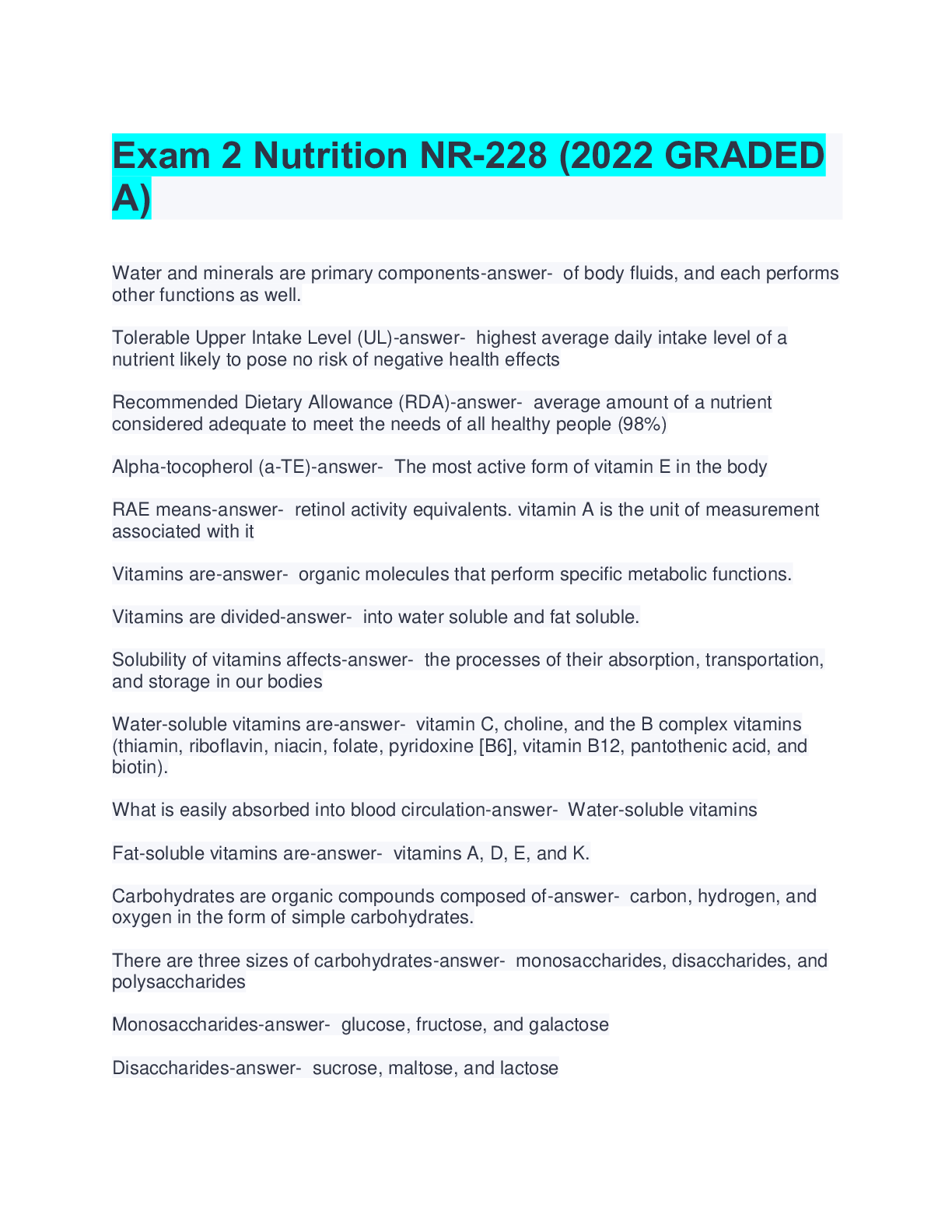
Water and minerals are primary components - ANSWER of body fluids, and each performs other functions as well.
Tolerable Upper Intake Level (UL) - ANSWER highest average daily intake
...
Exam 2 Nutrition NR-228
Water and minerals are primary components - ANSWER of body fluids, and each performs other functions as well.
Tolerable Upper Intake Level (UL) - ANSWER highest average daily intake level of a nutrient likely to pose no risk of negative health effects
Recommended Dietary Allowance (RDA) - ANSWER average amount of a nutrient considered adequate to meet the needs of all healthy people (98%)
Alpha-tocopherol (a-TE) - ANSWER The most active form of vitamin E in the body
RAE means - ANSWER retinol activity equivalents. vitamin A is the unit of measurement associated with it
Vitamins are - ANSWER organic molecules that perform specific metabolic functions.
Vitamins are divided - ANSWER into water soluble and fat soluble.
Solubility of vitamins affects - ANSWER the processes of their absorption, transportation, and storage in our bodies
Water-soluble vitamins are - ANSWER vitamin C, choline, and the B complex vitamins (thiamin, riboflavin, niacin, folate, pyridoxine [B6], vitamin B12, pantothenic acid, and biotin).
What is easily absorbed into blood circulation - ANSWER Water-soluble vitamins
Fat-soluble vitamins are - ANSWER vitamins A, D, E, and K.
Carbohydrates are organic compounds composed of - ANSWER carbon, hydrogen, and oxygen in the form of simple carbohydrates.
There are three sizes of carbohydrates - ANSWER monosaccharides, disaccharides, and polysaccharides
Monosaccharides - ANSWER glucose, fructose, and galactose
Disaccharides - ANSWER sucrose, maltose, and lactose
Polysaccharides - ANSWER starch, fiber, and glycogen
Food carbohydrates are divided into two categories - ANSWER simple carbohydrates and complex carbohydrates
Simple carbohydrates - ANSWER monosaccharides and disaccharides
Complex carbohydrates - ANSWER polysaccharides, excluding glycogen
Dietary Reference Intake (DRI) for carbohydrates - ANSWER 130 g/day for adults between 19and 30 years of age.
Acceptable Macronutrient Distribution Range (AMDR) - ANSWER 45% to 65% of kcal intake per day as primarily complex carbohydrates.
Dietary Guidelines recommends - ANSWER emphasizing a plant-based diet including fruits, vegetables, cooked dried beans and peas, whole grains, and seeds.
Energy circulates in the bloodstream - ANSWER glucose
Carbohydrates - ANSWER are an abundant food source of energy and dietary fiber
Blood glucose levels - ANSWER are regulated and balanced through hormonal systems. normal range 70- 100 mg per deciliter
Hypoglycemia and diabetes mellitus - ANSWER may occur when these systems cannot regulate glucose within normal levels.
Dietary fiber - ANSWER does not provide energy; it is not digestible by humans.
Consuming adequate quantities of soluble and insoluble fiber - ANSWER has significant health benefits.
The DRI for dietary fiber - ANSWER 25 to 38 g for adult women and men, respectively.
Best carbohydrate food energy sources - ANSWER grains, legumes, and starchy root vegetables.
Best dietary fiber sources: - ANSWER fruits, vegetables, and whole-grain products.
Nutrients are lost when - ANSWER unrefined (whole) grains are refined
Dietary Guidelines recommends increased consumption of - ANSWER complex carbohydrates
MyPlate proposes - ANSWER 6 ounces of grains, 4.5 cups of vegetables, and 2 cups of fruits
[Show More]






![Preview of AORN PERIOP 101 FINAL EXAM 2026 QUESTIONS AND VERIFIED ANSWERS [LATEST UPDATE]](https://browseimages.nyc3.digitaloceanspaces.com/paper-images/2026/04/07/sGJvJ3aH2026-04-07-04-5869d464cbba16f.png)














.png)
.png)