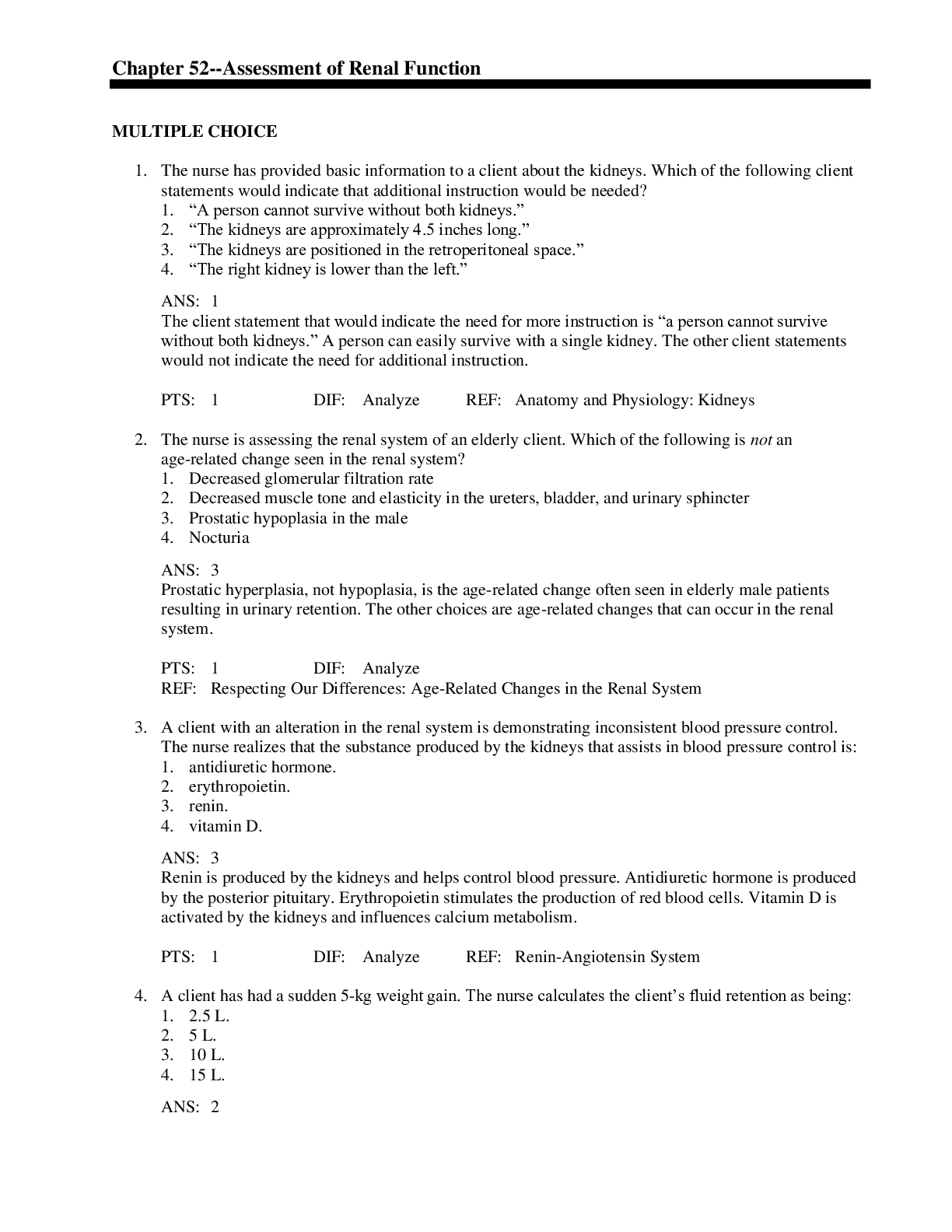
Chapter 52--Assessment of Renal Function
MULTIPLE CHOICE
1. The nurse has provided basic information to a client about the kidneys. Which of the following client
statements would indicate that additional instruction w
...
Chapter 52--Assessment of Renal Function
MULTIPLE CHOICE
1. The nurse has provided basic information to a client about the kidneys. Which of the following client
statements would indicate that additional instruction would be needed?
1. “A person cannot survive without both kidneys.”
2. “The kidneys are approximately 4.5 inches long.”
3. “The kidneys are positioned in the retroperitoneal space.”
4. “The right kidney is lower than the left.”
PTS: 1 DIF: Analyze REF: Anatomy and Physiology: Kidneys
2. The nurse is assessing the renal system of an elderly client. Which of the following is not an agerelated change seen in the renal system?
1. Decreased glomerular filtration rate
2. Decreased muscle tone and elasticity in the ureters, bladder, and urinary sphincter
3. Prostatic hypoplasia in the male
4. Nocturia
PTS: 1 DIF: Analyze
REF: Respecting Our Differences: Age-Related Changes in the Renal System
3. A client with an alteration in the renal system is demonstrating inconsistent blood pressure control. The
nurse realizes that the substance produced by the kidneys that assists in blood pressure control is:
1. antidiuretic hormone.
2. erythropoietin.
3. renin.
4. vitamin D.
PTS: 1 DIF: Analyze REF: Renin-Angiotensin System
4. A client has had a sudden 5-kg weight gain. The nurse calculates the client’s fluid retention as being:
1. 2.5 L.
2. 5 L.
3. 10 L.
4. 15 L.
PTS: 1 DIF: Apply REF: Red Flag: Fluid Volume Excess
5. The nurse is collecting a 24-hour urine specimen from a client with an indwelling urinary catheter.
How should the nurse collect this specimen?
1. Empty the catheter bag once a shift and place the urine in a collection container on ice.
2. Disconnect the catheter from the tubing and drain the urine directly into the collection
container.
3. Aspirate urine from the tubing port with a sterile needle every hour and place in a
collection container on ice.
4. Place the catheter bag on ice and empty regularly into the collection bottle, which is also
kept on ice.
PTS: 1 DIF: Apply REF: Table 52-1 Urine Studies
6. The nurse needs to collect a urine specimen for culture from a client who does not have an indwelling
urinary catheter. Which of the following instructions would the nurse provide the client regarding how
to collect this sample?
1. “Decrease your water intake so the sample will be more concentrated.”
2. “I will need to catheterize you to obtain urine.”
3. “Please use the wipe and cup for the sample.”
4. “When you use the urinal, please call so that I can get the sample.”
PTS: 1 DIF: Apply REF: Table 52-1 Urine Studies
7. The nurse is reviewing the results of serum laboratory tests conducted on a client. Which of the
following results should be reported?
1. Calcium 8.5 mg/dL
2. Potassium 6.1 mEq/L
3. Serum creatinine 1.4 mg/dL
4. Sodium 144 mEq/L
8. A client, diagnosed with renal calculi, is experiencing extreme pain. The nurse explains to the client
that the cause of the pain is due to the:
1. stone scratching the kidney tissue.
2. stone scraping against the bladder.
3. buildup of pressure in the ureters.
4. spasms of the urethra.
PTS: 1 DIF: Apply REF: Ureters
9. A client has sustained trauma to the trigone portion of the bladder. The nurse realizes that which of the
following will be affected in this client?
1. The ureters and urethra
2. The nephrons
3. The detrusor muscle will spasm
4. The ability to concentrate urine will be lost
PTS: 1 DIF: Analyze REF: Urinary Bladder
10. The nurse is assessing the skin of a client diagnosed with renal insufficiency. Which of the following is
the nurse most likely going to assess in this client?
1. Evidence of scratching
2. Bruises
3. Flushing
4. Moist skin with good turgor
PTS: 1 DIF: Apply REF: Skin
11. A client diagnosed with a kidney disorder is scheduled for a diagnostic test that uses a contrast agent.
Which of the following can be done to protect this client’s kidney functioning?
1. Restrict fluids.
2. Administer acetylcysteine as prescribed.
3. Provide 0.9% normal saline through an intravenous access device.
4. Maintain bed rest.
PTS: 1 DIF: Apply
REF: Red Flag: Using Contrast Agents in Renal Diagnostics
12. A client is scheduled for a renal ultrasound and a barium swallow. The nurse realizes that which of the
following should be done regarding these diagnostic tests?
1. Complete the barium swallow first.
2. Complete the renal ultrasound first.
3. Complete the barium swallow and then have the renal ultrasound done immediately
afterward.
4. Wait 8 hours after the barium swallow to complete the renal ultrasound.
PTS: 1 DIF: Analyze
REF: Red Flag: Potential Problems Associated with Renal Ultrasounds
13. A client with chronic renal disease asks the nurse why she needs to receive erythropoietin injections.
Which of the following should the nurse respond to this client?
1. “It makes more vitamin D in your body.”
2. “It encourages your kidneys to remove more waste products.”
3. “It stimulates red blood cell production in the bone marrow.”
4. “It helps remove ammonia from your blood.”
PTS: 1 DIF: Apply REF: Table 52-2 Blood Studies
MULTIPLE RESPONSE
1. A nurse is assessing a client for signs of decreased kidney function. Which of the following are
symptoms of possible decreased kidney function? (Select all that apply.)
1. Increased appetite
2. Metallic taste in the mouth
3. Pruritus
4. Reduced energy level
5. Urine output of 240 mL in 8 hours
6. Weight gain
PTS: 1 DIF: Analyze REF: Health History
2. The nurse is reviewing a client’s current medication list for those that can be nephrotoxic. Which of the
following medications can be nephrotoxic? (Select all that apply.)
1. Amphotericin B
2. Chloroquine
3. Erythromycin
4. Gentamicin
5. Tobramycin
6. Vancomycin
PTS: 1 DIF: Apply
REF: Box 52-3 Potentially Nephrotoxic Drugs and Other Agents
3. A nurse is collecting a 24-hour urine sample from a client without an indwelling urinary catheter.
Which of the following are steps for collecting the sample? (Select all that apply.)
1. Discard the first void and save all subsequent urine for 24 hours.
2. Discard the last void.
3. Record the first void as the beginning time.
4. Save all urine in a 24-hour period.
5. Save the first void.
6. Save all urine voided except the last specimen.
PTS: 1 DIF: Apply REF: Table 52-1 Urine Studies
4. The nurse realizes that a client diagnosed with kidney disease is at risk for acid-base imbalances.
Which of the following explains how the kidney contributes to acid-base balance? (Select all that
apply.)
1. Secretes hydrogen ions
2. Reabsorbs bicarbonate
3. Generates new bicarbonate
4. Produces erythropoietin
5. Converts vitamin D
6. Excretes waste products from protein metabolism
PTS: 1 DIF: Analyze REF: Box 52-1 Functions of the Kidney
5. A client has a disorder that is affecting the reabsorption ability of the kidney. Which of the following
does the renal tubule usually reabsorb to support body functions? (Select all that apply.)
1. Water
2. Glucose
3. Amino acids
4. Vitamins
5. Calcium
6. Ammonia
PTS: 1 DIF: Analyze
REF: Figure 52-5 Processes and Structures of the Nephron
6. A client is recovering from a renal biopsy. After this procedure, the nurse should instruct the client to
notify the nurse for which of the following? (Select all that apply.)
1. Problems voiding
2. Obvious blood in the urine
3. Increased pain
4. Fever
5. Painful urination
6. Constipation
PTS: 1 DIF: Apply REF: Nursing Management
[Show More]



 Med Surg test Latest Verified Questions and all Correct Answers with Explanations Chapter 52 Assessment and Management of Patients with En.png)
.png)