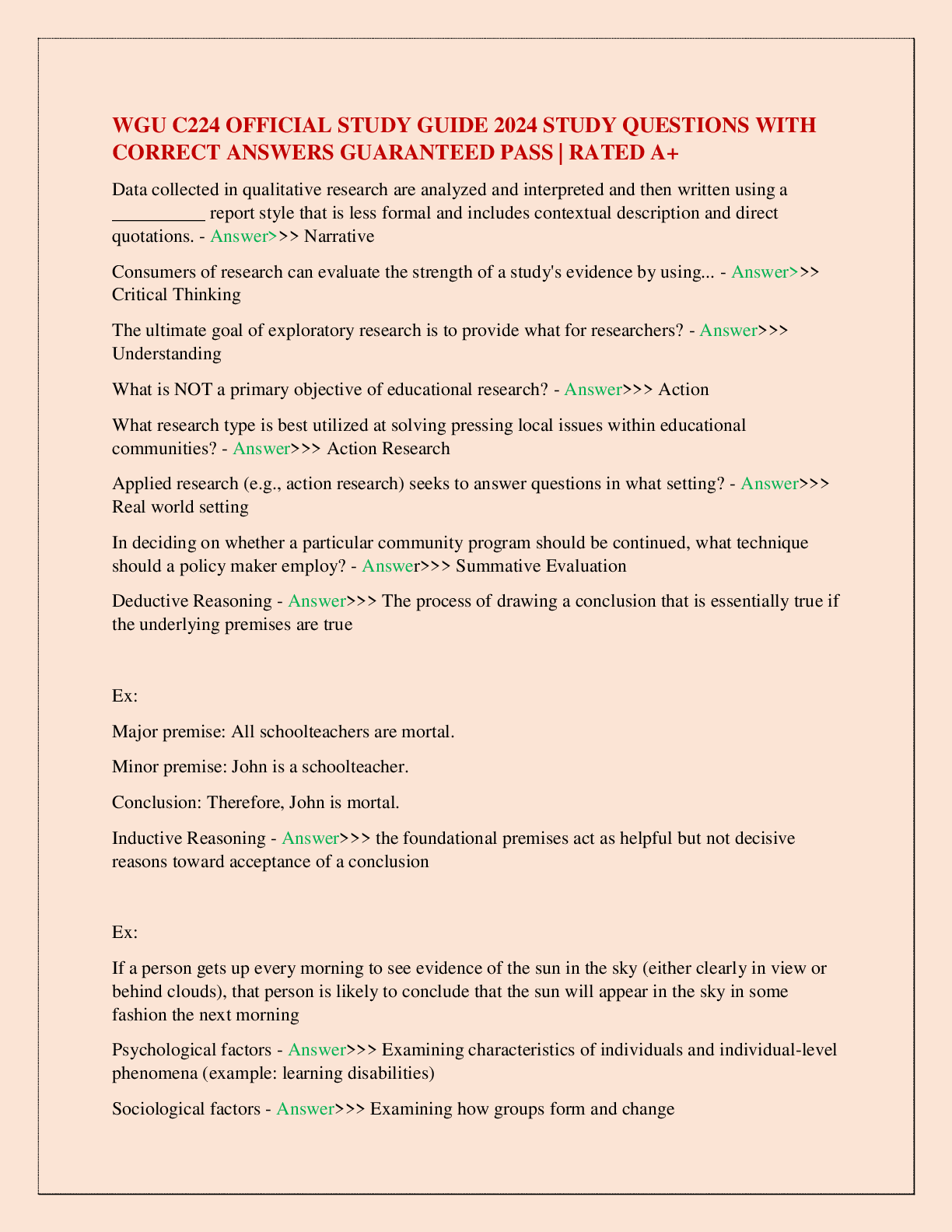
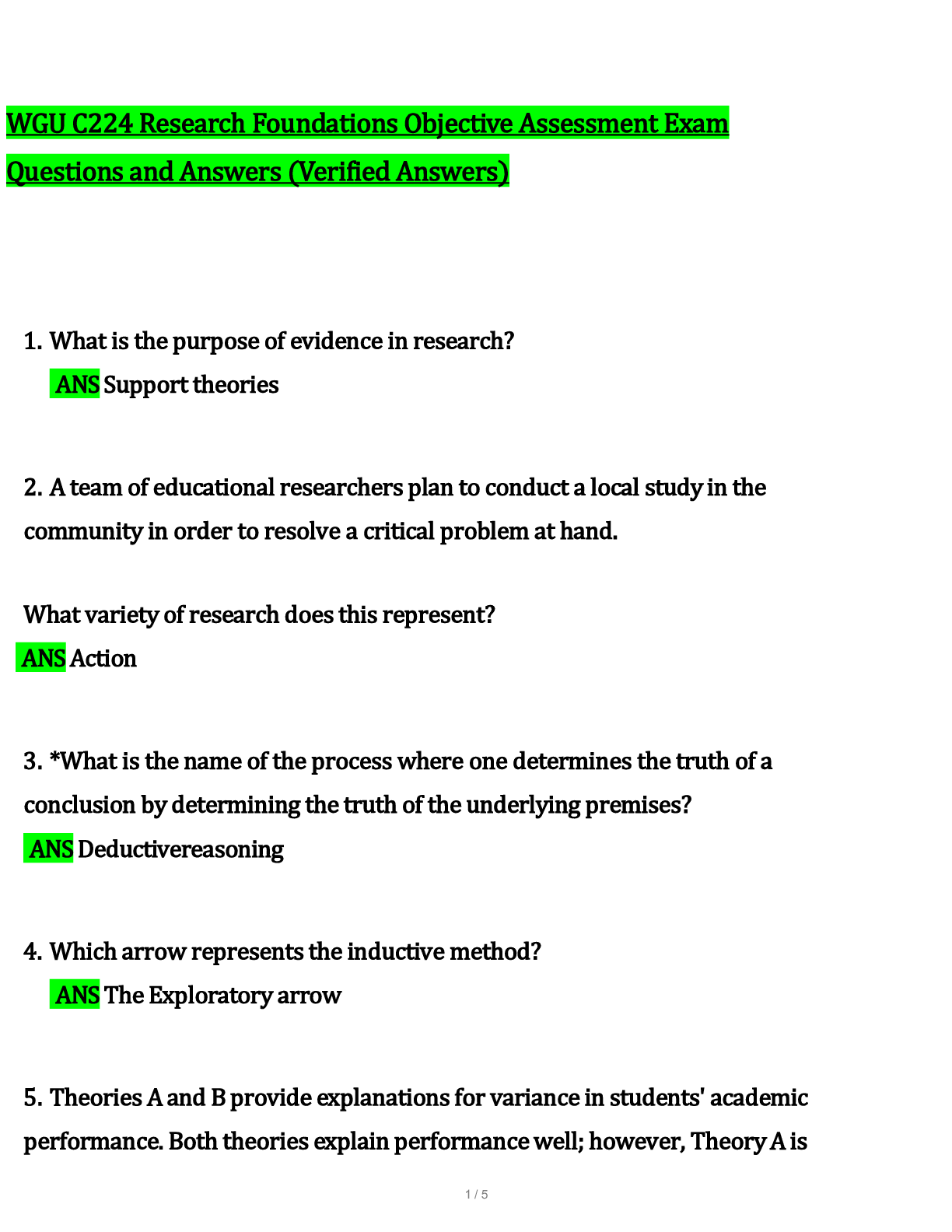
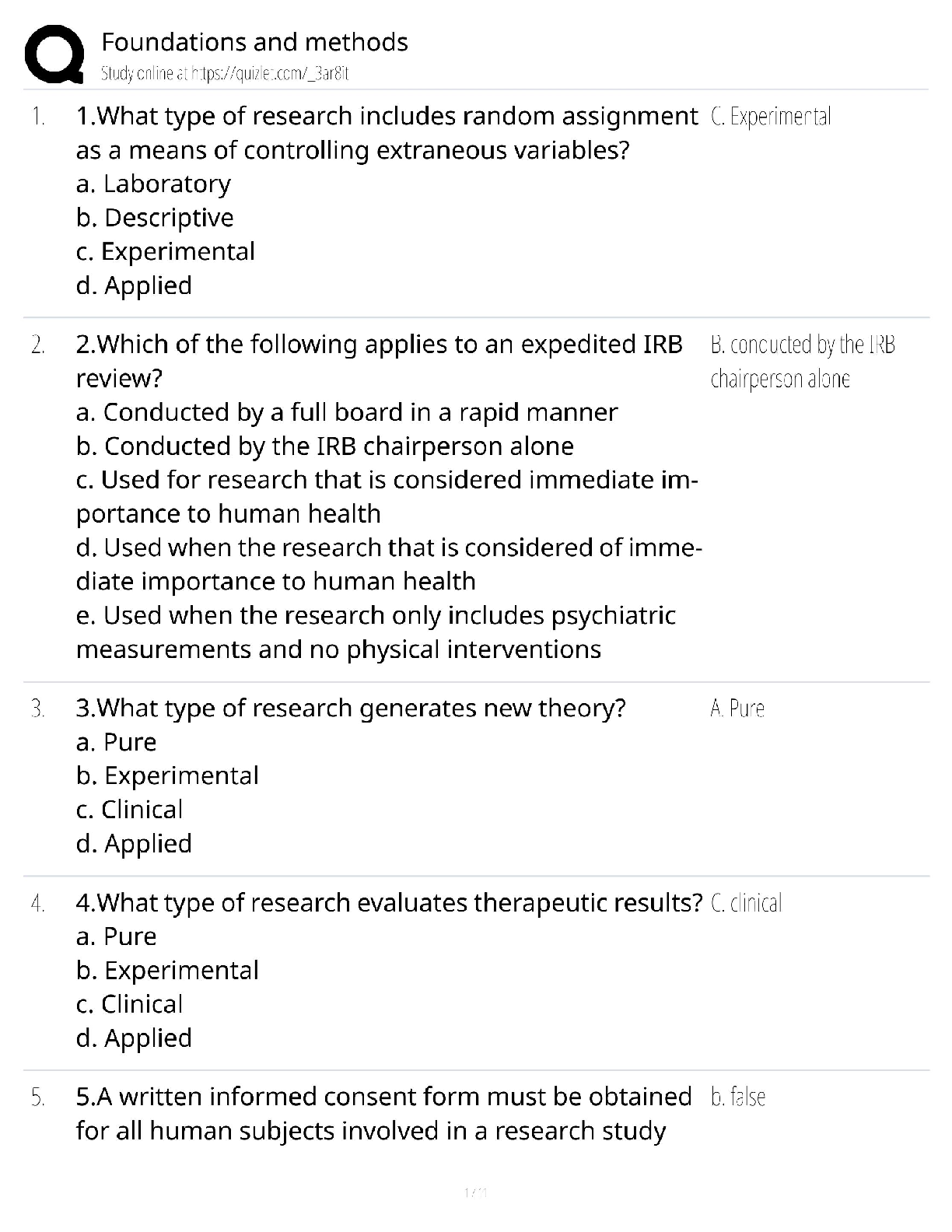
WGU C224 - STUDY GUIDE Latest 2022
Graded A
Characteristics of Quantitative Research ✔✔numerical data (quantity); hypothesis & research
procedure are stated BEFORE data collection; large sample size; rely on statistic
...
WGU C224 - STUDY GUIDE Latest 2022
Graded A
Characteristics of Quantitative Research ✔✔numerical data (quantity); hypothesis & research
procedure are stated BEFORE data collection; large sample size; rely on statistical procedure; low
interaction with subjects; rely on controlling, measuring, and generalizing; objective by nature
Quantitative Methods/Designs ✔✔survey research; correlational research; causal comparative;
experimental; single subject experimental
Sampling techniques for quantitative research ✔✔simple random; stratified; cluster; systematic;
Simple random ✔✔(quant) selection using table of random numbers
Stratified ✔✔(quant) selection based on dividing up into subgroups which have roughly equal
representation
Cluster ✔✔(quant) intact groups are selected as by classroom, efficient but less representative
Systematic ✔✔(quant) take a population and select every Kth invidual i.e. sample population =
100 and you select every 5th person on list.
Qualitative Research ✔✔*emphasis on words and feelings; *research problems/methods evolve
as understanding of topic increases; *smaller sample sizes; *relies on categorizing & organizing
data into themes or patterns to describe & synthesize the data; *high level interaction with subjects;
*many possible contexts & meanings for different people; *subjective by nature
Qualitative Research Methods ✔✔observation/field notes; interviews: face-to-face, phone, focus
group; questionnaires; archival documents; journals; audio/video
Qualitative Sampling Techniques ✔✔intensity; homogenous; criterion; snowball; random
purposive
Characteristics of Action Research (comes out of qualitative research) ✔✔*persuasive &
authoritative b/c it's done by teachers for teachers; *relevant b/c solves real world problems;
*accessible b/c teachers already have built-in audience as test subjects; *encourages school reform
by providing an action plan; *practical by nature (see ch20).
Selecting topics - Characteristics of good research topics ✔✔*researchable (can be solved by
collecting and analyzing data); *interesting enough to hold your attention (love it); *significant
(contributes to field of knowledge); *ethical (no harm done); *manageable (keep it in scope)
How to write a good research question ✔✔*solvable by collecting data; *cannot be answered with
simple yes/no; *what is the effect of x on y (x is indep. Variable, y is dependent variable); *i.e.
What is the effect of an after school reading program (x) on students' reading comprehension scores
(y)?
Purpose & function of literature review ✔✔*see what's already been done; *reveals what needs to
be done; *addresses the research questions; *provides rationale for your hypothesis; *avoids
mistakes of others; *may suggest ideas not previously considered; *provide new direction to your
research
Resource Identification Evaluation & Selection ✔✔*primary & secondary sources; WGU library:
books, articles, e-reserves, ERIC; *What was problem statement?; *Who was studied?; *Where
was source published?; When was source published?; *How was study conducted?; *see ch 3 for
more detail
5 types Hypotheses ✔✔1. Deductive, 2. Inductive, 3. Directional, 4. Non-directional, 5. Null
Hypothesis ✔✔based on sound reasoning consistent with theory or observation; provides
reasonable explanation for a predicted outcome; states the expected relationship between variables;
is testable within a reasonable time frame
Evaluating a research report ✔✔*does it include all appropriate heading according to the research
design? (i.e. intro, prob. Stmt., lit review, hypothesis, etc.); *enough detail to allow the reader to
completely understand the what, why, when, and how.; *look out for researcher bias; *review
comprehensive list in ch. 22
Measurement instruments ✔✔*reliability - degree to which a test consistently measures whatever
it is measuring; *validity - degree to which a test measures what it is intended to measure; *validity
assumes reliability
Factors that threaten validity of measurement instruments ✔✔*unclear test directions; *ambiguous
test items; *complex vocabulary & sentence structure; *subjective scoring; *items on test not
covered in instruction; *inconsistent testing procedures; *cheating (see pg 158)
How to determine reliability? ✔✔*stability (test - re-test); *equivalence (2 similar tests); *Internal
Consistency (requires only 1 test administration) split half, Kuder Richardson, Chronibachs Alpha)
; see chapter 6
Types of Measurement Instruments (see Ch. 6) ✔✔Achievement tests; aptitude tests; Affective
tests; Projective tests
Dependent variable ✔✔the effect or outcome
Independent variable ✔✔the cause or treatment
Measurement Scales ✔✔variables - a placeholder that can assume any one of a range of values
Variables ✔✔nominal - named categories i.e. male/female; ordinal - ranks form high to low, i.e.
class rank; interval - scores on achievement tests i.e. 90% and 100%; ratio - has true zero point i.e.
height, weight, time, distance, *(pp145-146)
Attitude scales commonly used in education ✔✔*likert - strongly agree to strongly disagree;
*semantic differential - select a position on a continuum i.e. Better to worse; *Rating scales -
various forms i.e. select the statement that best describes you
Data analysis (ch. 18) ✔✔categorical analysis for qualitative data; statistical methods for
quantitative data
Analyzing Qualitative Data ✔✔-reading/memoing; -classifying; -identifying themes & patterns; -
coding
Analyzing Quantitative data (commonly used statistical procedures) ✔✔-descriptive statistics =
describes a set of data; -inferential = tests of significance between two or more means, allows
generalization, significance level p. <.05 or .01
Types of descriptive statistics (measures of) ✔✔frequencies; central tendency; variability; relative
position; relationship
Types of inferential statistics ✔✔t-tests; ChiSquare; Anova
t-tests ✔✔statistical measure: test means of 2 independent samples, significantly different?
ChiSquare ✔✔statistical measure: used for nominal scales (male/female), compares proportions
actually observed to the proportions expected to see if they are significantly different, ie flipping
a coin 50x
Anova ✔✔statistical measure: 2 or more means statistically different?
[Show More]

.png)


.png)
.png)
.png)