BIO 250 Final 2021 questions and answers
latest
Serves the senses of hearing and equilibrium .
ANS: Vestibulocochlear
C1 spinal nerve emerges between the first and second cervical vertebrae .
ANS: False
What is th
...
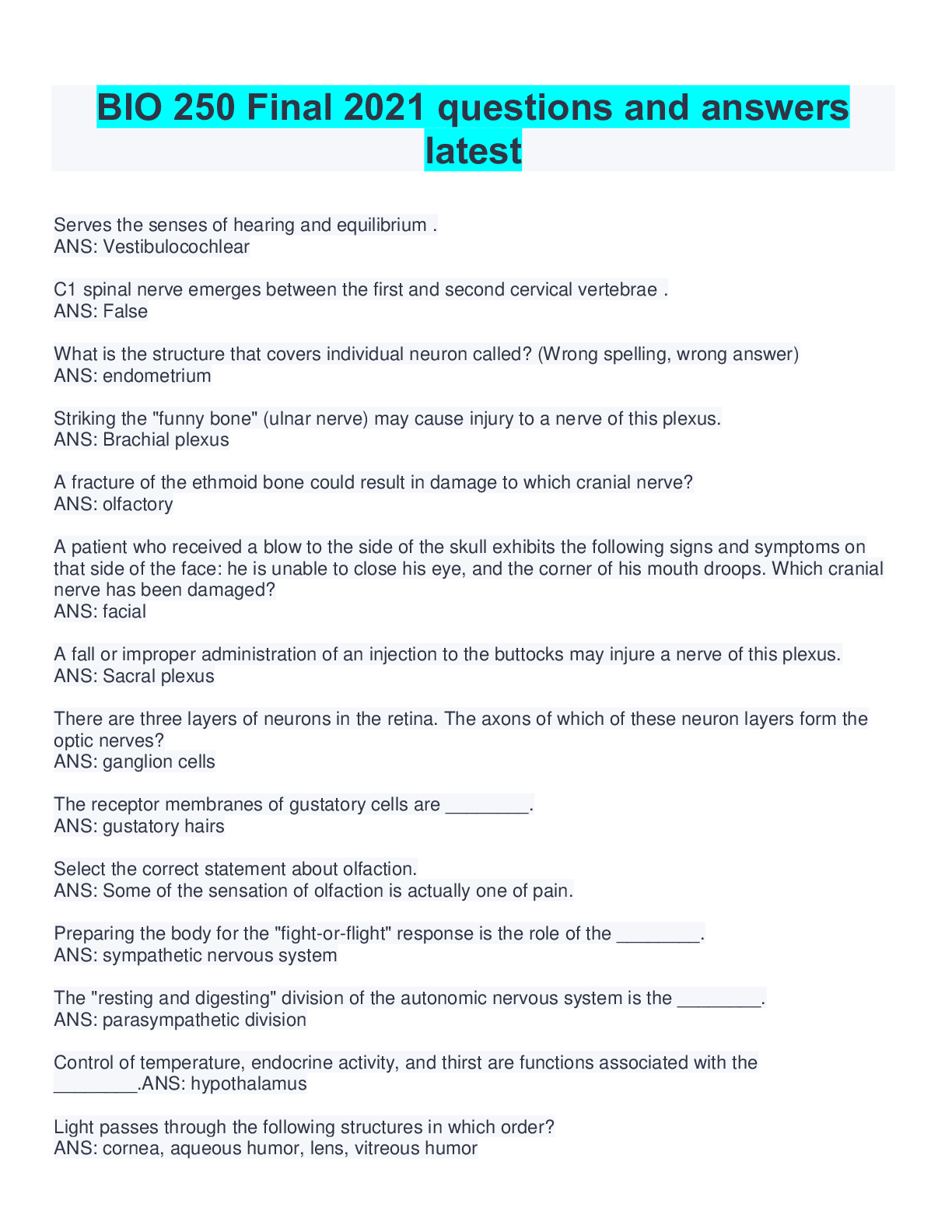
BIO 250 Final 2021 questions and answers
latest
Serves the senses of hearing and equilibrium .
ANS: Vestibulocochlear
C1 spinal nerve emerges between the first and second cervical vertebrae .
ANS: False
What is the structure that covers individual neuron called? (Wrong spelling, wrong answer)
ANS: endometrium
Striking the "funny bone" (ulnar nerve) may cause injury to a nerve of this plexus.
ANS: Brachial plexus
A fracture of the ethmoid bone could result in damage to which cranial nerve?
ANS: olfactory
A patient who received a blow to the side of the skull exhibits the following signs and symptoms on
that side of the face: he is unable to close his eye, and the corner of his mouth droops. Which cranial
nerve has been damaged?
ANS: facial
A fall or improper administration of an injection to the buttocks may injure a nerve of this plexus.
ANS: Sacral plexus
There are three layers of neurons in the retina. The axons of which of these neuron layers form the
optic nerves?
ANS: ganglion cells
The receptor membranes of gustatory cells are ________.
ANS: gustatory hairs
Select the correct statement about olfaction.
ANS: Some of the sensation of olfaction is actually one of pain.
Preparing the body for the "fight-or-flight" response is the role of the ________.
ANS: sympathetic nervous system
The "resting and digesting" division of the autonomic nervous system is the ________.
ANS: parasympathetic division
Control of temperature, endocrine activity, and thirst are functions associated with the
________.ANS: hypothalamus
Light passes through the following structures in which order?
ANS: cornea, aqueous humor, lens, vitreous humor
The spinal nerves that make up the Brachial Plexus consists of the following.
ANS: C5-C8 & T1
The major targets of growth hormone are ________.
ANS: bones and skeletal muscles
Which organ is responsible for synthesizing ANP?
ANS: the heart
The single most important regulator of calcium levels in the blood is ________.
ANS: parathyroid hormone
Aldosterone ________.
ANS: functions to increase sodium reabsorption
Which of the choices below is the parent cell for all formed elements of blood?
ANS: hemocytoblast
No visible cytoplasmic granules are present in ________.
ANS: monocytes
A lack of intrinsic factor, leading to a deficiency of vitamin B12 and causing an appearance of large
pale cells called mastocytes, is characteristic of ________.
ANS: pernicious anemia
Which of the following is characteristic of all leukocytes?
ANS: They are nucleated.
A foramen oval ________.
ANS: connects the two atria in the fetal heart
When viewing a dissected heart, it is easy to visually discern the right and left ventricles by
________.
ANS: noticing the thickness of the ventricle walls
MATCHING: Match the following figure with the correct part/s of the part. Choices are use once or
not-at-all.
ANS: Tricuspid valve. B
Correct! Left ventricle. E
Correct! Pulmonary veins. C
When viewing a dissected heart, it is easy to visually discern the right and left ventricles by
________.
ANS: noticing the thickness of the ventricle walls
Compared to skeletal muscle, cardiac muscle ________.
ANS: has gap junctions that allow it to act as a functional syncytium
Prevents backflow into the left ventricle.
ANS: Aortic valve
Vasodilation is a widening of the lumen due to smooth muscle contraction.
ANS: False
Which statement best describes arteries?
ANS: All carry blood away from the heart.
The hepatic portal vein ________.
ANS: carries nutrient-rich blood to the liver
The most common type of blood capillary is the ________.
ANS: continuous capillary
Which statement best describes arteries?
ANS: All carry blood away from the heart.
Permitting the exchange of nutrients and gases between the blood and tissue cells is the primary
function of ________.
ANS: capillaries
The arteries that are also called distributing arteries are the ________.
ANS: muscular arteries
Which tunic of an artery is most responsible for maintaining blood pressure and continuous blood
circulation?
ANS: tunica media
Modified capillaries that are lined with phagocytes are called ________.
ANS: sinusoids
Small organs intimately associated with lymphatic vessels.
ANS: Lymph nodes
Which lymphatic structure drains lymph from the right upper limb and the right side of the head and
thorax?
ANS: right lymphatic duct
Which of the following is not a part of the lymphatic system?
ANS: erythrocytes
The main site of gas exchange is the ________.
ANS: alveoli
The walls of the alveoli are composed of two types of cells, type I and type II. The function of type II is
to ________.
ANS: secrete surfactant
Select the correct statement about the pharynx.
ANS: The auditory tube drains into the nasopharynx.
Where the respiratory zone of the lungs begins.
ANS: Respiratory bronchioles
Hydrochloric acid is secreted by which of the secretory cells of the stomach?
ANS: parietal cells
Peristaltic waves are ________.
ANS: waves of muscular contractions that propel contents from one point to another
Which vitamin requires intrinsic factor in order to be absorbed?
ANS: B12
Surgical cutting of the lingual frenulum would occur in which part of the body?
ANS: oral cavity
Peyer's patches are found in the submucosa of the distal end of the small intestine.
ANS: True
The pancreas has both an endocrine and an exocrine function.
ANS: True
From the esophagus to the anal canal, the walls of every organ of the alimentary canal are made up
of the same four basic layers. Arrange them in order from the lumen.
ANS: mucosa, submucosa, muscularis externa, and serosa
The chemical and mechanical processes of food breakdown are called ________.
ANS: digestion
The urinary bladder is composed of ________ epithelium.
ANS: transitional
The renal corpuscle is made up of ________.
ANS: Bowman's capsule and glomerulus
The filtration membrane includes all except ________.
ANS: renal fascia
Fenestrated vessels that allow passage of all plasma elements but not blood cells.
ANS: Glomerular capillaries
Low pressure, porous vessels that reabsorb solutes and water from the tubule cells.
ANS: Peritubular capillaries
The act of emptying the bladder is called voiding.
ANS: True
The urethra contains an internal sphincter of smooth muscle.
ANS: True
Which of the choices below is the salt level-monitoring part of the nephron?
ANS: macula dense
Which of the following glands are responsible for 70% of the synthesis of semen?
ANS: the seminal vesicles
The primary function of the uterus is to ________.
ANS: receive, retain, and nourish a fertilized ovum
Fertilization generally occurs in the ________.
ANS: fallopian tubes
The cells that produce testosterone in the testis are called ________.
ANS: interstitial endocrine cells
Which hormone is absolutely necessary for ovulation to occur?
ANS: LH
A human egg or sperm contains 23 pairs of chromosomes.
ANS: False
The "master switch" for male reproductive development is ________.ANS: the SRY gene
Pharynx
ANS: the membrane-lined cavity behind the nose and mouth, connecting them to the esophagus.
Larynx
ANS: voice box; passageway for air moving from pharynx to trachea; contains vocal cords
alveolar ducts
ANS: the subdivisions of the respiratory bronchioles, which terminate in the alveolar sacs that
resemble clusters of grapes.
segmental bronchi (tertiary)ANS: Airways leading into specific lung segments.
respiratory bronchioles
ANS: branches of the terminal bronchioles that subdivide into several alveolar ducts
respiratory zone function
ANS: 1. defense
2. gas exchange
3. regulation of various blood properties
conducting zone function
ANS: filter, warm, and moisten air, and deliver air to the site of EXTERNAL RESPIRATION in the
lungs
Regions where secondary infection occurs after nasal infection
ANS: sinus ??
Layers of the wall of the alimentary canal
ANS: mucosa, submucosa, muscularis, serosa
Ingestion
ANS: Intake of food
Digestion
ANS: Breakdown of food substances into simpler forms that can be absorbed and used
Absorption
ANS: The process by which nutrient molecules pass through the wall of the digestive system into the
blood
Frenulum
ANS: midline fold of tissue that connects the tongue to the floor of the mouth
Falciform ligaments
ANS: thin, sickle-shaped, fibrous structure that connects the anterior part of the liver to the ventral
wall of the abdomen
lateral ligaments
ANS: horizontal from cervix and vagina to the lateral pelvic wall ??
coronary ligaments
ANS: attach liver to diaphragm
ligamentum teres hepatis
ANS: round ligament of the liver
Parts of the small intestines
ANS: the duodenum, jejunum, and ileum.
fauces (oropharynx)ANS: opening between oral cavity and oropharynx
Where mechanical food breakdown occurs
ANS: mouth
Mechanical digestion begins in your mouth with chewing, then moves to churning in the stomach and
segmentation in the small intestine.
intrinsic factor function
ANS: aids in the absorption of vitamin B12
pancreas function
ANS: regulates blood sugar (insulin & glucagon)
Secretes pancreatic juice which breaks down all categories of food
produces digestive enzymes for fats, carbs, and proteins
Parietal cells vs chief cells
ANS: Parietal cells are the epithelial cells that secrete HCl and intrinsic factor. They are located in the
gastric glands found in lining of fundus and stomach.
The gastric chief cells , are cells in the stomach that release pepsinogen and chymosin. ... These are
located , in clusters at the base of the gastric glands.
The Kupffer cells of the liver
ANS: are resident liver macrophages and play a critical role in maintaining liver functions. Under
physiological conditions, they are the first innate immune cells and protect the liver from bacterial
infections
Visceral and parietal peritoneum
ANS: Parietal peritoneum is that portion that lines the abdominal and pelvic cavities. Those cavities
are also known as the peritoneal cavity.
Visceral peritoneum covers the external surfaces of most abdominal organs, including the intestinal
tract.
epiglottis function
ANS: prevents food from going into the trachea and instead directs it to the esophagus
Different sphincters found in urethra
ANS: -external urethral sphincter
-internal urethral sphincter
Location of ADH receptors in the nephron
ANS: In the basolateral membrane of cells in the cortical and medullary collecting tubules
Nephron and its parts
ANS: Functional unit of the kidney, responsible for filtration of blood and urine formation (2 parts, with
other parts in them)
Retroperitoneal
ANS: pertaining to behind the peritoneum
trigone of bladder
ANS: triangular region at the base of the urinary bladder between the openings of the two ureters and
the urethra
JG apparatus and its parts
ANS: The juxtaglomerular apparatus consists of the juxtaglomerular cells of the afferent glomerular
arteriole, the efferent glomerular arteriole, the extra glomerular mesangial cells, and that small portion
of the distal tubule known as the macula densa that is located beside the renal glomerulus.
[Show More]