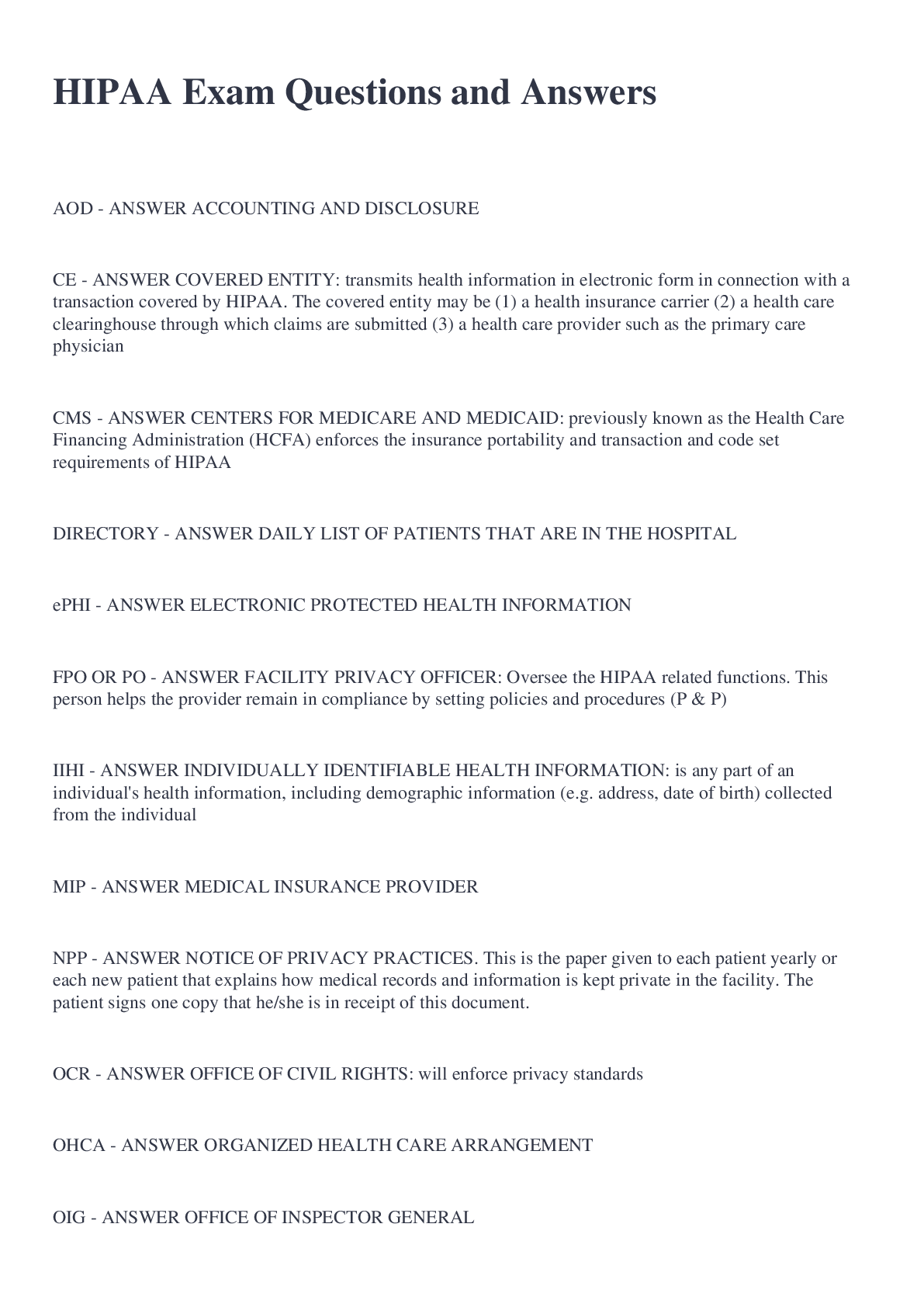
AOD - ANSWER ACCOUNTING AND DISCLOSURE
CE - ANSWER COVERED ENTITY: transmits health information in electronic form in connection with a transaction covered by HIPAA. The covered entity may be (1) a health insurance ca
...
AOD - ANSWER ACCOUNTING AND DISCLOSURE
CE - ANSWER COVERED ENTITY: transmits health information in electronic form in connection with a transaction covered by HIPAA. The covered entity may be (1) a health insurance carrier (2) a health care clearinghouse through which claims are submitted (3) a health care provider such as the primary care physician
CMS - ANSWER CENTERS FOR MEDICARE AND MEDICAID: previously known as the Health Care Financing Administration (HCFA) enforces the insurance portability and transaction and code set requirements of HIPAA
DIRECTORY - ANSWER DAILY LIST OF PATIENTS THAT ARE IN THE HOSPITAL
ePHI - ANSWER ELECTRONIC PROTECTED HEALTH INFORMATION
FPO OR PO - ANSWER FACILITY PRIVACY OFFICER: Oversee the HIPAA related functions. This person helps the provider remain in compliance by setting policies and procedures (P & P)
IIHI - ANSWER INDIVIDUALLY IDENTIFIABLE HEALTH INFORMATION: is any part of an individual's health information, including demographic information (e.g. address, date of birth) collected from the individual
MIP - ANSWER MEDICAL INSURANCE PROVIDER
NPP - ANSWER NOTICE OF PRIVACY PRACTICES. This is the paper given to each patient yearly or each new patient that explains how medical records and information is kept private in the facility. The patient signs one copy that he/she is in receipt of this document.
OCR - ANSWER OFFICE OF CIVIL RIGHTS: will enforce privacy standards
OHCA - ANSWER ORGANIZED HEALTH CARE ARRANGEMENT
OIG - ANSWER OFFICE OF INSPECTOR GENERAL
P & P - ANSWER POLICIES AND PROCEDURES: These are the rules for the facility to follow in regards to HIPAA
PHI - ANSWER PROTECTED HEALTH INFORMATION: is any data that identifies an individual and describes his/her health status, age, sex, ethnicity, or other demographic characteristics, whether or not that information is stored or transmitted electronically.
TPO - ANSWER TREATMENT, PAYMENT, HEALH CARE OPERATIONS
Compliance - ANSWER In health the health care industry is the process of meeting regulations, recommendations, and expectations of federal and state agencies that pay for health care services and regulate the industry
E-health information management - ANSWER All transactions in which health care information is accessed, processed, stored, and transferred using electronic technologies
What rights do patients have regarding requesting medical records? - ANSWER Patients have the legal right to request (1) access and amendments to their health records, (2) an accounting of those who have received their health information, and (3) restrictions on who can access their health records
Privacy - ANSWER is the condition of being secluded from the presence or view of others
Confidentiality - ANSWER using discretion in keeping secret information
Disclosure - ANSWER the release, transfer, provision of access to, or divulging in any other manner information
When is a consent form NOT required for PHI? - ANSWER A consent form is NOT required before physicians use or disclose protected health information for treatment, payment, or routine health care operations (TPO)
Breach of Confidential Communication - ANSWER Unauthorized release of information is called breach of confidential communication and is also considered an HIPAA violation.
Confidentiality between physician and patient is automatically waived in the following situations - ANSWER 1. When a patient is a member of a managed care organization
Confidentiality between physician and patient is automatically waived in the following situations - ANSWER 2. When patients have certain communicable diseases that are highly contagious or infectious
Confidentiality between physician and patient is automatically waived in the following situations - ANSWER 3. When a medical device breaks or malfunctions, the Food and Drug Administration requires providers to report certain information
Confidentiality between physician and patient is automatically waived in the following situations - ANSWER 4. When a patient is suspect in a criminal investigation or to assist in locating a missing person, material witness, or suspect, police have the right to request certain information
Confidentiality between physician and patient is automatically waived in the following situations - ANSWER 5. When the patient's records are subpoenaed or there is a search warrant
Confidentiality between physician and patient is automatically waived in the following situations - ANSWER 6. When the patient is suing someone, such as an employer
Confidentiality between physician and patient is automatically waived in the following situations - ANSWER 7. When there is a suspicious death or suspected crime victim, providers must report cases
Confidentiality between physician and patient is automatically waived in the following situations - ANSWER 8. When the physician examines a patient at the request of a third party
Confidentiality between physician and patient is automatically waived in the following situations - ANSWER 9. Good of society
Confidentiality between physician and patient is automatically waived in the following situations - ANSWER 10. Medicare information
When was HIPAA enacted? - ANSWER Congress wrote law to be enacted for August 1996. The final modifications were done by April 2003.
HIPAA Title I - ANSWER Health insurance reform
HIPAA Title II - ANSWER Administration simplification
HIPAA - Title I - ANSWER 1. Major goal is to assure that individuals' health information is properly protected.
2. A broad law that covers many issues.
3. Allows people to move their health insurance with them as they change jobs.
HIPAA - Title II - ANSWER 1. Governs how information is shared with other healthcare workers.
2. Governs computer sharing between patient care givers and insurance companies.
Who is covered by HIPAA? - ANSWER Individual and group plans that pay the cost of medical care:
1. Health plans - MediCal
2. Dental plans - Long-term Care
3. Vision plans
4. Prescriptions
5. HMO's
6. Medicare
Who is considered a Healthcare Provider under HIPAA? - ANSWER 1. Anyone who provides care for patients
2. Anyone who electronically transmits health information in connection with certain transactions.
Healthcare clearing houses - ANSWER Covers when ever anyone discloses an individual's identifiable health information.
What information needs to be Protected? - ANSWER Any "Individually identifiable health information"
1. Demographic data - address, phone number
2. Social security number, birth date, etc.
3. Medical record numbers, Health plan numbers or Account numbers
4. Certificates and license numbers
5. Photographs
WHAT NEEDS PROTECTING? - ANSWER 1. Past, present or future physical and/or mental health or condition.
2. Provision of health care to the person
3. Future payment schedules
4. Voice prints, finger prints
How does it benefit healthcare providers? - ANSWER 1. Lowers cost of administration transactions
2. Paves the way for cost-effective, uniform, fair and confidential health information practices.
3. Paves the way for standards to be set on how information is shared.
Who can have access to the information? - ANSWER 1. The patient
2. The patient's representative - with written permission
3. Researchers without identifying data
4. Consultations between healthcare providers by referral
5. Those who pay the bills - insurance companies.
6. Care managers & care coordinators
What are the consequences of not following HIPAA laws? - ANSWER 1. Civil penalties:
fines up to $100 for each violation up to a total of $25,000.
2. Criminal penalties:
Jail time up to 10 years and a fine of $250,000.
Who is to know, even without the patient's permission? - ANSWER 1. Public Health: Infectious diseases - TB, Hepatitis, HIV positive, Ebola fever, etc. Dog bites, etc.
2. Victim of abuse, neglect or domestic violence.
HiPAA Administrative Procedures SAFEGUARDS - ANSWER planning, audits, identification procedures, passwords.
HiPAA Physical SAFEGUARDS - ANSWER protection for the building, fires, earthquakes, theft.
HiPAA Technical SAFEGUARDS - ANSWER access control, authorization, authentication, encryption.
HOW ARE PATIENTS NOTIFIED OF THEIR RIGHTS? - ANSWER 1. A disclosure statement is given to all new patients.
2. A yearly renewal of the confidentiality statement/signature/consent.
3. Signed statement allowing you to discuss information with designated others.
4. A consent must be signed before using electronic sharing of information
Who enforces the HIPAA Act? - ANSWER 1. Centers for Medicare and MediCal
Enforces the insurance portability and transaction and code requirements.
[Show More]














![Preview of THE TEFL ACADEMY LEVEL 5 - ASSIGNMENT C - AUTHENTIC MATERIAL [2026]](https://browseimages.nyc3.digitaloceanspaces.com/paper-images/2026/04/10/HpVkRcWV2026-04-10-11-5769d96426bd64f.png)