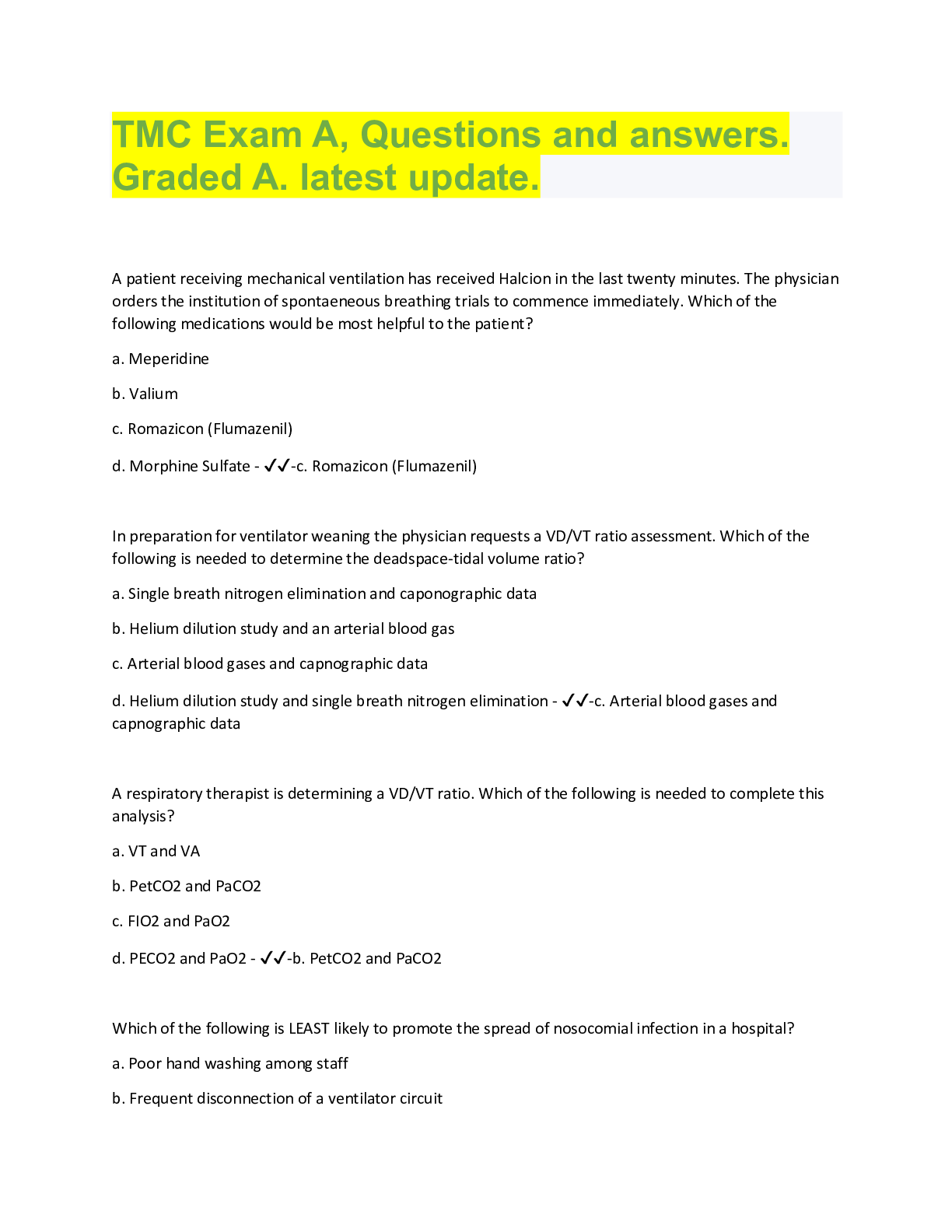
2022 TMC Practice EXAM A (questions with 100% verified correct answers)A 48 year-old female is admitted to the ED with diaphoresis, jugular venous distension,
and 3+ pitting edema in the ankles. These findings are consi
...
2022 TMC Practice EXAM A (questions with 100% verified correct answers)A 48 year-old female is admitted to the ED with diaphoresis, jugular venous distension,
and 3+ pitting edema in the ankles. These findings are consistent with - >>>>heart
failure
A patient is admitted to the ED following a motor vehicle accident. On physical exam,
the respiratory therapist discovers that breath sounds are absent in the left chest with a
hyperresonant percussion note. The trachea is shifted to the right. The patient's heart
rate is 45/min, respiratory rate is 30/min, and blood pressure is 60/40 mm Hg. What
action should the therapist recommend first? - >>>>Needle aspirate the 2nd left
intercostal space
All of the following strategies are likely to decrease the likelihood of damage to the
tracheal mucosa EXCEPT - >>>>using a low residual volume, low compliance cuff
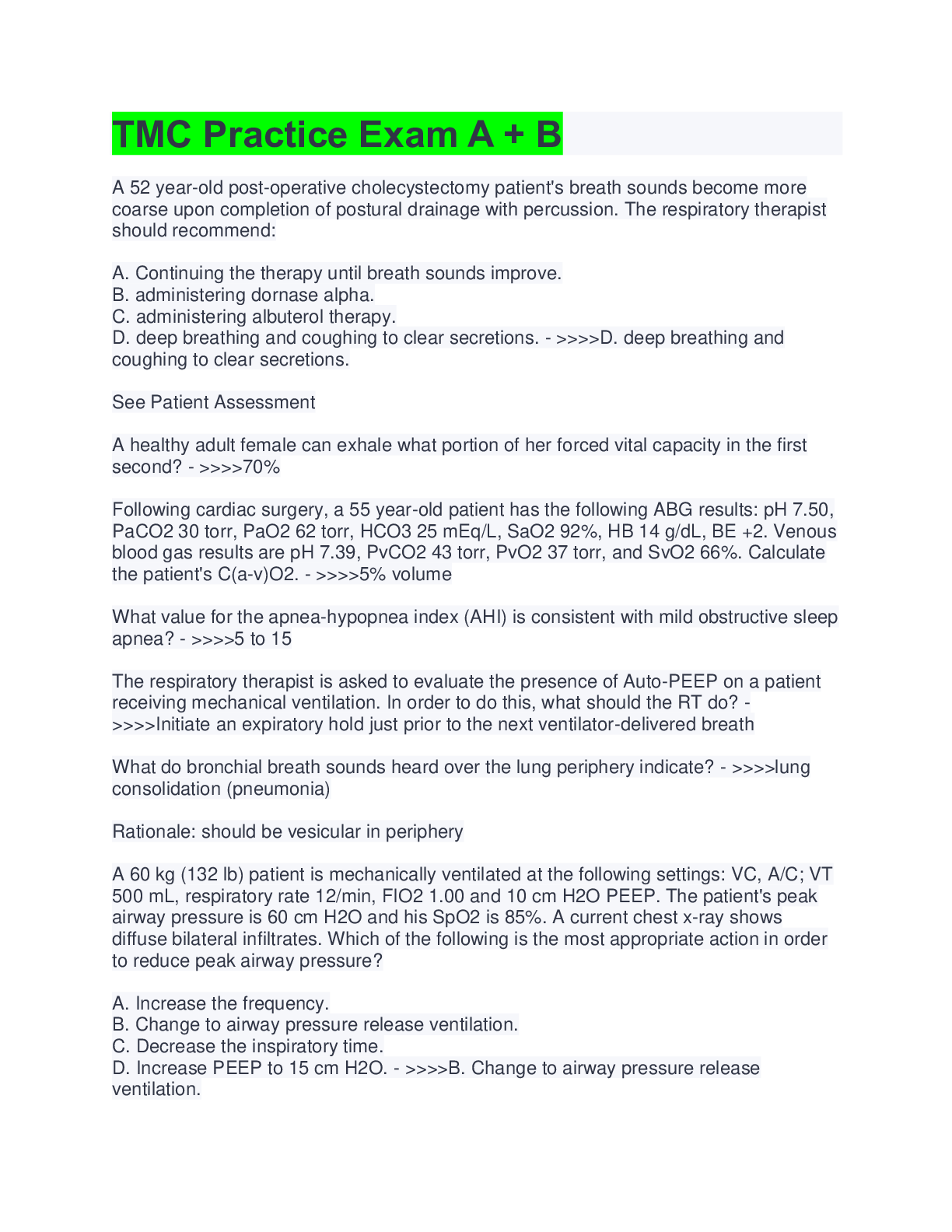
A 52 year-old post-operative cholecystectomy patient's breath sounds become more
coarse upon completion of postural drainage with percussion. The respiratory therapist
should recommend - >>>>deep breathing & coughing to clear secretions
A 65 kg spinal cord injured patient develops atelectasis. His inspiratory capacity is 30%
of his predicted value. What bronchial hygiene therapy would be most appropriate
initially? - >>>>IPPB
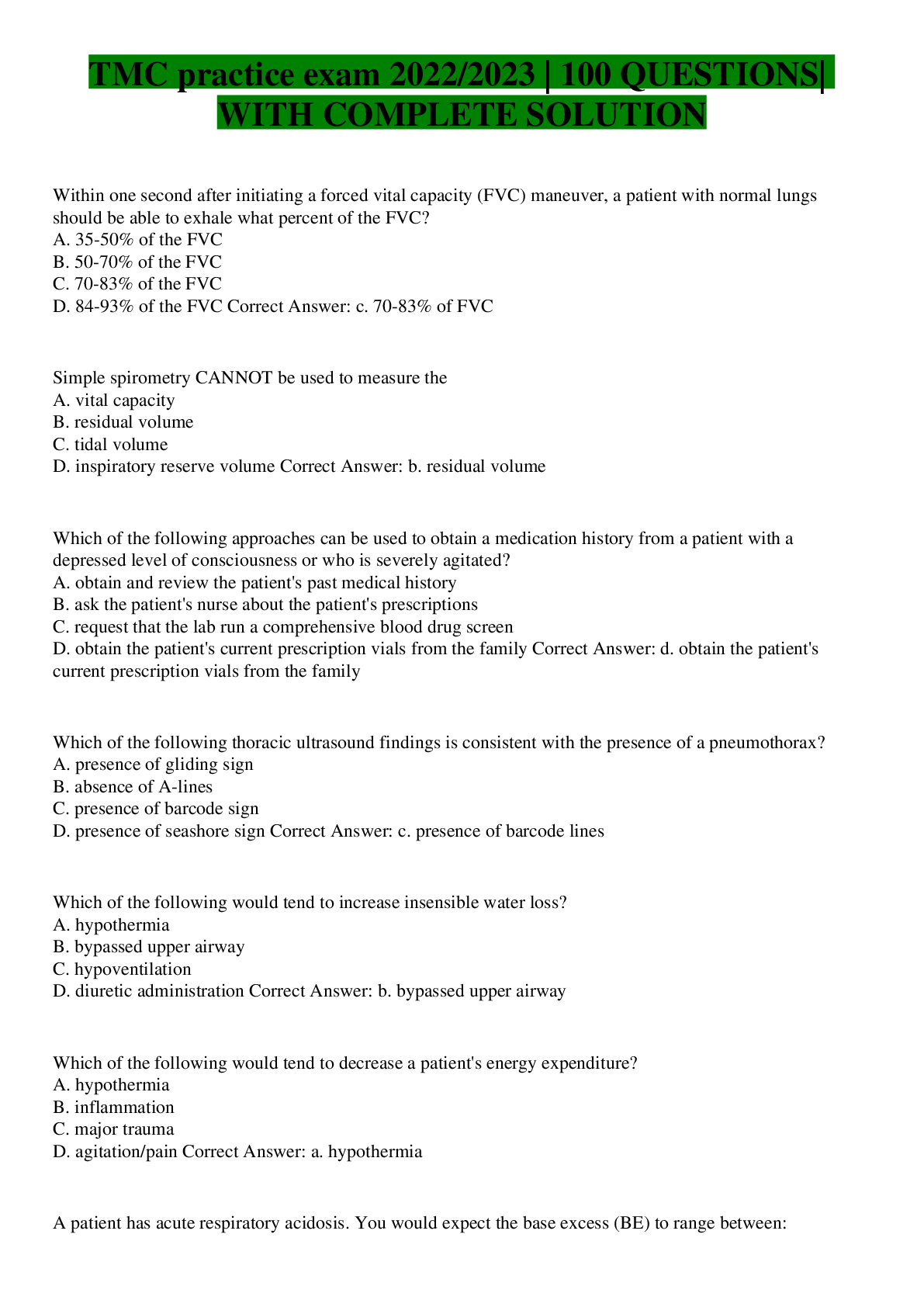
A healthy adult female can exhale what portion of her forced vital capacity in the first
second? - >>>>70%
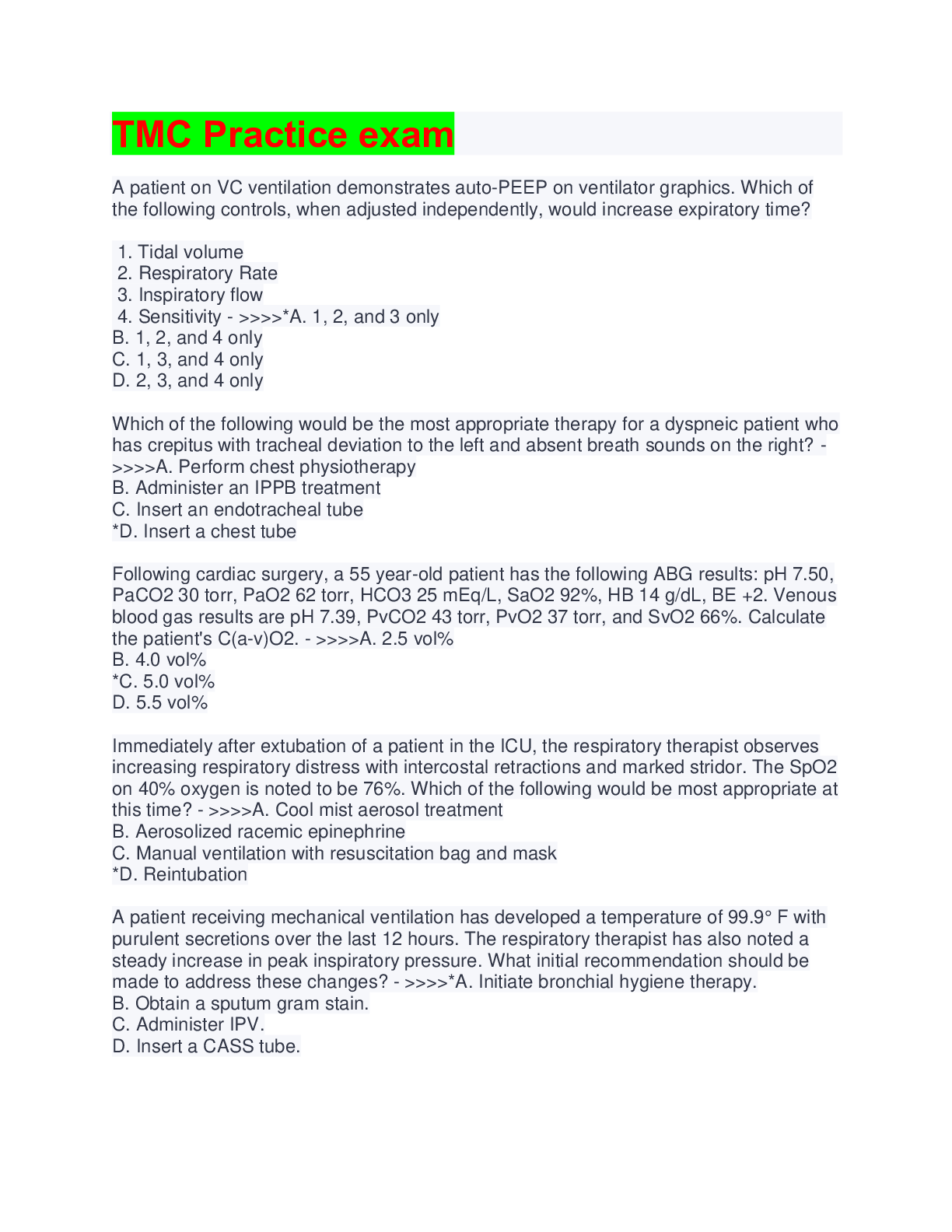
A patient on VC ventilation demonstrates auto-PEEP on ventilator graphics. Which of
the following controls, when adjusted independently, would increase expiratory time?
1. Tidal volume
2. respiratory rate
3. inspiratory flow
4. sensitivity - >>>>1, 2, and 3 only
Which of the following would be the most appropriate therapy for a dyspneic patient who
has crepitus with tracheal deviation to the left and absent breath sounds on the right? -
>>>>insert a chest tube
Following cardiac surgery, a 55 year-old patient has the following ABG results: pH 7.50,
PaCO2 30 torr, PaO2 62 torr, HCO3 25 mEq/L, SaO2 92%, HB 14 g/dL, BE +2. Venous
blood gas results are pH 7.39, PvCO2 43 torr, PvO2 37 torr, and SvO2 66%. Calculate
the patient's C(a-v)O2. - >>>>5.0 vol %
[Show More]






.png)
.png)
.png)
.png)

