Chapter 54--Renal Dysfunction: Nursing Management
MULTIPLE CHOICE
1. The nurse, caring for a client diagnosed with pyelonephritis, realizes that common risk factors for the
development of this disorder include all of
...
Chapter 54--Renal Dysfunction: Nursing Management
MULTIPLE CHOICE
1. The nurse, caring for a client diagnosed with pyelonephritis, realizes that common risk factors for the
development of this disorder include all of the following EXCEPT:
1. urinary retention.
2. urinary calculi.
3. prostate gland hypertrophy.
4. orthostatic hypotension.
PTS: 1 DIF: Analyze REF: Pyelonephritis: Etiology
2. A client is diagnosed with autosomal dominant polycystic kidney disease. During data collection,
which assessment finding would the nurse expect to discover?
1. Decreasing abdominal girth and proteinuria
2. Urinary tract infection and hypotension
3. Pain and hematuria
4. Irregularly shaped kidney and glucosuria
ANS: 3
PTS: 1 DIF: Apply
REF: Polycystic Kidney Disease: Assessment with Clinical Manifestations
3. A client is being prescribed medication to treat polycystic kidney disease. Which of the following
medications would be indicated for this client?
1. Cephalosporin
2. Antifungal
3. Antihypertensive
4. Antiarrhythmic
PTS: 1 DIF: Apply
REF: Box 54-1 Antibiotic Therapy for Infected Cysts in Patients with Polycystic Kidney Disease
4. A client is diagnosed with resistant polycystic kidney disease. The medications which may be
indicated for this client would be:
1. penicillin and aminoglycosides.
2. clindamycin and gentamicin.
3. metolazone and amiloride.
4. pyridium and urogesic.
PTS: 1 DIF: Analyze
REF: Box 54-1 Antibiotic Therapy for Infected Cysts in Patients with Polycystic Kidney Disease
5. A client is diagnosed with rhabdomyolysis. The nurse realizes that an emergency condition that may
occur with this diagnosis would be:
1. shortness of breath.
2. joint aches.
3. pulmonary hemorrhage.
4. compartment syndrome.
PTS: 1 DIF: Analyze REF: Rhabdomyolysis: Etiology; Pathophysiology
6. During the admitting assessment process, a client asks, “What is oliguria?” Based on the nurse’s
knowledge, the best response would be:
1. “Oliguria is a urine output less than 50 mL in 24 hours.”
2. “Oliguria is a urine output less than 250 mL in 24 hours.”
3. “Oliguria is a urine output less than 400 mL in 24 hours.”
4. “Oliguria is a decreased urine output indicative of disease.”
PTS: 1 DIF: Apply REF: Acute Renal Failure: Pathophysiology
7. A client is diagnosed with acute renal failure. Which of the following diagnostic studies will the nurse
be most concerned with?
1. Blood glucose and HbA1c
2. Toxicology screening and chloride level
3. Potassium and digitalis levels
4. Chest x-ray study and magnesium level
PTS: 1 DIF: Analyze
REF: Table 54-2 Alterations in ARF/AKI and the Mechanisms of the Alterations
8. A client has been prescribed a restricted potassium diet. An appropriate snack for the client would be:
1. banana.
2. applesauce.
3. orange juice.
4. dried dates.
PTS: 1 DIF: Apply
REF: Acute Renal Failure/Acute Kidney Injury: Nutrition
9. A client diagnosed with chronic renal failure is prescribed a diet low in protein. The rationale for this
diet is that:
1. protein sources are broken down and converted to urea, which is then filtered by the
kidney.
2. protein sources are of low biological value.
3. protein increases calcium and sodium levels.
4. deficit protein metabolism breaks down muscle tissue.
PTS: 1 DIF: Analyze REF: Chronic Renal Failure: Nutrition
10. A client diagnosed with chronic renal failure asks the nurse, “What’s the difference between
hemodialysis and peritoneal dialysis?” Which of the following statements best explains the difference?
1. “Hemodialysis is done three times a week and lasts 3 to 4 hours; peritoneal dialysis is done
daily.”
2. “Hemodialysis uses a graft or fistula and pumps blood through a semipermeable membrane
in a hemodialyzer as the filter. Peritoneal dialysis uses the peritoneal lining of the
abdominal cavity as the filter.”
3. “Hemodialysis and peritoneal dialysis use different equipment.”
4. “There are different dietary requirements for hemodialysis and peritoneal dialysis.”
PTS: 1 DIF: Apply
REF: Chronic Renal Failure: Hemodialysis; Peritoneal Dialysis and Chronic Ambulatory Peritoneal
Dialysis
11. The nurse would expect that a client recovering from a kidney transplant would be prescribed all the
following medications EXCEPT:
1. prednisone.
2. cyclosporine.
3. azathioprine.
4. vancomycin.
PTS: 1 DIF: Analyze REF: Chronic Renal Failure: Renal Transplantation
12. A client diagnosed with acute renal failure from an intrarenal cause should be instructed to:
1. expect blood in the urine.
2. avoid using NSAIDs.
3. increase fluids.
4. maintain a normal activity schedule.
PTS: 1 DIF: Apply REF: Table 54-1 Etiology of ARF/AKI
13. A client diagnosed with acute renal failure has a magnesium level of 1.0 mg/dL Which of the
following will the nurse most likely assess in this client?
1. Broad, flat T-waves
2. ST depression
3. Prolonged QT
4. No clinical signs
PTS: 1 DIF: Apply
REF: Table 54-2 Alterations in ARF/AKI and the Mechanisms of the Alterations
14. After the nurse provides a client diagnosed with acute renal failure with Kayexalate 30 grams by
mouth, the client begins to experience frequent loose bowel movements. Which of the following does
this client’s response indicate to the nurse?
1. The client needs to be treated with insulin and dextrose.
2. The client needs to receive sodium bicarbonate.
3. The client needs an additional dose of Kayexalate.
4. The client is experiencing a response that is indicative of successful treatment.
PTS: 1 DIF: Analyze REF: Box 54-3 Management of Hyperkalemia
MULTIPLE RESPONSE
1. The nurse is assessing circulation through a client’s arteriovenous shunt. Which of the following are
signs of a patent site? (Select all that apply.)
1. Normal blood pressure
2. Positive bruit
3. Pulse present distal to the site
4. Dry dressing
5. Palpable thrill
6. Good skin turgor
PTS: 1 DIF: Analyze
REF: Box 54-7 Management of Vascular Access Devices in Dialysis
2. For a client to be diagnosed with Anti-Glomerular Basement Membrane disease, the nurse realizes that
which of the following characteristics must be present? (Select all that apply.)
1. Anti–glomerular basement membrane (GBM) antibodies
2. Sinus infection
3. Pulmonary hemorrhage
4. Proliferative glomerulonephritis
5. Increased heart rate
6. Rapidly dropping blood pressure
PTS: 1 DIF: Analyze REF: Anti-GBM Disease (Goodpasture's Syndrome)
3. During discharge teaching with a client diagnosed with autosomal dominant polycystic kidney disease,
the nurse should stress which of the following points? (Select all that apply.)
1. Take more tub baths.
2. Void frequently.
3. Practice good perineal hygiene.
4. Void after intercourse.
5. Take showers.
6. Limit fluids.
PTS: 1 DIF: Apply
REF: Polycystic Kidney Disease: Patient and Family Teaching
4. The nurse is caring for a client diagnosed with pyelonephritis. Which of the following are appropriate
interventions that the nurse should perform? (Select all that apply.)
1. Ensure adequate hydration.
2. Monitor vital signs and fluid balance.
3. Insert a urinary catheter.
4. Provide urinary antiseptics.
5. Monitor electrolytes and creatinine level.
6. Monitor hemoglobin level.
PTS: 1 DIF: Apply
REF: Pyelonephritis: Collaborative Management Including Nursing Intervention Classifications
(NIC)
5. The nurse is caring for a client diagnosed with chronic renal failure. Which of the following would be
considered expected manifestations of this disorder? (Select all that apply.)
1. Left ventricular dysfunction
2. Anemia
3. Diarrhea
4. Constipation
5. Prickly burning sensation of the extremities
6. Restless legs
PTS: 1 DIF: Analyze
REF: Table 54-5 Clinical Manifestations of Chronic Kidney Failure
6. A client is diagnosed with Wegener’s granulomatosis. Which of the following will the nurse most
likely assess in this client? (Select all that apply.)
1. Shortness of breath and cough
2. Tinnitus
3. Abdominal pain
4. Conjunctivitis
5. Muscle aches
6. Vomiting
PTS: 1 DIF: Apply
REF: Skills 360: Assessment of Wegener's Granulomatosis
[Show More]


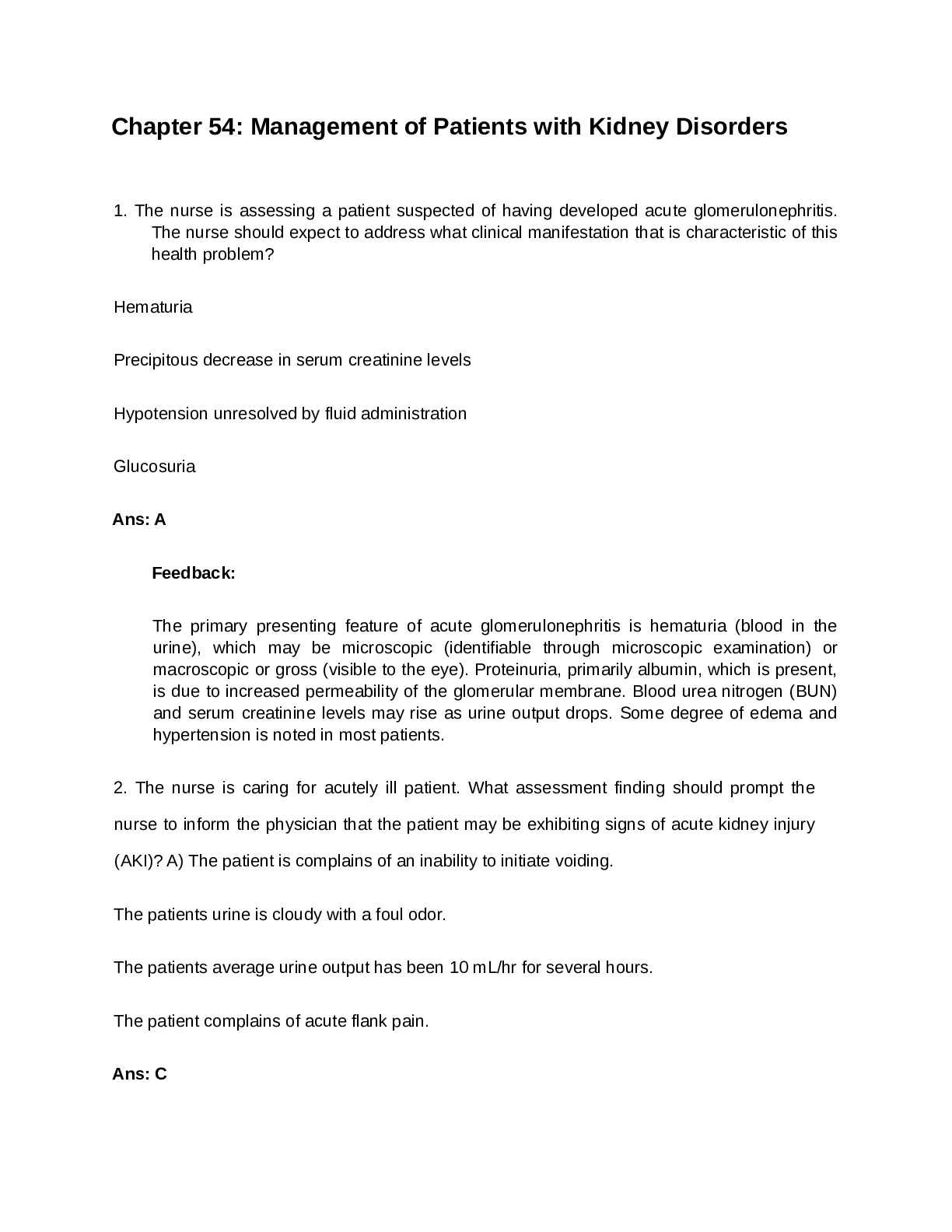
 Med Surg test Latest Verified Questions and all Correct Answers with Explanations Chapter 54 Management of Patients with Kidney Disorders.png)
 Med Surg test Latest Verified Questions and all Correct Answers with Explanations Chapter 54 Management of Patients with Kidney Disorders.png)

.png)