Lewis 11 Nursing Questions And Answers
2022
The nurse assesses a patient's surgical wound on the first postoperative day and
notes redness and warmth around the incision. Which action by the nurse is
appropriate?
...
Lewis 11 Nursing Questions And Answers
2022
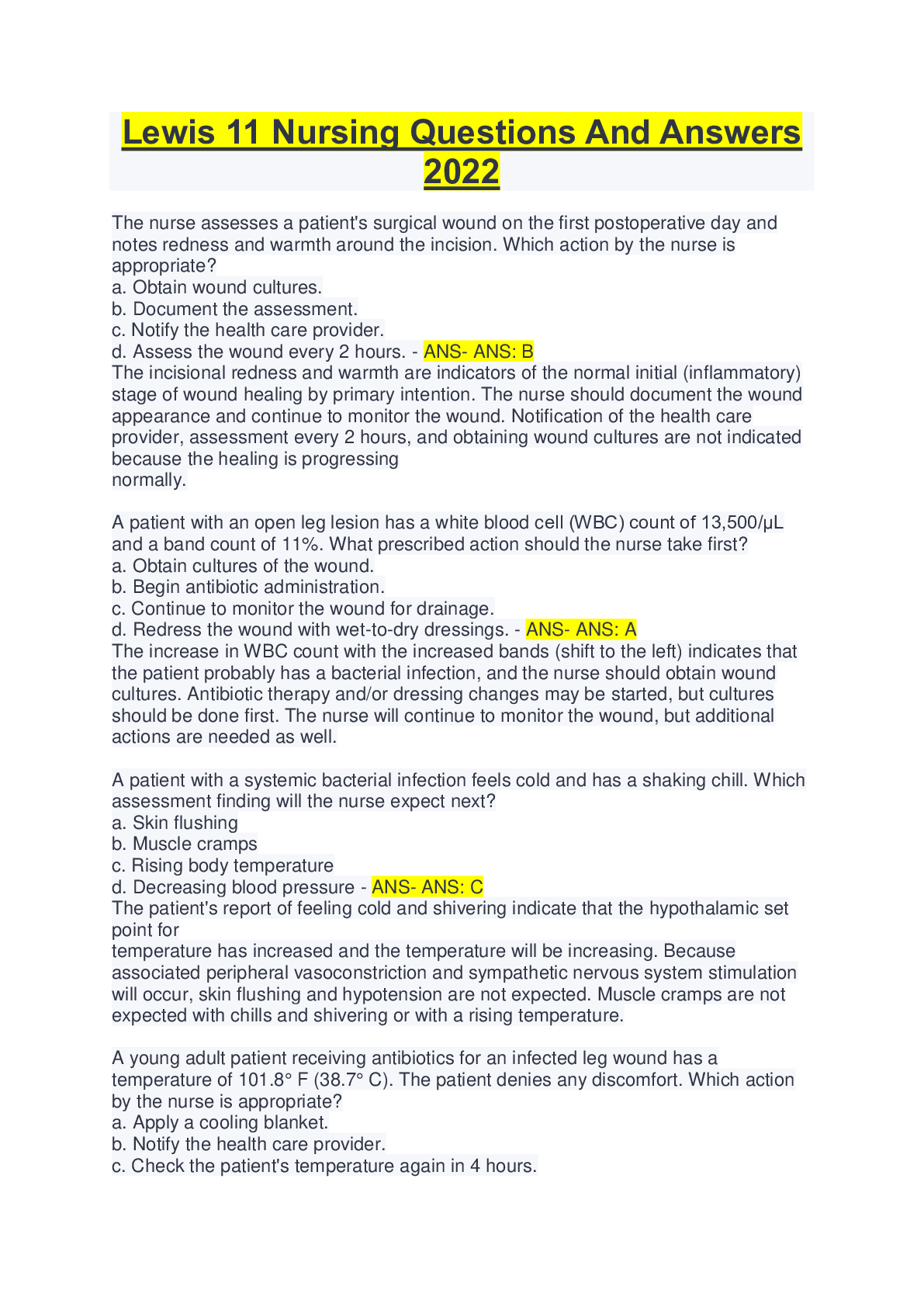
The nurse assesses a patient's surgical wound on the first postoperative day and
notes redness and warmth around the incision. Which action by the nurse is
appropriate?
a. Obtain wound cultures.
b. Document the assessment.
c. Notify the health care provider.
d. Assess the wound every 2 hours. - ANS- ANS: B
The incisional redness and warmth are indicators of the normal initial (inflammatory)
stage of wound healing by primary intention. The nurse should document the wound
appearance and continue to monitor the wound. Notification of the health care
provider, assessment every 2 hours, and obtaining wound cultures are not indicated
because the healing is progressing
normally.
A patient with an open leg lesion has a white blood cell (WBC) count of 13,500/μL
and a band count of 11%. What prescribed action should the nurse take first?
a. Obtain cultures of the wound.
b. Begin antibiotic administration.
c. Continue to monitor the wound for drainage.
d. Redress the wound with wet-to-dry dressings. - ANS- ANS: A
The increase in WBC count with the increased bands (shift to the left) indicates that
the patient probably has a bacterial infection, and the nurse should obtain wound
cultures. Antibiotic therapy and/or dressing changes may be started, but cultures
should be done first. The nurse will continue to monitor the wound, but additional
actions are needed as well.
A patient with a systemic bacterial infection feels cold and has a shaking chill. Which
assessment finding will the nurse expect next?
a. Skin flushing
b. Muscle cramps
c. Rising body temperature
d. Decreasing blood pressure - ANS- ANS: C
The patient's report of feeling cold and shivering indicate that the hypothalamic set
point for
temperature has increased and the temperature will be increasing. Because
associated peripheral vasoconstriction and sympathetic nervous system stimulation
will occur, skin flushing and hypotension are not expected. Muscle cramps are not
expected with chills and shivering or with a rising temperature.
A young adult patient receiving antibiotics for an infected leg wound has a
temperature of 101.8° F (38.7° C). The patient denies any discomfort. Which action
by the nurse is appropriate?
a. Apply a cooling blanket.
b. Notify the health care provider.
c. Check the patient's temperature again in 4 hours.
d. Give acetaminophen prescribed as-needed for pain - ANS- ANS: C
Mild to moderate temperature elevations (less than 103° F) do not harm young adult
patients and may benefit host defense mechanisms. Continue to monitor the
temperature. Antipyretics are not indicated unless the patient has fever-related
symptoms, and the patient does not require analgesics if not reporting discomfort.
There is no need to notify the patient's health
care provider of a fever in a patient who is already being treated for the infection or
to use a cooling blanket for a moderate temperature elevation.
DIF: Cognitive Level: Apply
A patient's 4 3-cm leg wound has a 0.4-cm black area in the center of the wound
surrounded
by yellow-green semiliquid material. Which dressing should the nurse apply to the
wound?
a. Dry gauze dressing
b. Nonadherent dressing
c. Hydrocolloid dressing
d. Transparent film dressing - ANS- ANS: C
The wound requires debridement of the necrotic areas and absorption of the yellow�green
slough. A hydrocolloid dressing, such as DuoDerm, would accomplish these goals.
Transparent film dressings are used for clean wounds or approximated surgical
incisions. Dry
dressings will not debride the necrotic areas. Nonadherent dressings will not absorb
wound
drainage or debride the wound.
The nurse notes that a patient's open abdominal wound widens as it extends deeper
into the abdomen. How would the nurse document this characteristic?
a. Eschar
b. Slough
c. Maceration
d. Undermining - ANS- ANS: D
Undermining is evident when a cotton-tipped applicator is placed in the wound and
there is a
narrower "lip" around the wound, which widens as the wound deepens. Eschar is a
crusted cover over a wound. Slough and maceration refer to loosening friable tissue.
A patient with rheumatoid arthritis has been taking oral corticosteroids for 2 years.
Which nursing action is most likely to detect early signs of infection in this patient?
a. Monitor white blood cell counts.
b. Check the skin for areas of redness.
c. Measure the temperature every 2 hours.
d. Ask about feelings of fatigue or malaise. - ANS- ANS: D
The earliest manifestation of an infection may be "just not feeling well." Common
clinical
manifestations of inflammation and infection are frequently not present when patients
receive
immunosuppressive medications.
The nurse should plan to use a wet-to-dry dressing for which patient?
a. A patient who has a pressure injury with pink granulation tissue.
b. A patient who has a surgical incision with pink, approximated edges.
c. A patient who has a full-thickness burn filled with dry, black material.
d. A patient who has a wound with purulent drainage and dry brown areas. - ANS�ANS: D
Wet-to-dry dressings are used when there is minimal eschar to be removed. A full�thickness wound filled with eschar will require interventions such as surgical
debridement to remove the necrotic tissue. Wet-to-dry dressings are not needed on
approximated surgical incisions. Wet-to-dry dressings are not used on uninfected
granulating wounds because of the damage to the granulation tissue.
A patient from a long-term care facility is admitted to the hospital with a sacral
pressure injury. The base of the wound involves subcutaneous tissue. How should
the nurse classify this pressure injury?
a. Stage 1
b. Stage 2
c. Stage 3
d. Stage 4 - ANS- ANS: C
A stage 3 pressure injury has full-thickness skin damage and extends into the
subcutaneous
tissue. A stage 1 pressure injury has intact skin with some observable damage such
as redness
or a boggy feel. Stage 2 pressure injuries have partial-thickness skin loss. Stage 4
pressure
injuries have full-thickness damage with tissue necrosis, extensive damage, or
damage to
bone, muscle, or supporting tissues.
A young male patient with paraplegia who has a stage 2 sacral pressure injury is
being cared for at home by his family. To prevent further tissue damage, what
instructions are most important for the nurse to teach the patient and family?
a. Change the patient's bedding frequently.
b. Apply a hydrocolloid dressing over the injury.
c. Change the patient's position every 1 to 2 hours.
d. Record the size and appearance of the injury weekly. - ANS- ANS: C
The most important intervention is to avoid prolonged pressure on bony prominences
by frequent repositioning. The other interventions may also be included in family
teaching.
The nurse will perform which action for a wet-to-dry dressing change on a patient's
stage 3 sacral pressure injury?
a. Pour sterile saline onto the new dry dressings after packing the wound.
b. Administer a prescribed PRN oral analgesic 30 minutes before the change.
c. Apply antimicrobial ointment before repacking the wound with moist dressings.
d. Soak the old dressings with sterile saline 30 minutes before the dressing change. -
ANS- ANS: B
Mechanical debridement with wet-to-dry dressings is painful, and patients should
receive pain
medications before the dressing change begins. The new dressings are moistened
with saline
before being applied to the wound but not soaked after packing. Soaking the old
dressings
before removing them will eliminate the wound debridement that is the purpose of
this type of
dressing. Application of antimicrobial ointments is not indicated for a wet-to-dry
dressing.
CONTINUES...
[Show More]