HESI NCLEX Review Exam 2022
Maslow's Hierarchy of Needs - - Physiologic
• Safety
• Love and Belonging
• Esteem
• Self-actualization
Nursing Process - - Assessment
• Diagnosis (Analysis)
• Planning
• Implementat
...
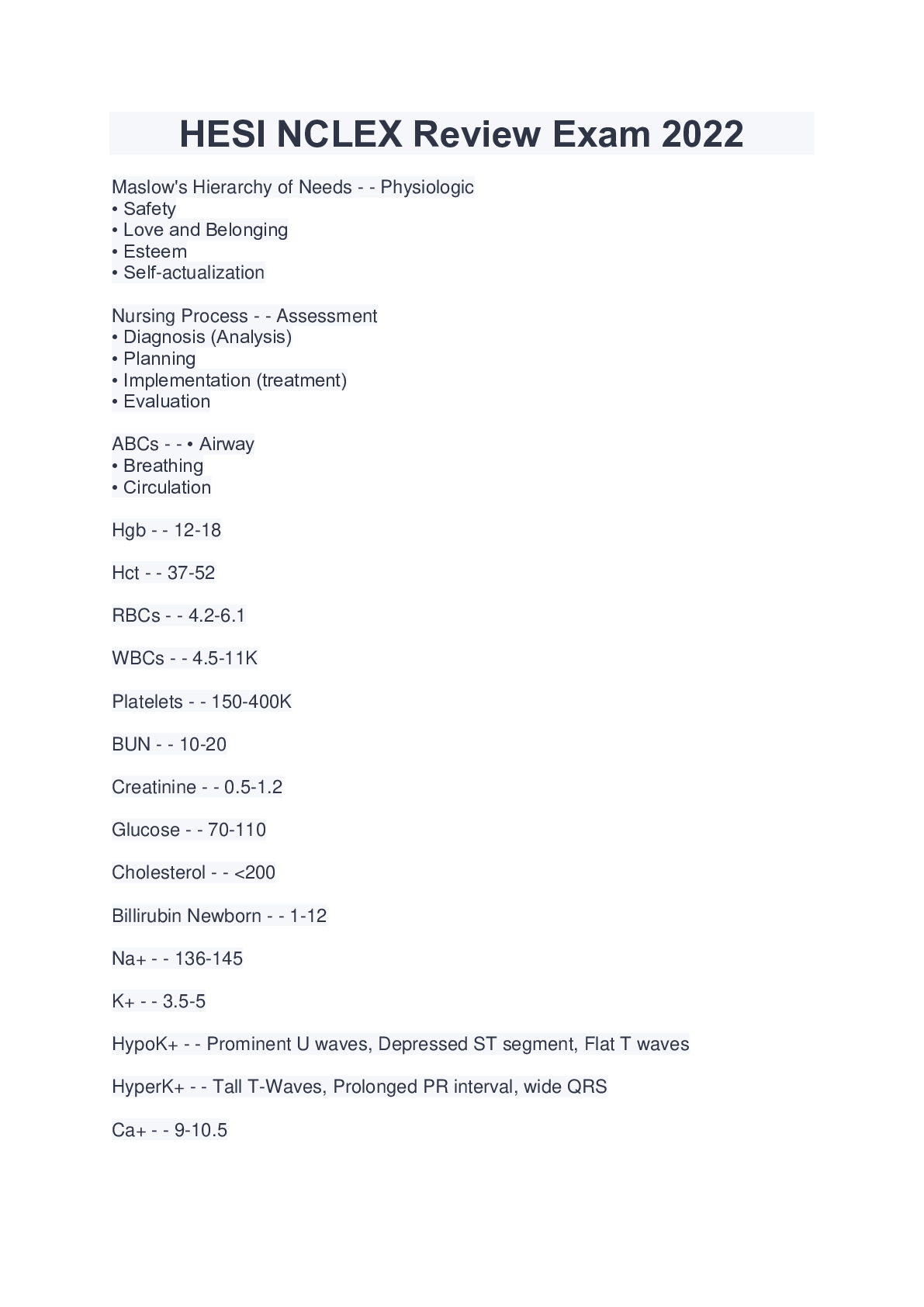
HESI NCLEX Review Exam 2022
Maslow's Hierarchy of Needs - - Physiologic
• Safety
• Love and Belonging
• Esteem
• Self-actualization
Nursing Process - - Assessment
• Diagnosis (Analysis)
• Planning
• Implementation (treatment)
• Evaluation
ABCs - - • Airway
• Breathing
• Circulation
Hgb - - 12-18
Hct - - 37-52
RBCs - - 4.2-6.1
WBCs - - 4.5-11K
Platelets - - 150-400K
BUN - - 10-20
Creatinine - - 0.5-1.2
Glucose - - 70-110
Cholesterol - - <200
Billirubin Newborn - - 1-12
Na+ - - 136-145
K+ - - 3.5-5
HypoK+ - - Prominent U waves, Depressed ST segment, Flat T waves
HyperK+ - - Tall T-Waves, Prolonged PR interval, wide QRS
Ca+ - - 9-10.5
Hypocalcemia - - muscle spasms, convulsions, cramps/tetany, + Trousseau's, +
Chvostek's, prolonged ST interval, prolonged QT segment
Mg+ - - 1.5-2.5
Cl- - - 96-106
Phos - - 3-4.5
Albumin - - 3.5-5
Spec Gravity - - 1.005-1.030
Hgb A1c - - 4-6% ideal, < 7.5% = OK (120 days)
Lithium - - 0.5-1.5
pH - - 7.35-7.45
CO2 - - 35-45 (Respiratory driver) ... High = Acidosis
HCO3 - - 21-28 (Metabolic driver) ... High = Alkalosis
Antidote Digoxin - - Digiband
Antidote Coumadin - - Vitamin K
Antidote Benzo - - Flumzaemil
AntidoteMag Sulfate - - Calcium gluconate
Antidote Heparin - - Protamine Sulfate
Antidote Tylenol - - Mucomist
Antidote Opiates - - Narcan
Antidote cholinergic meds - - Atropine
Rifampin (for TB) - - Rust/orange/red urine and body fluids
Pyridium (for bladder infection) - - Orange/red/pink urine
Glasgow Coma Scale - - <8 = coma
Diabetic Coma vs. Insulin Shock - - Give glucose first - If no help, give insulin
Fruity Breath - - Diabetic Ketoacidosis
Acidosis - - If it comes out of your ass
Alkalosis - - Vomiting
Lipitor (statins) - - No grapefruit juice
Hold Digoxin - - HR <60
ACE Inhibitor dose - - Stay in bed for 3 hours
Pulmonary air embolism prevention - - Trendelenburg (HOB down) + on left side (to
trap air in right side of heart)
Head Trauma and Seizures - - Maintain airway = primary concern
Peptic Ulcers - - Feed a Duodenal Ulcer (pain relieved by food) ... Starve a gastric
ulcer
Acute Pancreatitis - - Fetal position, Bluish discoloration of flanks (Turner's Sign),
Bluish discoloration of pericumbelical region (Cullen's Sign), Board like abdomen
with guarding ... Self digestion of pancreas by trypsin
Hold tube feeding if - - residual > 100mL
Gullain-Barre Syndrome - - Weakness progresses from legs upward - Resp arrest
Trough draw - - ~30 min before scheduled administration
Peak Draw - - 30-60 min after drug administration.
Most suicides occur - - after beginning of improvement with increase in energy levels
MAOIs - - Hypertensive Crisis with Tyramine foods
Nardil, Marplan, Parnate
Need 2 wk gap from SSRIs and TCAs to admin MAOIs
Phenothiazines - - (typical antipsychotics) - EPS, Photosensitivity
Atypical Antipsychotics - - work on positive and negative symptoms, less EPS
Benzos (Ativan, Lorazepam, etc) - - good for Alcohol withdrawal and Status
Epilepticus
Alcohol Withdrawal - - Delerium Tremens - Tachycardia, tachypnea, anxiety, nausea,
shakes, hallucinations, paranoia ... (DTs start 12-36 hrs after last drink)
Opiate (Heroin, Morphine, etc.) Withdrawal - - Watery eyes, runny nose, dilated
pupils, NVD, cramps
Stimulants Withdrawal - - Depression, fatigue, anxiety, disturbed sleep
Hypoventilation - - Acidosis (too much CO2)
Hyperventilation - - Alkalosis (low CO2)
No BP or IV on side of Mastectomy - - No BP or IV on side of Mastectomy
Pinpoint Pupils - - Opiate OD
Lesions of Midbrain - - Decerebrate Posturing (Extended elbows, head arched back)
Lesions of Cortex - - Decorticate Posturing (Flexion of elbows, wrists, fingers,
straight legs, mummy position)
Urine Output of 30 mL/hr - - minimal competency of heart and kidney function
Renal Failure - - Restrict protein intake
Usually 3 phases (Oligouric, Diuretic, Recovery)
Monitor Body Wt and I&Os
Fluid and electrolyte problems - - Watch for HyperK+ (dizzy, wk, nausea, cramps,
arhythmias)
Pre-renal Problem - - Interference with renal perfusion
Intra-renal Problem - - Damage to renal parenchyma
Post-renal Problem - - Obstruction in UT anywhere from tubules to urethral meatus.
Steroid Effects - - Moon face, hyperglycemia, acne, hirsutism, buffalo hump, mood
swings, weight gain - Spindle shape, osteoporosis, adrenal suppression (delayed
growth in kids) . . . (Cushing's Syndrome symptoms)
Addison's' Crisis - - medical emergency (vascular collapse, hypoglycemia,
tachycardia ... Admin IV glucose + corticosteroids) ... No PO corticosteroids on
empty stomach
Potassium sparing diuretic - - Aldactone (Spironolactone) ... Watch for hyperK+ with
this and ACE Inhibitors.
Cardiac Enzymes - - roponin (1 hr), CKMB (2-4 hr), Myoglobin (1-4 hr), LDH1 (12-24
hr)
MI Tx - - Nitro - Yes ... NO Digoxin, Betablockers, Atropine
Fibrinolytics - - Streptokinase, Tenecteplase (TNKase)
BPH Tx - - TURP (Transurethral Resection of Prostate) ... some blood for 4 days,
and burning for 7 days post-TURP.
Bladder Irrigation - - Only isotonic sterile saline
Post Thyroidectomy - - Keep tracheostomy set by the bed with O2, suction and
Calcium gluconate
Pericarditis - - Pericardial Friction Rub, Pain relieved by leaning forward
If a chest-tube becomes disconnected - - do not clamp ... Put end in sterile water
Chest Tube drainage system - - should show bubbling and water level fluctuations
(tidaling with breathing)
TB - - Treatment with multidrug regimen for 9 months ... Rifampin reduces
effectiveness of OCs and turns pee orange ... Isoniazide (INH) increases Dilantin
blood levels
Use bronchodilators before steroids for asthma - - Exhale completely, Inhale deeply,
Hold breath for 10 seconds
Suctioning - - Pre and Post oxygenate with 100% O2 ... No more than 3 passes ...
No longer than 15 seconds ... Suction on withdrawal with rotation
COPD: - - • Emphysema = Pink Puffer
• Chronic Bronchitis = Blue Bloater (Cyanosis, Rt sided heart failure =
bloating/edema)
O2 Administration - - • Never more than 6L/min by cannula
• Must humidify with more than 4L/hr
• No more than 2L/min with COPD ... (CO2 Narcosis)
• In ascending order of delivery potency: Nasal Cannula, Simple Face Mask,
Nonrebreather Mask, Partial Rebreather Mask, Venturi Mask
• Restlessness and Irritability = Early signs of cerebral hypoxia
IVs and Blood Product Administration - - Vitals and Breath Sounds ... before, during
and after infusion (15 min after start, then 30 min later, then hourly up to 1 hr after)
IVs and Blood Product Administration Check Blood - - Exp Date, clots, color, air
bubbles, leaks
Blood Product Administration
If transfusion rxn - - Stop and KVO with NS
o Pre-medicate with Benadryl prn for previous urticaria rxns
Isotonic Solutions - - • D5W
• NS (0.9% NaCl)
• Ringers Lactate
• NS only with blood products and Dilantin
Diabetes and Insulin
o When in doubt - - Treat for Hypoglycemia first
Hypoglycemia - - confusion, HA, irritable, nausea, sweating, tremors, hunger,
slurring
Hyperglycemia - - weakness, syncope, polydipsia, polyuria, blurred vision, fruity
breath
Draw Regular - - (Clear) insulin into syringe first when mixing insulins
Rapid Acting Insulins - - Lispro (Humalog) and Aspart (Novolog) ... O: 5-15 min, P:
.75-1.5 hrs
Short Acting Insulin - - Regular (human) ... O: 30-60 min, P: 2-3 hrs (IV Okay)
Intermediate Acting Insulin - - Isophane Insulin (NPH) ... O: 1-2 hrs, P: 6-12 hrs
Long Acting Insulin - - Insulin Glargine (Lantus) ... O: 1.1 hr, P: 14-20 hrs (Don't Mix)
Oral Hypoglycemics decrease glucose levels by - - stimulating insulin production by
beta cells of pancreas, increasing insulin sensitivity and decreasing hepatic glucose
production
• Glyburide, Metformin (Glucophage), Avandia, Actos
• Acarbose blunts sugar levels after meals
Syphilis (Treponema pallidum) - - Chancre + red painless lesion (Primary Stage, 90
days) ... Secondary Stage (up to 6 mo) = Rash on palms and soles + Flu-like
symptoms ... Tertiary Stage = Neurologic and Cardiac destruction (10-30 yrs) ...
Treated with Penicillin G IM.
Call Dr. post op if - - < 30 mL/hr urine, Sys BP < 90, T > 100 or < 96
Enema positioning - - Left Sims (flow into sigmoid)
Liver Biopsy positioning - - Right side with pillow/towel against puncture site
Cardiac Catheterization positioning - - Flat (HOB no more than 30 degrees), Leg
straight 4-6 hrs, bed rest 6-12 hrs
Amputation positioning - - Supine, elevate stump for 48 hrs
Post Op Breathing Exercises - - Every 2 hours
• Sit up straight
• Breath in deeply thru nose and out slowly thru pursed lips
• Hold last breath 3 seconds
• Then cough 3 times (unless abd wound - reinforce/splint if cough)
Watch for Stridor after any neck/throat Sx - - Watch for Stridor after any neck/throat
Sx
If chest tube comes disconnected - - put free end in container of sterile water
Removing Chest Tube - - Valsalvas, or Deep breath and hold
NG Tube Length - - End of nose, to era lobe, to xyphoid (~22-26 inches)
A-fib and A-flutter = - - thrombus formation
Left Hemisphere Lesion - - aphasia, agraphia, slow, cautious, anxious, memory okay
Right Hemisphere Lesion - - can't recognize faces, loss of depth perception,
impulsive behavior, confabulates, poor judgment, constantly smiles, denies illness,
loss of tonal hearing
Head Injuries - - Even subtle changes in mood, behavior, restlessness, irritability,
confusion may indicate increased ICP
• Change in level of responsiveness = Most important indicator of increased ICP
• Watch for CSF leaks from nose or ears - Leakage can lead to meningitis and mask
intracranial injury since usual increased ICP symps may be absent.
Spinal Cord Injuries - - • Respiratory status paramount ... C3-C5 innervates
diaphragm
• 1 wk to know ultimate prognosis
• Spinal Shock = Complete loss of all reflex, motor, sensory and autonomic activity
below the lesion = Medical emergency
• Permanent paralysis if spinal cord in compressed for 12-24 hrs
• Hypotension and Bradycardia with any injury above T6
• Bladder Infection = Common cause of death (try to keep urine acidic)
Burns - - • Infection = Primary concern
• HyperK+ due to cell damage and release of intracellular K+
• Give meds before dressing changes - Painful
• Massive volumes of IV fluid given, due to fluid shift to interstitial spaces and
resultant shock
Fractures - - Report abnormal assessment findings promptly ... Compartment
Syndrome may occur = Permanent damage to nerves and vessels
Pain, Pallor, Pulse, Paresthesia, Paralysis
ELISA and Western Blot - - HIV
Chvostek's Sign - - (Facial spasm after facial nerve tap) ... Hypocalcemia
(hypoparathyroidism)
Bloody Diarrhea = - - Ulcerative Colitis
= Pyloric Stenosis - - Olive-Shaped Mass (epigastric) and Projectile Vomiting
= Intussiception - - Current Jelly Stool (blood and mucus) and Sausage-Shaped
Mass in RUQ
Butterfly Rash = - - Systemic Lupus Erythemastosus
CONTINUES...
[Show More]