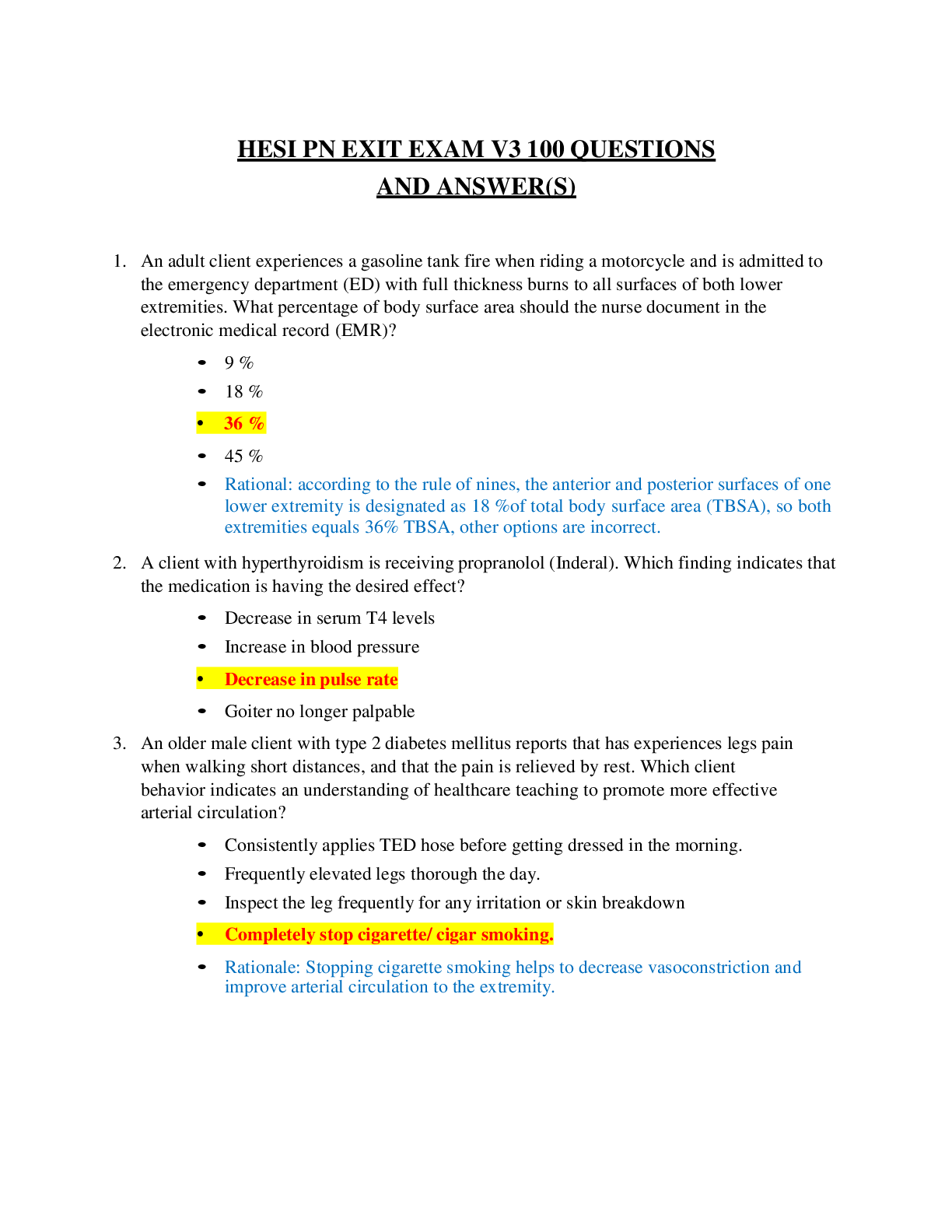
Peds HESI Version 2 Qustions And Answers 2022
"A mother tells the nurse that her child does not want anything to do with toilet
training and yells "NO!" consistently when she tries to toilet train. The child is 2 year
...
Peds HESI Version 2 Qustions And Answers 2022
"A mother tells the nurse that her child does not want anything to do with toilet
training and yells "NO!" consistently when she tries to toilet train. The child is 2 years
old. According to Erikson, the nurse interprets that the child is experiencing which
psychosocial crisis?"
a. autonomy vs shame and doubt
b. initiative vs guilt
c. industry vs inferiority
d. trust vs mistrust - ANS- Autonomy vs shame and doubt
A 2-year-old child is admitted to the hospital with juvenile rheumatoid arthritis (JRA).
During the focused assessment, the nurse makes it a priority to note the presence of
which of the following?"
a. increased irritability and the child's insistence to be carried out
b. complaints of joint stiffness
c. history of daily temperature elevations
d. description of how difficult it is to move around after periods of inactivity - ANS�increased irritability and the child's insistence to be carried out
A mother of a toddler who is hospitalized with mild dehydration must leave her child
to go to work. Which behavior would the nurse expect to observe in the toddler
immediately after the mother's departure?
a. silently curled in bed with a blanket
b. loudly crying and kicking both legs
c. playing quietly with a favorite toy
d. sucking thumb and rocking back and forth - ANS- loudly crying and kicking both
legs
"A newborn infant is diagnosed with hypospadias, and the mother asks the nurse
about the disorder. The nurse bases the response on which of the following?"
a. it is a congenital anomaly in which the actual opening of the urethra meatus is
below the normal placement on the glans penis
b. it occurs when one or both testes fail to descend through the inguinal canal into
the scrotal sac
c. it is a congenital anomaly in which the actual opening of the urethral meatus is
dorsal to the urethral opening
d. it is a congential anomaly characterized by the extrusion of the urinary bladder to
the outside of the body - ANS- it is a congenital anomaly in which the actual opening
of the urethra meatus is below the normal placement on the glans penis
A home care nurse is providing instructions to a child with cystic fibrosis about how
to perform the "huff" maneuver; the child asks the nurse about the purpose of this
type of breathing. The nurse makes which response to the child?
a. "this type of breathing is used to mobilize secretions so that they can be easily
coughed out"
b. "this type of breathing prolongs inspiration time"
c. "this type of breathing moves air out of the lower lungs"
d. "this type of breathing moves air through the lungs" - ANS- "this type of breathing
is used to mobilize secretions so that they can be easily coughed out"
A home care nurse is instructing the mother of a child with cystic fibrosis (CF) about
the appropriate dietary measures. The nurse tells the mother that the child needs to
consume a:
a. low calorie, low fat diet
b. high calorie, high protein diet
c. low calorie, low protein diet
d. high calorie, restricted fat - ANS- high calorie, high protein diet
Breathing exercises and postural drainage is prescribed for a child with cystic
fibrosis. A nurse implements these procedures by telling the child to:
a. perform the postural drainage, then the breathing exercises
b. perform the breathing exercises, then the postural drainage
c. schedule the procedures so they are 4 hours apart
d. perform postural drainage in the morning and breathing exercises in the evening -
ANS- perform the postural drainage, then the breathing exercises
A nurse is reviewing the results of a sweat test performed on a child with cystic
fibrosis (CF). The nurse would expect to note which finding?
a. a sweat sodium concentration less than 40 mEq/L
b. a sweat potassium concentration less than 40 mEq/L
c. a sweat potassium concentration greater than 40 mEq/L
d. a sweat sodium concentration greater than 60 mEq/L - ANS- a sweat sodium
concentration greater than 60 mEq/L
Methylphenidate (Ritalin) is prescribed for a child with a diagnosis of attention deficit
hyperactivity disorder (ADHD). The nurse provides instructions to the mother
regarding the administration of the medication and tells the mother to administer the
medication:
a. before dinner and at bedtime
b. before breakfast and before the noontime meal
c. in the morning after breakfast and at bedtime
d. at the noontime and evening meals - ANS- before breakfast and before the
noontime meal
"Methylphenidate hydrochloride (Ritalin) is prescribed for a 10-year-old child
diagnosed with attention deficit hyperactivity disorder, and the nurse provides
instructions to the mother about administration of the medication. The nurse
determines that the mother understands the instructions when the mother states:"
a. I will give my child the medication at bedtime so that he will be rested and alert for
school the next day
b. I will give my child the medication after meals to obtain the full effects of the
medication
c. I will give my child the medication at breakfast and lunch to prevent insomnia
d. I will give my child the medication with water to prevent kidney damage - ANS- I
will give my child the medication at breakfast and lunch to prevent insomnia
Methylphenidate (Ritalin) is prescribed for a child with attention deficit hyperactivity
disorder (ADHD). The nurse provides instructions to the mother regarding the
administration of the medication. Which statement by the mother would indicate a
need for further instructions?
a. I will administer the medication with the noontime meal
b. I will keep the medication tightly capped and away from direct heat
c. I should inform the school nurse that my child is taking this medication
d. I should avoid giving the medications on Saturdays and Sundays to provide a
medication holiday - ANS- I should avoid giving the medications on Saturdays and
Sundays to provide a medication holiday
A client with diplopia has been given an eye patch to promote better vision and
prevent injury. The nurse teaches the client to do which of the following as part of
correct use of this item?
a. wear the patch continuously, alternating eyes each day
b. wear the patch continuously, alternating eyes each week
c. use the patch only when vision is exceptionally blurry
d. put the patch on for an hour, and then take it off for an hour - ANS- wear the patch
continuously, alternating eyes each day
A student nurse examines an Asian American infant's eyes and notes that the
infant's eyes are crossed. The registered nurse asks the student to interpret the
finding. Which statement by the student indicates an understanding of this
assessment finding?
a. it probably isn't strabismus but appears that way because of the child;s ethnic
background
b. you will want to call the pediatrician immediately because this could lead to
detached retina
c. it probably is strabismus because the baby's mother has abused tranquilizers
d. strabismus isn't life threatening but it requires surgery in the first 2 months to
prevent the crossed eyes from being a life long condition - ANS- it probably isn't
strabismus but appears that way because of the child;s ethnic background
A nurse notes that a client's eyes are continuously moving back and forth within the
eye sockets. The nurse documents in the medical record that the client has:
a. ataxia
b. nystagmus
c. pronator drift
d. hyperreflexia - ANS- nystagmus
"A nurse is providing instructions to the mother of a child with a diagnosis of
strabismus of the left eye, and the nurse reviews the procedure for patching the
child. The nurse determines that the mother understands the procedure if the mother
makes which statement?"
a. I will place the patch on the right eye
b. I will place the patch on both eyes
c. I will place the patch on the left eye
d. I will alternate the patch from the right to the left eye every hour - ANS- I will place
the patch on the right eye
A nurse develops a plan of care for a one-month-old infant hospitalized for
intussusception. Which nursing measure would be most effective to provide
psychosocial support for the parent-child relationship?
a. encourage the parents to go home and get some sleep
b. encourage the parents to room-in with their infant
c. provide educational materials
d. initiate home nutritional support as early as possible - ANS- encourage the
parents to room-in with their infant
"A 12-year-old child is seen in the health care clinic. During the assessment, which
finding would suggest to the nurse that the child is experiencing a disruption in the
development of self-concept?"
a. the child has a part-time babysitting job
b. the child enjoys playing chess and mastering new skills with this game
c. the child has many friends
d. the child has an intimate relationship with a significant other - ANS- the child has
an intimate relationship with a significant other
A nurse is preparing to care for a child from a culture different from the nurse's. What
is the best way to address the cultural needs of the child and family when the child is
admitted to the health care facility?
a. ask questions and explain to the family why the questions are being asked
b. explain to the family that while the child is being treated, they need to discontinue
cultural practices because they may be harmful to the child
c. ignore cultural needs because they are not important to health care professionals
d. only address those issues that directly affect the nurse's care of the child - ANS�ask questions and explain to the family why the questions are being asked
"A 4-year-old child with cancer is admitted to the hospital for radiation therapy and
surgery. To assess adequacy of support for the child's psychosocial needs, the
nurse would ask the parents which question?"
a. what signs and symptoms has your child been having?
b. Will a family member be able to stay with the child most of the time?
c. How long have you known your child's diagnosis?
d. what are your child's favorite books, activities and toys? - ANS- Will a family
member be able to stay with the child most of the time?
A community health nurse is providing instructions to a group of mothers regarding
the safe use of car seats for toddlers. The nurse determines that the mother of a
toddler understands the instructions if the mother states which of the following?
a. The care seat can be placed in a face-forward position when the height of the
toddler is 27 inches
b. The car seat should never be placed in a face-forward position
c. the car seat can be placed in a face-forward position at any time
d. The car seat is suitable for the toddler until the toddler reaches the weight of 40
pounds - ANS- The car seat is suitable for the toddler until the toddler reaches the
weight of 40 pounds
"When administering a liquid medication to an uncooperative toddler, the nurse
would implement which strategy?"
a. allow the parents to remain the room
b. remove the child to another room away from the parents
c. restrain the child in a high chair
d. restrain the child in a papoose restraining device - ANS- allow the parents to
remain the room
A toddler is admitted to the hospital for fever of unknown origin. The mother's time at
the hospital is limited to the hours that her other children are in school. The nurse
shows an understanding of a toddler's psychosocial development by making which
statement to the mother?
a. it is better to leave without saying good-bye, so your child will not be upset
b. your child is too old to be having separation anxiety. Crying is just a way for
children to control parents
c. your child is egocentric, which allows a child to self comfort
d. games like peek-a-boo and hide and seek will help your child understand that you
will return - ANS- games like peek-a-boo and hide and seek will help your child
understand that you will return
A mother of a 3-year-old child calls a neighbor who is a nurse and tells the nurse that
her child just ate the mouse poison that was stored in a cabinet. The nurse would
instruct the mother to take what action immediately?
a. call the poison control center
b. give the child a glass of carbonated beverage to drink
c. take the child to the ER
d. try to determine how much mouse poison the child consumed - ANS- call the
poison control center
The community health nurse is providing a yearly summer educational session to
parents in a local community. The topic of the session is prevention and treatment
measures for poison ivy. The nurse instructs the parents that if the child comes in
contact with poison ivy they should:
a. immediately bring the child to the ER
b. not be concerned if a rash is not noted on the skin
c. shower the child immediately, lathering and rinsing the child several times
d. apply calamine lotion immediately to the exposed skin areas - ANS- shower the
child immediately, lathering and rinsing the child several times
A home care nurse visits a 3-year-old child with chickenpox. The child's mother tells
the nurse that the child keeps scratching the skin at night and asks the nurse what to
do. The nurse tells the mother to:
a. apply generous amounts of cortisone cream to prevent itching
b. place soft cotton gloves on the child's hands at night
c. keep the child in a warm room at night so the covers will not cause the child to
scratch
d. give the child a glass of warm milk at bedtime to help the child sleep - ANS- place
soft cotton gloves on the child's hands at night
A clinic nurse is providing home care instructions to the mother of a 3-year-old child
with a diagnosis of vomiting and diarrhea due to gastroenteritis. The nurse instructs
the mother to give the child which of the following to maintain hydration status?
a. popsicles
b. soda pop
c. apple juice
d. pedialyte - ANS- pedialyte (oral electrolyte solution)
A nurse is collecting data on a child suspected of having rheumatic fever. The nurse
plans to obtain specific data regarding recent illnesses in the child and asks the
parent which question?
a. has the child had a recent streptococcal infection of the throat?
b. has the child had a recent ear infection?
c. has the child had a recent case of otitis media?
d. has the child had a recent case of pneumonia - ANS- has the child had a recent
streptococcal infection of the throat?
A child is admitted to the hospital with a diagnosis of acute rheumatic fever. The
nurse analyzes the laboratory results and determines that which of the following
findings would confirm the likelihood of acute rheumatic fever?
a. increased leukocyte count
b. decreased hemoglobin count
c. increased antibody level
d. decreased erythrocyte sedimentation rate - ANS- increased antibody level
A child is admitted to the hospital with a diagnosis of acute rheumatic fever. The
nurse reviews the blood laboratory findings knowing that which of the following will
confirm the likelihood of this disorder?
a. increased leukocyte count
b. decreased hemoglobin count
c. increased antistreptolysin-O (ASO)
d. decreased erthrocyte sedimentation rate - ANS- increased antistreptolysin-O
(ASO)
A nurse is assessing a child admitted to the hospital with a diagnosis of rheumatic
fever. The nurse asks the child's mother which significant question during the
assessment?
a. has your child had difficulty urinating?
b. has any family member had a sore throat within the past few weeks?
c. has any family member had a gastrointestinal disorder in the past few weeks?
d. has your child been exposed to anyone with chickenpox? - ANS- has any family
member had a sore throat within the past few weeks?
An infant brought to the emergency room is unresponsive and in respiratory distress.
The nurse opens the infant's airway by which method?
a. hyperextension
b. jaw thrust
c. tongue-jaw lift
d. head tilt/ chin lift - ANS- tongue-jaw lift
"A child with a tracheal obstruction is brought to the emergency room by emergency
medical services. The child has aspirated a marble, and the foreign body is removed
in the emergency room by direct laryngoscopy. After the procedure, the nurse
informs the mother of the child that:"
a. the child will need to be hospitalized for observation
b. the child may go home with a prescription for antibiotics
c. the child will need to return to the hospital for a chest x-ray in 1 week
d. the child will require a bronchoscopy for follow up evaluation in 1 month - ANS�the child will need to be hospitalized for observation
A nurse is teaching the client taking medications by inhalation about the advantages
of a newly prescribed spacer device. The nurse determines the need for further
teaching if the client states that the spacer device:
a. reduces the frequency of medication to only once per day
b. reduces the chance of yeast infection because large drops arn't deposited on the
oral tissues
c. disperses medication more deeply and uniformly
d. reduces the need to coordinate timing between pressing the inhaler and
inspiration - ANS- reduces the frequency of medication to only once per day
A client is taking albuterol (Ventolin) by inhalation but cannot cough up secretions.
The nurse teaches the client to do which of the following to best help clear the
bronchial secretions?
a. administer an extra dose before bedtime
b. take in increased amounts of fluids every day
c. get more exercise each day
d. Use a dehumidifier in the home - ANS- take in increased amounts of fluids every
day
"A client taking albuterol (Ventolin) experiences a severe episode of wheezing, which
the nurse interprets as bronchospasm. A telephone call is made to the physician's
office to report the occurrence. The nurse does which of the following while waiting
for the physician to return the call?"
a. administer the next dose of albuterol as scheduled
b. withholds the next dose of albuterol
c. administer a double dose of albuterol
d. administers half the dose of albuterol - ANS- withholds the next dose of albuterol
"A client is unable to expectorate sputum for a sputum sample, and the nurse is
preparing to obtain the sample via saline inhalation. The nurse instructs the client to
inhale the warm saline vapor via nebulizer by:"
a. hold the nebulizer under the nose
b. keeping the lips closed lightly over the mouthpiece
c. keeping the lips closed tightly over the mouthpiece
d. alternating one vapor breath with one breath from room air - ANS- keeping the lips
closed lightly over the mouthpiece
A 5-year-old child is admitted to the hospital for heart surgery to repair the tetralogy
of Fallot. The nurse reviews the child's record and notes that the child has clubbed
fingers. The nurse understands that the clubbing is most likely caused by:
a. peripheral hypoxia
b. delayed physical growth
c. chronic hypertension
d. destruction of bone marrow - ANS- peripheral hypoxia
"A 10-month-old infant is hospitalized for respiratory syncytial virus (RSV). Using
knowledge of growth and development according to Erik Erikson and Jean Piaget,
the nurse should do which of the following to meet the infant's developmental
needs?"
a. wash hands, wear a mask and keep the infant as quiet as possible
b. follow the home feeding schedule and allow the infant to be held only when the
parents visit
c. restrain the infant continuously to prevent tubes from being dislodged
d. provide a consistent routine, as well as touching, rocking, and cuddling throughout
the hospitalization - ANS- provide a consistent routine, as well as touching, rocking,
and cuddling throughout the hospitalization
A nurse is developing a postoperative plan of care for an infant who will undergo a
pyloromyotomy for the treatment of hypertrophic pyloric stenosis. The nurse
documents in the plan that the infant should be placed in which position in the
postoperative period?
a. supine with the head of the bed elevated
b. prone with the head of the bed elevated
c. flat on the nonoperative side
d. flat on the operative side - ANS- prone with the head of the bed elevated
A clinic nurse is performing an assessment on a child. Which finding indicates the
presence of an inguinal hernia?
a. painless inguinal swelling that appears when the child cries or strains
b. complaints of difficulty defecating
c. complaints of a dribbling urinary stream
d. absence of the tests with scrotum - ANS- painless inguinal swelling that appears
when the child cries or strains
The nurse is providing instructions to the parents of a child with a hernia regarding
measures that will aid in reducing the hernia. The nurse determines that the parents
understand these measures if they state which of the following?
a. we will be sure to give our child a fleet enema every day to prevent constipation
b. we will make sure that our child participates in physical activity every day
c. we will provide comfort measures to reduce any crying periods by our child
d. we will encourage our child to cough every few hours on a daily basis - ANS- we
will provide comfort measures to reduce any crying periods by our child
A nurse is caring for a child after an inguinal hernia repair. Which finding would
indicate that the surgical repair was effective?
a. abdominal distention
b. absence of inguinal swelling with crying
c. a clean, dry incision
d. an adequate flow of urine - ANS- absence of inguinal swelling with crying
A nurse is providing home care instructions to the parents of an infant who had
surgical repair of an inguinal hernia. The nurse instructs the parents to do which of
the following to prevent infection at the surgical site?
a. change the diapers as soon as they become damp
b. report a fever immediately
c. soak the infant in a tub bath twice a day for the next 5 days
d. restrict the infant's physical activity - ANS- change the diapers as soon as they
become damp
"When obtaining a history from parents of a 5 month old child suspected of having
intussusception, which assessment area would be most important for the nurse to
address?"
a. pattern of abdominal pain
b. known allergies
c. dietary intake during the past 24 hours
d. usual pattern of bowel movements - ANS- pattern of abdominal pain
A nurse is assessing a child after hydrostatic reduction for intussusception. The
nurse would expect to observe which finding after this procedure?
a. severe colicy-type pain with vomiting
b. currant jelly like stools
c. passage of barium or water soluble contrast with stools
d. severe abdominal distention - ANS- passage of barium or water soluble contrast
with stools
"A nurse is caring for a child with intussusception. During care, the child passes a
normal brown stool. The most appropriate nursing action is to:"
a. report the passage of a normal brown stool to the physician
b. prepare the child and parents for the possibility of surgery
c. note the child's physical symptoms
d. prepare the child for hydrostatic reduction - ANS- report the passage of a normal
brown stool to the physician
A nurse is preparing a plan of care for a child being admitted to the hospital with a
diagnosis of congestive heart failure (CHF). The nurse avoids including which of the
following in the plan?
a. limiting the time the child is allowed to bottle-feed
b. elevating the head of the bed
c. waking the child for feeding to ensure adequate nutrition
d. providing oxygen during stressful periods - ANS- waking the child for feeding to
ensure adequate nutrition
A nurse caring for a child with congestive heart failure provides instructions to the
parents regarding the administration of digoxin (Lanoxin). Which statement by the
mother indicates a need for further instructions?
a. if my child vomits after I give the medication, I will not repeat the dose
b. I will check my child's pulse before giving the medication
c. I will check the dose of the medication with my husband before I give the
medication
d. I will mix the medication with food - ANS- I will mix the medication with food
A nurse prepares to administer digoxin (Lanoxin) to a newborn infant with a
diagnosis of congestive heart failure. The nurse notes that the apical rate is 140
beats per minute. Which of the following nursing actions is appropriate?
a. administer the digoxin because the apical rate is within normal limits
b. recheck the apical rate in 1 hour and administer the medication at that time
c. notify the physician because the apical rate is lower than the normal range
d. hold the medication, because the apical rate is normal, indication that the
medication is not needed - ANS- administer the digoxin because the apical rate is
within normal limits
A nurse is caring for a child with a diagnosis of congestive heart failure (CHF). The
nurse avoids which action in caring for the child?
a. allowing uninterrupted rest periods
b. limiting the time the child is allowed to bottle-feed
c. providing oxygen during stressful periods
d. keeping the head of the bed flat - ANS- keeping the head of the bed flat
list two contraindications to live virus immunization - ANS- immunocompromised
child
a child in a household with an immunocompromised individual
list three classic signs and symptoms of measles - ANS- photophobia
confluent rash that begins on the face and spreads downward
Koplik spots on the buccal mucosa
list the signs and symptoms of iron deficiency - ANS- anemia; pale conjunctive; pale
skin; atrophy of papillae on tongue; brittle, ridged, or spoon-shaped nails; and thyroid
edema
identify food sources of vitamin A - ANS- liver, sweet potatoes, carrots, spinach,
peaches and apricots
what disease occurs with vitamin C deficiency? - ANS- Scurvy
What measurements reflect present nutritional status? - ANS- weight, skin-fold
thickness, and arm circumference
List the signs and symptosm of dehydration in an infant - ANS- Poor skin turgor,
absence of tears, dry mucous membranes, weight loss, depressed fontanel, and
decreased urinary output
list the laboratory findings that can be expected in a dehydrated child - ANS- loss of
bicarbonated/decreased pH
loss of sodium (hyponatremia)
loss of potassium (hypokalemia)
elevated Hct and elevated BUN
How should burns in child be assessed? - ANS- by using the Lund-Browder chart,
which takes into account the changing proportions of the child's body
CONTINUES...
[Show More]


 Questions, Answers & Rationale, A+ Guide.png)
.png)
.png)


.png)
.png)



.png)


.png)
.png)


 (1).png)