Metabolism exam questions and answers 2022
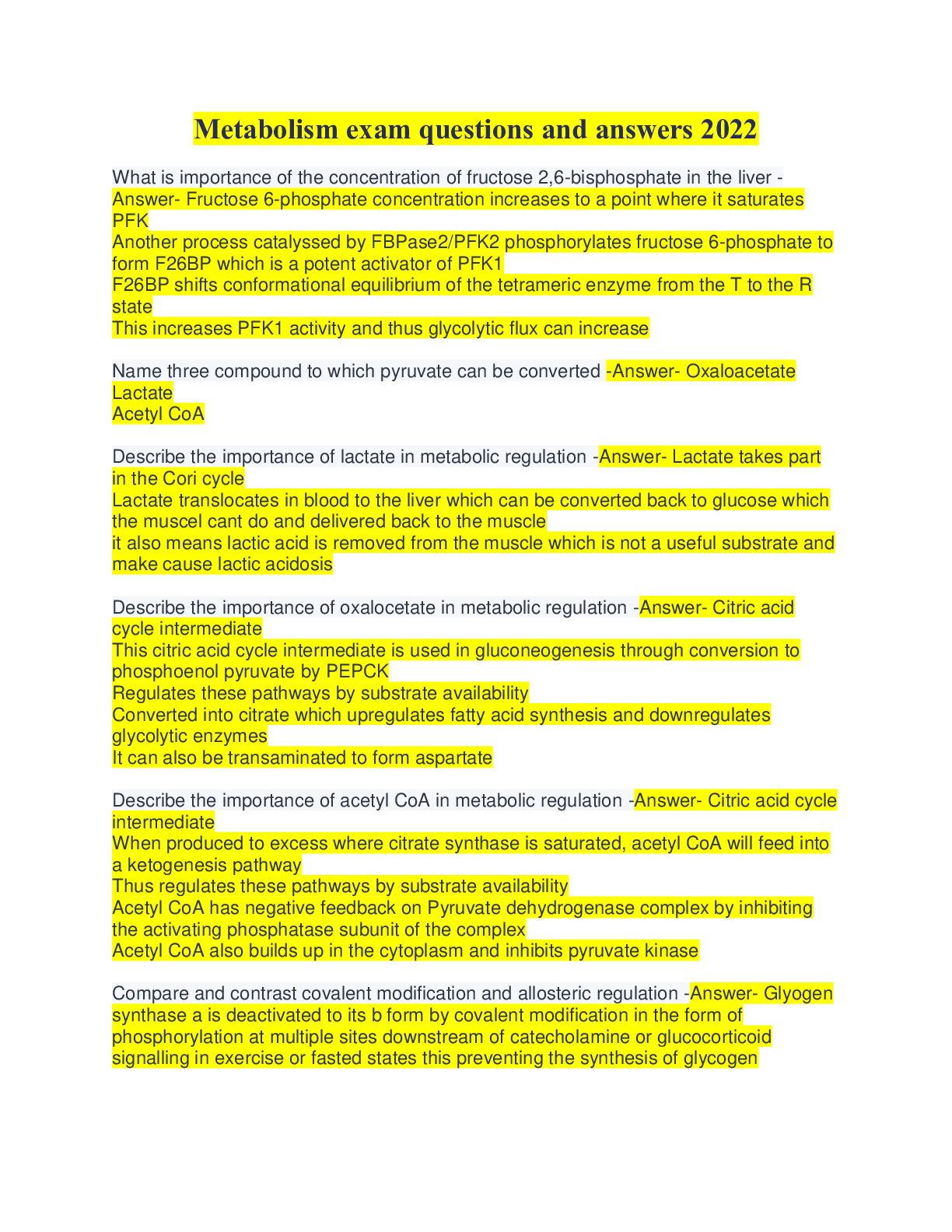
What is importance of the concentration of fructose 2,6-bisphosphate in the liver -Answer- Fructose 6-phosphate concentration increases to a point where it saturates PFK
Ano
...
Metabolism exam questions and answers 2022
What is importance of the concentration of fructose 2,6-bisphosphate in the liver -Answer- Fructose 6-phosphate concentration increases to a point where it saturates PFK
Another process catalyssed by FBPase2/PFK2 phosphorylates fructose 6-phosphate to form F26BP which is a potent activator of PFK1
F26BP shifts conformational equilibrium of the tetrameric enzyme from the T to the R state
This increases PFK1 activity and thus glycolytic flux can increase
Name three compound to which pyruvate can be converted -Answer- Oxaloacetate
Lactate
Acetyl CoA
Describe the importance of lactate in metabolic regulation -Answer- Lactate takes part in the Cori cycle
Lactate translocates in blood to the liver which can be converted back to glucose which the muscel cant do and delivered back to the muscle
it also means lactic acid is removed from the muscle which is not a useful substrate and make cause lactic acidosis
Describe the importance of oxalocetate in metabolic regulation -Answer- Citric acid cycle intermediate
This citric acid cycle intermediate is used in gluconeogenesis through conversion to phosphoenol pyruvate by PEPCK
Regulates these pathways by substrate availability
Converted into citrate which upregulates fatty acid synthesis and downregulates glycolytic enzymes
It can also be transaminated to form aspartate
Describe the importance of acetyl CoA in metabolic regulation -Answer- Citric acid cycle intermediate
When produced to excess where citrate synthase is saturated, acetyl CoA will feed into a ketogenesis pathway
Thus regulates these pathways by substrate availability
Acetyl CoA has negative feedback on Pyruvate dehydrogenase complex by inhibiting the activating phosphatase subunit of the complex
Acetyl CoA also builds up in the cytoplasm and inhibits pyruvate kinase
Compare and contrast covalent modification and allosteric regulation -Answer- Glyogen synthase a is deactivated to its b form by covalent modification in the form of phosphorylation at multiple sites downstream of catecholamine or glucocorticoid signalling in exercise or fasted states this preventing the synthesis of glycogen
However if exogenous glucose becomes available in the fed state, insulin signalling will increase hexokinase expression which increases concentration of glucose 6-phosphate, an allosteric activator of glycogen synthase
In this case allosteric regulation overrides covalent modification shifting the equilbrium for the relaxed state where the covalent modifcations can be removed by a pyrophosphatase (PP1) whose activity is upregulated by covalent modification in inuslin signalling converting glycogen synthase into its active a form
In glycogen breakdown however the covalent modifcation downstream of catecholamine signalling occurs at serine 14 of each monomer converting the b form into the a form
This overrides the allosteric inhibition by glucose 6-phosphate on glycogen phosphorylase
Describe the three stages in the calvin cycle -Answer- Three stages: fixation, reduction and regeneration
Fixation involves the carboxylation of ribulose 1,5-bisphosphate to produce two molecules of phosphoglyerate.
So for each of 6 molecules of Ru15BP 6 CO2 incorporate to produce 12 phosphoglycerate
This is is catalysed by the enzyme rubisco is the cytoplasm or in the stroma of a choloroplast.
Reduction starts with the phosphorylation of each phosphoglycerate to 1,3-bisphosphoglycerate which requires 12 ATP
This provides a suitable substrate for reduction by 12 NADH produce 12 Glyceraldehyde 1,3-phosphate
Subsequent dephosphorylation produces 12 Glyceraldehyde 3-phosphate
One phosphate from this is used for in the ATP synthesis associated with light reaction
Glyceraldehyde 3-phosphate can be utilised for starch synthesis in the stroma or converted to DHAP for sucrose synthesis or glycolysis in the cytosol
Regeneration involves the remaining 10 glyceraldehyde 3-phosphates which are converted to 6 ribulose 1,5-bisphosphate which is catalysed by phosphoribulokinase to start the cycle again
What is rusticyanin what is its role in iron oxidation? -Answer- Copper-containing periplasmic protein which carries electrons by reducing copper II to Cu I
It forms the electron transport chain spanning the periplasm of iron oxidsing bacteria such as A ferrooxidans. Cyc2 connect iron oxidation at the membrane to the periplasm by spanning the OM
Rusticyanin can take this electron pass to Cyc1
Cyc1 feeds into split pathway
Describe photorespiration and discuss nay positive or negative effect it has -Answer- Oxygenation of rubisco is a common occurence due to the lack of specificity for either molecule
This process makes the Calvin cyle not as efficient as carboxylation however since along with one phosphoglycerate produced in each fixation event there is also a molecule of phosphoglycolate produced
Positive: phosphoglycerate can pass through the Calvin cycle and be utilised to synthesise sugars or feed into glycolysis
Negative: but since only half the phosphoglycerate production can be achieved when comparing oxygenation with carboxylation it will not be as efficient since phosphoglycolate must first be converted in a number of steps to RuBP to participate in the Calvin cycle
Ammonia is produced which must be reassimilated in a glutamine synthetase reaction which requires ATP
NAD(P)H also consumed
This glutamine is also further processed in reducing power consuming a transamination reaction
These steps use up resources generated in photosynthesis such as ATP leading to less efficiency of the process
Phosphoglycolate is also an inhibitor of some enzymes (phosphofructokinase and triosephosphate isomerase) in glycolysis and Calvin cycle
What cofactors are present in mammalian complex II -Answer- FAD->2Fe-2S->4Fe-4S->3Fe-4s->ubiquinone binding site but also a heme b which acts as an electron sink to prevent radical generation
Catalyses the reaction
Succinate+ubiquinone->fumarate+ubiquinol
What are the two terminal oxidases that can be found in mitochondria of higher plants and what are the reactions that they catalyse -Answer- Ubiquinol oxidase
2ubiquinol+O2->2ubiquinone+2H2O
Cytochrome C oxidase
4cytc(red)+O2+8H->4cytc(ox)+2H2O+4H
Feedforward vs. feeback in different types of metabolic pathways -Answer- Feedback:
hexokinases (excl. glucokinase)
glucose 6-phosphate allosterically
Feedforward: first commited step of glycolysis is catalysed by PFK. F16PP activates the next regulated enzyme pyruvate kinase downstream
Feedback: citrate can enhance the effect of another inhibitor of PFK increasing the affinity for ATP rather than AMP, an activator of PFK
Feedback:glucokinase inhibited by translocation to the nucleus by GKRP which is more efficient upon binding a downstream product fructose 6-phosphate
Feedforward: glucose acts in an opposite manner when concentration rises in the cytoplasm it rises in the nucleus and facilitates the translocation of GKRP-glucokinase back to the cytoplasm
[Show More]