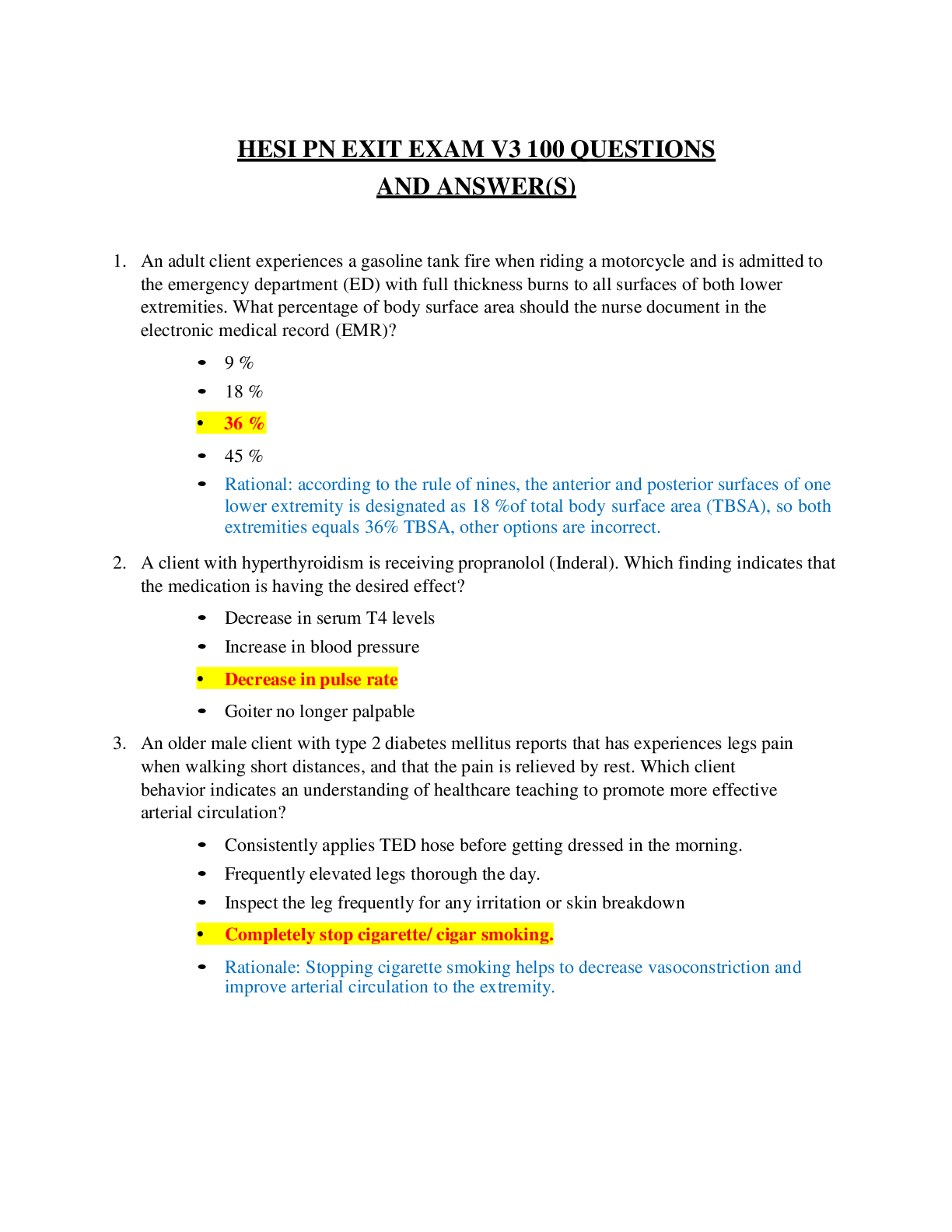
HESI Med Surg Questions And Answers
2022
The nurse assesses a patient with shortness of breath for evidence of long-standing
hypoxemia by inspecting:
A. Chest excursion
B. Spinal curvatures
C. The respiratory p
...
HESI Med Surg Questions And Answers
2022
The nurse assesses a patient with shortness of breath for evidence of long-standing
hypoxemia by inspecting:
A. Chest excursion
B. Spinal curvatures
C. The respiratory pattern
D. The fingernail and its base - ANS- D. The fingernail and its base Clubbing, a sign
of long-standing hypoxemia, is evidenced by an increase in the angle between the
base of the nail and the fingernail to 180 degrees or more, usually accompanied by
an increase in the depth, bulk, and sponginess of the end of the finger.
2. The nurse is caring for a patient with COPD and pneumonia who has an order for
arterial blood gases to be drawn. Which of the following is the minimum length of
time the nurse should plan to hold pressure on the puncture site?
A. 2 minutes
B. 5 minutes
C. 10 minutes
D. 15 minutes - ANS- B. 5 minutes Following obtaining an arterial blood gas, the
nurse should hold pressure on the puncture site for 5 minutes by the clock to be sure
that bleeding has stopped. An artery is an elastic vessel under higher pressure than
veins, and significant blood loss or hematoma formation could occur if the time is
insufficient.
3. The nurse notices clear nasal drainage in a patient newly admitted with facial
trauma, including a nasal fracture. The nurse should:
A. test the drainage for the presence of glucose.
B. suction the nose to maintain airway clearance.
C. document the findings and continue monitoring.
D. apply a drip pad and reassure the patient this is normal. - ANS- A. test the
drainage for the presence of glucose. Clear nasal drainage suggests leakage of
cerebrospinal fluid (CSF). The drainage should be tested for the presence of
glucose, which would indicate the presence of CSF.
4. When caring for a patient who is 3 hours postoperative laryngectomy, the nurse's
highest priority assessment would be:
A. Airway patency
B. Patient comfort
C. Incisional drainage
D. Blood pressure and heart rate - ANS- A. Airway patency Remember ABCs with
prioritization. Airway patency is always the highest priority and is essential for a
patient undergoing surgery surrounding the upper respiratory system.
5. When initially teaching a patient the supraglottic swallow following a radical neck
dissection, with which of the following foods should the nurse begin?
A. Cola
B. Applesauce
C. French fries
D. White grape juice - ANS- A. ColaWhen learning the supraglottic swallow, it may
be helpful to start with carbonated beverages because the effervescence provides
clues about the liquid's position. Thin, watery fluids should be avoided because they
are difficult to swallow and increase the risk of aspiration. Nonpourable pureed
foods, such as applesauce, would decrease the risk of aspiration, but carbonated
beverages are the better choice to start with.
6. The nurse is caring for a patient admitted to the hospital with pneumonia. Upon
assessment, the nurse notes a temperature of 101.4° F, a productive cough with
yellow sputum and a respiratory rate of 20. Which of the following nursing diagnosis
is most appropriate based upon this assessment? A. Hyperthermia related to
infectious illness
B. Ineffective thermoregulation related to chilling
C. Ineffective breathing pattern related to pneumonia
D. Ineffective airway clearance related to thick secretions - ANS- A. Hyperthermia
related to infectious illness Because the patient has spiked a temperature and has a
diagnosis of pneumonia, the logical nursing diagnosis is hyperthermia related to
infectious illness. There is no evidence of a chill, and her breathing pattern is within
normal limits at 20 breaths per minute. There is no evidence of ineffective airway
clearance from the information given because the patient is expectorating sputum.
7. Which of the following physical assessment findings in a patient with pneumonia
best supports the nursing diagnosis of ineffective airway clearance? A. Oxygen
saturation of 85%
B. Respiratory rate of 28
C. Presence of greenish sputum
D. Basilar crackles - ANS- D. Basilar crackles The presence of adventitious breath
sounds indicates that there is accumulation of secretions in the lower airways. This
would be consistent with a nursing diagnosis of ineffective airway clearance because
the patient is retaining secretions.
8. Which of the following clinical manifestations would the nurse expect to find during
assessment of a patient admitted with pneumococcal pneumonia? A.
Hyperresonance on percussion
B. Fine crackles in all lobes on auscultation
C. Increased vocal fremitus on palpation D. Vesicular breath sounds in all lobes -
ANS- C. Increased vocal fremitus on palpation. A typical physical examination
finding for a patient with pneumonia is increased vocal fremitus on palpation. Other
signs of pulmonary consolidation include dullness to percussion, bronchial breath
sounds, and crackles in the affected area.
9. Which of the following nursing interventions is of the highest priority in helping a
patient expectorate thick secretions related to pneumonia?
A. Humidify the oxygen as able
B. Increase fluid intake to 3L/day if tolerated.
C. Administer cough suppressant q4hr.
D. Teach patient to splint the affected area. - ANS- B. Increase fluid intake to 3L/day
if tolerated. Although several interventions may help the patient expectorate mucus,
the highest priority should be on increasing fluid intake, which will liquefy the
secretions so that the patient can expectorate them more easily. Humidifying the
oxygen is also helpful, but is not the primary intervention. Teaching the patient to
splint the affected area may also be helpful, but does not liquefy the secretions so
that they can be removed.
10. During discharge teaching for a 65-year-old patient with emphysema and
pneumonia, which of the following vaccines should the nurse recommend the patient
receive?
A. S. aureus
B. H. influenzae
C. Pneumococcal
D. Bacille Calmette-Guérin (BCG) - ANS- C. Pneumococcal The pneumococcal
vaccine is important for patients with a history of heart or lung disease, recovering
from a severe illness, age 65 or over, or living in a long-term care facility.
11. The nurse evaluates that discharge teaching for a patient hospitalized with
pneumonia has been most effective when the patient states which of the following
measures to prevent a relapse?
A. "I will increase my food intake to 2400 calories a day to keep my immune system
well."
B. "I must use home oxygen therapy for 3 months and then will have a chest x-ray to
reevaluate."
C. "I will seek immediate medical treatment for any upper respiratory infections."
D. "I should continue to do deep-breathing and coughing exercises for at least 6
weeks." - ANS- D. "I should continue to do deep-breathing and coughing exercises
for at least 6 weeks." It is important for the patient to continue with coughing and
deep breathing exercises for 6 to 8 weeks until all of the infection has cleared from
the lungs. A patient should seek medical treatment for upper respiratory infections
that persist for more than 7 days. Increased fluid intake, not caloric intake, is
required to liquefy secretions. Home O2 is not a requirement unless the patient's
oxygenation saturation is below normal.
12. After admitting a patient to the medical unit with a diagnosis of pneumonia, the
nurse will verify that which of the following physician orders have been completed
before administering a dose of cefotetan (Cefotan) to the patient?
A. Serum laboratory studies ordered for AM
B. Pulmonary function evaluation
C. Orthostatic blood pressures
D. Sputum culture and sensitivity - ANS- D. Sputum culture and sensitivityThe nurse
should ensure that the sputum for culture and sensitivity was sent to the laboratory
before administering the cefotetan. It is important that the organisms are correctly
identified (by the culture) before their numbers are affected by the antibiotic; the test
will also determine whether the proper antibiotic has been ordered (sensitivity
testing). Although antibiotic administration should not be unduly delayed while
waiting for the patient to expectorate sputum, all of the other options will not be
affected by the administration of antibiotics.
13. Which of the following nursing interventions is most appropriate to enhance
oxygenation in a patient with unilateral malignant lung disease?
A. Positioning patient on right side.
B. Maintaining adequate fluid intake
C. Performing postural drainage every 4 hours
D. Positioning patient with "good lung down" - ANS- D. Positioning patient with "good
lung down" Therapeutic positioning identifies the best position for the patient
assuring stable oxygenation status. Research indicates that positioning the patient
with the unaffected lung (good lung) dependent best promotes oxygenation in
patients with unilateral lung disease. For bilateral lung disease, the right lung down
has best ventilation and perfusion. Increasing fluid intake and performing postural
drainage will facilitate airway clearance, but positioning is most appropriate to
enhance oxygenation.
14. A 71-year-old patient is admitted with acute respiratory distress related to cor
pulmonale. Which of the following nursing interventions is most appropriate during
admission of this patient?
A. Delay any physical assessment of the patient and review with the family the
patient's history of respiratory problems. B. Perform a comprehensive health history
with the patient to review prior respiratory problems.
C. Perform a physical assessment of the respiratory system and ask specific
questions related to this episode of respiratory distress.
D. Complete a full physical examination to determine the effect of the respiratory
distress on other body functions. - ANS- C. Perform a physical assessment of the
respiratory system and ask specific questions related to this episode of respiratory
distress.Because the patient is having respiratory difficulty, the nurse should ask
specific questions about this episode and perform a physical assessment of this
system. Further history taking and physical examination of other body systems can
proceed once the patient's acute respiratory distress is being managed.
15. When planning appropriate nursing interventions for a patient with metastatic
lung cancer and a 60-pack-year history of cigarette smoking, the nurse recognizes
that the smoking has most likely decreased the patient's underlying respiratory
defenses because of impairment of which of the following?
A. Reflex bronchoconstriction
B. Ability to filter particles from the air
C. Cough reflex
D. Mucociliary clearance - ANS- D. Mucociliary clearance Smoking decreases the
ciliary action in the tracheobronchial tree, resulting in impaired clearance of
respiratory secretions, chronic cough, and frequent respiratory infections.
16. While ambulating a patient with metastatic lung cancer, the nurse observes a
drop in oxygen saturation from 93% to 86%. Which of the following nursing
interventions is most appropriate based upon these findings?
A. Continue with ambulation as this is a normal response to activity.
B. Move the oximetry probe from the finger to the earlobe for more accurate
monitoring during activity.
C. Obtain a physician's order for supplemental oxygen to be used during ambulation
and other activity.
D. Obtain a physician's order for arterial blood gas determinations to verify the
oxygen saturation. - ANS- C. Obtain a physician's order for supplemental oxygen to
be used during ambulation and other activity. An oxygen saturation level that drops
below 90% with activity indicates that the patient is not tolerating the exercise and
needs to have supplemental oxygen applied.
17. The nurse is caring for a 73-year-old patient who underwent a left total knee
arthroplasty. On the third postoperative day, the patient complains of shortness of
breath, slight chest pain, and that "something is wrong." Temperature is 98.4o F,
blood pressure 130/88, respirations 36, and oxygen saturation 91% on room air.
Which of the following should the nurse first suspect as the etiology of this episode?
A. Septic embolus from the knee joint
B. Pulmonary embolus from deep vein thrombosis
C. New onset of angina pectoris
D. Pleural effusion related to positioning in the operating room - ANS- B. Pulmonary
embolus from deep vein thrombosis The patient presents the classic symptoms of
pulmonary embolus: acute onset of symptoms, tachypnea, shortness of breath, and
chest pain.
18. In the case of pulmonary embolus from deep vein thrombosis, which of the
following actions should the nurse take first?
A. Notify the physician.
B. Administer a nitroglycerin tablet sublingually.
C. Conduct a thorough assessment of the chest pain.
D. Sit the patient up in bed as tolerated and apply oxygen. - ANS- D. Sit the patient
up in bed as tolerated and apply oxygen.The patient's clinical picture is consistent
with pulmonary embolus, and the first action the nurse takes should be to assist the
patient. For this reason, the nurse should sit the patient up as tolerated and apply
oxygen before notifying the physician.
19. The nurse is caring for a postoperative patient with sudden onset of respiratory
distress. The physician orders a STAT ventilation-perfusion scan. Which of the
following explanations should the nurse provide to the patient about the procedure?
A. This test involves injection of a radioisotope to outline the blood vessels in the
lungs, followed by inhalation of a radioisotope gas.
B. This test will use special technology to examine cross sections of the chest with
use of a contrast dye.
C. This test will use magnetic fields to produce images of the lungs and chest. D.
This test involves injecting contrast dye into a blood vessel to outline the blood
vessels of the lungs. - ANS- A. This test involves injection of a radioisotope to outline
the blood vessels in the lungs, followed by inhalation of a radioisotope gas.A
ventilation-perfusion scan has two parts. In the perfusion portion, a radioisotope is
injected into the blood and the pulmonary vasculature is outlined. In the ventilation
part, the patient inhales a radioactive gas that outlines the alveoli.
20. During assessment of a 45-year-old patient with asthma, the nurse notes
wheezing and dyspnea. The nurse interprets that these symptoms are related to
which of the following pathophysiologic changes? A. Laryngospasm B.
Overdistention of the alveoli C. Narrowing of the airway D. Pulmonary edema - ANS�C. Narrowing of the airwayNarrowing of the airway leads to reduced airflow, making
it difficult for the patient to breathe and producing the characteristic wheezing.
21. A 45-year-old man with asthma is brought to the emergency department by
automobile. He is short of breath and appears frightened. During the initial nursing
assessment, which of the following clinical manifestations might be present as an
early symptom during an exacerbation of asthma?
A. Anxiety
B. Cyanosis
C. Hypercapnia
D. Bradycardia - ANS- A. Anxiety An early symptom during an asthma attack is
anxiety because he is acutely aware of the inability to get sufficient air to breathe. He
will be hypoxic early on with decreased PaCO2 and increased pH as he is
hyperventilating.
22. The nurse is assigned to care for a patient who has anxiety and an exacerbation
of asthma. Which of the following is the primary reason for the nurse to carefully
inspect the chest wall of this patient?
A. Observe for signs of diaphoresis
B. Allow time to calm the patient
C. Monitor the patient for bilateral chest expansion
D. Evaluate the use of intercostal muscles - ANS- D. Evaluate the use of intercostal
muscles The nurse physically inspects the chest wall to evaluate the use of
intercostal (accessory) muscles, which gives an indication of the degree of
respiratory distress experienced by the patient.
23. Which of the following positions is most appropriate for the nurse to place a
patient experiencing an asthma exacerbation?
A. Supine
B. Lithotomy
C. High-Fowler's
D. Reverse Trendelenburg - ANS- C. High-Fowler'sThe patient experiencing an
asthma attack should be placed in high-Fowler's position to allow for optimal chest
expansion and enlist the aid of gravity during inspiration.
24. The nurse is caring for a patient with an acute exacerbation of asthma. Following
initial treatment, which of the following findings indicates to the nurse that the
patient's respiratory status is improving?
A. Wheezing becomes louder
B. Vesicular breath sounds decrease
C. Aerosol bronchodilators stimulate coughing
D. The cough remains nonproductive - ANS- A. Wheezing becomes louder The
primary problem during an exacerbation of asthma is narrowing of the airway and
subsequent diminished air exchange. As the airways begin to dilate, wheezing gets
louder because of better air exchange.
25. The nurse identifies the nursing diagnosis of activity intolerance for a patient with
asthma. The nurse assesses for which of the following etiologic factor for this nursing
diagnosis in patients with asthma?
A. Anxiety and restlessness
B. Effects of medications
C. Fear of suffocation
D. Work of breathing - ANS- D. Work of breathingWhen the patient does not have
sufficient gas exchange to engage in activity, the etiologic factor is often the work of
breathing. When patients with asthma do not have effective respirations, they use all
available energy to breathe and have little left over for purposeful activity.
26. The nurse is assigned to care for a patient in the emergency department
admitted with an exacerbation of asthma. The patient has received a β-adrenergic
bronchodilator and supplemental oxygen. If the patient's condition does not improve,
the nurse should anticipate which of the following is likely to be the next step in
treatment?
A. Pulmonary function testing
B. Systemic corticosteroids
C. Biofeedback therapy
D. Intravenous fluids - ANS- B. Systemic corticosteroids Systemic corticosteroids
speed the resolution of asthma exacerbations and are indicated if the initial response
to the β-adrenergic bronchodilator is insufficient.
27. A patient with acute exacerbation of COPD needs to receive precise amounts of
oxygen. Which of the following types of equipment should the nurse prepare to use?
A. Venturi mask
B. Partial non-rebreather mask
C. Oxygen tent
D. Nasal cannula - ANS- A. Venturi mask The Venturi mask delivers precise
concentrations of oxygen and should be selected whenever this is a priority concern.
The other methods are less precise in terms of amount of oxygen delivered.
28. While teaching a patient with asthma about the appropriate use of a peak flow
meter, the nurse instructs the patient to do which of the following?
A. Use the flow meter each morning after taking medications to evaluate their
effectiveness.
B. Empty the lungs and then inhale quickly through the mouthpiece to measure how
fast air can be inhaled.
C. Keep a record of the peak flow meter numbers if symptoms of asthma are getting
worse.
D. Increase the doses of the long-term control medication if the peak flow numbers
decrease. - ANS- C. Keep a record of the peak flow meter numbers if symptoms of
asthma are getting worse. It is important to keep track of peak flow readings daily
and when the patient's symptoms are getting worse. The patient should have specific
directions as to when to call the physician based on personal peak flow numbers.
Peak flow is measured by exhaling into the meters and should be assessed before
and after medications to evaluate their effectiveness.
29. The physician has prescribed salmeterol (Serevent) for a patient with asthma. In
reviewing the use of dry powder inhalers (DPIs) with the patient, the nurse should
provide which of the following instructions?
A. "Close lips tightly around the mouthpiece and breathe in deeply and quickly."
B. "To administer a DPI, you must use a spacer that holds the medicine so that you
can inhale it."
C. "Hold the inhaler several inches in front of your mouth and breathe in slowly,
holding the medicine as long as possible." D. "You will know you have correctly used
the DPI when you taste or sense the medicine going into your lungs." - ANS- A.
"Close lips tightly around the mouthpiece and breathe in deeply and quickly." Dry
powder inhalers do not require spacer devices. The patient should be instructed to
breathe in deeply and quickly to ensure medicine moves down deeply into lungs.
The patient may not taste or sense the medicine going into the lungs.
30. The nurse determines that a patient is experiencing common adverse effects
from the inhaled corticosteroid beclomethasone (Beclovent) after noting which of the
following?
A. Adrenocortical dysfunction and hyperglycemia
B. Elevation of blood glucose and calcium levels
C. Oropharyngeal candidiasis and hoarseness
D. Hypertension and pulmonary edema - ANS- C. Oropharyngeal candidiasis and
hoarseness Oropharyngeal candidiasis and hoarseness are common adverse effects
from the use of inhaled corticosteroids because the medication can lead to
overgrowth of organisms and local irritation if the patient does not rinse the mouth
following each dose.
31. The nurse determines that the patient understood medication instructions about
the use of a spacer device when taking inhaled medications after hearing the patient
state which of the following as the primary benefit?
A. "Now I will not need to breathe in as deeply when taking the inhaler medications."
B. "This device will make it so much easier and faster to take my inhaled
medications."
C. "I will pay less for medication because it will last longer."
D. "More of the medication will get down into my lungs to help my breathing." - ANS�D. "More of the medication will get down into my lungs to help my breathing." A
spacer assists more medication to reach the lungs, with less being deposited in the
mouth and the back of the throat.
32. Which of the following test results identify that a patient with an asthma attack is
responding to treatment?
A. A decreased exhaled nitric oxide
B. An increase in CO2 levels
C. A decrease in white blood cell count
D. An increase in serum bicarbonate levels - ANS- A. A decreased exhaled nitric
oxide. Nitric oxide levels are increased in the breath of people with asthma. A
decrease in the exhaled nitric oxide concentration suggests that the treatment may
be decreasing the lung inflammation associated with asthma.
33. The nurse determines that the patient is not experiencing adverse effects of
albuterol (Proventil) after noting which of the following patient vital signs?
A. Oxygen saturation 96%
B. Respiratory rate of 18
C. Temperature of 98.4° F
D. Pulse rate of 76 - ANS- D. Pulse rate of 76 Albuterol is a β2-agonist that can
sometimes cause adverse cardiovascular effects. These would include tachycardia
and angina. A pulse rate of 76 indicates that the patient did not experience
tachycardia as an adverse effect.
34. The patient has an order for each of the following inhalers. Which of the following
should the nurse offer to the patient at the onset of an asthma attack? A. Albuterol
(Proventil)
B. Beclomethasone (Beclovent)
C. Ipratropium bromide (Atrovent)
D. Salmeterol (Serevent) - ANS- A. Albuterol (Proventil) Albuterol is a short-acting
bronchodilator that should initially be given when the patient experiences an asthma
attack.
35. The nurse who has administered a first dose of oral prednisone (Deltasone) to
the patient with asthma writes on the care plan to begin monitoring which of the
following patient parameters?
A. Intake and output
B. Bowel sounds
C. Apical pulse
D. Deep tendon reflexes - ANS- A. Intake and output Corticosteroids such as
prednisone can lead to fluid retention. For this reason, it is important to monitor the
patient's intake and output.
36. The nurse is assisting a patient to learn self-administration of beclomethasone
two puffs inhalation q6hr. The nurse explains that the best way to prevent oral
infection while taking this medication is to do which of the following as part of the
self-administration techniques?
A. Chew a hard candy before the first puff of medication.
B. Ask for a breath mint following the second puff of medication.
C. Rinse the mouth with water before each puff of medication.
D. Rinse the mouth with water following the second puff of medication. - ANS- D.
Rinse the mouth with water following the second puff of medication. The patient
should rinse the mouth with water following the second puff of medication to reduce
the risk of fungal overgrowth and oral infection.
37. The nurse is scheduled to give a dose of salmeterol by metered dose inhaler
(MDI). The nurse would administer the right drug by selecting the inhaler with which
of the following trade names?
A. Vanceril
B. Serevent
C. AeroBid
D. Atrovent - ANS- B. Serevent The trade or brand name for salmeterol, an
adrenergic bronchodilator, is Serevent.
38. The nurse is evaluating whether a patient understands how to safely determine
whether a metered dose inhaler is empty. The nurse interprets that the patient
understands this important information to prevent medication underdosing when the
patient describes which method to check the inhaler?
A. Place it in water to see if it floats.
B. Shake the canister while holding it next to the ear.
C. Check the indicator line on the side of the canister.
D. Keep track of the number of inhalations used. - ANS- D. Keep track of the number
of inhalations used. It is no longer appropriate to see if a canister floats in water or
not as research has demonstrated this is not accurate. The best method to
determine when to replace an inhaler is by knowing the maximum puffs available per
MDI and then replacing when those inhalations have been used.
39. The nurse is scheduled to give a dose of ipratropium bromide by metered dose
inhaler. The nurse would administer the right drug by selecting the inhaler with which
of the following trade names?
A. Vanceril
B. Pulmicort
C. AeroBid
D. Atrovent - ANS- D. Atrovent The trade or brand name for ipratropium bromide, an
anticholinergic medication, is Atrovent.
40. The patient has an order for albuterol 5 mg via nebulizer. Available is a solution
containing 2 mg/ml. How many milliliters should the nurse use to prepare the
patient's dose?
A. 0.2
B. 2.5
C. 3.75
D. 5.0 - ANS- B. 2.5
41. When planning patient teaching about emphysema, the nurse understands that
the symptoms of emphysema are caused by which of the following?
A. Hypertrophy and hyperplasia of goblet cells in the bronchi
B. Collapse and hypoventilation of the terminal respiratory unit
C. An overproduction of the antiprotease alpha1-antitrypsin
D. Hyperinflation of alveoli and destruction of alveolar walls - ANS- D. Hyperinflation
of alveoli and destruction of alveolar walls In emphysema, there are structural
changes that include hyperinflation of alveoli, destruction of alveolar walls,
destruction of alveolar capillary walls, narrowing of small airways, and loss of lung
elasticity.
42. The patient has an order for albuterol 5 mg via nebulizer. Available is a solution
containing 1 mg/ml. How many milliliters should the nurse use to prepare the
patient's dose?
A. 0.2
B. 2.5
C. 3.75
D. 5.0 - ANS- D. 5.0
43. The nurse evaluates that nursing interventions to promote airway clearance in a
patient admitted with COPD are successful based on which of the following findings?
A. Absence of dyspnea
B. Improved mental status
C. Effective and productive coughing
D. PaO2 within normal range for the patient - ANS- C. Effective and productive
coughing The issue of the question is airway clearance, which is most directly
evaluated as successful if the patient can engage in effective and productive
coughing.
44. When caring for a patient with COPD, the nurse identifies a nursing diagnosis of
imbalanced nutrition less than body requirements after noting a weight loss of 30 lb.
Which of the following would be an appropriate intervention to add to the plan of care
for this patient?
A. Teach the patient to use frozen meals at home that can be microwaved.
B. Provide a high-calorie, high-carbohydrate, nonirritating, frequent feeding diet.
C. Order fruits and fruit juices to be offered between meals.
D. Order a high-calorie, high-protein diet with six small meals a day. - ANS- D. Order
a high-calorie, high-protein diet with six small meals a day.Because the patient with
COPD needs to use greater energy to breathe, there is often decreased oral intake
because of dyspnea. A full stomach also impairs the ability of the diaphragm to
descend during inspiration, interfering with the work of breathing. Finally, the
metabolism of a high carbohydrate diet yields large amounts of CO2, which may lead
to acidosis in patients with pulmonary disease. For these reasons, the patient with
emphysema should take in a high-calorie, high-protein diet, eating six small meals
per day.
45. The nurse reviews pursed lip breathing with a patient newly diagnosed with
emphysema. The nurse reinforces that this technique will assist respiration by which
of the following mechanisms?
A. Preventing bronchial collapse and air trapping in the lungs during exhalation
B. Increasing the respiratory rate and giving the patient control of respiratory patterns
C. Loosening secretions so that they may be coughed up more easily
D. Promoting maximal inhalation for better oxygenation of the lungs - ANS- A.
Preventing bronchial collapse and air trapping in the lungs during exhalation The
focus of pursed lip breathing is to slow down the exhalation phase of respiration,
which decreases bronchial collapse and subsequent air trapping in the lungs during
exhalation.
46. Nursing assessment findings of jugular vein distention and pedal edema would
be indicative of which of the following complications of emphysema? A. Acute
respiratory failure
B. Pulmonary edema caused by left-sided heart failure
C. Fluid volume excess secondary to cor pulmonale
D. Secondary respiratory infection - ANS- C. Fluid volume excess secondary to cor
pulmonale Cor pulmonale is a right-sided heart failure caused by resistance to right
ventricular outflow due to lung disease. With failure of the right ventricle, the blood
emptying into the right atrium and ventricle would be slowed, leading to jugular
venous distention and pedal edema.
47. A patient has been receiving oxygen per nasal cannula while hospitalized for
COPD. The patient asks the nurse whether oxygen use will be needed at home.
Which of the following would be the most appropriate response by the nurse? A.
"Long-term home oxygen therapy should be used to prevent respiratory failure."
B. "Oxygen will be needed when your oxygen saturation drops to 88% and you have
symptoms of hypoxia.
C. "Long-term home oxygen therapy should be used to prevent heart problems
related to emphysema."
D. "Oxygen will not be needed until or unless you are in the terminal stages of this
disease." - ANS- B. "Oxygen will be needed when your oxygen saturation drops to
88% and you have symptoms of hypoxia.Long-term oxygen therapy in the home
should be considered when the oxygen saturation is 88% or less and the patient has
signs of tissue hypoxia, such as cor pulmonale, erythrocytosis, or impaired mental
status.
48. Before discharge, the nurse discusses activity levels with a 61-year-old patient
with COPD and pneumonia. Which of the following exercise goals is most
appropriate once the patient is fully recovered from this episode of illness?
A. Slightly increase activity over the current level.
B. Walk for 20 minutes a day, keeping the pulse rate less than 130 beats per minute.
C. Limit exercise to activities of daily living to conserve energy.
D. Swim for 10 min/day, gradually increasing to 30 min/day. - ANS- B. Walk for 20
minutes a day, keeping the pulse rate less than 130 beats per minute. The patient
will benefit from mild aerobic exercise that does not stress the cardiorespiratory
system. The patient should be encouraged to walk for 20 min/day, keeping the pulse
rate less than 75% to 80% of maximum heart rate (220 minus patient's age).
49. The nurse evaluates that a patient is experiencing the expected beneficial effects
of ipratropium (Atrovent) after noting which of the following assessment findings?
A. Increased peak flow readings
B. Increased level of consciousness
C. Decreased sputum production
D. Increased respiratory rate - ANS- A. Increased peak flow readings. Ipratropium is
a bronchodilator that should lead to increased PEFRs.
50. The nurse is teaching a patient how to self-administer ipratropium (Atrovent) via
a metered dose inhaler. Which of the following instructions given by the nurse is
most appropriate to help the patient learn proper inhalation technique?
A. "Avoid shaking the inhaler before use." B. "Breathe out slowly before positioning
the inhaler."
C. "After taking a puff, hold the breath for 30 seconds before exhaling."
D. "Using a spacer should be avoided for this type of medication." - ANS- B.
"Breathe out slowly before positioning the inhaler." It is important to breathe out
slowly before positioning the inhaler. This allows the patient to take a deeper breath
while inhaling the medication thus enhancing the effectiveness of the dose.
51. Which of the following statements made by a patient with COPD indicates a need
for further education regarding the use of an ipratropium inhaler?
A. "I should rinse my mouth following the two puffs to get rid of the bad taste."
B. "I should wait at least 1 to 2 minutes between each puff of the inhaler."
C. "If my breathing gets worse, I should keep taking extra puffs of the inhaler until I
can breathe more easily."
D. "Because this medication is not fast-acting, I cannot use it in an emergency if my
breathing gets worse. - ANS- C. "If my breathing gets worse, I should keep taking
extra puffs of the inhaler until I can breathe more easily." The patient should not take
extra puffs of the inhaler at will to make breathing easier. Excessive treatment could
trigger paradoxical bronchospasm, which would worsen the patient's respiratory
status.
52. When assessing a patient's sleep-rest pattern related to respiratory health, the
nurse would ask if the patient: (Select all that apply.)
A. Has trouble falling asleep
B. Awakens abruptly during the night
C. Sleeps more than 8 hours per night
D. Has to sleep with the head elevated - ANS- A,B,D The patient with sleep apnea
may have insomnia and/or abrupt awakenings. Patients with cardiovascular disease
(e.g., heart failure that may affect respiratory health) may need to sleep with the
head elevated on several pillows (orthopnea). Sleeping more than 8 hours per night
is not indicative of impaired respiratory health.
53. A patient is being discharged from the emergency department after being treated
for epistaxis. In teaching the family first aid measures in the event the epistaxis
would recur, which of the following measures would the nurse suggest? (Select all
that apply.)
A. Tilt patients head backwards
B. Apply ice compresses to the nose
C. Pinch the entire soft lower portion of the nose
D. Partially insert a small gauze pad into the bleeding nostril - ANS- B,C,D First aid
measures to control epistaxis includes placing the patient in a sitting position, leaning
forward. Tilting the head back does not stop the bleeding, but rather allows the blood
to enter the nasopharynx, which could result in aspiration or nausea/vomiting from
swallowing blood. All of the other options are appropriate first aid treatment of
epistaxis.
54. To promote airway clearance in a patient with pneumonia, the nurse instructs the
patient to do which of the following? (Select all that apply.)
A. Splint the chest when coughing
B. Maintain a semi-Fowler's position
C. Maintain adequate fluid intake
D. Instruct patient to cough at end of exhalation - ANS- A,C,D The nurse should
instruct the patient to splint the chest while coughing. This will reduce discomfort and
allow for a more effective cough. Maintaining adequate fluid intake liquefies
secretions, allowing easier expectoration. Coughing at the end of exhalation
promotes a more effective cough. The patient should be positioned in an upright
sitting position (high-Fowler's) with head slightly flexed.
55. During admission of a patient diagnosed with non-small cell carcinoma of the
lung, the nurse questions the patient related to a history of which of the following risk
factors for this type of cancer? (Select all that apply.)
A. Asbestos exposure
B. Cigarette smoking
C. Exposure to uranium
D. Chronic interstitial fibrosis - ANS- A,B,C Non-small carcinoma is associated with
cigarette smoking and exposure to environmental carcinogens, including asbestos
and uranium. Chronic interstitial fibrosis is associated with the development of
adenocarcinoma of the lung.
56. When admitting a 45-year-old female with a diagnosis of pulmonary embolism,
the nurse will assess the patient for which of the following risk factors? (Select all
that apply.)
A. Obesity
B. Pneumonia
C. Hypertension
D. Cigarette smoking - ANS- A,C,D Research has demonstrated an increased risk of
pulmonary embolism in women associated with obesity, heavy cigarette smoking,
and hypertension. Other risk factors include immobilization, surgery within the last 3
months, stroke, history of DVT, and malignancy.
57. When admitting a patient with the diagnosis of asthma exacerbation, the nurse
will assess for which of the following potential triggers? (Select all that apply.)
A. Exercise
B. Allergies
C. Emotional stress
D. Decreased humidity - ANS- A,B,C Although the exact mechanism of asthma is
unknown, there are several triggers that may precipitate an attack. These include
allergens, exercise, air pollutants, respiratory infections, drug and food additives,
psychologic factors, and GERD.
1. The arterial blood gas (ABG) readings that indicate compensated respiratory
acidosis are a PaCO2 of
A. 30 mm Hg and bicarbonate level of 24 mEq/L.
B. 30 mm Hg and bicarbonate level of 30 mEq/L.
C. 50 mm Hg and bicarbonate level of 20 mEq/L.
D. 50 mm Hg and bicarbonate level of 30 mEq/L. - ANS- D. 50 mm Hg and
bicarbonate level of 30 mEq/L. If compensation is present, carbon dioxide and
bicarbonate are abnormal (or nearly so) in opposite directions (e.g., one is acidotic
and the other alkalotic).
2. A patient admitted to the emergency department with tension pneumothorax and
mediastinal shift following an automobile crash is most likely to exhibit A.
bradycardia.
B. severe hypotension.
C. mediastinal flutter.
D. a sucking chest wound. - ANS- B. severe hypotension. Mediastinal shift may
cause compression of the lung in the direction of the shift and compression, traction,
torsion, or kinking of the great vessels. Blood return to the heart is dangerously
impaired and causes a subsequent decrease in cardiac output and blood pressure.
Tachycardia is a clinical manifestation of tension pneumothorax. An uncovered
opened pneumothorax is associated with a sucking chest wound and mediastinal
flutter.
3. In preparing the preoperative teaching plan for a patient who is to undergo a total
laryngectomy, a nurse should give highest priority to the
A. tracheostomy being in place for 2 to 3 days.
B. patient's not being able to speak normally again.
C. insertion of a gastrostomy feeding tube during surgery.
D. patient's not being able to perform deep-breathing exercises. - ANS- B. patient's
not being able to speak normally again. Patients who have a total laryngectomy have
a permanent tracheostomy and will need to learn how to speak using alternative
methods, such as an artificial larynx. The tracheostomy will be permanent to allow
normal breathing patterns and air exchange. After surgery, the patient's nutrition is
supplemented with enteral feedings, and when the patient can swallow secretions,
oral feedings can begin. Deep-breathing exercises should be performed with the
patient at least every 2 hours to prevent further pulmonary complications.
4. After a posterior nasal pack is inserted by a physician, the patient is very anxious
and states, "I don't feel like I'm breathing right." The immediate intervention the nurse
should initiate is to
A. monitor ABGs.
B. reassure the patient that this is normal discomfort.
C. cut the pack strings and pull the packing out with a hemostat.
D. direct a flashlight into the patient's mouth and inspect the oral cavity. - ANS- D.
direct a flashlight into the patient's mouth and inspect the oral cavity. The nurse
should inspect the oral cavity for the presence of blood, soft palate necrosis, and
proper placement of the posterior plug. If the posterior plug is visible, the physician
should be notified for readjustment of the packing. Reassurance, cutting the strings,
and ABGs are not top priority interventions. The nurse needs further data before
intervening.
5. A nurse is performing assessment for a patient diagnosed with chronic obstructive
pulmonary disease (COPD). Which of the following findings should the nurse expect
to observe?
A. Nonproductive cough
B. Prolonged inspiration
C. Vesicular breath sounds
D. Increased anterior-posterior chest diameter - ANS- D. Increased anterior-posterior
chest diameter An increased anterior-posterior diameter is a compensatory
mechanism experienced by patients with COPD and is caused by air-trapping.
Patients with COPD have a productive cough, often expectorating copious amounts
of sputum. Because of air-trapping, patients with COPD experience a prolonged
expiration because the rate of gas on exhalation takes longer to escape. Chest
auscultation for patients with COPD often reveals wheezing, crackles, and other
adventitious breath sounds.
6. A nurse is working on a respiratory care unit where many of the patients are
affected by asthma. Which of the following actions by the nurse would most likely
increase respiratory difficulty for the patients?...
[Show More]




 Questions, Answers & Rationale, A+ Guide.png)








.png)
.png)


 (1).png)