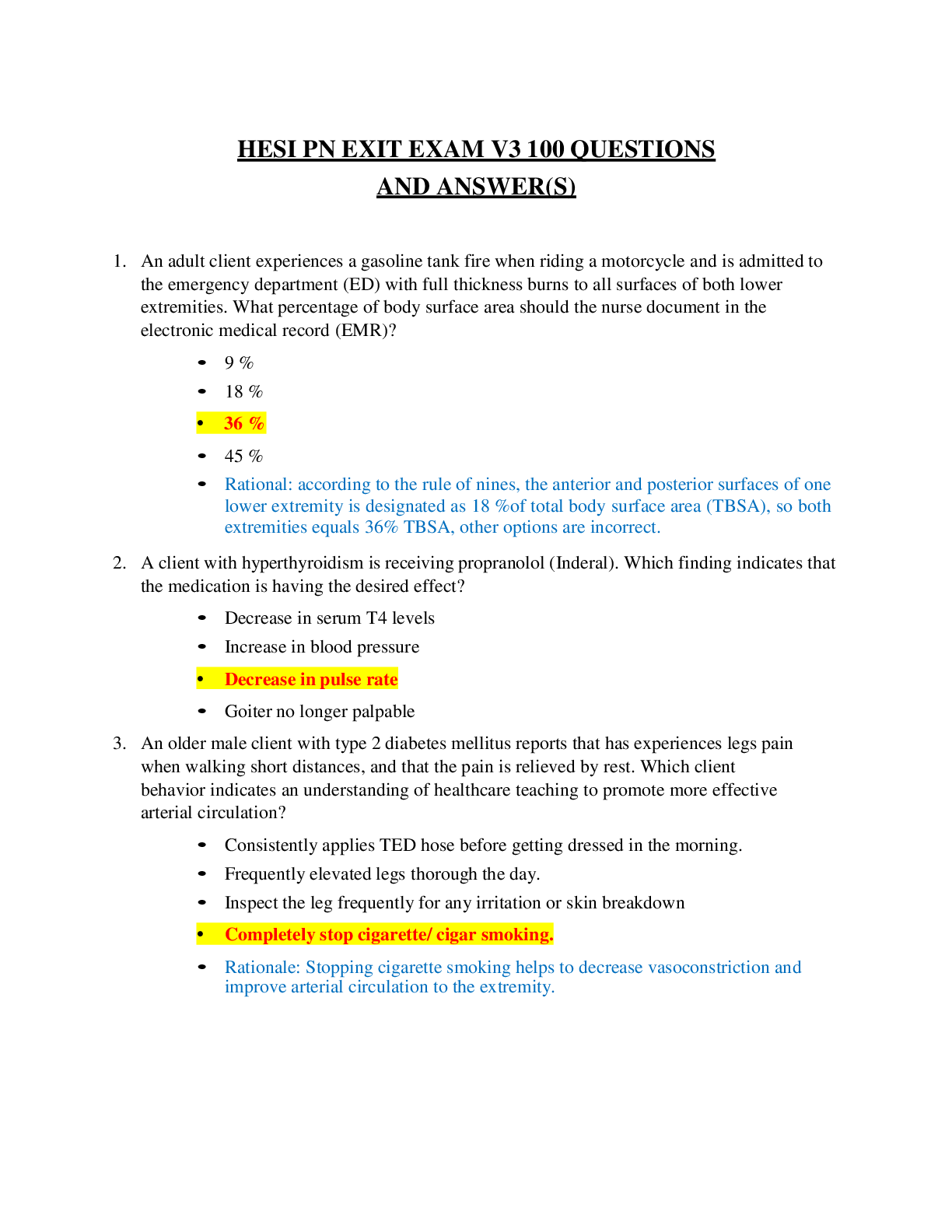
HESI Comprehensive Final Questions And
Answers 2022
When establishing realistic goals, the nurse:
A. Bases the goals on the nurse's personal knowledge.
B. Knows the resources of the health care facility, family, and
...
HESI Comprehensive Final Questions And
Answers 2022
When establishing realistic goals, the nurse:
A. Bases the goals on the nurse's personal knowledge.
B. Knows the resources of the health care facility, family, and the client.
C. Must have a client who is physically and emotionally stable.
D. Must have the client's cooperation. - ANS- Ans: B
A client is ordered to receive an intramuscular injection of medication. When
preparing to administer the injection, the nurse selects the ventrogluteal site based
on which reason?
a. there is a high possibility of injecting into subQ fat
b. the area is free of major blood vessels and fat
c. the site lies close to the radial nerve
d. the site is in close proximity to the sciatic nerve - ANS- b. the area is free of major
blood vessels and fat
The student nurse is preparing to administer medication through a feeding tube.
Which of the following statements if made by the student nurse indicates correct
understanding?
A) "I will perform hand hygiene. Gloves are only necessary for tube insertion, not
medication administration."
B) "The head of the bed should be kept flat during medication administration."C) "I
will aspirate gastric contents to check placement of the feeding tube and residual
volume and then I will dispose of the aspirate properly."D) "I will flush with 10 mL of
tap water after each medicine and with 30-60 mL of water after the last medication." -
ANS- D
A nursing measure to promote sleep in school-age children is to:
1. Make sure the room is dark and quiet
2. Encourage evening exercise
3. Encourage television watching
4. Encourage quiet activities prior to bed time. - ANS- 4. Encourage quiet activities
prior to bed time.
The amount of sleep needed during the school years is individualized because of
varying states of activities and levels of health. A 6-year old averages 11-12 hours of
sleep nightly, whereas an 11-year old sleeps about 9-10 hours. The 6- or 7-year old
can usually be persuaded to go to bed by encouraging quiet activities.
A female client verbalizes that she has been having trouble sleeping and feels wide
awake as soon as getting into bed. The nurse recognizes that there are many
interventions the promote sleep. Check all that apply.
1. Eat a heavy snack before bedtime
2. Read in bed before shutting out the light
3. Leave the bedroom if you are unable to sleep
4. Drink a cup of warm tea with milk at bedtime
5. Exercise in the afternoon rather than the evening
6. Count backwards from 100 to 0 when your mind is racing. - ANS- Answer: 3, 5,
and 6.
Lying in bed when one is unable to sleep increases frustration and anxiety which
further impede sleep; other activities, such as reading or watching television, should
not be conducted in bed. Counting backwards requires minimal concentration but it
is enough to interfere with thoughts that distract a person from falling asleep.
A nurse is caring for a client who has a history of falls. Which of the following actions
is the nurse's priority?
A. Complete a fall-risk assessment.
B. Educate the client and family about fall risks.
C. Eliminate safety hazards from the client's environment.
D. Make sure the client uses assistive aids in his possession - ANS- A. Complete a
fall-risk assessment.
When a fall results in injury and hospitalization, a cycle of disuse may occur over
time. When establishing a care plan for the patient and family to prevent this, it is
important to remember disuse is most likely a result of:
A. Decreasing muscle strength.
B. Decreased joint mobility.
C. Fear of repeated falls.
D. Changes in sensory perception. - ANS- C. Fear of repeated falls.
A home health nurse is completing a home assessment for safety risks for a new
older adult patient. Which one of the following home observations is in most need of
modification?
A) The temperature of common area rooms is kept at 72°F.
B) Carpeting is glued down with no holes or frayed edges and tile floors are intact.
C) An area rug is placed in front of the sink and toilet in the patient's bathroom.
D) A three-prong grounded extension cord is in good condition. - ANS- C) An area
rug is placed in front of the sink and toilet in the patient's bathroom.
Area rugs present a fall risk and should not be used by the older adult in the
bathroom. The nurse should identify the risk, instruct the patient to remove the area
rug, and ensure that the patient verbalizes an understanding of these instructions.
On the second visit, the nurse (or another member of the health care team) should
make sure that the rug was removed so that the risk is eliminated. The temperature
is pleasant and comfortable and presents no risk. The glued-down carpeting is not
movable and does not present a fall risk. The three-prong extension cord is in good
condition and out of a common pathway, so it does not present a fall risk.
A home care nurse is conducting a home assessment evaluation for an older adult's
bathroom. Which findings should the nurse identify as safety issues for the patient?
A) A tub bench in the bathtub
B) Diffuse lighting in the bathroom
C) A liquid soap bottle for the bathtub and sink
D) The absence of grab bars - ANS- D) The absence of grab bars
General fall prevention guidelines for the older adult's bathroom include grab bars in
the tub, in the shower, and near the toilet. A tub bench in the bathtub ensures a
patient a place to sit during a shower and decreases the risk of falls. Good lighting
helps the patient see better in the bathroom, and diffuse lighting is often better than
one direct light source. Bar soaps should be replaced with liquid soaps.
A nurse who works in a skilled nursing facility is looking for ways to reduce the
incidence of falls among the residents. Which of the following recommendations by
the nurse will decrease the greatest number of falls in the facility?
A) Install nightlights in all the residents' bathrooms.
B) Complete a fall history and assessment for each resident upon admission.
C) Refer residents who need assistance with ambulation to occupational therapy.
D) Provide side rails on the beds to keep residents from falling out of bed. - ANS- B)
Complete a fall history and assessment for each resident upon admission.
Each resident should have a fall risk assessment upon admission to any nursing
facility. This will help identify high risk residents. Nightlights will help when going to
the bathroom but is not generalized enough to reduce all types of falls. Residents
who need assistance to ambulate might need a referral to physical or occupational
therapy, but this will not reduce falls as much as comprehensive assessments. Side
rails to keep residents in bed are restraints; a better option would be low beds.
According to Erikson's Theory of development, which of the following older adults
has successfully navigated the stage of ego integrity versus despair?
A. A 70-year-old man who is reluctant to retire because work is everything to him.
B. 78-year-old woman who has scheduled her third face lift.
C. 80-year-old man who has informed his children that he has made his funeral
arrangements.
D. 67-year-old woman who is depressed because she has not been promoted at
work for the past 10 years. - ANS- C. 80-year-old man who has informed his children
that he has made his funeral arrangements.
Successfully navigating the stage of ego integrity versus despair requires that the
individual accept normal bodily changes associated with aging, find meaning in life
apart from work, accepts the inevitability of death, and is at peace with his or her life.
Characteristic behaviors of older adults who have successfully met Erikson's ego
integrity versus despair developmental task include:
A. Fear of death.
B. Feelings that life has been lived in vain.
C. Identity is related to career and work only.
D. Honest acceptance of the life that has passed. - ANS- D. Honest acceptance of
the life that has passed.
Ego integrity versus despair is the developmental stage of older adults. The quality
associated with successful passage of this stage is integrity, defined as an honest
acceptance of the life that has passed and the stage of life that is currently being
lived. Individuals who have reached this stage are said to be at peace with
themselves. The inability to reach this stage leads to fear of death and despair that
life has been lived in vain. Ego differentiation, which is a part of the developmental
stage of ego integrity, involves achieving an identity apart from work.
The nurse is caring for the client with pneumonia. An expected client outcome is,
The client will maintain adequate
oxygenation by discharge. Which outcome criterion indicates the goal is met?
A) Client taking antibiotic as ordered.
B) Client identifies signs and symptoms of recurrence of infection.
C) Client coughing and deep breathing every one hour.
D) Client no longer requires oxygen. - ANS- Ans: D
The client who is maintaining adequate oxygenation would not require oxygen. The
client could be able to do the other three options and still have problems with
oxygenation.
A 70-year-old female patient who has had a number of strokes refuses further life�sustaining interventions, including artificial nutrition and hydration. She is competent,
understands the consequences of her actions, is not depressed, and persists in
refusing treatment. Her doctor is adamant that she cannot be allowed to die this way,
and her daughter agrees. An ethics consult has been initiated. Who would be the
appropriate decision maker?
a. Patient
b. Daughter
c. Doctor
d. Ethics consult team - ANS- a. Patient
Because this patient is competent, she has the right to refuse therapy that she finds
to be disproportionately burdensome, even if this hastens her death. Neither her
daughter nor her doctor has the authority to assume her decision-making
responsibilities unless she asks them to do this. The ethics consult team is not a
decision-making body; it can make recommendations but has no authority to order
anything.
A 6-year-old boy is admitted to the pediatric unit with chills and a fever of 104°F
(40°C). What physiological process explains why the child is at risk for developing
dyspnea?
A: Fever increases metabolic demands, requiring increased oxygen need.
B: Blood glucose stores are depleted, and the cells do not have energy to use
oxygen.
C: Carbon dioxide production increases as result of hyperventilation.
D: Carbon dioxide production decreases as a result of hypoventilation. - ANS- A:
Fever increases metabolic demands, requiring increased oxygen need.
A nurse is prepping to teach a pt. plan for a client with rheumatoid arthritis. Which
dietary recommendation may help this client reduce inflammation?
a. fish oil
b. vitamin d
c. iron rich foods
d. calcium carbonate - ANS- a. fish oil
When teaching an adult patient about eardrops, which statement will the nurse
include?
A. "Hold your ear down and back to instill the drops."
B. "If you feel dizzy after instilling the ear drops, stand up and walk around the
room."
C. "Warm the ear drops up for 30 seconds in the microwave before using them."
D. "Lie on the opposite side of that of your affected ear for about 5 minutes after
instilling the drug." - ANS- D. "Lie on the opposite side of that of your affected ear for
about 5 minutes after instilling the drug."
Adults are supposed to hold the ear up and back for ear drops.
A patient who has diabetes and acute abdominal pain is admitted for an exploratory
laparotomy. When planning postoperative interventions to promote wound healing,
what is the nurse's highest priority?
a. Maintaining the patient's blood glucose within a normal range
b. Ensuring that the patient has an adequate dietary protein intake
c. Giving antipyretics to keep the temperature less than 102° F (38.9° C)
d. Redressing the surgical incision with a dry, sterile dressing twice daily - ANS- A
Elevated blood glucose will impair wound healing in multiple ways. Ensuring
adequate nutrition is important for the postoperative patient, but a higher priority is
blood glucose control. A temperature of 102° F will not impact wound healing.
Application of a dry, sterile dressing daily may be ordered, but frequent dressing
changes for a wound healing by primary intention is not necessary to promote wound
healing.
Which activities can the nurse working in the outpatient clinic delegate to a licensed
practical/vocational nurse (LPN/VN)? (Select all that apply.)
a. Administer patch testing to a patient with allergic dermatitis.
b. Interview a new patient about chronic health problems and allergies.
c. Apply a sterile dressing after the health care provider excises a mole.
d. Explain potassium hydroxide testing to a patient with a skin infection.
e. Teach a patient about site care after a punch biopsy of an upper arm lesion. -
ANS- A, C
Skills such as administration of patch testing and sterile dressing technique are
included in LPN/VN education and scope of practice. Obtaining a health history and
patient education require registered nurse (RN) level education and scope of
practice.
The reversal of a hyperglycemic, hyperosmolar, nonketonic coma secondary to TPN
requires the administration of:
A. Anticoagulants
B. Histamine blockers
C. Insulin
D. Sodium lactate - ANS- C. Insulin
For safe administration of oral medications through a feeding tube, specific attention
must be paid to: (Select all that apply.)
A) Proper placement of the tube
B) The patient's temperature
C) Whether the medication can be crushed for administration through the tube
D) The patient's electrolyte status - ANS- A,C
The student nurse is preparing to administer medication through a feeding tube.
Which of the following statements if made by the student nurse indicates correct
understanding?
A) "I will perform hand hygiene. Gloves are only necessary for tube insertion, not
medication administration."
B) "The head of the bed should be kept flat during medication administration."
C) "I will aspirate gastric contents to check placement of the feeding tube and
residual volume and then I will dispose of the aspirate properly."
D) "I will flush with 10 mL of tap water after each medicine and with 30-60 mL of
water after the last medication." - ANS- D) "I will flush with 10 mL of tap water after
each medicine and with 30-60 mL of water after the last medication."
You are attempting to administer medication through a feeding tube but are unable
to do so because of a blockage in the tube. What action(s) should you take? (Select
all that apply.)
A) For a newly inserted tube, notify physician and obtain x-ray confirmation of
positioning.
B) Clamp the tube and try again at a later time.
C) For an established tube, attempt to flush tube with large-bore syringe and warm
water.
D) Soak the end of the tube in warm water.
E) If unable to flush, contact physician for replacement of tube and potential need to
reroute medication.
F) Have the patient place the chin to the chest and swallow. - ANS- A,C,E
A patient with lung cancer has a feeding tube to help meet nutritional needs because
of difficulty swallowing since radiation treatments. The patient requests some pain
medication. The patient has an order for morphine, 5 mg IV push, every 2 hours as
needed, or MS Contin (extended-release morphine tablet) 30 mg every 8 hours as
needed. You return with the injectable form to be administered IV. The patient seems
upset by this, stating, "I take a morphine pill for pain; why are you bringing me a
shot?" What is your best response?
A) "This is the same medication only in a form that I can administer through your IV
line. The pill form you took at home should never be crushed, so I am unable to
administer it through your feeding tube. This is the safest route for your pain
medication to be administered at this time."
B) "Your physician has ordered pain medication that may be administered either IV
or through your feeding tube. To administer medications through your feeding tube,
the medications must first be crushed, and it is simply easier to administer the pain
medication through your IV."
C) "This is the same medication you have taken at home only in a form that I can
administer through your IV. It will take effect quicker than if I crushed your
medication and administered it through your feeding tube."
D) "I have brought you pain medication that can be administered through your IV, but
if you prefer to have the pill form, I can go prepare it to be administered - ANS- A
What do you enact for droplet precautions? - ANS- Wash Hands
Don Mask and Eye Protection
Don Gown then Gloves
Remove gloves then gown
Wash hands
Remove eye protection/mask
Wash hands
Cough etiquette - ANS- - Cover your nose/mouth with a tissue when you cough, and
promptly dispose of the contaminated tissue.
- Place a surgical mask on a patient if it doesn't compromise respiratory function or is
applicable.
- Perform hand hygiene after contact with contaminated respiratory secretions.
- Maintain spatial separation greater than 3 feet from persons with respiratory
infection.
A nurse is providing teaching about cough etiquette to a client who has influenza.
Which of the following instructions should the nurse include in the teaching?
a. "cover your nose and mouth with a tissue when coughing"
b. "where gloves when preparing meals if coughing a lot"
c. "stay 2 feet away from others when coughing"
d. "turning your head away when coughing can transmit micro-organisms into the air"
- ANS- A.
The nurse should instruct the client to cover their nose and mouth with a tissue when
coughing and discard the tissue in the nearest trash
The nurse is working on a unit that is equipped with electronic medication
administration processes. This includes a computer at the bedside that allows for
scanning a bar code on the medication order, the medication label, and the client's
ID band. Which of the following is the BEST method for the nurse to practice
regularly?
a. The nurse should rely solely on the barcoding scanner because it promotes safer
medication administration practices.
b. The nurse should rely on a combination of nursing judgment and decision-making
along with the computerized system.
c. The nurse should never give a medication that a bar-coding system scans as
"incorrect medication."
d. The use should override any medication that the machine scans as "incorrect
medication" and administer it. - ANS- B
Rationale: Although bar-coding scanners and computers promote safer medication
administration practices, computers do not take the place of nursing judgment.
Computerized systems can have glitches and improper codes inadvertently in the
system; the nurse should confirm the order, the medication, and the client, and then
make the decisions to administer or not.
When caring for a hospitalized patient with a urinary catheter, which nursing action
best prevents the patient from acquiring an infection?
a. Inserting the catheter using strict clean technique
b. Performing hand hygiene before and after providing perineal care
c. Fully inflating the catheter's balloon according to the manufacturer's
recommendation
d. Disconnecting and replacing the catheter drainage bag once per shift - ANS- ANS:
B
Hand hygiene helps prevent infection in patients with a urinary catheter. A catheter
should be inserted in the hospital setting using sterile technique. Inflating the balloon
fully prevents dislodgement and trauma, not infection. Disconnecting the drainage
bag fromt he catheter creates a break in the system and an open portal of entry and
increases risk of infection.
A nurse is positioning a sterile drape to extend the working area when performing a
urinary catheterization. Which of the
following is an appropriate technique for this procedure?
A) Use sterile gloves to handle the entire drape surface.
B) Fold the lower edges of the drape over the sterile-gloved hands.
C) Touch only the outer two inches of the drape when not wearing sterile gloves.
D) When reaching over the drape do not allow clothing to touch the drape. - ANS�Ans: A
Feedback:
Using sterile gloves allows the nurse to handle the entire drape surface. The nurse
should fold the lower edges of the
drape over the sterile-gloved hands for protection when positioning. When not
wearing sterile gloves, the nurse should
touch only the outer one inch (2.5 cm) of the drape, and the nurse should not reach
over the drape because this would
contaminate a sterile area.
The nurse has completed the administration of a cleaning enema for a client being
prepared for intestinal surgery. Complete documentation by the nurse of this event
includes all but which of the following assessments? (Select all that apply.)
A. Type of solution
B. Length of time solution retained
C. Relief of flatus and abdominal distention
D. Amount of return - ANS- Ans: A, B, C
Rationale: Document color, odor, amount and consistency of feces, and the
condition of the perineal area. The remaining actions are also documented.
A client is scheduled for a colonoscopy. The nurse will provide information to the
client about which type of enema?
A. Oil retention
B. Return flow
C. High, large volume
D. Low, small volume - ANS- Ans: D
Rationale: Small-volume enemas along with other preparations are used to prepare
the client for this procedure. An oil retention enema is used to soften hard stool
(option 1). Return flow enemas help expel flatus (option 2). Because of the risk of
loss of fluid and electrolytes, high, large-volume enemas are seldom used (option 3).
The nurse assesses a client's abdomen several days after abdominal surgery. It is
firm, distended, and painful to palpate. The client reports feeling "bloated." The nurse
consults with the surgeon, who orders an enema. The nurse prepares to give what
kind of enema?
A. Soapsuds
B. Retention
C. Return flow
D. Oil retention - ANS- Ans: C
Rationale: This provides relief of postoperative flatus, stimulating bowel motility.
Options 1, 2, and 4 manage constipation and do not provide flatus relief.
The nurse is administering a cleansing enema to a client with a fecal impaction.
Before administering the enema, the nurse should assist the client to which position?
- ANS- Left Sims' position, with the head of the bed flat
The nurse is preparing to administer an enema to an adult client. Which interventions
should the nurse plan to perform for this procedure? - ANS- - Apply disposable
gloves.
- Lubricate the enema tube and insert it approximately 4 inches.
- Clamp the tubing if the client expresses discomfort during the procedure.
- Ensure that the temperature of the solution is between 100° F (37.8° C) and 105° F
(40.5° C).
The nurse must transfer the adult client with R sided weakness from bed to a
wheelchair. Where should the nurse position the wheelchair?
A) at a 90 degree angle to the head of the bed on the client's affected side.
B) at a 45 degree angle to the head of the bed on the client's unaffected side.
C) parallel to the foot of the bed on the client's affected side.
D) facing the head of the bed on the client's unaffected side. - ANS- B) at a 45
degree angle to the head of the bed on the client's unaffected side.
A nurse is transferring a patient from a bed to a wheelchair using a mechanical lift.
Which is a basic nursing intervention associated with this procedure?
1. Lock the base lever in the open position when moving the mechanical lift.
2. Raise the mechanical lift so that the patient is six inches off the mattress.
3. Keep the wheels of the mechanical lift locked throughout the procedure.
4. Ensure the patients feet are guarded when sitting on the mechanical lift. - ANS- 4.
Ensure the patients feet are guarded when sitting on the mechanical lift.
The nurse is helping a client walk in the hallway when the client suddenly reaches for
the handrail and states, "I feel so
weak. I think I am going to pass out." Which of the following initial actions by the
nurse is appropriate?
A) Firmly grasp the client's gait belt.
B) Support the client's body against yours and gently slide the client onto the floor.
C) Ask the client to lean against the wall while you obtain a wheelchair.
D) Apply oxygen and wait several minutes for the weakness to pass.
E) Ask the patient, "When was the last time you ate?" - ANS- Ans: B
Feedback:
Assessing for the potential causes of the weakness should occur after the client's
safety is assured.
The nurse is preparing to move a client from bed into a wheelchair to eat lunch.
What client data would the nurse check
to see if the assistance of another nurse is needed?
A) Client restrictions
B) Client age
C) Client food preferences
D) Client restraint - ANS- Ans: A
Feedback:
When attempting to move a client, the nurse would first check the client's chart to
see if the client has any physical limitations or restrictions. The nurse would also
evaluate the client's condition and determine whether or not the client can help with
positioning or understand directions. Lastly, the nurse would evaluate the client's
body weight and his or her own strength. Age and food preferences would not affect
movement. Clients with restraints still need to be moved
and repositioned.
A nurse is caring for a patient who has been hospitalized for a spinal cord injury
following a motor vehicle accident. Which action would the nurse perform when
logrolling the patient to reposition him on his side?
a. Have the patient extend his arms outward and cross his legs on top of a pillow.
b. Stand at the side of the bed in which the patient will be turned while another nurse
gently pushes the patient from the other side.
c. Have the patient cross his arms on his chest and place a pillow between his
knees.
d. Place a cervical collar on the patient's neck and gently roll him to the other side of
the bed. - ANS- Ans: C.
The procedure for logrolling a patient is: (1) Have the patient cross the arms on the
chest and place a pillow between the knees; (2) have two nurses stand on one side
of the bed opposite the direction the patient will be turned with the third helper
standing on the other side and if necessary, a fourth helper at the head of the bed to
stabilize the neck; (3) fanfold or roll the drawsheet tightly against the patient and
carefully slide the patient to the side of the bed toward the nurses; (4) have one
helper move to the other side of the bed so that two nurses are on the side to which
the patient is turning; (5) face the patient and have everyone move on a
predetermined time, holding the drawsheet taut to support the body, and turn the
patient as a unit toward the two nurses.
Heat should be used for the following: - ANS- *relaxation of muscle spasms
*pain relief
*support of the healing process
*reduction of edema once it has stabilized (stopped increasing)
*elevation of body temperature
contradictions to heat therapy - ANS- *suspected appendicitis - using heat could
cause enough increased blood flow to the area to result in a ruptured appendix
*bleeding wound or injury - applying heat would dilate the vessels increasing the
bleeding
*newly injured joints - heat increases edema making joint mobility more difficult
*large areas of the body in certain cardiac patients- extensive heat application can
result in massive vasodilation to the superficial skin layers depriving major organs of
blood supply
Ensure that prongs are in the nares properly. - ANS- A poorly fitting nasal cannula
leads to hypoxemia and skin breakdown
When would the nurse plan to use Z-track technique for the administration of an
intramuscular injection?
A. When there is insufficient muscle mass in the landmarked area
B. When massaging the area after medication administration is contraindicated
C. With medications that are known to be irritating, painful, and/or staining to tissues
D. With any injection that is given into the ventrogluteal muscle - ANS- Ans: C
The Z-track method prevents medication from leaking into subcutaneous tissues
where it can be irritating and/or painful.
To assess the quality of a patient's pain, the RN asks which question? - ANS- "What
word best describes the pain you are experiencing?"
The wound care clinical nurse specialist has been consulted to evaluate a wound on
the leg of a client with diabetes. The
wound care nurse determines that damage has occurred to the subcutaneous
tissues; how would she document this
wound?
A) Stage I pressure ulcer
B) Stage II pressure ulcer
C) Stage III pressure ulcer
D) Stage IV pressure ulcer - ANS- Ans: C
Feedback:
Damage to the subcutaneous tissue indicates a stage III ulcer.
A stage I ulcer is a defined area of persistent redness in lightly pigmented skin and a
persistent red, blue, or purple hue in darker pigmented skin.
A stage II pressure ulcer is superficial and may present as a blister or abrasion.
Extensive destruction associated with full-thickness skin loss is categorized as a
stage IV pressure ulcer.
The nurse is caring for a pt who often coughs and chokes while eating and taking his
meds, but the pt insists he is fine. The nurse recognizes this as a priority pt problem
of risk for aspiration. The nursing interventions she would implement to prevent
aspiration pneumonia are: (Select All That Apply)
A. HOB always elevated during meals
B. Monitor pt ability to swallow small bites
C. Give small frequent drinks of thin liquid
D. Consult a nutritionist and obtain swallow studies
E. Monitor the patient's ability to swallow saliva
F. Place pt on NPO status til swallowing returns to normal - ANS- A, B, D, E
A pt is admitted to the hospital with bronchopneumonia. The nurse knows that this pt
has pneumonia that:
A. has only affected a certain lobe of the lung
B. has affected bilateral lower lobes
C. is scattered throughout the lung, with affected patches throughout.
D. will cause aspiration, so pt should be monitored - ANS- Ans: C
bronchopneumonia is scattered affected areas throughout multiple lobes of the lungs
Which nursing action will be most effective in preventing aspiration pneumonia in
patients who are at risk?
a. Turn and reposition immobile patients at least every 2 hours.
b. Place patients with altered consciousness in side-lying positions.
c. Monitor for respiratory symptoms in patients who are immunosuppressed.
d. Provide for continuous subglottic aspiration in patients receiving enteral feedings. -
ANS- ANS: B
The risk for aspiration is decreased when patients with a decreased level of
consciousness are placed in a side-lying or upright position. Frequent turning
prevents pooling of secretions in immobilized patients but will not decrease the risk
for aspiration in patients at risk. Monitoring of parameters such as breath sounds and
oxygen saturation will help detect pneumonia in immunocompromised patients, but it
will not decrease the risk for aspiration. Continuous subglottic suction is
recommended for intubated patients but not for all patients receiving enteral
feedings.
A nurse is to transfer a patient from a bed to a chair. After washing hands, providing
privacy, and explaining the transfer to the patient, the nurse ensures that the wheels
on the bed are locked and moves the bed to the lowest position. Place the following
steps in the order in which the transfer should be implemented:
1. Verify if the patient feels dizzy.
2. Assess the patients vital signs and strength while in the supine position.
3. Assist the patient to a sitting position on the side of the bed with the feet on the
floor.
4. Elevate the head of the bed to the high fowlers position and put footwear on the
patients feet.
5. Support the patient sitting on the side of the bed for several minutes before
transferring to a chair. - ANS- 2, 4, 3, 1 ,5.
In addition to proper positioning, which of the following would be an important
nursing measure for a patient who is immobile?
A. Encouraging a low-calcium diet to prevent kidney stones
B. Limiting fluid intake so she does not have to use the bedpan as frequently
C. Encouraging the patient to lie still so he does not cause a blood clot to become
dislodged
D. Performing a skin assessment to dependent areas at least once every shift -
ANS- D.
An immobile patient is at risk for pressure-related injury to the skin, especially from
the patient is incontinent or diaphoretic. Frailty (bony prominences) also increases
the risk for pressure injury. Therefore, a skin assessment at least once a shift is
important for the early detection of decubitus. Other responses are incorrect. A diet
low in calcium will not prevent kidney stones; kidney stones develop only in
susceptible people, regardless of calcium intake. Limiting the fluid intake will place
the patient at risk for a urinary tract infection. Keeping extremities still will lead to
increased venous pooling and risk for the development of blood clots.
A nurse is transferring a patient from a bed to a wheelchair. Which should the nurse
do to quickly assess this patients tolerance to the change in position?
[Show More]


.png)
.png)



.png)
.png)


 (1).png)