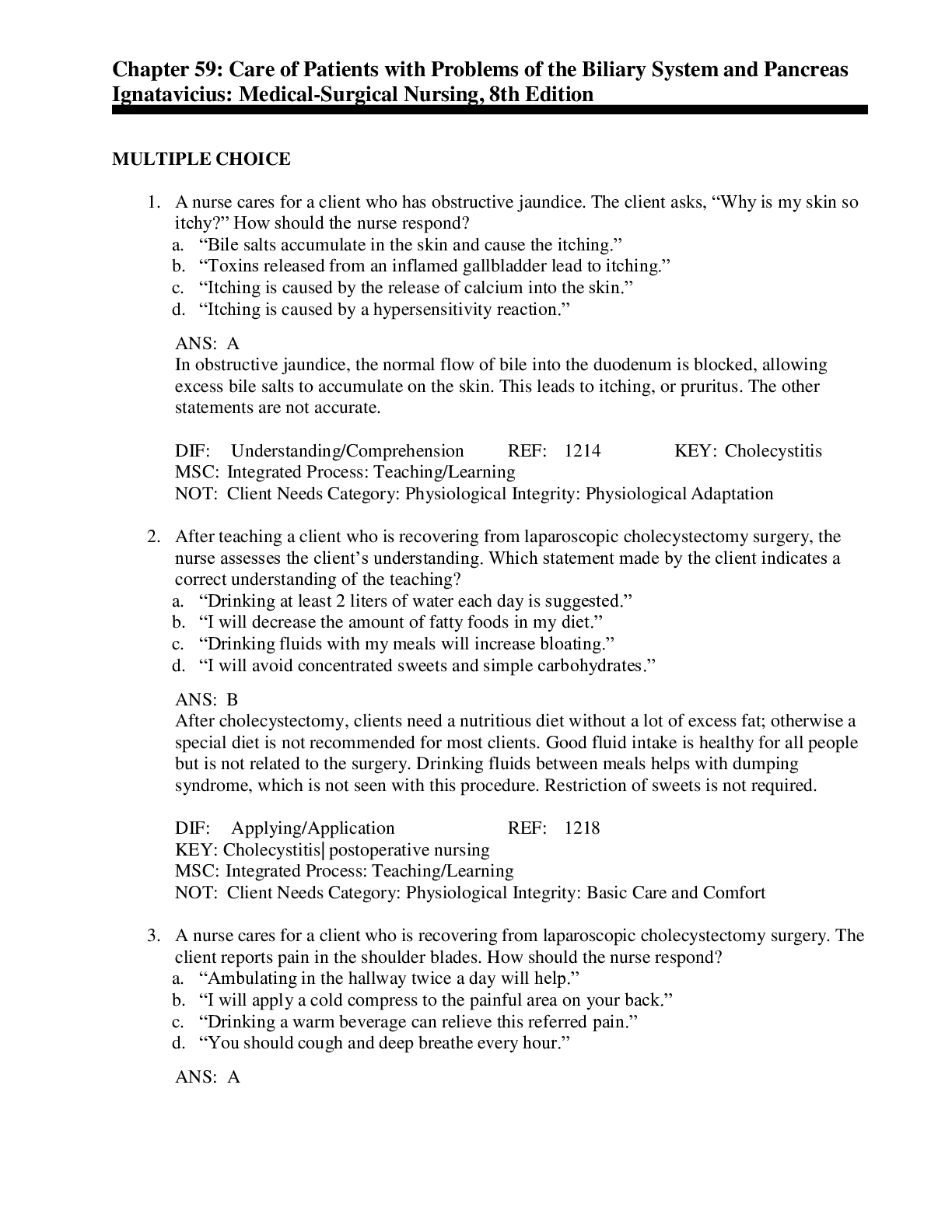
Chapter 59-- Musculoskeletal Dysfunction: Nursing Management
MULTIPLE CHOICE
1. A client is diagnosed with osteoarthritis. The nurse would not expect to find which of the following
during assessment?
1. Bouchard’s no
...
Chapter 59-- Musculoskeletal Dysfunction: Nursing Management
MULTIPLE CHOICE
1. A client is diagnosed with osteoarthritis. The nurse would not expect to find which of the following
during assessment?
1. Bouchard’s nodes
2. Crepitus
3. Heberden’s nodes
4. Symmetrical joint involvement
PTS: 1 DIF: Apply
REF: Osteoarthritis: Assessment with Clinical Manifestations
2. The nurse is instructing a client diagnosed with osteoarthritis. Which of the following statements
indicates that the client understands these instructions?
1. “Exercise will not be of help because it will stress my joints.”
2. “I will need to lose weight; my doctor says about 20 pounds.”
3. “I will take my medications only if the pain is very bad.”
4. “I can still go on my marathon shopping trips with my daughter.”
PTS: 1 DIF: Analyze
REF: Osteoarthritis: Collaborative Management; Evaluation of Outcomes
3. A client diagnosed with gout is concerned about the formation of nodules. The nurse should explain
that these nodules are called:
1. Bouchard’s nodes.
2. cysts.
3. Heberden’s nodes.
4. tophi.
PTS: 1 DIF: Apply REF: Gout: Pathophysiology
4. A client is experiencing an acute attack of gout. The nurse should be prepared to provide which of the
following medications as prescribed?
1. Allopurinol
2. Colchicine
3. Probenecid
4. Sulfinpyrazone
PTS: 1 DIF: Apply REF: Gout: Pharmacology
5. A client is going to have tender points examined to determine the diagnosis of fibromyalgia. The nurse
should instruct the client the number of tender points that must be positive for the diagnosis would be:
1. 11.
2. 13.
3. 15.
4. 17.
.
PTS: 1 DIF: Apply
REF: Fibromyalgia: Assessment with Clinical Manifestations
6. The nurse is teaching a group of community members at the senior center about osteoporosis. Which
of the following clinical manifestations should the nurse instruct as not being related to the disorder?
1. Decrease in height
2. Fractures
3. Kyphosis
4. Pain
PTS: 1 DIF: Apply
REF: Osteoporosis: Assessment with Clinical Manifestations
7. During an assessment, the nurse determines that a client has a forward curvature of the thoracic spine.
Which of the following terms would the nurse use to document this assessment finding?
1. Kyphosis
2. Lordosis
3. Scoliosis
4. Spondylolisthesis
PTS: 1 DIF: Apply REF: Spinal Disorders
8. A client is being evaluated for generalized skeletal pain and pain in the hips, ribs, and feet. The nurse
observes that the client walks with a waddling gait. Because of this information, which of the
following should the nurse suspect is occurring with this client?
1. Osteomalacia
2. Osteomyelitis
3. Osteosarcoma
4. Paget’s disease
PTS: 1 DIF: Analyze REF: Osteomalacia: Pathophysiology
9. A young client has been diagnosed with a soft tissue tumor resembling striated muscle in the neck. The
nurse realizes that this type of tumor would be considered:
1. chondrosarcoma.
2. Ewing’s sarcoma.
3. neurofibrosarcoma.
4. rhabdomyosarcoma.
PTS: 1 DIF: Analyze REF: Tumors of the Musculoskeletal System
10. When assessing a client diagnosed with ankylosing spondylitis, which of the following clinical
manifestations will the nurse most likely assess?
1. Small irregular pupil
2. Heel pain
3. Onycholysis
4. Respiratory depression
PTS: 1 DIF: Analyze
REF: Ankylosing Spondylitis: Assessment with Clinical Manifestations
11. A client is surprised to learn that she has been diagnosed with osteoporosis since she does not smoke,
is not underweight, and exercises. The nurse should assess if the client has any secondary conditions
which could cause the disorder, including:
1. diabetes mellitus.
2. heart failure.
3. fibromyalgia.
4. lactose intolerance.
PTS: 1 DIF: Apply
REF: Table 59-2 Contributing Factors to Secondary Osteoporosis
12. The nurse is assessing a client who is demonstrating clinical manifestations of Paget’s disease. The
nurse realizes that which of the following diagnostic tests will aid in the diagnosis of this disorder?
1. Chest x-ray
2. Hand x-ray
3. Serum albumin level
4. Serum alkaline phosphatase level
PTS: 1 DIF: Analyze REF: Paget's Disease: Diagnostic Tests
13. A client diagnosed with Paget’s disease is prescribed alendronate (Fosamax). Which of the following
should the nurse instruct the client regarding this medication?
1. “Do not eat anything for 30 minutes after taking a dose.”
2. “Take the medication on a full stomach.”
3. “Go to the physician’s office for the medication to be provided intravenously.”
4. “Expect to stay on this medication for only 6 months.”
PTS: 1 DIF: Apply
REF: Table 59-4 Biphosphonates used with Paget's Disease
MULTIPLE RESPONSE
1. The nurse is assessing a client who is diagnosed with gout. Which of the following findings will the
nurse most likely assess in this client? (Select all that apply.)
1. Decreased range of motion
2. Edema in a joint
3. Elevated uric acid levels
4. Pain that develops over many weeks
5. Fever
6. Headache
PTS: 1 DIF: Analyze REF: Gout: Assessment with Clinical Manifestations
2. The nurse is instructing a client diagnosed with gout about a low-purine diet. Which of the following
foods would be identified as those to avoid when following this diet? (Select all that apply.)
1. Avocados
2. Milk
3. Scallops
4. White bread
5. Alcohol
6. Bacon
PTS: 1 DIF: Apply REF: Gout: Nutrition
3. During an assessment, the nurse determines that a client has risk factors for the development of
osteoporosis. Which of the following are considered risk factors for this disorder? (Select all that
apply.)
1. Balanced diet
2. Corticosteroid therapy
3. Low body weight
4. Smoker
5. Impaired vision
6. Alcohol intake is one drink per month
PTS: 1 DIF: Analyze
REF: Red Flag: Risk Factors for Developing Osteoporosis and Related Fractures
4. A client is experiencing symptoms associated with the second-stage of Lyme disease. Which of the
following will the nurse most likely assess in this client? (Select all that apply.)
1. Erythema migrans
2. Numbness and pain in the arms and legs
3. Paralysis of facial muscles
4. Meningitis
5. Knee pain and swelling
6. Memory loss
PTS: 1 DIF: Apply
REF: Lyme Disease: Assessment with Clinical Manifestations
5. A client has been diagnosed with fibromyalgia. The nurse realizes that which of the following
categories of medications have been successful in the treatment of this disorder? (Select all that apply.)
1. Antiarrhythmics
2. Antibiotics
3. Antidepressants
4. Analgesics
5. Calcium channel blockers
6. Muscle relaxants
PTS: 1 DIF: Analyze REF: Fibromyalgia: Pharmacology
[Show More]


 Med Surg test Latest Verified Questions and all Correct Answers with Explanations Chapter 59.png)
 Med Surg test Latest Verified Questions and all Correct Answers with Explanations Chapter 59.png)

.png)