Chapter 62--Female Reproductive Dysfunction: Nursing Management
MULTIPLE CHOICE
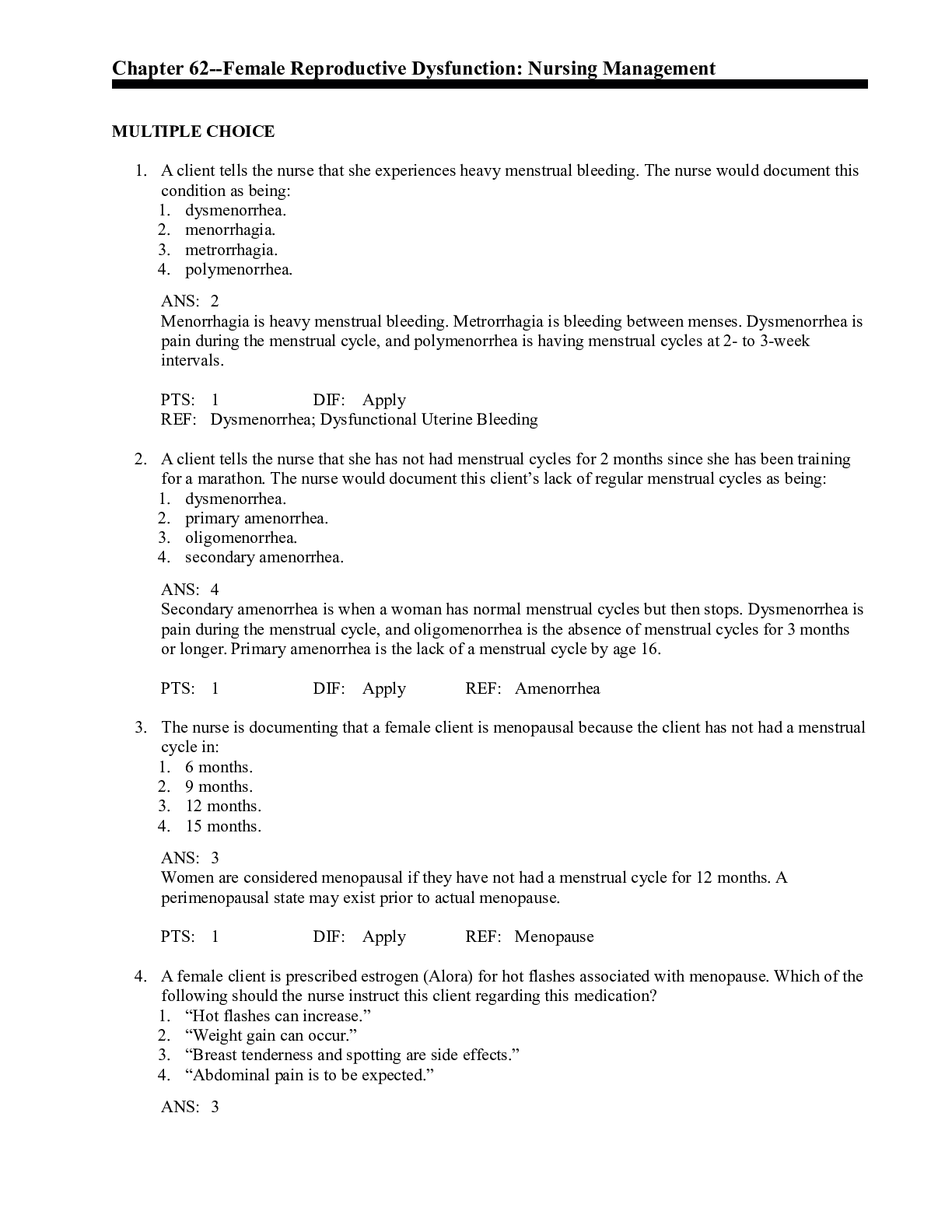
1. A client tells the nurse that she experiences heavy menstrual bleeding. The nurse would document this
condition as being:
1. dysmenor
...
Chapter 62--Female Reproductive Dysfunction: Nursing Management
MULTIPLE CHOICE
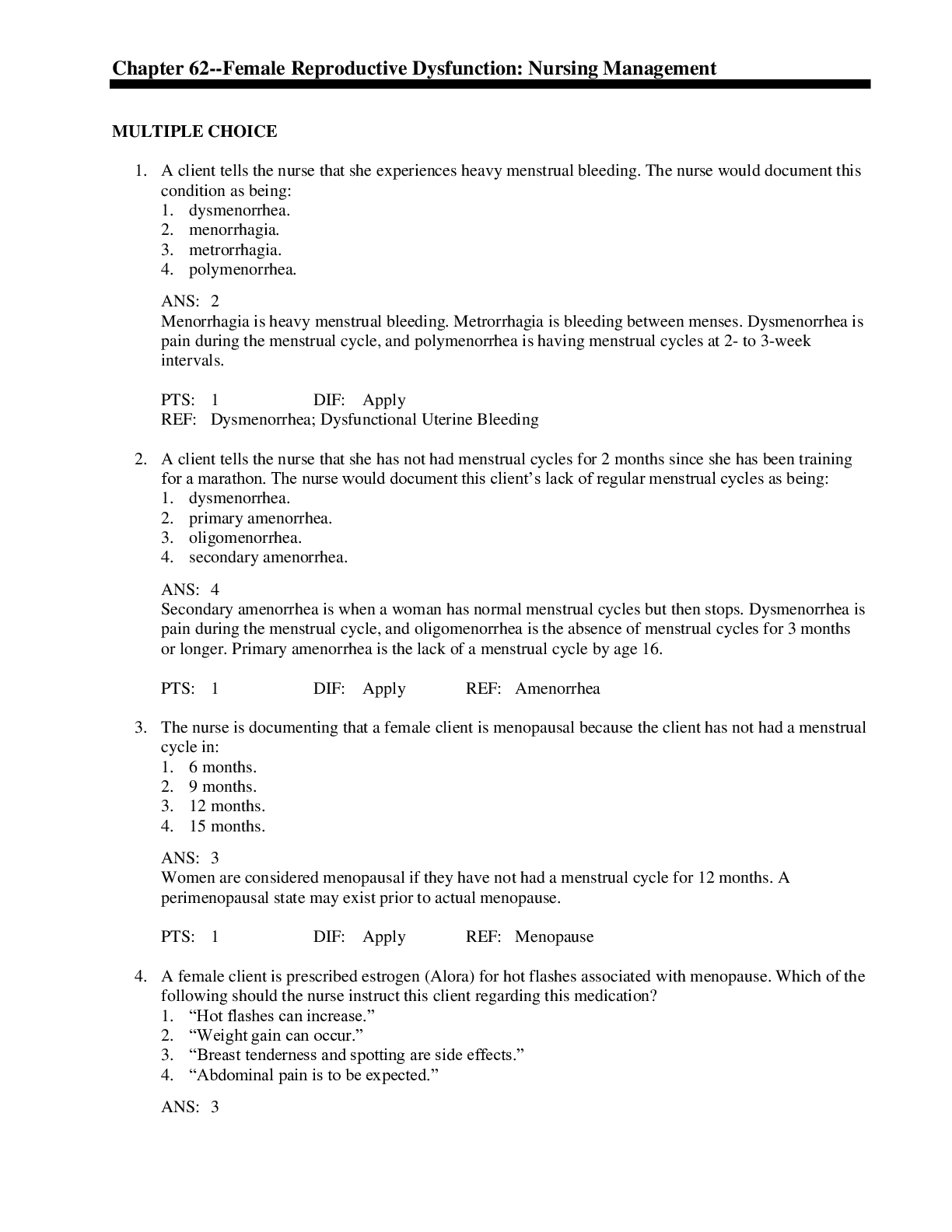
1. A client tells the nurse that she experiences heavy menstrual bleeding. The nurse would document this
condition as being:
1. dysmenorrhea.
2. menorrhagia.
3. metrorrhagia.
4. polymenorrhea.
PTS: 1 DIF: Apply
REF: Dysmenorrhea; Dysfunctional Uterine Bleeding
2. A client tells the nurse that she has not had menstrual cycles for 2 months since she has been training
for a marathon. The nurse would document this client’s lack of regular menstrual cycles as being:
1. dysmenorrhea.
2. primary amenorrhea.
3. oligomenorrhea.
4. secondary amenorrhea.
PTS: 1 DIF: Apply REF: Amenorrhea
3. The nurse is documenting that a female client is menopausal because the client has not had a menstrual
cycle in:
1. 6 months.
2. 9 months.
3. 12 months.
4. 15 months.
PTS: 1 DIF: Apply REF: Menopause
4. A female client is prescribed estrogen (Alora) for hot flashes associated with menopause. Which of the
following should the nurse instruct this client regarding this medication?
1. “Hot flashes can increase.”
2. “Weight gain can occur.”
3. “Breast tenderness and spotting are side effects.”
4. “Abdominal pain is to be expected.”
PTS: 1 DIF: Apply
REF: Table 62-1 Medications Used to Treat Menstrual Disorders
5. The nurse is caring for a female client recovering from surgery to remove the uterus, cervix, ovaries,
and fallopian tubes using a traditional approach. The nurse realizes this client has had a:
1. complete hysterectomy.
2. laparoscopically assisted vaginal hysterectomy.
3. partial hysterectomy.
4. total abdominal hysterectomy and bilateral salpingo-oophorectomy.
PTS: 1 DIF: Analyze
REF: Dysfunctional Uterine Bleeding: Planning and Implementation: Surgery
6. A female client, experiencing vulvar itching and discomfort, is diagnosed with Candida. What would
the nurse expect to find when assessing this client?
1. Foul, fishy odor
2. Gray, thin, watery discharge
3. Thick, white discharge
4. Yellow, green discharge
ANS: 3
PTS: 1 DIF: Apply REF: Infections: Vaginitis
7. A female client who has been menstruating has a temperature of 103.5°F, blood pressure 88/56 mmHg,
and a diffuse rash. The nurse realizes that this client is most likely experiencing:
1. pelvic inflammatory disease.
2. herpes simplex virus.
3. human papillomavirus.
4. toxic shock syndrome.
PTS: 1 DIF: Analyze REF: Toxic Shock Syndrome
8. The nurse is teaching a group of young adults about prevention of sexually transmitted infections
(STIs). Which of the following instructions would not be included during teaching?
1. Abstinence is the only way to completely prevent STIs.
2. Condoms provide some protection against STIs.
3. Make sure you and your partner finish the entire treatment regimen.
4. Once one STI is diagnosed, you are less likely to have an infection with another STI.
PTS: 1 DIF: Apply
REF: Sexually Transmitted Infection: Planning and Implementation: Population-Based Care
9. A 52-year-old female client had been treated for human papillomavirus. After 3 years of testing, the
client’s Pap smears are normal. The nurse realizes that the client’s next Pap smear should be in:
1. 2 years
2. 3 years
3. 5 years
4. 10 years
PTS: 1 DIF: Analyze REF: Table 62-3 Changes in Pap Smear Guidelines
10. A female client has had a type 1 female circumcision. The nurse realizes that which of the following
has been surgically removed on the client?
1. Clitoris
2. Clitoris and labia minora
3. Clitoris, labia minora, inner surface of labia majora, and suturing of the vagina
4. Clitoris and uterus
PTS: 1 DIF: Analyze REF: Female Circumcision
11. The nurse determines that a female client is at risk for developing a gynecological malignancy because
which of the following is assessed?
1. Alcohol intake of one drink every week
2. Currently overweight
3. Smoking history
4. History of constipation
PTS: 1 DIF: Analyze REF: Malignancies
12. A female client diagnosed with infertility is prescribed medication. The nurse would provide
instruction regarding which of the following medications?
1. Viagra
2. Delatestryl
3. Testim
4. Clomiphene citrate
PTS: 1 DIF: Apply REF: Infertility: Pharmacology
MULTIPLE RESPONSE
1. A female client is diagnosed with premenstrual dysphoric disorder. Which of the following will the
nurse most likely assess in this client? (Select all that apply.)
1. Feeling sad or hopeless
2. Feeling anxious
3. Mood swings
4. Increased sleep
5. Anger
6. Thirst
PTS: 1 DIF: Apply
REF: Premenstrual Syndrome and Premenstrual Dysphoric Disorder
2. A female client, diagnosed with pelvic inflammatory disease, is being considered for inpatient
treatment. Which of the following would indicate that the client should be admitted to the hospital for
care of this disorder? (Select all that apply.)
1. The client is pregnant.
2. The client will not adhere to the prescribed antibiotic therapy.
3. The client’s temperature is 103 degrees°F.
4. The client is experiencing symptoms of a tubo-ovarian abscess.
5. The client’s blood pressure is 120/80 mmHg.
6. The client has purulent cervical discharge.
PTS: 1 DIF: Analyze
REF: Box 62-1 Criteria for Inpatient Treatment of PID
3. A client is diagnosed with a sexually transmitted infection that the nurse needs to report to the local
health department. Which of the following sexually transmitted infections need to be reported by the
nurse? (Select all that apply.)
1. Bacteria vaginitis
2. HPV
3. HIV
4. Chlamydia
5. Gonorrhea
6. Syphilis
PTS: 1 DIF: Apply REF: Health Care Resources
4. A female client is diagnosed with a cystocele. The nurse should prepare to instruct the client on which
of the following? (Select all that apply.)
1. Kegel exercises
2. Pessary insertion
3. Use of estrogen cream
4. Operative repair
5. Hysterectomy
6. Antibiotics
PTS: 1 DIF: Apply REF: Pelvic Relaxation
5. A client is diagnosed with uterine fibroids. Which of the following would indicate that surgery is
needed for this client? (Select all that apply.)
1. Abnormal bleeding not responsive to other therapy
2. Weight gain of 10 lbs over the last 3 months
3. Growth of fibroids after menopause
4. Chronic constipation
5. Client unable to conceive
6. Diagnosed with iron deficiency anemia
PTS: 1 DIF: Analyze
REF: Box 62-2 Indications for Surgical Management of Fibroids
[Show More]

.png)
 Med Surg test Latest Verified Questions and all Correct Answers with Explanations Chapter 62 Managements of Patients with Burn Injury.png)
.png)

 (1).png)