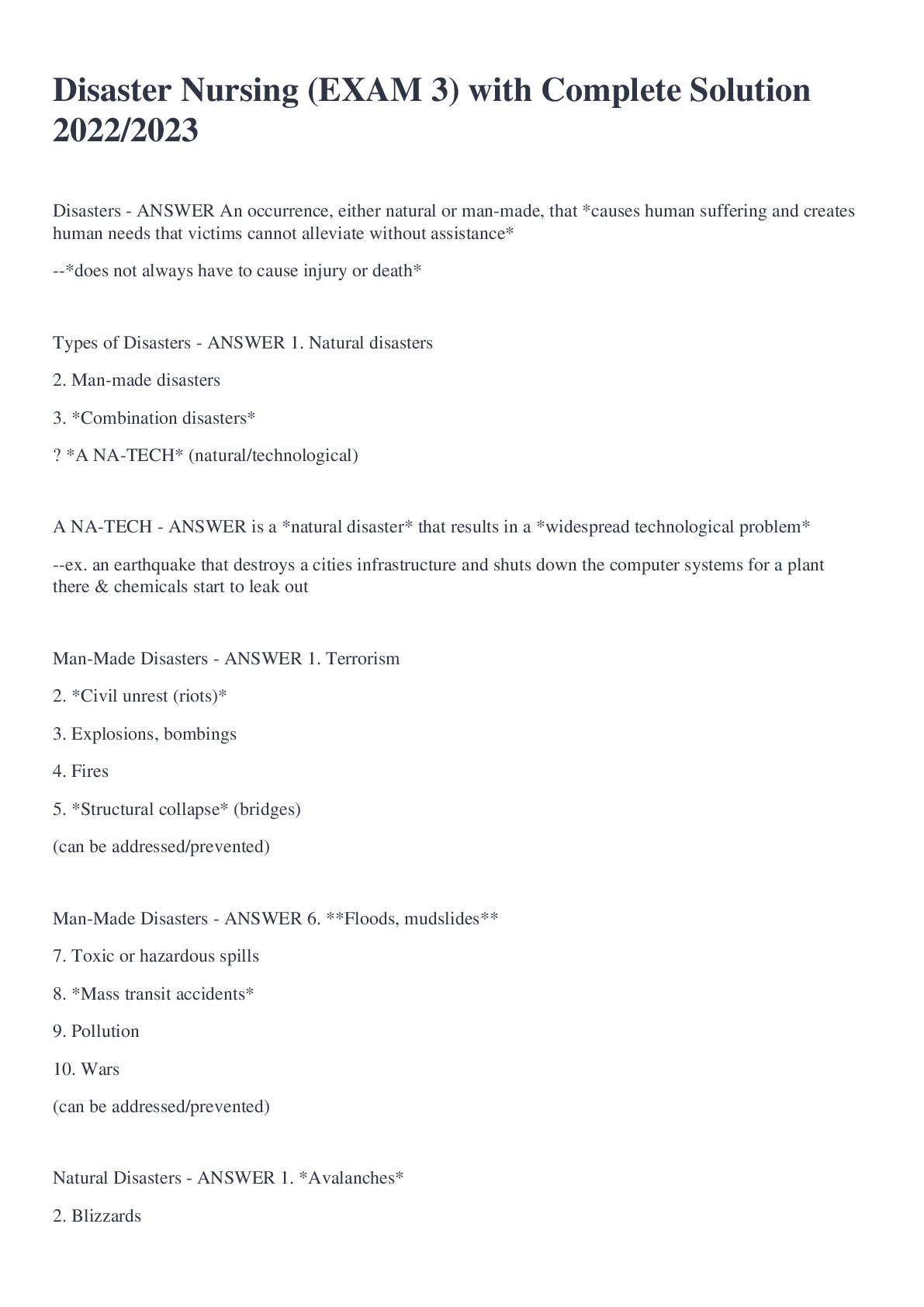
Disasters - ANSWER An occurrence, either natural or man-made, that *causes human suffering and creates human needs that victims cannot alleviate without assistance*
--*does not always have to cause injury or death*
T
...
Disasters - ANSWER An occurrence, either natural or man-made, that *causes human suffering and creates human needs that victims cannot alleviate without assistance*
--*does not always have to cause injury or death*
Types of Disasters - ANSWER 1. Natural disasters
2. Man-made disasters
3. *Combination disasters*
● *A NA-TECH* (natural/technological)
A NA-TECH - ANSWER is a *natural disaster* that results in a *widespread technological problem*
--ex. an earthquake that destroys a cities infrastructure and shuts down the computer systems for a plant there & chemicals start to leak out
Man-Made Disasters - ANSWER 1. Terrorism
2. *Civil unrest (riots)*
3. Explosions, bombings
4. Fires
5. *Structural collapse* (bridges)
(can be addressed/prevented)
Man-Made Disasters - ANSWER 6. **Floods, mudslides**
7. Toxic or hazardous spills
8. *Mass transit accidents*
9. Pollution
10. Wars
(can be addressed/prevented)
Natural Disasters - ANSWER 1. *Avalanches*
2. Blizzards
3. Communicable disease epidemics
4. Droughts, wildfires
5. Earthquakes, tsunamis
Natural Disasters - ANSWER 6. Hailstorms
7. Heat waves
8. Hurricanes
9. Tornados, cyclones
10. Volcanic eruptions
Terrorism - ANSWER the unlawful use of force and or *violence against persons or property* to *intimidate or coerce a government, the civilian population*, or any segment thereof, in *furtherance of political or social objectives*.
Terrorism - ANSWER *premeditated, politically motivated violence* perpetrated *against noncombatant targets by sub-national groups* or *clandestine agents*
Acts of Terrorism - ANSWER 1. *Threats* of terrorism
2. *Assassinations*
3. *Kidnappings*
4. Hijackings
5. Bombings, *Computer hacking*, etc.
Weapons of Mass Destruction - ANSWER 1. Designed or *intended to cause death or serious bodily injury* through release, dissemination, or impact of toxic or poisonous chemicals, or their precursors
Weapons of Mass Destruction - ANSWER 2. Any weapon involving a disease organism (biological agents)
3. Any weapon that is designed to release *radiation or radioactivity* at a level *dangerous to human life* (chemical agents)
Primary Agents - ANSWER The physical item that *actually causes the injury* or destruction, i.e. *heat, wind, water, smoke* etc.
Secondary Agents - ANSWER *caused by the primary agent*, i.e. bacteria, viruses, epidemics, contaminated water (from flooding) or food (can last over months depending on the damage done)
Characteristics of Disasters - ANSWER 1. *Frequency* (how often--also may causes desensitivity; been there, done that attitude. but should cause more preparedness)
2. *Predictability* (ability to *determine when*)
Characteristics of Disasters - ANSWER 3. *Preventability* (how preventable is it)
4. *Imminence*
--the *speed of onset* of an impending disaster & *amount of forecast/warning*
Characteristics of Disasters - ANSWER 5. *Scope and number of casualties*:
--both the *demographic area (how big)* involved & *# of individuals affected*, injured, or killed.
6. *Intensity* (level of destruction & devastation of the event--hurricane category maybe)
Primary prevention - ANSWER 1. *Aimed at preventing the occurrence* of a disaster or limiting the consequences (mitigation)
2. Occurs in *nondisaster and predisaster stages*
Secondary prevention - ANSWER 1. Safety *before search and rescue, and triage of victims*
2. Assessment of destruction and devastation
3. **Implemented once the disaster occurs**
Tertiary prevention - ANSWER 1. Focuses on *recovery & restoring* the community to previous levels of functioning
2. Aimed at *preventing a recurrence* or *minimizing the effects of future disasters*
Disaster Management - ANSWER 1. A *collaborative interdisciplinary team effort is needed* between a *network of agencies and individuals*.
2. Develop a disaster plan
Developing a disaster plan - ANSWER ● Communities can respond *more quickly, more effectively*, and with less confusion.
● *Ensures that resources* are available.
● *Delineates roles and responsibilities of all personnel and agencies*, both official and unofficial.
Phases of a Disaster - ANSWER 1. *Pre-impact phase* (Forecast, early warning, preparedness)
2. *Impact phase* (Close monitoring of impact; *deploying rescue teams*)
3. *Post-impact phase* (Medical care, food, repair/restore)
Local government (Governmental Responsibilities) - ANSWER *Responsible for the safety and welfare* of its citizens. (refer to state government if not enough resources)
State government (Governmental Responsibilities) - ANSWER Involved *when a disaster overwhelms the local community's resources*.
Federal government (Governmental Responsibilities) - ANSWER *Develops a system connecting all levels* of government *without duplicating effort*. (provides funding)
Agencies Involved in Disaster
Preparedness, Planning, and Response - ANSWER ● Local, State, and Regional Emergency Management Officials.
● American Red Cross/ Salvation Army.
● Local Hospitals, EMS, Fire and Police Dept. Home Health, Medical supply agencies.
● Public Health Department
Agencies Involved in Disaster
Preparedness, Planning, and Response - ANSWER ● Faith-Based Organizations
● Federal Emergency Management Agency (FEMA)
● Department of Homeland Security.
● Center for Disease Control (CDC)
● Texas Department of State Health Services (DSHS)
● Communities and volunteers
U.S. Department of Homeland Security (DHS)
*primary missions* - ANSWER 1. Lead the *unified national effort to secure America*
2. Prevent and *deter terrorist attacks*
3. Protect against and *respond to threats and hazards* to the nation
U.S. Department of Homeland Security (DHS) *GOAL* - ANSWER 1. Sets the *"vision for nationwide preparedness"*
2. *Identifies the core capabilities* and *targets necessary to achieve preparedness* across *5 mission areas*:
--Prevention,
--Protection,
--*Mitigation*,
--Response, and
--Recovery.
*Principles of Disaster Management* - ANSWER 1. Prevention/mitigation
2. Preparedness
3. Response, rescue, *emerging medical care*, & *triage*
4. Reconstruction & recovery
Prevention/*Mitigation* - ANSWER 1. *Identify potential disaster* risks.
● *Create risk maps*
2. *Educate citizens* regarding what actions to take to *prepare for disasters*.
● Individual, family, and community level
Prevention/*Mitigation* - ANSWER 3. Develop a *plan for meeting the potential disasters* identified.
Mitigation - ANSWER Actions or *measures taken that
can either prevent the disaster or
reduce the severity*/impact of the
effects of the disaster.
--Plan must be **realistic and simple**
Preparedness/Planning Stage:
Individual and Family Preparedness - ANSWER 1. Training in first aid
2. Assembling a *disaster emergency kit*
(flash, radio, water)
[Show More]