PMP Prep 2021
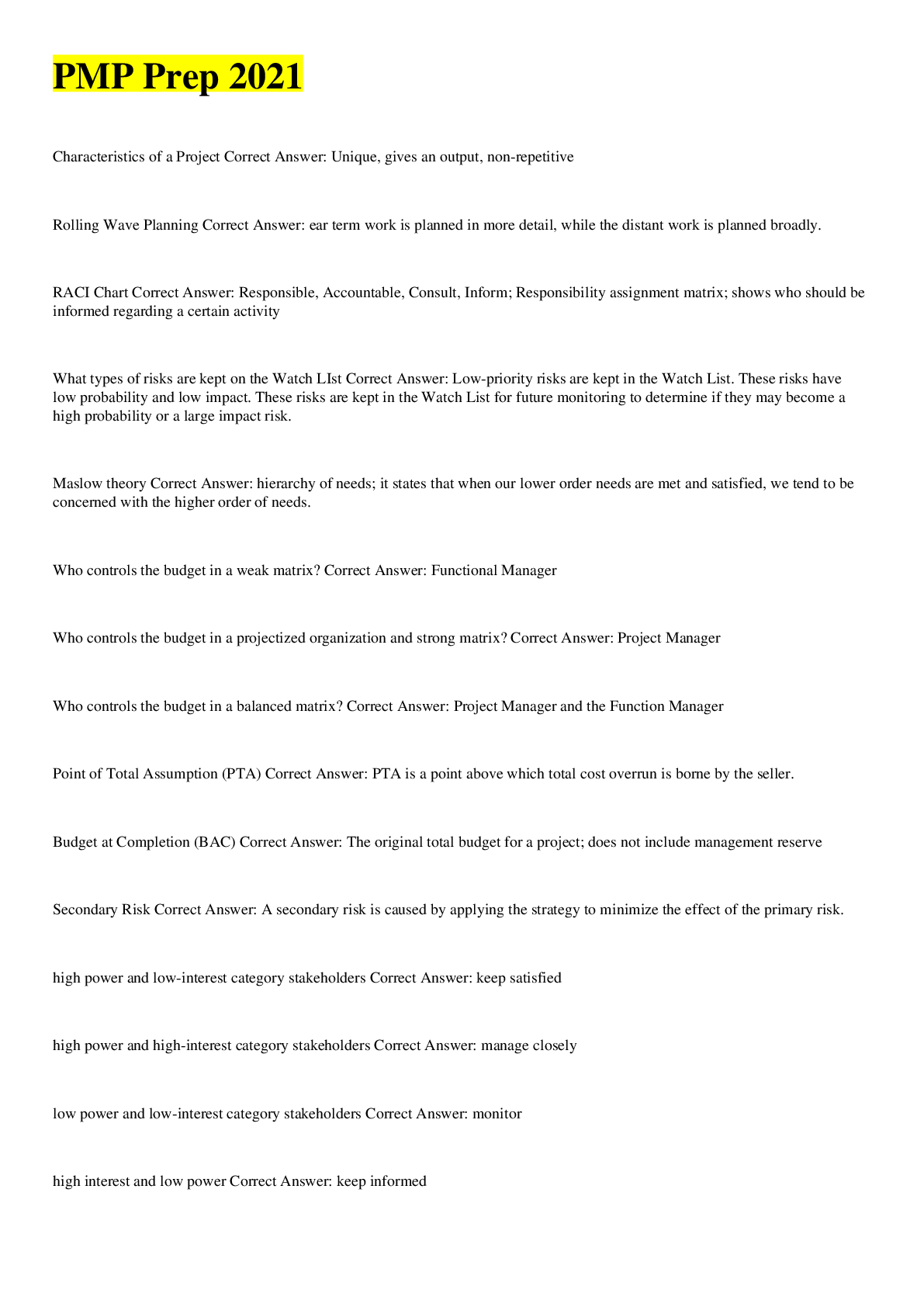
Characteristics of a Project Correct Answer: Unique, gives an output, non-repetitive
Rolling Wave Planning Correct Answer: ear term work is planned in more detail, while the distant work is planned
...
PMP Prep 2021
Characteristics of a Project Correct Answer: Unique, gives an output, non-repetitive
Rolling Wave Planning Correct Answer: ear term work is planned in more detail, while the distant work is planned broadly.
RACI Chart Correct Answer: Responsible, Accountable, Consult, Inform; Responsibility assignment matrix; shows who should be informed regarding a certain activity
What types of risks are kept on the Watch LIst Correct Answer: Low-priority risks are kept in the Watch List. These risks have low probability and low impact. These risks are kept in the Watch List for future monitoring to determine if they may become a high probability or a large impact risk.
Maslow theory Correct Answer: hierarchy of needs; it states that when our lower order needs are met and satisfied, we tend to be concerned with the higher order of needs.
Who controls the budget in a weak matrix? Correct Answer: Functional Manager
Who controls the budget in a projectized organization and strong matrix? Correct Answer: Project Manager
Who controls the budget in a balanced matrix? Correct Answer: Project Manager and the Function Manager
Point of Total Assumption (PTA) Correct Answer: PTA is a point above which total cost overrun is borne by the seller.
Budget at Completion (BAC) Correct Answer: The original total budget for a project; does not include management reserve
Secondary Risk Correct Answer: A secondary risk is caused by applying the strategy to minimize the effect of the primary risk.
high power and low-interest category stakeholders Correct Answer: keep satisfied
high power and high-interest category stakeholders Correct Answer: manage closely
low power and low-interest category stakeholders Correct Answer: monitor
high interest and low power Correct Answer: keep informed
Enterprise Environmental Factors Correct Answer: Conditions, not under the immediate control of the team, that influence, constrain, or direct the project, program, or portfolio. Rules & Regulations, Organization Culture, and Market Conditions are examples of Enterprise Environmental Factors.
Contingency reserve Correct Answer: A time or dollar amount allotted as a response to KNOWN risk events that may occur within a project.
Organizational Process Assets Correct Answer: assets possessed by an organization to help you to run the project efficiently and smoothly; e.g. policies, procedures, lessons learned, etc.
Planned Value Correct Answer: Planned Value (PV) is the authorized budget assigned to work to be accomplished for an activity or WBS component.
(Planned % Complete) X (BAC)
Standard deviation equation Correct Answer: Standard Deviation = (Pessimistic Estimate - Optimistic Estimate)/6
Management Reserve Correct Answer: discretionary reserve set aside by upper management to be used to cover future situations that can't be predicted. unidentified risk.
Gold plating Correct Answer: Gold Plating is a phenomenon where you add some extra features to the product in order to make the client happy. Gold Plating may increase cost and risks.
TCPI Correct Answer: To Complete Performance Index. The efficiency needed to complete project. If greater than 1, you need to work with better cost performance.
TCPI = (BAC - EV) / (BAC - AC)
Scope Creep Correct Answer: The uncontrolled expansion to product or project scope without adjustments to time, cost, and resources.
Resource leveling Correct Answer: you arrange resources to maximize their utility.
Pareto Chart Correct Answer: Vertical bar graph on which bar height reflects frequency or impact of causes; helps you identify the minor number of sources causing most of the troubles.
workaround Correct Answer: A response to an unplanned risk event
defect repair Correct Answer: Defect Repair is a process where you correct a defective component.
preventative action Correct Answer: Preventive actions are taken when the project is trending away from the planned scope, schedule, cost, or quality requirements. Preventive actions are proactive in nature, based on a variance and trend analysis.
Preventive actions are intended to ensure the project is delivered in alignment with the agreed-upon project baselines.
corrective action Correct Answer: Corrective actions are taken when the project has deviated from the planned scope, schedule, cost, or quality requirements. Corrective actions are reactive in nature and are intended to bring the project's performance back into alignment with the agreed-upon project baselines.
Triple Constraint Correct Answer: time, cost, scope
Fishbone diagram is also known as Correct Answer: cause-and-effect and Ishikawa diagram.
Which estimate is given more weight in the PERT estimate formula? Correct Answer: Most Likely estimate; (Optimistic + 4*Most-Likely + Pessimistic)/6
In which project phases do you identify the project stakeholders? Correct Answer: all phases
EMV = Correct Answer: Expected Monetary Value = Impact * Probability
Which relationship model is most commonly used in the Precedence diagrams Correct Answer: start to finish
Delphi Technique Correct Answer: A decision-making technique in which group members (experts) do not meet face-to-face but respond in writing to questions posed by the group leader.
What theory was suggested by Demming? Correct Answer: The Plan-do-Check-Act doctrine - used in scrum, iterative and agile practice
CPI = Correct Answer: EV/AC (earned value/actual cost)
SV (schedule variance) Correct Answer: EV-PV
Screening system Correct Answer: predefined criteria that are used to short-list vendors for source selection
Predictive Life Cycle Correct Answer: More traditional approach; bulk of planning up front; execute in a single pass; sequential
Iterative Life Cycle Correct Answer: Allows feedback for unfinished work to improve and modify that work
Incremental Life Cycle Correct Answer: Provides finished deliverables that the customer may be able to use immediately
Agile Life Cycle Correct Answer: Iterative and Incremental to refine work items and deliver frequently
Agile Team Members Correct Answer: Cross functional team member, team facilitator, product owner
In an agile team, what is the product owners role? Correct Answer: guide direction of work; rank work based on business value; provide fedback; work with stakeholders, cutomers and teams to define product direction; create the backlog for and with the team
Team Facilitator role Correct Answer: servant leader; scrum master; coach
T shaped people Correct Answer: have a speciality but also breadth of experience across multiple skills
Retrospective Correct Answer: At regular intervals, the team reflects on work product, how to become more effective and then tunes and adjusts its behavior accordingly. Doesn't have to be after an iteration only - can be when the team is stuck, when the team complets something, when its been a few weeks since the last retrospective, etc.
What are some methodologies that can be used for Agile project management? Correct Answer: DAD, Crystal Methods, BDD, TDD, Kanban
What are some useful types of documentation for Agile projects? Correct Answer: Acceptance testing documents, user documentation, support documentation
Identify the four Scrum inspect and adapt events. Correct Answer: Sprint Planning, Sprint review, Daily Scrum, Sprint Restrospective
Identify some of the recommended components of a business case. Correct Answer: Goals, Strategy, Opportunity, Project Vision
Which are suitable types of contracts for an Agile project? Correct Answer: Not to exceed with fixed fee, incentive contracts, service contracts for the series of fixed price contracts, time and material contracts, cost reimbursible
What are the five Agile project management model phases? Correct Answer: Envisioning, Adapting, Exploring, Speculating, Closing
Identify characteristics of the Agile method. Correct Answer: *Identifies issues earlier and changes are easier to implement
*Agile is incremental
*Agile is iterative
*Agile focuses on highest-value items first
*Agile allows for feedback to be obtained early and often
Agile Primary Value Correct Answer: Individuals and Interactions
Working Software
[Show More]