Stress and strain
3.1 Introduction
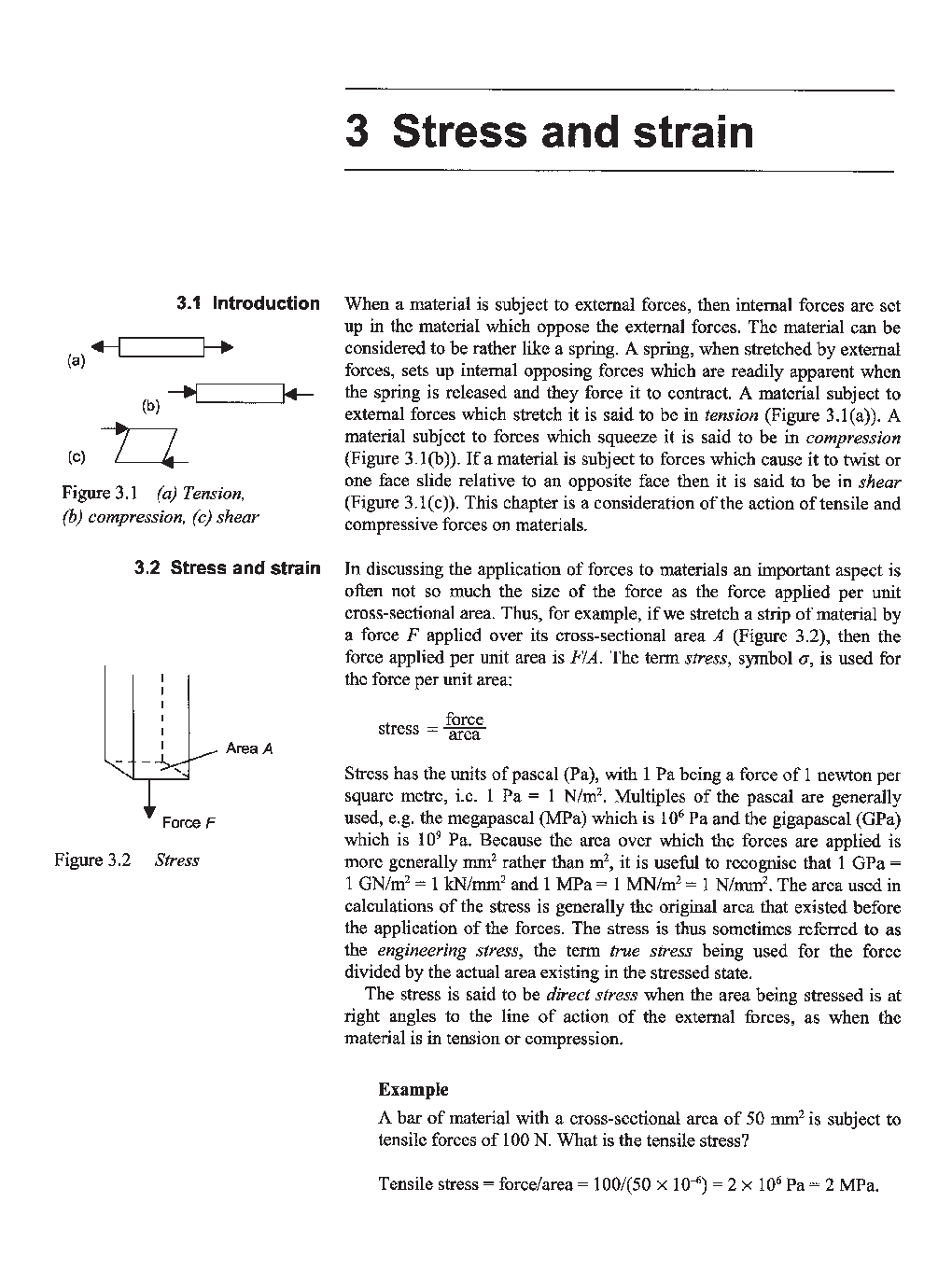
Figure 3.1 (a) Tension,
(b) compression, (c) shear
When a material is subject to external forces, then internal forces are set
up in the material which oppose the external for
...
Stress and strain
3.1 Introduction
Figure 3.1 (a) Tension,
(b) compression, (c) shear
When a material is subject to external forces, then internal forces are set
up in the material which oppose the external forces. The material can be
considered to be rather like a spring. A spring, when stretched by external
forces, sets up internal opposing forces which are readily apparent when
the spring is released and they force it to contract. A material subject to
external forces which stretch it is said to be in tension (Figure 3.l(a)). A
material subject to forces which squeeze it is said to be in compression
(Figure 3.l(b)). If a material is subject to forces which cause it to twist or
one face slide relative to an opposite face then it is said to be in shear
(Figure 3.l(c)). This chapter is a consideration of the action of tensile and
compressive forces on materials.
3.2 Stress and strain In discussing the application of forces to materials an important aspect is
often not so much the size of the force as the force applied per unit
cross-sectional area. Thus, for example, if we stretch a strip of material by
a force F applied over its cross-sectional area A (Figure 3.2), then the
force applied per unit area is FIA. The term stress, symbol o, is used for
the force per unit area:
Force F
Figure 3.2 Stress
stress =
force
,,,
Stress has the units of pascal (Pa), with 1 Pa being a force of 1 newton per
square metre, i.e. 1 Pa = 1 N/mZ. Multiples of the pascal are generally
used, e.g. the megapascal (MPa) which is 106 Pa and the gigapascal (GPa)
which is 109 Pa. Because the area over which the forces are applied is
more generally mm2 rather than m2, it is usell to recognise that 1 GPa =
1 GN/m2 = 1 kN/mm2 and 1 MPa = 1 MN/m2 = 1 NI&. The area used in
calculations of the stress is generally the original area that existed before
the application of the forces. The stress is thus sometimes referred to as
the engineering stress, the term true stress being used for the force
divided by the actual area existing in the stressed state.
The stress is said to be direct stress when the area being stressed is at
right angles to the line of action of the external forces, as when the
material is in tension or compression.
Example
A bar of material with a cross-sectional area of 50 mm2 is subject to
tensile forces of 100 N. What is the tensile stress?
Tensile stress = forcelarea = 100/(50 X 104) = 2 X 10⁶ Pa = 2 MPa.
Stress and strain 33
Example
A pipe has an outside diameter of 50 mm and an inside diameter of
45 mm and is acted on by a tensile force of 50 kN. What is the stress
acting on the pipe?
The cross-sectional area of the pipe is !An(@ - d2), where D is the
external diameter and d the internal diameter. Thus, the crosssectional area = '/4z(502 - 452) = 373 mm2. Hence:
Stress = - - - 3:!~ :r6 = 134 X 106 Pa = 134 MPa
3.2.1 Direct strain
Original
length
L# f (a) Force
Force I , A * compression
Figure 3.3 (a) Tensile strain.
(b) compressive strain
Area over which
force applied A
Figure 3.4 Shear
When a material is subject to tensile or compressive forces, it changes in
length (Figure 3.3). The term strain, symbol E, is used for:
change in length Strain = original length
Since strain is a ratio of two lengths it has no units; note that both lengths
must be in the same units of length. Thus we might, for example, have a
strain of 0.01. This would indicate that the change in length is 0.01 X the
original length. However, strain is frequently expressed as a percentage:
change in length
Strain as a % = original length X 100%
Thus the strain of 0.01 as a percentage is l%, i.e. this is when the change
in length is 1 % of the original length.
Example
A strip of material has a length of 50 mm. When it is subject to
tensile forces it increases in length by 0.020 mm. What is the strain?
change in length Strain = 0.020 - 0.000 04 or 0.04% original length - 50
Example
A tensile test piece has a gauge length of 50 mm. This increases by
0.030 mm when subject to tensile forces. What is the strain?
change in length Strain = 0'030 - 0.000 06 or 0.06% original length - 50
3.2.2 Shear stresses and strains
There is another way we can apply forces to materials and that is in such a
way as to tend to slide one layer of the material over an adjacent layer.
This is termed shear. Shear stresses are not direct stresses since the forces
being applied are in the same plane as the area being stressed. Figure 3.4
34 Engineering Science
shows how a material can be subject to shear. With shear, the area over
which forces act is in the same plane as the line of action of the forces.
The force per unit area is called the shear stress:
shear stress =
force
The unit of shear stress is the pascal (Pa).
With tensile and compressive stresses, changes in length are produced;
with shear stress there is an angular change 4. Shear strain is defined as
being the angular deformation:
shear strain = 4
Figure 3.5 Example
The unit used is the radian and, since the radian is a ratio, shear strain can
be either expressed in units of radians or without units.
Example
Figure 3.5 shows a component that is attached to a vertical surface by
means of an adhesive. The area of the adhesive in contact with the
component is 100 mm2. The weight of the component results in a
force of 30 N being applied to the adhesive-component interface.
What is the shear stress?
Shear stress = forcelarea = 30/(100 X 10") = 0.3 X 10⁶ Pa = 0.3 MPa.
[Show More]





![Preview of eBook [PDF] Barash, Cullen, and Stoelting's Clinical Anesthesia 9th Edition By Bruce F. Cu](https://browseimages.nyc3.digitaloceanspaces.com/paper-images/2024/Aug/29/8DF2QRTq2024-08-29-10-3966d0259b7c4b5.png)
![Preview of eBook [PDF] Burns' Pediatric Primary Care 7th Edition BY Dawn Lee Garzon Maaks,, Nancy Bar](https://browseimages.nyc3.digitaloceanspaces.com/paper-images/2024/Aug/26/WR2rowXX2024-08-26-02-0966cc625bea839.png)
![Preview of eBook [PDF] AACN Essentials of Progressive Care Nursing 5th Edition By Sarah A. Delgado](https://browseimages.nyc3.digitaloceanspaces.com/paper-images/2024/Aug/29/ipbdJSTN2024-08-29-11-1466d02df30fc96.png)
![Preview of [eTextbook] [PDF] Labor Economics 9th Edition By George Borjas](https://browseimages.nyc3.digitaloceanspaces.com/paper-images/2025/Jan/13/JcsHZtUb2025-01-13-07-42678542822cb77.png)
![Preview of [eTextbook] [PDF] Our Sexuality Enhanced Edition, Loose-leaf Version 14 Edition By Robert](https://browseimages.nyc3.digitaloceanspaces.com/paper-images/2025/Jan/11/dWqGQ6Ng2025-01-11-11-566782db1b759b0.png)