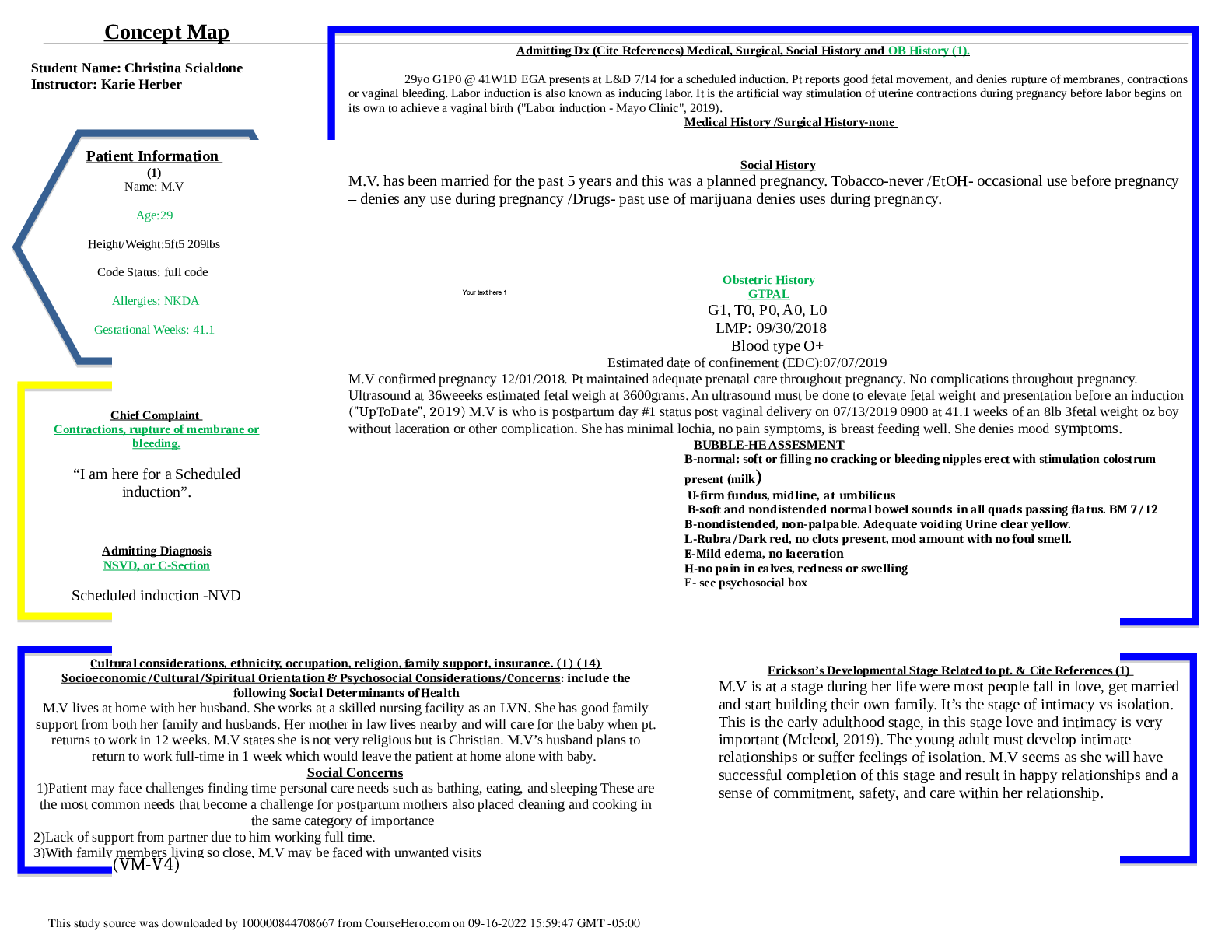
Admitting Dx (Cite References) Medical, Surgical, Social History and OB History (1).
29yo G1P0 @ 41W1D EGA presents at L&D 7/14 for a scheduled induction. Pt reports good fetal movement, and denies rupture of membranes,
...
Admitting Dx (Cite References) Medical, Surgical, Social History and OB History (1).
29yo G1P0 @ 41W1D EGA presents at L&D 7/14 for a scheduled induction. Pt reports good fetal movement, and denies rupture of membranes, contractions
or vaginal bleeding. Labor induction is also known as inducing labor. It is the artificial way stimulation of uterine contractions during pregnancy before labor begins on
its own to achieve a vaginal birth ("Labor induction - Mayo Clinic", 2019).
Medical History /Surgical History-none
Social History
M.V. has been married for the past 5 years and this was a planned pregnancy. Tobacco-never /EtOH- occasional use before pregnancy
– denies any use during pregnancy /Drugs- past use of marijuana denies uses during pregnancy.
Obstetric History
GTPAL
G1, T0, P0, A0, L0
LMP: 09/30/2018
Blood type O+
Estimated date of confinement (EDC):07/07/2019
M.V confirmed pregnancy 12/01/2018. Pt maintained adequate prenatal care throughout pregnancy. No complications throughout pregnancy.
Ultrasound at 36weeeks estimated fetal weigh at 3600grams. An ultrasound must be done to elevate fetal weight and presentation before an induction
("UpToDate", 2019) M.V is who is postpartum day #1 status post vaginal delivery on 07/13/2019 0900 at 41.1 weeks of an 8lb 3fetal weight oz boy
without laceration or other complication. She has minimal lochia, no pain symptoms, is breast feeding well. She denies mood symptoms.
BUBBLE-HE ASSESMENT
B-normal: soft or filling no cracking or bleeding nipples erect with stimulation colostrum
present (milk)
U-firm fundus, midline, at umbilicus
B-soft and nondistended normal bowel sounds in all quads passing flatus. BM 7/12
B-nondistended, non-palpable. Adequate voiding Urine clear yellow.
L-Rubra/Dark red, no clots present, mod amount with no foul smell.
E-Mild edema, no laceration
H-no pain in calves, redness or swelling
E- see psychosocial box
Chief Complaint
Contractions, rupture of membrane or
bleeding.
“I am here for a Scheduled
induction”.
Admitting Diagnosis
NSVD, or C-Section
Scheduled induction -NVD
Cultural considerations, ethnicity, occupation, religion, family support, insurance. (1) (14)
Socioeconomic /Cultural/Spiritual Orientation & Psychosocial Considerations/Concerns: include the
following Social Determinants of Health
M.V lives at home with her husband. She works at a skilled nursing facility as an LVN. She has good family
support from both her family and husbands. Her mother in law lives nearby and will care for the baby when pt.
returns to work in 12 weeks. M.V states she is not very religious but is Christian. M.V’s husband plans to
return to work full-time in 1 week which would leave the patient at home alone with baby.
Social Concerns
1)Patient may face challenges finding time personal care needs such as bathing, eating, and sleeping These are
the most common needs that become a challenge for postpartum mothers also placed cleaning and cooking in
the same category of importance
2)Lack of support from partner due to him working full time.
3)With family members living so close, M.V may be faced with unwanted visits
Erickson’s Developmental Stage Related to pt. & Cite References (1)
M.V is at a stage during her life were most people fall in love, get married
and start building their own family. It’s the stage of intimacy vs isolation.
This is the early adulthood stage, in this stage love and intimacy is very
important (Mcleod, 2019). The young adult must develop intimate
relationships or suffer feelings of isolation. M.V seems as she will have
successful completion of this stage and result in happy relationships and a
sense of commitment, safety, and care within her relationship.
Patient Information
(1)
Name: M.V
Age:29
Height/Weight:5ft5 209lbs
Code Status: full code
Allergies: NKDA
Gestational Weeks: 41.1
Concept Map
Student Name: Christina Scialdone
Instructor: Karie Herber
This study source was downloaded by 100000844708667 from CourseHero.com on 09-16-2022 15:59:47 GMT -05:00
Your text here 1
(VM-V4)
Patient Education (In Pt.) & Discharge Planning (home needs)
After delivery, M.V begin to shed the mucous membrane that lined the uterus during pregnancy. M.V will have
vaginal discharge consisting of this membrane and blood (lochia) for weeks. Blood will be bright red for the first few
days and then it will taper, becoming watery and change from pinkish brown to yellowish white.
M.V might feel occasional contractions after delivery this is caused by the uterus contracting to shrink down to per
pregnancy size. Inform the nurse if pain medications are needed.
Performing Kegel exercises are an important component of strengthening the perineal muscles after delivery and may be
begun as soon as it is comfortable to do so.
-Provide pt. with contact numbers to make postpartum care appointment, provide pediatrician information. call the
healthcare provider if the patient experiences any of the following: Fever, foul-smelling lochia, Large blood clots (golf
ball–sized or bigger) or bleeding that saturates a pad in one hour,Discharge, erythema, or severe pain from incisions or
stitched areas, Hot, red, painful areas on the breasts or Bleeding and/or severe pain in the nipples or breasts,Severe
headaches and/or blurred vision,Frequent, painful urination and Signs of depression (Berens,2016).
-lactation consult- M.V has chosen to breast feed and be a first-time mom she can benefit from the extra support and
assistance when she may have breastfeeding concerns.
-Information about WIC provided. Pt expressed concerns about not having an adequate breast pump for when she returns
to work. The WIC program may be able to provide M.V with assistance.
- Nutrition consult provided. M.V gained 50lbs during this pregnancy and expressed concerns about losing the weight.
A dietician can also determine the patient’s daily requirements of specific nutrients to promote sufficient nutritional intake.
Medical Management/ Orders/ Medications & Allergies (2)
NKA
Name Dose RT Freq. MOA RN Considerations Onset/Peak/Duration
(Insulin)
Colace
(docusate)
Stool softener
100mg
QD
PO QD increasing the
amount of
water the stool
absorbs in the
gut, making the
stool softer and
easier to pass.
Side effects may
include stomach pain,
diarrhea and
dependence.
Electrolyte imbalance
may occur with
excessive use. Assess
for abdominal
distention, bowel
sounds, amount of
stool and consistency
24hr
72
Ibuprofen
(Motrin)
NSIDS for pain
800mg PO
[Show More]
 (1).png)















.png)