Antepartum: NCLEX Exam Questions
with Answers
A nursing instructor asks a nursing student to describe the procedure for relieving an
airway obstruction on an unconscious pregnant woman at 8 months' gestation. The
...
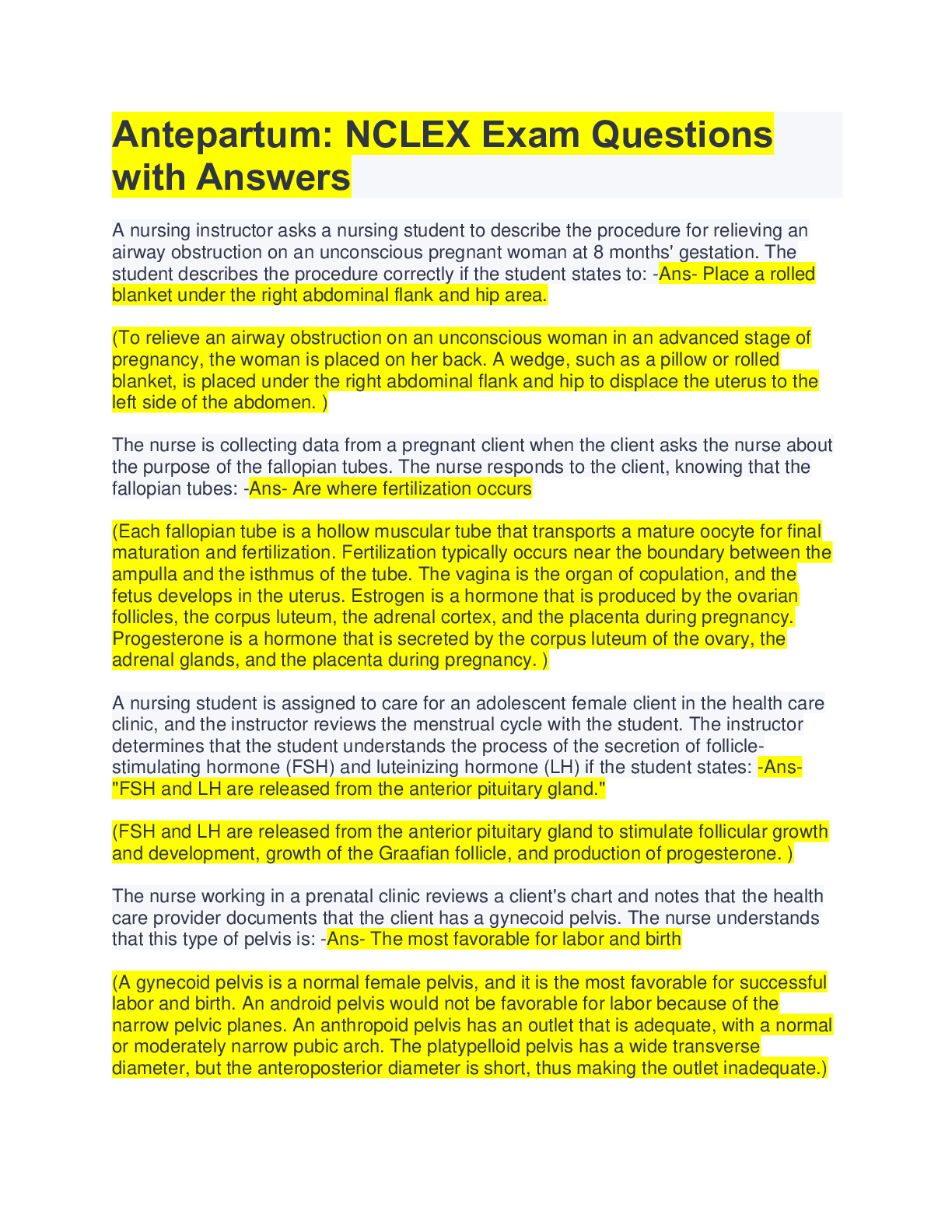
Antepartum: NCLEX Exam Questions
with Answers
A nursing instructor asks a nursing student to describe the procedure for relieving an
airway obstruction on an unconscious pregnant woman at 8 months' gestation. The
student describes the procedure correctly if the student states to: -Ans- Place a rolled
blanket under the right abdominal flank and hip area.
(To relieve an airway obstruction on an unconscious woman in an advanced stage of
pregnancy, the woman is placed on her back. A wedge, such as a pillow or rolled
blanket, is placed under the right abdominal flank and hip to displace the uterus to the
left side of the abdomen. )
The nurse is collecting data from a pregnant client when the client asks the nurse about
the purpose of the fallopian tubes. The nurse responds to the client, knowing that the
fallopian tubes: -Ans- Are where fertilization occurs
(Each fallopian tube is a hollow muscular tube that transports a mature oocyte for final
maturation and fertilization. Fertilization typically occurs near the boundary between the
ampulla and the isthmus of the tube. The vagina is the organ of copulation, and the
fetus develops in the uterus. Estrogen is a hormone that is produced by the ovarian
follicles, the corpus luteum, the adrenal cortex, and the placenta during pregnancy.
Progesterone is a hormone that is secreted by the corpus luteum of the ovary, the
adrenal glands, and the placenta during pregnancy. )
A nursing student is assigned to care for an adolescent female client in the health care
clinic, and the instructor reviews the menstrual cycle with the student. The instructor
determines that the student understands the process of the secretion of folliclestimulating hormone (FSH) and luteinizing hormone (LH) if the student states: -Ans-
"FSH and LH are released from the anterior pituitary gland."
(FSH and LH are released from the anterior pituitary gland to stimulate follicular growth
and development, growth of the Graafian follicle, and production of progesterone. )
The nurse working in a prenatal clinic reviews a client's chart and notes that the health
care provider documents that the client has a gynecoid pelvis. The nurse understands
that this type of pelvis is: -Ans- The most favorable for labor and birth
(A gynecoid pelvis is a normal female pelvis, and it is the most favorable for successful
labor and birth. An android pelvis would not be favorable for labor because of the
narrow pelvic planes. An anthropoid pelvis has an outlet that is adequate, with a normal
or moderately narrow pubic arch. The platypelloid pelvis has a wide transverse
diameter, but the anteroposterior diameter is short, thus making the outlet inadequate.)
The client asks the nurse about the purpose of the placenta. The nurse plans to
respond to the client, knowing that the placenta: -Ans- Provides an exchange of
nutrients and waste products between the mother and the fetus
(The placenta provides an exchange of nutrients and waste products between the
mother and the fetus. The amniotic fluid surrounds, cushions, and protects the fetus and
allows for fetal movement. The amniotic fluid also maintains the body temperature of the
fetus.)
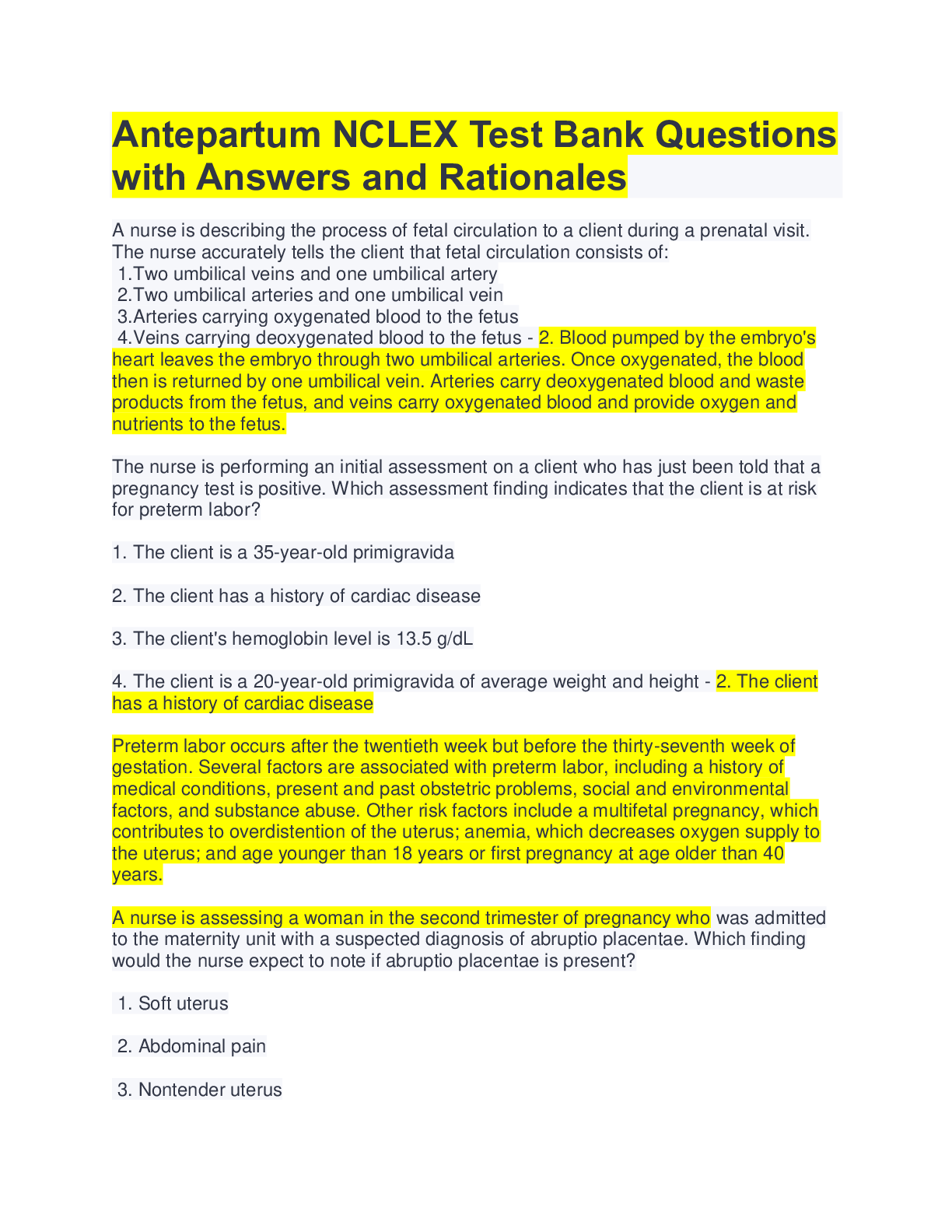
The nurse is describing the process of fetal circulation to a client during a prenatal visit.
The nurse tells the client that fetal circulation consists of: -Ans- Two umbilical arteries
and one umbilical vein
(Blood pumped by the fetus' heart leaves the fetus through two umbilical arteries. After
the blood is oxygenated, it is then returned by one umbilical vein. Arteries carry
deoxygenated blood and waste products from the fetus, and veins carry oxygenated
blood and provide oxygen and nutrients to the fetus.)
A nursing student is assigned to a client in labor. The nursing instructor asks the student
to describe fetal circulation, specifically the ductus venosus. The instructor determines
that the student understands the structure of the ductus venosus if the student states
that it: -Ans- Connects the umbilical vein to the inferior vena cava
(The ductus venosus connects the umbilical vein to the inferior vena cava. The foramen
ovale is a temporary opening between the right and left atria. The ductus arteriosus
joins the aorta and the pulmonary artery.)
During a prenatal visit, the nurse checks the fetal heart rate (FHR) of a client in the third
trimester of pregnancy. The nurse determines that the FHR is normal if which of the
following heart rates is noted? -Ans- 150 beats per minute
(Fetal heart rate depends on gestational age. It is normally 160 to 170 beats per minute
during the first trimester, but it slows with fetal growth to 110 or 120 (low end) to 160
(high end) beats per minute near or at term.)
The nurse is teaching a pregnant woman about the physiological effects and hormone
changes that occur during pregnancy. The woman asks the nurse about the purpose of
estrogen. The nurse bases the response on which of the following purposes of
estrogen? -Ans- It stimulates uterine development to provide an environment for the
fetus, and stimulates the breasts to prepare for lactation.
(Estrogen stimulates uterine development to provide an environment for the fetus, and it
stimulates the breasts to prepare for lactation. Progesterone maintains the uterine lining
for implantation and relaxes all smooth muscle. Human placental lactogen stimulates
the metabolism of glucose and converts the glucose to fat. Human chorionic
[Show More]