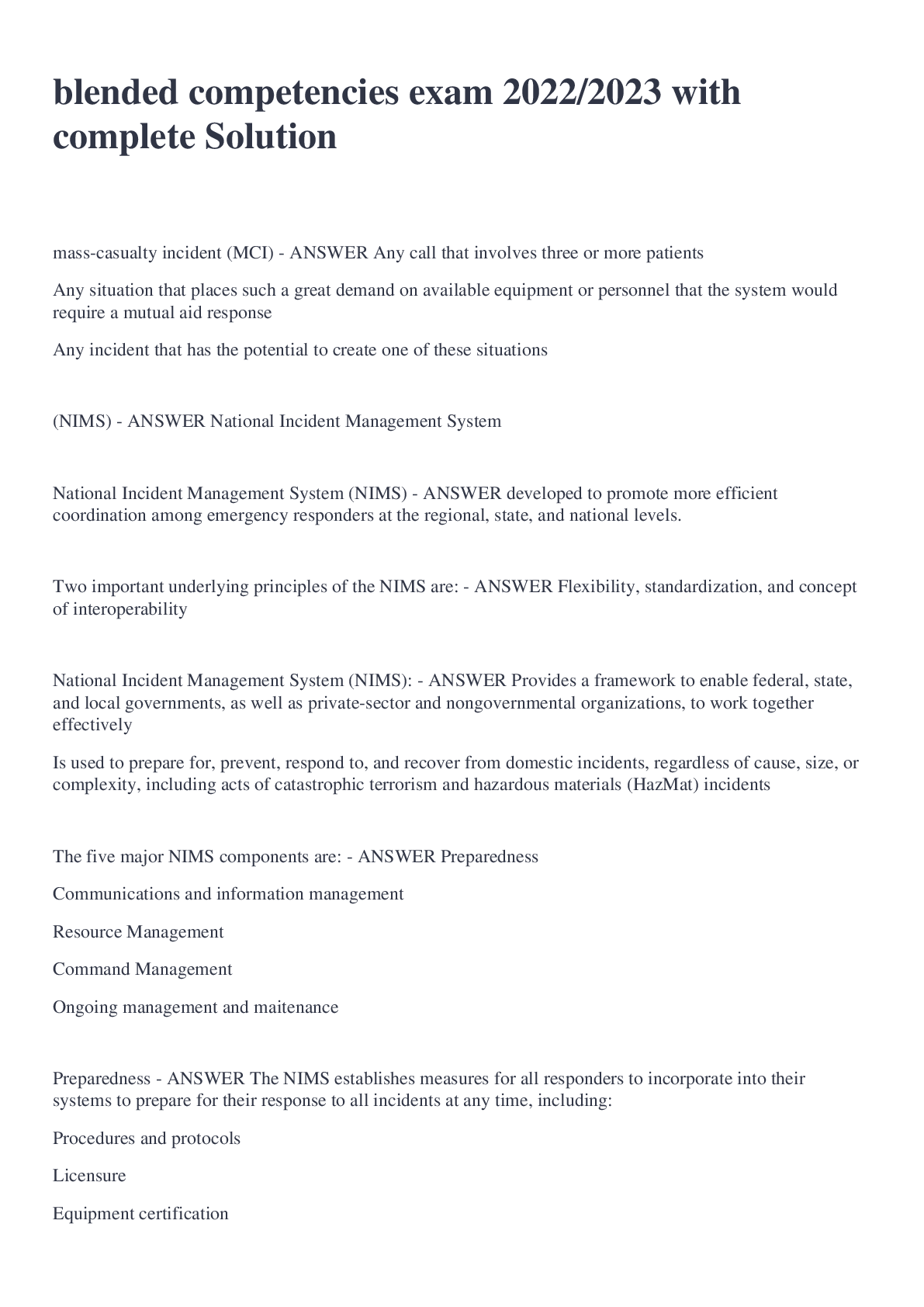
mass-casualty incident (MCI) - ANSWER Any call that involves three or more patients
Any situation that places such a great demand on available equipment or personnel that the system would require a mutual aid response
...
mass-casualty incident (MCI) - ANSWER Any call that involves three or more patients
Any situation that places such a great demand on available equipment or personnel that the system would require a mutual aid response
Any incident that has the potential to create one of these situations
(NIMS) - ANSWER National Incident Management System
National Incident Management System (NIMS) - ANSWER developed to promote more efficient coordination among emergency responders at the regional, state, and national levels.
Two important underlying principles of the NIMS are: - ANSWER Flexibility, standardization, and concept of interoperability
National Incident Management System (NIMS): - ANSWER Provides a framework to enable federal, state, and local governments, as well as private-sector and nongovernmental organizations, to work together effectively
Is used to prepare for, prevent, respond to, and recover from domestic incidents, regardless of cause, size, or complexity, including acts of catastrophic terrorism and hazardous materials (HazMat) incidents
The five major NIMS components are: - ANSWER Preparedness
Communications and information management
Resource Management
Command Management
Ongoing management and maitenance
Preparedness - ANSWER The NIMS establishes measures for all responders to incorporate into their systems to prepare for their response to all incidents at any time, including:
Procedures and protocols
Licensure
Equipment certification
Communications and information management - ANSWER Effective communications, information management, and sharing are critical aspects of domestic incident management.
The NIMS communications and information systems enable the essential functions needed to provide interoperability.
Resource management - ANSWER The NIMS sets up mechanisms to describe, inventory, track, and dispatch resources before, during, and after an incident.
The NIMS also defines standard procedures to recover equipment used during the incident.
Command management - ANSWER The NIMS standardizes incident management for all hazards and across all levels of government.
The NIMS standard incident command structures are based on three key constructs:
ICS
Multiagency coordination systems
Public information systems
Ongoing management and maintenance - ANSWER The multijurisdictional, multidisciplinary NIMS Integration Center (NIC) provides strategic direction for and oversight of the NIMS.
It supports routine maintenance and continuous improvement of the system in the long term, including research and development of supporting technologies.
The purpose of the incident command system (ICS) is to: - ANSWER Ensure responder and public safety
Achieve incident management goals
Ensure the efficient use of resources
designed to avoid duplication and freelancing
limit the span of control of any one individual
The organizational levels may include: - ANSWER sections
branches
divisions and groups
Sections - ANSWER Responsible for a major functional area such as finance, logistics, planning, or operations
Branches: - ANSWER Managed by the branch director; may be functional or geographic in nature
These tend to be established when span of control is a problem
Branches are in charge of activity directly related to the section (ie, fire, law enforcement, EMS, operations, etc.).
Divisions and groups - ANSWER Serve to align resources and/or crews under one supervisor.
Divisions usually refer to crews working in the same geographic area.
Groups usually refer to crews working in the same functional area, but possibly in different locations.
Incident Commander (IC) - ANSWER the parson in charge of the incident overall
Assess the incident
Establish the strategic objectives and priorities
Develop a plan to manage the incident
Small incidents often mean the IC will do it all.
In an incident of medium size or complexity, the IC may delegate some functions but retain others.
In a complex situation, the IC may appoint team members to all of the command roles.
Unified Command System - ANSWER A command system used in larger incidents in which there is a multiagency response or multiple jurisdictions are involved.
Plans are drawn up in advance by all agencies that assume a shared responsibility for decision making.
Single Command System - ANSWER One person is in charge, even if multiple agencies respond.
generally used with incidents in which one agency has the majority of responsibility for incident management.
Ideally, it is used for short-duration, limited incidents that require the services of a single agency.
Command Post - ANSWER set up in a vehicle, it should be well marked, and you should know its location.
Make sure that your supervisor or the IC knows of any plans or operations before they are initiated.
If the incident is very large, you will report to a supervisor working under the IC.
Transfer of Command - ANSWER Because an incident can rapidly change in size and complexity, an IC may turn over command to someone with more experience in a critical area.
The process of moving the responsibility for incident command from one Incident Commander to another. Transfer of command must include a transfer of command briefing, which may be oral, written, or a combination of both.
Termination of Command - ANSWER The end of the incident command structure when an incident draws to a close.
The general staff defined in the ICS includes the following sections: - ANSWER Finance
Logistics
Operations
Planning
Commmand
Finance - ANSWER Responsible for documenting all expenditures at an incident for reimbursement
Finance personnel are not usually needed at smaller incidents, but at larger incidents it is necessary to keep track of personnel hours and expenditures for materials and supplies.
The time unit
The procurement unit
The compensation and claims unit
The cost unit
Logistics - ANSWER Responsible for:
Communications equipment
Facilities
Food and water
Fuel
Lighting
Medical equipment and supplies for patients and emergency responders
Logistics personnel are trained to find food, shelter, and health care for you and the other responders at the scene of an MCI.
Operations - ANSWER Responsible for managing the tactical operations usually handled by the IC on routine EMS calls
The operations section chief will supervise the people working at the scene of the incident, who will be assigned to branches, divisions, and groups.
Operations personnel often have experience in management within EMS.
Planning - ANSWER Solves problems as they arise during the incident
obtain data about the problems, analyze the previous incident plan, and predict what or who is needed to make the new plan work.
development of an incident action plan, which is the central tool for planning during a response to a disaster emergency.
Three important positions on the command team that help the general staff and the IC are: - ANSWER Safety Officer
Public Information Officer
Liaison Officer
Safety officer - ANSWER Monitors the scene for conditions or operations that may present a hazard to responders and patients
May need to work with environmental health and HazMat specialists
Has the authority to stop an emergency operation whenever a rescuer is in danger
Should remove hazards to EMS personnel and patients before the hazards cause injury
Public information officer (PIO) - ANSWER Provides the public and media with clear and understandable information
Keeps the media safe and from becoming part of the incident
May cooperate with PIOs from other agencies in a joint information center (JIC)
In some circumstances, the PIO/JIC may be responsible for distributing a message designed to help a situation, prevent panic, and provide evacuation directions.
[Show More]


![Preview of AORN PERIOP 101 FINAL EXAM 2026 QUESTIONS AND VERIFIED ANSWERS [LATEST UPDATE]](https://browseimages.nyc3.digitaloceanspaces.com/paper-images/2026/04/07/sGJvJ3aH2026-04-07-04-5869d464cbba16f.png)