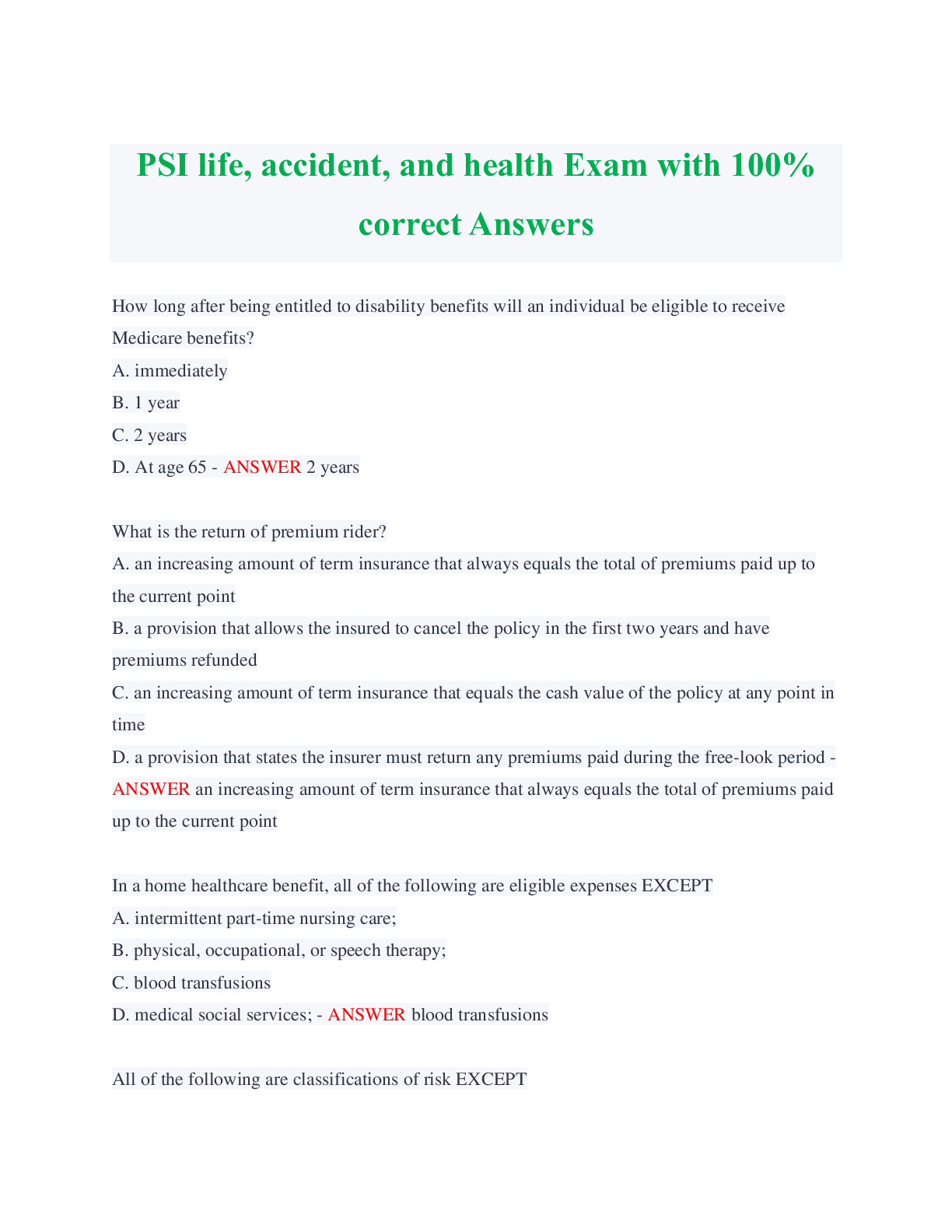
EVP - ANSWER Employee Value Proposition
Productivity, Results, and Value. - ANSWER Provide _________ and __________ to an enterprise, and the enterprise will provide it's employees with something of __________.
Att
...
EVP - ANSWER Employee Value Proposition
Productivity, Results, and Value. - ANSWER Provide _________ and __________ to an enterprise, and the enterprise will provide it's employees with something of __________.
Attracting, motivating, engaging, and retaining. - ANSWER Throughout history, employers have been challenged with ______, ________, _________, and _________ employees.
Compensation, benefits, work-life effectiveness, recognition, performance management, and talent development. - ANSWER What are the six elements of total rewards?
Designing, implementing, and assessing. - ANSWER The total rewards module provides a framework for _______, ____________ and ____________ the rewards packages offered throughout the organization.
Economic, Labor Market, Cultural Norms, and Regulatory. - ANSWER Name the external influences that are out of direct control of the organization and that impact an organization's culture and strategies.
Economic - ANSWER Rising or falling conditions in the global _______ landscape. Require timely and measured responses from TR professionals in adjusting programs to meet changing situations.
Labor Market - ANSWER TR professionals must understand _______ ________ trends and movements to reach the sweet spot of attracting the necessary talent at a cost that is affordable and sustainable.
Cultural Norms - ANSWER TR professionals must have a grasp of the customs, social mores and drivers of the diverse makeup and expectations of the workforce to effectively tailor programs for maximum efficacy.
Regulatory - ANSWER The __________ and legal environment can vary widely by country and region, affecting the design and implementation of total rewards in various ways. Programs should be assessed to ensure they can be legally applied at the local level. This may require adaptation or even alternative programs to ensure compliance.
Rewards - ANSWER Organizations deploy ___________ as the strategic tool to achieve business objectives.
Business Strategy - ANSWER __________ _________ is the broad framework of principles and approaches that guide the day-to-day decisions affecting business. Is also a company's broad plan for competitively positioning its products or services with the intent to accomplish or support the company's mission.
Vision, Mission, and Business Strategy - ANSWER Understanding the importance of the relationship between _____, ______ and the resulting ______ ________ will assist the human resources professional in becoming a strategic partner.
Corporate Vision - ANSWER A statement about what the organization wants to become. It drives the direction of an organization.
Corporate Mission - ANSWER A precise description of what the organization does, its reason for existence or its purpose for being.
Operational Excellence - ANSWER Is primarily a price/cost-based strategy. This strategy often includes a combination of price, quality, dependability and ease of purchase that competitors cannot match. The corporate culture typically strives to minimize waste and reward efficiency.
Product/service leadership - ANSWER Primarily an innovation-based strategy. This strategy focuses on innovation, product development and market exploitation. The corporate culture encourages imagination and a mind-set drive by the prospect of creating the future. Organizations that use this strategy offer products and services that expand performance boundaries and create more/better ideas and commercialize them faster than their competitors.
Customer Intimacy - ANSWER Primarily a solutions-based strategy. This strategy focuses on creating results for carefully selected customers (making them successful). The corporate culture encourages deep and lasting relationships with customers. Organizations that use this strategy build bonds with targeting customers; they meet or exceed customer needs to build customer loyalty.
Business Life Cycle - ANSWER _______ ________ _______ is the progression of steps and organization passes through from its creation to its decline. There are four stages.
Start-up - ANSWER The organization is new with little or no formal policies or procedures. The organization's focus is on obtaining capital, marketing products or services, initial sales growth, and cash conservation.
Growth - ANSWER In this stage, the organization is highly focused on _______ sales, increasing distribution capability and determining how to efficiently produce products or services to meet ________ demand. _______ typically generates the need to begin standardizing procedures through policy creation.
Mature - ANSWER The ________ stage is characterized by a focus on maintaining/increasing market share, improving productivity and otherwise reducing cost of sales. Improvements to products are more evolutionary than revolutionary. The organization typically has higher levels of bureaucracy and greater amounts of cash on hand than at other stages.
Decline - ANSWER At this point, the organization's revenues are ________. It must decide whether to reinvest in current products, create new products or maximize profits with current products as long as possible.
Organizational Culture - ANSWER ___________ _________ determines how and why a company operates in the way it does. Typically it includes a set of often unspoken expectations, behavioral norms and performance standards to which the organization has become accustomed. Are subject to both internal and external influences and greatly influenced by organization's leadership.
Human Resource Strategy - ANSWER This is the organization's overall plan for attraction, motivation, engagement and retention of employees. The business strategy and organizational culture are key to development of the ___________ __________ strategy.
Total Rewards Strategy - ANSWER Considers the drivers (organizational culture, business strategy and human resource strategy) and uses them to guide the design of programs for each of the six elements of _______ _______. It is the art of combining these elements into tailored packages to meet the needs of the organization and its employees. In order for the strategy to be successful, employees must perceive monetary and nonmonetary rewards as valuable. What strategy is this?
Total Rewards - ANSWER The monetary and nonmonetary return provided to employees in exchange for their time, talents, efforts and results.
Compensation - ANSWER Pay provided by an employer to an employee for services rendered. This includes both fixed and variable pay tied to performance levels.
Benefits - ANSWER Programs an employer uses to supplement the cash compensation that employees receive. These health, income protection, savings and retirement programs provide security for employees and their families.
Work-life Effectiveness - ANSWER A specific set of organizational practices, polices, and programs plus a philosophy that actively supports efforts to help employees achieve success both at work and home.
Recognition - ANSWER Acknowledges or gives special attention to employee actions, efforts, behavior or performance and supports business strategy by reinforcing certain behaviors that contribute to organizational success. These programs can be either formal or informal.
Performance Management - ANSWER The alignment or organizational, team and individual efforts towards the achievement of business goals and organizational success. It includes establishing expectations, skill demonstration, assessment, feedback and continuous improvement.
Talent Development - ANSWER Provides the opportunity and tools for employees to advance their skills and competencies in both their short- and long-term careers. Organizations support career opportunities to effectively deploy talented employees, enabling them to deliver their greatest value to the organization.
Industry, Size, Geographic Location or Performance - ANSWER This total rewards strategy identifies the appropriate labor market segments for each employer group where the market is identified according to _______, ________, ___________ ____________ or ______________
Competitive Position - ANSWER This total rewards strategy identifies the desired _______ ________ in the market for each employee group. Many companies want to offer a rewards program targeted at the 50th percentile in a market.
Optimal Mix - ANSWER This total rewards strategy identifies the ______ _______ of total rewards elements for each employee group. Examples: generous benefits and relatively low wages or higher wages and lower benefits.
Earned and Allocated - ANSWER This total rewards strategy identifies the way each element will be ________ and _____________. Examples: performance vs. entitlement, individual versus group incentives, fixed vs. flexible benefits (choice).
Senior Management/board of directors, human resource leadership, employees, and outside consultants. - ANSWER Who are the key players involved in total rewards strategy development.
Senior Management/board of directors - ANSWER Typically gives approval to the strategy and approves officer compensation. Their involvement is important for buy-in and ownership.
Human Resource Leadership - ANSWER Articulates the HR Strategy and is instrumental in facilitating the process. Develops total rewards management.
Employees - ANSWER Internal, external or exit surveys may provide guidance in identifying the relative importance of total rewards elements to various groups. Identify the key player involved in the Total Rewards Strategy.
Outside Consultants - ANSWER Work closely with HR to facilitate the process of the Total Rewards Strategy.
Attract - ANSWER Is the ability an organization has to draw the right kind of talent necessary to achieve organizational success. __________ of an adequate (and perpetual) supply of qualified talent is essential for the organization's survival, and it is one of the key planks of business strategy.
Motivate - ANSWER Is the ability to cause employees to behave in a way that achieves the highest performance levels. There are two types.
Intrinsic Motivation - ANSWER This type of ________ is linked to factors that include an employee's sense of achievement, respect for the whole person, trust and appropriate advancement opportunities. Consistently results in higher performance levels.
Extrinsic Motivation - ANSWER This type of _________ is most frequently associated with rewards that are tangible, such as pay.
Engage - ANSWER Refers to the highest level of commitment or discretionary effort. The employee typically experiences a heightened positive emotional connection to the organization and its people. Example: Demonstrating a strong commitment to the organization.
Retain - ANSWER Is the organization's ability to keep employees who are valued contributors to organizational success for as long as is mutually beneficial. Desired talent can be kept on staff by using a dynamic blend of elements from the total rewards package as employees move through their career life cycles. However, not all _______ is desirable, which is why a formal ___________ strategy with appropriate steps is essential.
Higher Profitability, Lower Labor Costs, and Greater Flexibility. - ANSWER These are advantages of a Total Rewards Approach.
Higher Profitability - ANSWER A direct link exists between employee motivation and product/service quality. Companies highly rated by their employees often have ___________ __________.
Lower Labor Costs - ANSWER Many programs in the work-life area are _______ ____ _____ solutions used to attract and retain employees. Availability of programs considered part of the work-life effectiveness element may reduce the compensation needed to attract talent. However, compensation savings should not be the driving force behind work-life offerings. Highly rated companies usually offer competitive programs within work-life, in addition to competitive compensation.
Greater Flexibility - ANSWER Each company, given its own specific challenges, customizes its total rewards programs in unique proportions. This is called the total rewards mix. Unique considerations may include job types, geographic and demographic issues. Name this advantage of the Total Rewards Approach.
Corporate Vision, Corporate Mission, Business Strategy, Business Life Cycle, and Organizational Culture. - ANSWER What are the drivers of the total rewards strategy?
Labor Market - ANSWER The appropriate ________ ___________ segment is identified by the total rewards strategy.
Competitive Position - ANSWER The desired _________ ___________ in the market for each employee group is identified by the total rewards strategy.
To attract talent at an affordable cost. - ANSWER Why is it important for TR professionals to understand labor market trends?
A broad plan for competitively positioning products supporting the mission. - ANSWER Describe the business strategy.
Talent development, recognition, and benefits - ANSWER Which of the three of the six elements of total rewards.
Outside Consultants - ANSWER Which of these key players involved in the development of the total rewards strategy works closely with HR to facilitate the process?
Offers flexibility for customizing total rewards programs in unique proportions. - ANSWER What is one of the advantages of taking a total rewards approach?
Optimal Mix - ANSWER The ________ _________ of total rewards elements for each employee group is identified by the total rewards strategy.
Earned and Allocated - ANSWER The way each element will be _________ and __________ is identified by the total rewards strategy.
[Show More]


![Preview of THE TEFL ACADEMY LEVEL 5 - ASSIGNMENT C - AUTHENTIC MATERIAL [2026]](https://browseimages.nyc3.digitaloceanspaces.com/paper-images/2026/04/10/HpVkRcWV2026-04-10-11-5769d96426bd64f.png)