True I False
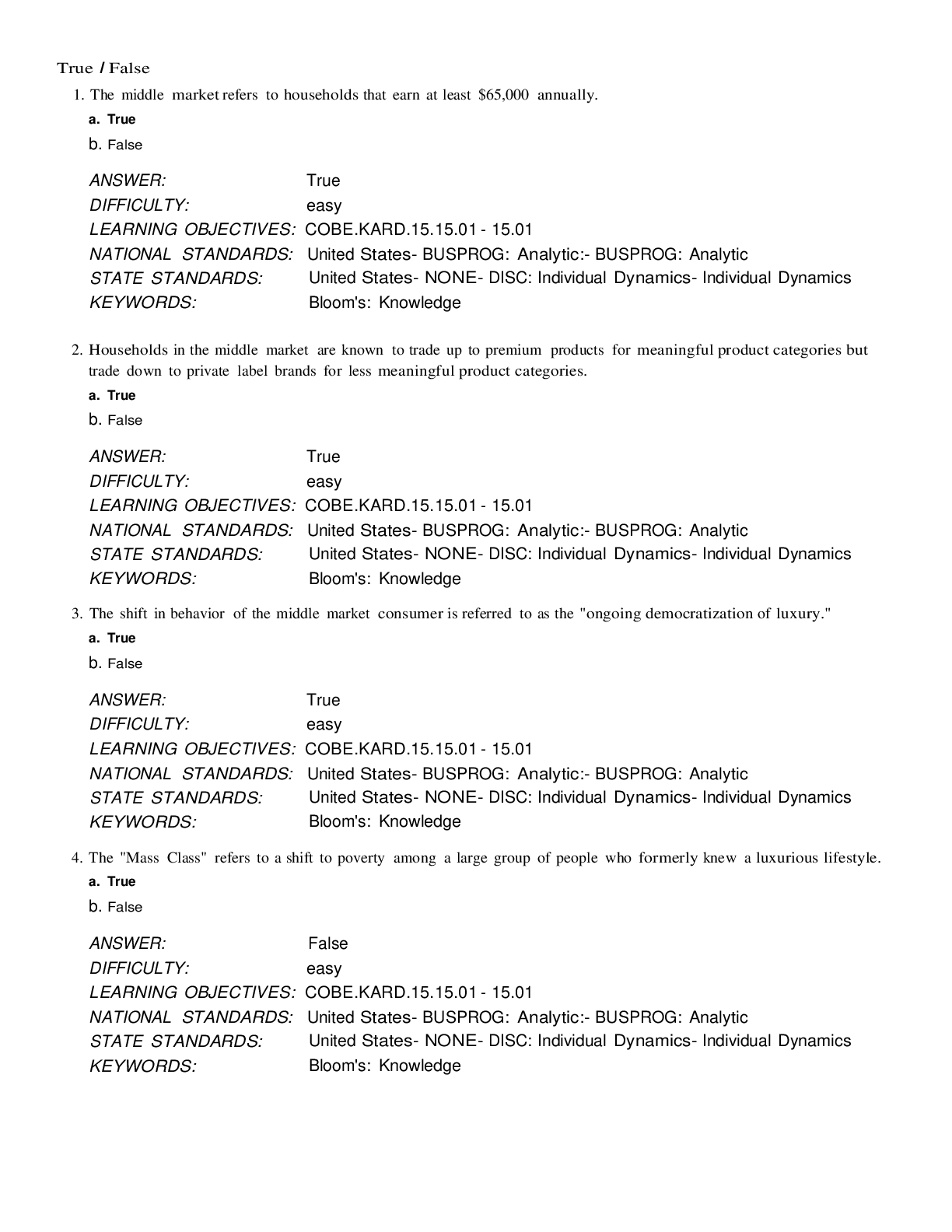
1. The middle market refers to households that earn at least $65,000 annually.
a. True
b. False
True
easy
COBE.KARD.15.15.01 - 15.01
NATIONAL STANDARDS: United States- BUSPROG: Analytic:
...
True I False
1. The middle market refers to households that earn at least $65,000 annually.
a. True
b. False
True
easy
COBE.KARD.15.15.01 - 15.01
NATIONAL STANDARDS: United States- BUSPROG: Analytic:- BUSPROG: Analytic
United States- NONE- DISC: Individual Dynamics- Individual Dynamics
Bloom's: Knowledge
2. Households in the middle market are known to trade up to premium products for meaningful product categories but trade down to private label brands for less meaningful product categories.
a. True
b. False
True
easy
COBE.KARD.15.15.01 - 15.01
NATIONAL STANDARDS: United States- BUSPROG: Analytic:- BUSPROG: Analytic
United States- NONE- DISC: Individual Dynamics- Individual Dynamics
Bloom's: Knowledge
3. The shift in behavior of the middle market consumer is referred to as the "ongoing democratization of luxury."
a. True
b. False
True
easy
COBE.KARD.15.15.01 - 15.01
NATIONAL STANDARDS: United States- BUSPROG: Analytic:- BUSPROG: Analytic
United States- NONE- DISC: Individual Dynamics- Individual Dynamics
Bloom's: Knowledge
4. The "Mass Class" refers to a shift to poverty among a large group of people who formerly knew a luxurious lifestyle.
a. True
b. False
False
easy
COBE.KARD.15.15.01 - 15.01
NATIONAL STANDARDS: United States- BUSPROG: Analytic:- BUSPROG: Analytic
United States- NONE- DISC: Individual Dynamics- Individual Dynamics
Bloom's: Knowledge
5. Marketing to subsistence markets can be done using multi-level marketing, which refers to small groups that supply goods to rural customers.
a. True
b. False
False
easy
COBE.KARD.15.15.01 - 15.01
NATIONAL STANDARDS: United States- BUSPROG: Analytic:- BUSPROG: Analytic
United States- NONE- DISC: Creation of Value- Creation of Value
Bloom's: Knowledge
6. Some sociologists view social structure as a horizontal division of heterogeneous groups based on lifestyle.
a. True
b. False
False
moderate
COBE.KARD.15.15.02- 15.02
NATIONAL STANDARDS: United States- BUSPROG: Analytic:- BUSPROG: Analytic
United States- NONE- DISC: Group Dynamics- Group Dynamics
Bloom's: Comprehension
7. Social class is defined as the overall standing a consumer occupies in society based on characteristics valued by others.
a. True
b. False
True
easy
COBE.KARD.15.15.02- 15.02
NATIONAL STANDARDS: United States- BUSPROG: Analytic:- BUSPROG: Analytic
United States- NONE- DISC: Group Dynamics- Group Dynamics
Bloom's: Knowledge
8. Consumers are so different that even though they may share the same social class, their lifestyles may vary a great deal.
a. True
b. False
False
moderate
COBE.KARD.15.15.02- 15.02
NATIONAL STANDARDS: United States- BUSPROG: Diversity
United States- NONE- DISC: Group Dynamics- Group Dynamics
Bloom's: Comprehension
9. Income is the best single predictor of social class. a. True
b. False
False
moderate
COBE.KARD.15.15.02 - 15.02
: United States - BUSPROG: Analytic: - BUSPROG: Analytic
United States - NONE - DISC: Group Dynamics - Group Dynamics
Bloom's: Comprehension
10. Social mobility describes the movement of one social class to another. a. True
b. False
True
easy
COBE.KARD.15.15.02 - 15.02
: United States - BUSPROG: Analytic: - BUSPROG: Analytic
United States - NONE - DISC: Group Dynamics - Group Dynamics
Bloom's: Knowledge
11. The phrase, the American Dream, refers to the possibility of being in the mass class. a. True
b. False
False
easy
COBE.KARD.15.15.02 - 15.02
: United States - BUSPROG: Analytic: - BUSPROG: Analytic
United States - NONE - DISC: Group Dynamics - Group Dynamics
Bloom's: Knowledge
12. Challenges faced by large populations include the strain they place on resources and infrastructure.
a. True
b. False
True
Easy
COBE.KARD.15.15.01 - 15.01
: United States - BUSPROG: Analytic
United States - NONE - DISC: Individual Dynamics - Individual Dynamics
Bloom's: Knowledge
13. Microenterprises are small informal groups that help supply goods and services to rural customers.
a. True
b. False
True
Easy
COBE.KARD.15.15.01 - 15.01
: United States - BUSPROG: Analytic
United States - NONE - DISC: Individual Dynamics - Individual Dynamics
Bloom's: Knowledge
14. Subsistence consumer-merchants (SCMS) sustain relationships through church, state, and family.
a. True
b. False
False
Easy
COBE.KARD.15.15.01 - 15.01
: United States - BUSPROG: Analytic
United States - NONE - DISC: Individual Dynamics - Individual Dynamics
Bloom's: Knowledge
15. China has made a deliberate attempt to control its population growth through its one-child law and this has affected the size of its consumer market.
a. True
b. False
True
Easy
COBE.KARD.15.15.01 - 15.01
: United States - BUSPROG: Analytic
United States - NONE - DISC: Individual Dynamics - Individual Dynamics
Bloom's: Knowledge
16. China’s fertility rate is 30% below its replacement rate and this will affect its long‐term population stability.
a. True
b. False
True
17. Because of its high birth rate, China, as a population is becoming younger and younger.
a. True
b. False
False
Easy
COBE.KARD.15.15.01 - 15.01
: United States - BUSPROG: Analytic
United States - NONE - DISC: Individual Dynamics - Individual Dynamics
Bloom's: Knowledge
18. Japan’s death rate currently exceeds its birth rate.
a. True
b. False
True
Easy
COBE.KARD.15.15.01 - 15.01
: United States - BUSPROG: Analytic
United States - NONE - DISC: Individual Dynamics - Individual Dynamics
Bloom's: Knowledge
19. When it comes to marketing globally based on income levels, marketers must remember that low income does not necessarily mean poverty.
a. True
b. False
True
Easy
COBE.KARD.15.15.01 - 15.01
: United States - BUSPROG: Analytic
United States - NONE - DISC: Individual Dynamics - Individual Dynamics
Bloom's: Knowledge
20. The market with the lowest levels of income is called the top of the pyramid.
a. True
b. False
False
21. Max Weber believed that the ranking people attain in society is derived from power, wealth, and country of residence.
a. True
b. False
False
Easy
COBE.KARD.15.15.02 - 15.02
: United States - BUSPROG: Analytic
United States - NONE - DISC: Individual Dynamics - Individual Dynamics
Bloom's: Knowledge
22. The principal behind social class is that consumers who occupy the same social class are likely to share common lifestyles and preferences based on similarities in income, property ownership, and occupation.
a. True
b. False
True
Easy
COBE.KARD.15.15.02 - 15.02
: United States - BUSPROG: Analytic
United States - NONE - DISC: Individual Dynamics - Individual Dynamics
Bloom's: Knowledge
23. Social class is determined primarily by income.
a. True
b. False
False
Easy
COBE.KARD.15.15.02 - 15.02
: United States - BUSPROG: Analytic
United States - NONE - DISC: Individual Dynamics - Individual Dynamics
Bloom's: Knowledge
24. Social mobility describes the movement of consumers from one geographic market to another.
a. True
b. False
False
Easy
COBE.KARD.15.15.02 - 15.02
: United States - BUSPROG: Analytic
United States - NONE - DISC: Individual Dynamics - Individual Dynamics
Bloom's: Knowledge
25. Marketers embrace the notion of social class because it helps to explain shopping habits.
a. True
b. False
True
Easy
COBE.KARD.15.15.02 - 15.02
: United States - BUSPROG: Analytic
United States - NONE - DISC: Individual Dynamics - Individual Dynamics
Bloom's: Knowledge
26. People whose wealth has been acquired within their own generation are known as the nouveaux riche.
a. True
b. False
True
Easy
COBE.KARD.15.15.05 - 15.05
: United States - BUSPROG: Analytic
United States - NONE - DISC: Individual Dynamics - Individual Dynamics
Bloom's: Knowledge
27. Those with old money are sometimes accused of conspicuous consumption in that they consume luxury goods just to demonstrate their wealth.
a. True
b. False
False
Easy
COBE.KARD.15.15.05 - 15.05
: United States - BUSPROG: Analytic
United States - NONE - DISC: Individual Dynamics - Individual Dynamics
Bloom's: Knowledge
28. The upper-upper group of wealthy Americans are usually labeled as professionals.
a. True
b. False
29. Income is equally distributed in the United States.
a. True
b. False
False
Easy
COBE.KARD.15.15.05 - 15.05
: United States - BUSPROG: Analytic
United States - NONE - DISC: Individual Dynamics - Individual Dynamics
Bloom's: Knowledge
30. Income is an adequate predictor of consumer behavior for high‐dollar expenditures that don’t reflect lifestyle
or values.
a. True
b. False
True
Easy
COBE.KARD.15.15.04 - 15.04
: United States - BUSPROG: Analytic
United States - NONE - DISC: Individual Dynamics - Individual Dynamics
Bloom's: Knowledge
31. Social class is better than income at predicting low-dollar expenditures reflecting status.
a. True
b. False
True
Easy
COBE.KARD.15.15.04 - 15.04
: United States - BUSPROG: Analytic
United States - NONE - DISC: Individual Dynamics - Individual Dynamics
Bloom's: Knowledge
32. Social class is closely linked to self-esteem for consumers who feel that their wealth was inherited.
a. True
b. False
33. Generations can be thought of as age cohorts.
a. True
b. False
True
Easy
COBE.KARD.15.15.06 - 15.06
: United States - BUSPROG: Analytic
United States - NONE - DISC: Individual Dynamics - Individual Dynamics
Bloom's: Knowledge
Multiple Choice
34. The shift in buying behavior for those in the middle-market to buy luxury goods has created a market called . a. mass luxury
b. mass prestige c. mass class
d. all of the above
d
easy
COBE.KARD.15.15.01 - 15.01
: United States - BUSPROG: Analytic: - BUSPROG: Analytic
United States - NONE - DISC: Individual Dynamics - Individual Dynamics
Bloom's: Knowledge
35. Which of the following might be purchased by a member of the "mass class"?
a. generic green beans b. Maybach automobile c. Louis Vuitton purse d. Cartier watch
a
easy
COBE.KARD.15.15.01 - 15.01
: United States - BUSPROG: Analytic: - BUSPROG: Analytic
United States - NONE - DISC: Individual Dynamics - Individual Dynamics
Bloom's: Comprehension
36. The premise of segmentation is . a. all consumers are not alike
b. mass market to as many consumers as possible c. target the largest market possible
d. all consumers are alike
a
easy
COBE.KARD.15.15.01 - 15.01
NATIONAL STANDARDS: United States- BUSPROG: Analytic:- BUSPROG: Analytic
United States- NONE- DISC: Group Dynamics- Group Dynamics
Bloom's: Knowledge
37. All of the following are steps in the segmentation process except . a. defme a broad product market
b. identify a variety of consumer needs c. analyze consumer profiles
d. organize potential subsets of consumers who share common characteristics
c
easy
COBE.KARD.15.15.01 - 15.01
NATIONAL STANDARDS: United States- BUSPROG: Analytic:- BUSPROG: Analytic
United States- NONE- DISC: Group Dynamics- Group Dynamics
Bloom's: Knowledge
38. Which term below refers to the statistical study of human populations?
a. demography
b. psychographies c. sociology
d. psychology
a
easy
COBE.KARD.15.15.01 - 15.01
NATIONAL STANDARDS: United States- BUSPROG: Analytic:- BUSPROG: Analytic
United States- NONE- DISC: Creation of Value- Creation of Value
Bloom's: Knowledge
39. Which stage of demographic transition refers to a population with equally high birth and death rates?
a. pre-industrial stage b. transitional stage
c. industrial stage
d. post-industrial stage
a
easy
COBE.KARD.15.15.01 - 15.01
NATIONAL STANDARDS: United States- BUSPROG: Analytic:- BUSPROG: Analytic
United States- NONE- DISC: Group Dynamics- Group Dynamics
Bloom's: Knowledge
40. Which stage of demographic transition refers to a population experiencing the onset of industrialization?
a. pre-industrial stage b. transitional stage
c. industrial stage
d. post-industrial stage
b
easy
COBE.KARD.15.15.01 - 15.01
NATIONAL STANDARDS: United States- BUSPROG: Analytic:- BUSPROG: Analytic
United States- NONE- DISC: Group Dynamics- Group Dynamics
Bloom's: Knowledge
41. Which stage of demographic transition is characterized by increasing affluence and urbanization?
a. pre-industrial stage b. transition stage
c. industrial stage
d. post-industrial stage
c
easy
COBE.KARD.15.15.01 - 15.01
NATIONAL STANDARDS: United States- BUSPROG: Analytic:- BUSPROG: Analytic
United States- NONE- DISC: Group Dynamics- Group Dynamics
Bloom's: Knowledge
42. Which stage of demographic transition is characterized by low death rates and low birth rates?
a. pre-industrial stage b. transition stage
c. post-industrial stage d. industrial stage
c
easy
COBE.KARD.15.15.01 - 15.01
NATIONAL STANDARDS: United States- BUSPROG: Analytic:- BUSPROG: Analytic
United States- NONE- DISC: Group Dynamics- Group Dynamics
Bloom's: Knowledge
43. What is the population growth rate in the industrial stage?
a. 0% b. 15% c. 20% d. 50%
a
easy
COBE.KARD.15.15.01 - 15.01
NATIONAL STANDARDS: United States- BUSPROG: Analytic:- BUSPROG: Analytic
United States- None- DISC: Environmental Influence- Environmental
Influence
Bloom's: Knowledge
44. Groups which help supply goods to rural customers are called .
a. macroenterprises
b. subsistence consumer-merchants c. pyramid marketers
d. multi-level marketers
b
easy
COBE.KARD.15.15.01 - 15.01
NATIONAL STANDARDS: United States- BUSPROG: Analytic:- BUSPROG: Analytic
United States- NONE- DISC: Group Dynamics- Group Dynamics
Bloom's: Knowledge
45. Why are subsistence consumer-merchants needed when marketing to subsistence economies?
a. distribution systems are not well developed in these markets b. they are opinion leaders in such markets
c. they control pricing schedules
d. all of the above
a
moderate
COBE.KARD.15.15.01 - 15.01
NATIONAL STANDARDS: United States- BUSPROG: Analytic:- BUSPROG: Analytic
United States- NONE- DISC: Creation of Value- Creation of Value
Bloom's: Comprehension
46. Subsistence consumer-merchants manage relationships in the areas of . a. vendor, customer, and family
b. vendor, distributor, and manufacturer
c. manufacturer, customs, and customers
d. customs, government, and manufacturer
a
moderate
COBE.KARD.15.15.01 - 15.01
NATIONAL STANDARDS: United States- BUSPROG: Analytic:- BUSPROG: Analytic
United States- NONE- DISC: Group Dynamics- Group Dynamics
Bloom's: Comprehension
47. What is a typical amount of income for a subsistence consumer?
a. $300/day b. $150/day c. $50/day d. $2/day
d
easy
COBE.KARD.15.15.01 - 15.01
NATIONAL STANDARDS: United States- BUSPROG: Analytic:- BUSPROG: Analytic
United States- NONE- DISC: Group Dynamics- Group Dynamics
Bloom's: Knowledge
48. Subsistence consumers are wealthy in . a. money
b. access
c. education
d. community relationships
d
moderate
COBE.KARD.15.15.01 - 15.01
NATIONAL STANDARDS: United States- BUSPROG: Analytic:- BUSPROG: Analytic
United States- NONE- DISC: Group Dynamics- Group Dynamics
Bloom's: Comprehension
49. All of the following nations are in Asia except . a. Latvia
b. Indonesia c. Pakistan d. Japan
a
easy
COBE.KARD.15.15.01 - 15.01
NATIONAL STANDARDS: United States- BUSPROG: Analytic:- BUSPROG: Analytic
United States- None- DISC: Environmental Influence- Environmental
Influence
Bloom's: Knowledge
50. Marketing in Russia is difficult in part because .
a. it is horne to Slavic, Turkic, Finno-Ugric and other cultures b. it is so poor
c. of its relationship to Europe
d. of its extreme wealth
a
moderate
COBE.KARD.15.15.01 - 15.01
NATIONAL STANDARDS: United States- BUSPROG: Analytic:- BUSPROG: Analytic
United States- None- DISC: Environmental Influence- Environmental
Influence
Bloom's: Comprehension
51. Which of the following variables contribute to social class?
a. geographic location b. gender
c. age
d. income
d
easy
COBE.KARD.15.15.02- 15.02
NATIONAL STANDARDS: United States- BUSPROG: Analytic:- BUSPROG: Analytic
United States- NONE- DISC: Group Dynamics- Group Dynamics
Bloom's: Knowledge
52. The phrase, the American Dream, refers to the possibility of . a. upward mobility
b. downward mobility c. horne ownership
d. higher education
a
easy
COBE.KARD.15.15.02- 15.02
NATIONAL STANDARDS: United States- BUSPROG: Analytic:- BUSPROG: Analytic
United States- NONE- DISC: Group Dynamics- Group Dynamics
Bloom's: Knowledge
53. Who created the first social structure used by marketers?
a. W. Lloyd Warner b. Max Weber
c. Warren Thompson
d. Kendall Jackson
a
moderate
COBE.KARD.15.15.05- 15.05
NATIONAL STANDARDS: United States- BUSPROG: Analytic:- BUSPROG: Analytic
United States- NONE- DISC: Group Dynamics- Group Dynamics
Bloom's: Knowledge
54. W. Lloyd Warner focused on a social structure that centered on . a. tradition
b. education c. income
d. community respect
d
moderate
COBE.KARD.15.15.05 - 15.05
: United States - BUSPROG: Analytic: - BUSPROG: Analytic
United States - NONE - DISC: Group Dynamics - Group Dynamics
Bloom's: Comprehension
55. Why did marketers embrace the social structure posed by W. Lloyd Warner?
a. researchers demonstrated the social classes were helpful in explaining shopping habits b. it led the way to better distribution systems
c. it suggested prices could be higher on most goods d. all of the above
a
moderate
COBE.KARD.15.15.05 - 15.05
: United States - BUSPROG: Analytic: - BUSPROG: Analytic
United States - NONE - DISC: Group Dynamics - Group Dynamics
Bloom's: Comprehension
56. Which of the following is not associated with downward mobility?
a. Housing foreclosures
b. Displaced workers
c. Unemployment
d. Education
d
Moderate
COBE.KARD.15.15.02 - 15.02
: United States - BUSPROG: Analytic
United States - NONE - DISC: Individual Dynamics - Individual Dynamics
Bloom's: Knowledge
57. The three major groupings of American social class includes all of the following except .
a. Upper
b. Upper-middle
c. Middle
d. Lower
b
Easy
COBE.KARD.15.15.02 - 15.02
: United States - BUSPROG: Analytic
United States - NONE - DISC: Individual Dynamics - Individual Dynamics
Bloom's: Knowledge
58. Joseph Kahl described social class as a matter of , social networks, and personal prestige. a. Income
b. Style
c. Status
d. Facebook
b
Easy
COBE.KARD.15.15.05 - 15.05
: United States - BUSPROG: Analytic
United States - NONE - DISC: Individual Dynamics - Individual Dynamics
Bloom's: Knowledge
59. Gilbert and Kahl depicted American class structure as .
a. Social network
b. A series of situations
c. A form of royalty
d. A pyramid
b
Moderate
COBE.KARD.15.15.05 - 15.05
: United States - BUSPROG: Analytic
United States - NONE - DISC: Individual Dynamics - Individual Dynamics
Bloom's: Knowledge
60. All of the following are jobs associated with Middle Americans except . a. School teachers
b. Electricians
c. Factory supervisors
d. Physicians
d
Easy
COBE.KARD.15.15.05 - 15.05
: United States - BUSPROG: Analytic
United States - NONE - DISC: Individual Dynamics - Individual Dynamics
Bloom's: Knowledge
61. Which of the following terms might be used to describe working class Americans?
a. New money
b. Family folk
c. Bottom of the pyramid
d. Soccer moms
b
Easy
COBE.KARD.15.15.05 - 15.05
: United States - BUSPROG: Analytic
United States - NONE - DISC: Individual Dynamics - Individual Dynamics
Bloom's: Knowledge
62. Where does the term ‘pecking order’ originate?
a. Chicken hierarchies
b. Status in lawyer offices
c. Military jargon
d. None of the above
a
Easy
COBE.KARD.15.15.05 - 15.05
: United States - BUSPROG: Analytic
United States - NONE - DISC: Individual Dynamics - Individual Dynamics
Bloom's: Knowledge
63. is externally assigned; gender is an example.
a. Earned status
b. Attributed status
c. Ascribed status
d. Achieved status
c
Moderate
COBE.KARD.15.15.05 - 15.05
: United States - BUSPROG: Analytic
United States - NONE - DISC: Individual Dynamics - Individual Dynamics
Bloom's: Knowledge
64. in social class is attributed to internal factors like effort and ability.
a. Earned status
b. Attributed status
c. Ascribed status
d. Achieved status
d
Moderate
COBE.KARD.15.15.05 - 15.05
: United States - BUSPROG: Analytic
United States - NONE - DISC: Individual Dynamics - Individual Dynamics
Bloom's: Knowledge
65. When developing social relationships, which of the following is an engagement cue?
a. Doodling
b. Self-grooming
c. Fiddling
d. Nodding
d
Easy
COBE.KARD.15.15.05 - 15.05
: United States - BUSPROG: Analytic
United States - NONE - DISC: Individual Dynamics - Individual Dynamics
Bloom's: Knowledge
66. When developing social relationships, which of the following is a disengagement cue?
a. Nodding b. Laughing c. doodling
d. Raising eyebrows
c
Easy
COBE.KARD.15.15.05 - 15.05
: United States - BUSPROG: Analytic
United States - NONE - DISC: Individual Dynamics - Individual Dynamics
Bloom's: Knowledge
67. Generations are similar in that they have likely experienced common experiences.
a. Historical
b. Political
c. Economic
d. All of the above
d
Easy
COBE.KARD.15.15.06 - 15.06
: United States - BUSPROG: Analytic
United States - NONE - DISC: Individual Dynamics - Individual Dynamics
Bloom's: Knowledge
68. Which age cohort in the United States was born prior to 1930?
a. Pre-depression generation
b. Depression generation
c. Baby boomers
d. Generation Z
a
Easy
COBE.KARD.15.15.06 - 15.06
: United States - BUSPROG: Analytic
United States - NONE - DISC: Individual Dynamics - Individual Dynamics
Bloom's: Knowledge
69. Which age cohort in the United States was born between 1930 and 1945?
a. Pre-depression generation
b. Depression generation
c. Baby boomers
d. Generation Z
b
Easy
COBE.KARD.15.15.06 - 15.06
: United States - BUSPROG: Analytic
United States - NONE - DISC: Individual Dynamics - Individual Dynamics
Bloom's: Knowledge
70. Which age cohort in the United States was born between 1946 and 1964?
a. Pre-depression generation
b. Depression generation
c. Baby boomers
d. Generation Z
c
Easy
COBE.KARD.15.15.06 - 15.06
: United States - BUSPROG: Analytic
United States - NONE - DISC: Individual Dynamics - Individual Dynamics
Bloom's: Knowledge
71. Which age cohort in the United States was born after 1995?
a. Pre-depression generation
b. Depression generation
c. Baby boomers
d. Generation Z
d
Easy
COBE.KARD.15.15.06 - 15.06
: United States - BUSPROG: Analytic
United States - NONE - DISC: Individual Dynamics - Individual Dynamics
Bloom's: Knowledge
72. The pre-depression generation is sometimes called the .
a. Silent generation
b. GI generation c. Breakfast club d. Baby boomers
b
Easy
COBE.KARD.15.15.06 - 15.06
: United States - BUSPROG: Analytic
United States - NONE - DISC: Individual Dynamics - Individual Dynamics
Bloom's: Knowledge
73. The depression generation is sometimes called the .
a. Breakfast club
b. GI Generation
c. Silent generation
d. Baby boomers
c
Easy
COBE.KARD.15.15.06 - 15.06
: United States - BUSPROG: Analytic
United States - NONE - DISC: Individual Dynamics - Individual Dynamics
Bloom's: Knowledge
74. Which characteristics tend to be associated with members of the silent generation and the GI generation?
a. Focuses on staying young
b. Focuses on working hard and saving money
c. Focuses on quality of life
d. Focuses on conspicuous consumption
b
Moderate
COBE.KARD.15.15.06 - 15.06
: United States - BUSPROG: Analytic
United States - NONE - DISC: Individual Dynamics - Individual Dynamics
Bloom's: Knowledge
75. The study of the mature market is known as .
a. Generationography
b. Gerontographics
c. Senioritis
d. Top of the pyramid
b
Moderate
COBE.KARD.15.15.06 - 15.06
: United States - BUSPROG: Analytic
United States - NONE - DISC: Individual Dynamics - Individual Dynamics
Bloom's: Knowledge
76. Which of the American generations is known as the biggest spenders?
Essay
77. List the three steps in the segmentation process.
78. Describe the types of behaviors that are characteristics of the middle market, known as the "mass class."
79. Explain the three distinct domains that Max Weber believed were relevant to the rankings people attained in society.
80. Explain the concept of social mobility and why it is important for marketers.
81. Identify the six classes of people identified by W. Lloyd Warner to describe groups of people who were approximately equal in community esteem and which was used by marketers to describe social structure in the population.
82. Describe how marketers view the social class group known as “upper Americans.”
83. Explain the difference between ascribed and achieved status.
84. Describe what a marketer might want to know about the segments in the mature market.
[Show More]