SSI Open Water Diver Final Exam Study
Guide Section 1
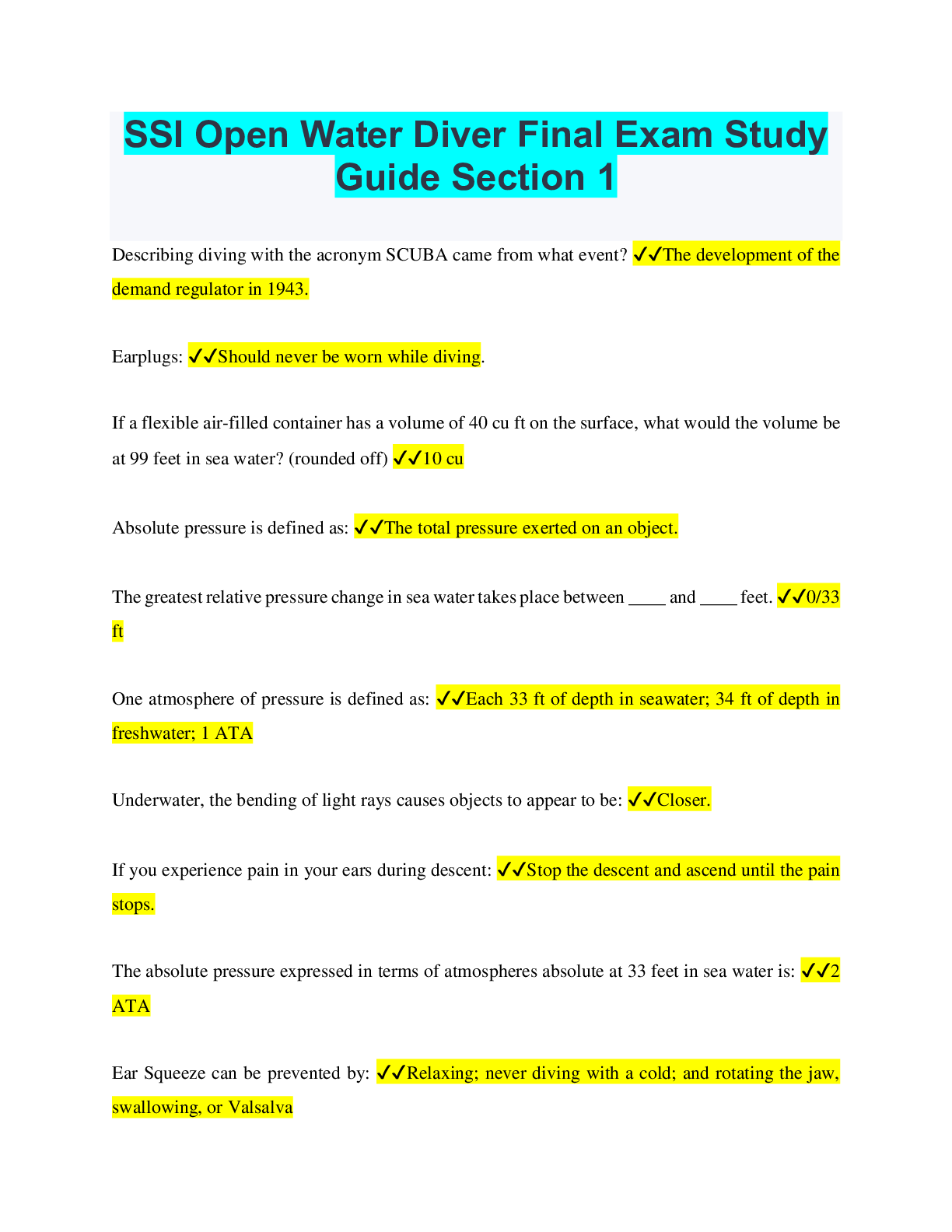
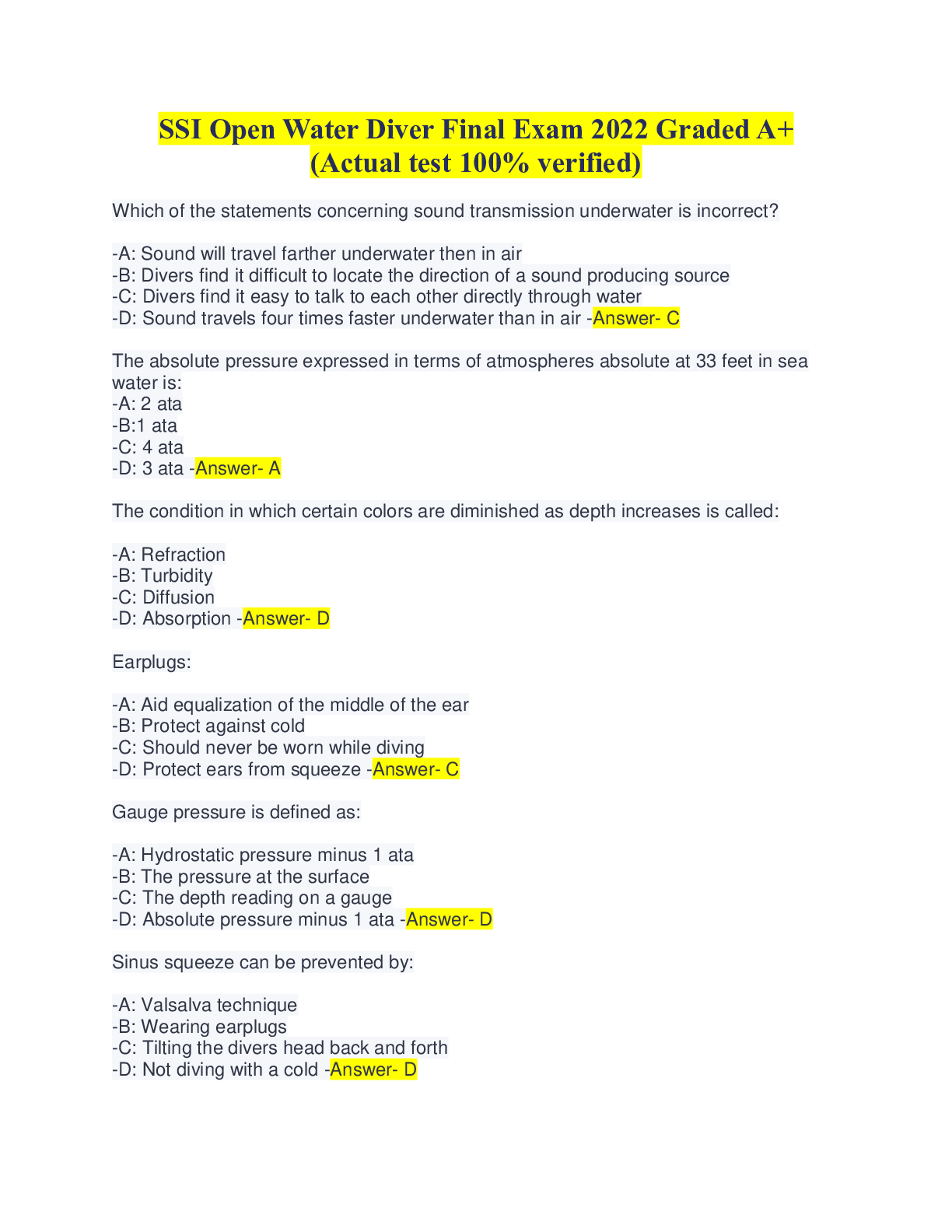
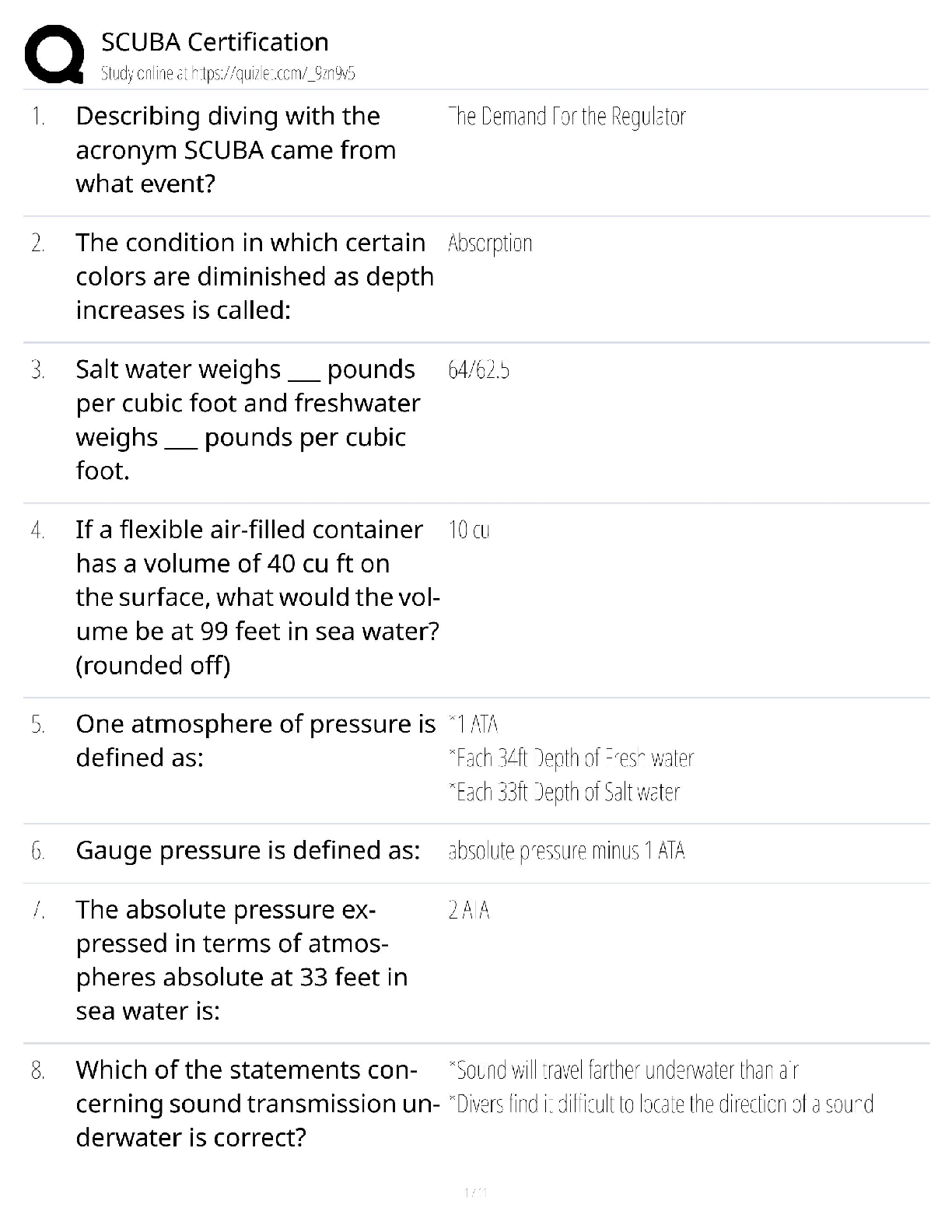
Describing diving with the acronym SCUBA came from what event? ✔✔The development of the
demand regulator in 1943.
Earplugs: ✔✔Should never be worn while diving.
...
SSI Open Water Diver Final Exam Study
Guide Section 1
Describing diving with the acronym SCUBA came from what event? ✔✔The development of the
demand regulator in 1943.
Earplugs: ✔✔Should never be worn while diving.
If a flexible air-filled container has a volume of 40 cu ft on the surface, what would the volume be
at 99 feet in sea water? (rounded off) ✔✔10 cu
Absolute pressure is defined as: ✔✔The total pressure exerted on an object.
The greatest relative pressure change in sea water takes place between ____ and ____ feet. ✔✔0/33
ft
One atmosphere of pressure is defined as: ✔✔Each 33 ft of depth in seawater; 34 ft of depth in
freshwater; 1 ATA
Underwater, the bending of light rays causes objects to appear to be: ✔✔Closer.
If you experience pain in your ears during descent: ✔✔Stop the descent and ascend until the pain
stops.
The absolute pressure expressed in terms of atmospheres absolute at 33 feet in sea water is: ✔✔2
ATA
Ear Squeeze can be prevented by: ✔✔Relaxing; never diving with a cold; and rotating the jaw,
swallowing, or Valsalva
The condition in which certain colors are diminished as depth increases is called: ✔✔Absorption.
Gauge pressure is defined as: ✔✔Absolute pressure minus 1 ATA
Sinus squeeze can be prevented by: ✔✔Not diving with a cold.
Which of the statements concerning sound transmission underwater is correct? ✔✔Sound travels
four times faster in water than in air; sound travels farther underwater than air; divers find it
difficult to locate the source of the sound underwater.
The first symptom of a sinus squeeze is usually: ✔✔A sharp pain of wedging sensation above the
eyes.
The purpose of equalization is to: ✔✔Introduce additional air into body air spaces in response to
increasing external pressure.
Salt water weighs ___ pounds per cubic foot and freshwater weighs ___ pounds per cubic foot.
✔✔64/62.5
Body heat is lost underwater ___ than in air. ✔✔25-30x faster.
The absolute pressure expressed in terms of atmospheres absolute at 99 feet in salt water is: ✔✔4
ATA
Proper equalization techniques must be learned in order to: ✔✔Prevent squeeze injuries, sinus
squeeze and ear pain.
The 6 Systems of Diving Equipment and Gear: ✔✔Six Systems: Snorkel, Exposure, Delivery,
Information, Buoyancy and Accessory.
Snorkel System components: ✔✔Mask, fins, boots, mesh bag, and snorkel.
Exposure System components: ✔✔Insulated suit, mitts or gloves and a dive hood.
Delivery System components: ✔✔Life support equipment for receiving air while underwater.
Information system components: ✔✔Dive computer which allows you to measure air, depth, time,
temperature, ascent and descent rates, and repetitive dives.
Buoyancy system components: ✔✔Part of the life support equipment and helps you achieve
optimal buoyancy during each dive, including surface flotation, controlled descents, proper
swimming attitude at depth and controlled ascents back to the surface. Has a visual and audible
signaling device and shears or a knife. Many BC's are weighted.
Accessory components: ✔✔Special tools, repair parts, cleaners, cameras, lights, navigation, etc.
to make diving more enjoyable and unique to you.
Historical event that led to the use of acronym SCUBA: ✔✔1. 1943, Jacques Cousteau, French
Naval Officer, and partner Emile Gagnan, developed the demand regulator which enabled a diver
to breathe air at the proper pressure for their depth in the amount needed. This allowed divers to
dive independently and self-contained with a life support system for the first time.
2. With this development, plus high-pressure compressors and cylinders created the SCUBA
acronym - Self-Contained Underwater Breathing Apparatus.
3. During this time (1900's), though, there was no formal training in how to dive and most sport
divers were very fit people whose strength and determination is what made up for the lack of safety
in their scuba uniforms. The risk of death and serious injury is what made it so initially exciting
for the first divers.
4. In 1955, the most serious hazard to divers was the lack of an air gauge - they had no way to tell
how their air supply was until depleted, forcing them to book it back to the surface. Regulators
also developed more breathing resistance the deeper you went.
Explain why pressure on an object increases as it descends underwater and give examples of the
effects of this increasing pressure. ✔✔1. Boyle's Law - if the temperature remains constant, the
volume of a gas in a flexible container will vary inversely as the absolute pressure changes and the
density will vary directly:
P1 × V1 = P2 × V2 (P1 = Starting Pressure, V1 = Starting Volume, P2 = Ending Pressure, V2 =
Ending Volume)
For diving: as water pressure increases, the volume of air spaces in your body decreases — and as
water pressure decreases, the volume of air spaces in your body increases.
2. Pressure is defined as force per unit area and is commonly expressed as Bar (Metric) or PSI
(Imperial); commonly thought of as the number of atmospheres.
3. Pressure-related diving injuries occur when a sufficient pressure differential exists between
ambient pressure and the pressure in the air spaces in our body, or gas spaces that are in contact
with our body.
4. Our bodies are almost three-fourths liquid, and the liquid portions of our bodies have no
difficulty with pressure changes. At the depths that sport divers dive, the liquid areas of the body
are in-compressible. This means that they will not change as pressure increases or decreases.
Gases, however, are compressible. Pressure on air-filled spaces in the body — from lungs to
microscopic spaces in dental fillings — will compress and expand as the ambient pressure changes.
Explain why the air volume in a flexible container decreases as it descends underwater and give
examples of the effects of this change in volume. ✔✔1. Air weighs approximately 0.08 pounds
per cubic foot. One atmosphere — the weight of a column of air one inch square extending from
sea level to the outer edge of the Earth's atmosphere — equals 14.7 psi of pressure. This pressure
is applied evenly on our bodies so we do not notice it as much.
2. Absolute/Ambient pressure —pressure exerted on an object, one atmosphere of pressure (14.7
psi) exerted by the air that is above the surface plus whatever additional pressure is exerted by the
water at depth. Expressed in pounds per square inch absolute (psia) or in atmospheres absolute
(ata).
3. Gauge pressure refers to the pressure readings on the gauge and reads zero at one atmosphere,
so gauge pressure may be found by subtracting one atmosphere from absolute pressure. Gauge
pressure is expressed in pounds per square inch gauge (psig) or in atmospheres gauge (atg). The
absolute pressure at sea level would be one atmosphere or 14.7 psia. Gauge pressure would be
zero.
4. The pressure increase per foot of descent in salt water is 0.445 psi (14.7 / 33). This means that
there is a pressure increase of about 0.5 psi for every foot of descent.
List five air spaces in the body that can be affected by increasing pressure and describe its effects
on these air spaces. ✔✔1. Ear - multiple parts within the ear are central to maintaining balance and
equilibrium within the body. The tympanic membrane keeps water and air out of the inner and
middle ear to prevent leakage, ringing, roaring, or deafness in the ear. Rupture can cause vertigo
and vomiting.
2. Sinuses - congestion traps air in a diver's sinuses. At one atmosphere absolute, there is almost
no way to equalize the sinuses when ambient pressure increases. As the diver descends, increasing
pressure can cause the sinus membranes to rupture. If this happens, the result is that air in the
sinuses is replaced by blood and tissue in a process of pressure equalization. Minor tissue damage
and bloody nose occur, no need for medical attention unless pain persists after dive.
3. Lungs - Occurs during snorkeling or freediving, descending without filling the lungs with air
can result in pockets of air in the lungs to compress and at greater depths can cause the lungs to
collapse, rupture, or bleed and leak fluid into them.
4. Mask/Eyes - Pressure increases as you descend, causing more pressure inside your mask that
compresses the blood vessels in your face. No pain, not bad, just makes you ugly and is easy to
prevent.
5. Skin/Suit - Dry suit or loose suit can compress air as you descend and pressure increases causing
little red marks and bruises on your skin during the dive. Preventable by wearing a proper fitting
suit or putting air into your dry suit every few min.
State the procedure used to equalize pressure in the middle and inner ear during descent. ✔✔1.
Swallow and rotate jaw.
2. Gently blow with your nose plugged to release the pressure building up inside the ears, gently
wiggle head side to side and move up in the water if this does not work the first time.
Describe the effects of depth on light penetration and body heat loss. ✔✔1. Underwater, vision
changes in unique ways and you will experience an interesting optical illusion called refraction.
Light rays bend as they pass from water into the airspace in your mask. This makes objects look
33% larger and 25% closer. This means that a 3 foot long fish you are looking at, from a distance
of four feet, will look like a four foot long fish at a distance of 3 feet.
2. The illumination, or amount of light in the water, will vary according to the position of the sun,
clouds, and surface wave conditions. Heavy water movement diminishes light penetration. In
addition, light spreads when it encounters water molecules, it becomes softer, less harsh, and the
intensity is decreased. This is called diffusion.
3. Warm colors disappear the deeper you dive - called absorption.
4. Particles in the water (turbidity) can also limit vision.
5. Variables affecting visibility underwater — refraction, illumination, absorption, diffusion and
turbidity.
6. Water temperatures can range from around 30 degrees F to over 80 degrees F, may even
encounter a temperature difference of 20 to 30 degrees F between the surface and depth.
7. Because cold water is dense, it sinks below warm water. This causes layers of various
temperatures as you descend. The difference in temperature can be harsh. These layers of different
temperatures are called thermoclines, occur in all bodies of water. Some are more dramatic than
others, which is why you need to wear thermal protection on every dive.
8. Theoretically you can lose body heat underwater about 25 to 30 times faster than in air through
direct contact with the water (conduction) and through the movement of the water across your skin
(convection). Adequate exposure protection increases your enjoyment in the water.
[Show More]
.png)
.png)

.png)