Pathophysiology - ANSWER the study of how disease processes affect the function of the body
sign vs symptom - ANSWER a sign is a physical manifestation (objective), a symptom is what the patient tells you about the di
...
Pathophysiology - ANSWER the study of how disease processes affect the function of the body
sign vs symptom - ANSWER a sign is a physical manifestation (objective), a symptom is what the patient tells you about the disease (subjective)
Cell components - ANSWER nucleus/nucleolus, cytoplasm, cell membrane
General Adaptation Syndrome (GAS) - ANSWER the body's adaptive response to stress in three phases—alarm, resistance, exhaustion.
Intracellular fluid (ICF) - ANSWER fluid inside cells
Extracellular fluid (ECF) - ANSWER fluid outside the cells; includes intravascular and interstitial fluids
intravascular fluid - ANSWER fluid within blood vessels
interstitial fluid - ANSWER liquid found between the cells of the body that provides much of the liquid environment of the body
edema - ANSWER Abnormal accumulation of fluid in interstitial spaces of tissues.
Fluid Volume Deficit (FVD) - ANSWER (hypovolemia) loss of both water and electrolytes in similar proportions from the ECF
fluid overload - ANSWER a condition that occurs when the body cannot handle the amount of fluid consumed
Hypervolemia - ANSWER abnormal increase in the volume of blood plasma in the body
RAAS (renin-angiotensin-aldosterone system) - ANSWER Maintain blood pressure;
Renin is released by kidneys in response to decreased blood volume; causes angiotensinogen to split & produce angiotensin I; lungs convert angiotensin I to angiotensin II; angiotensin II stimulates adrenal gland to release aldosterone & causes an increase in peripheral vasoconstriction
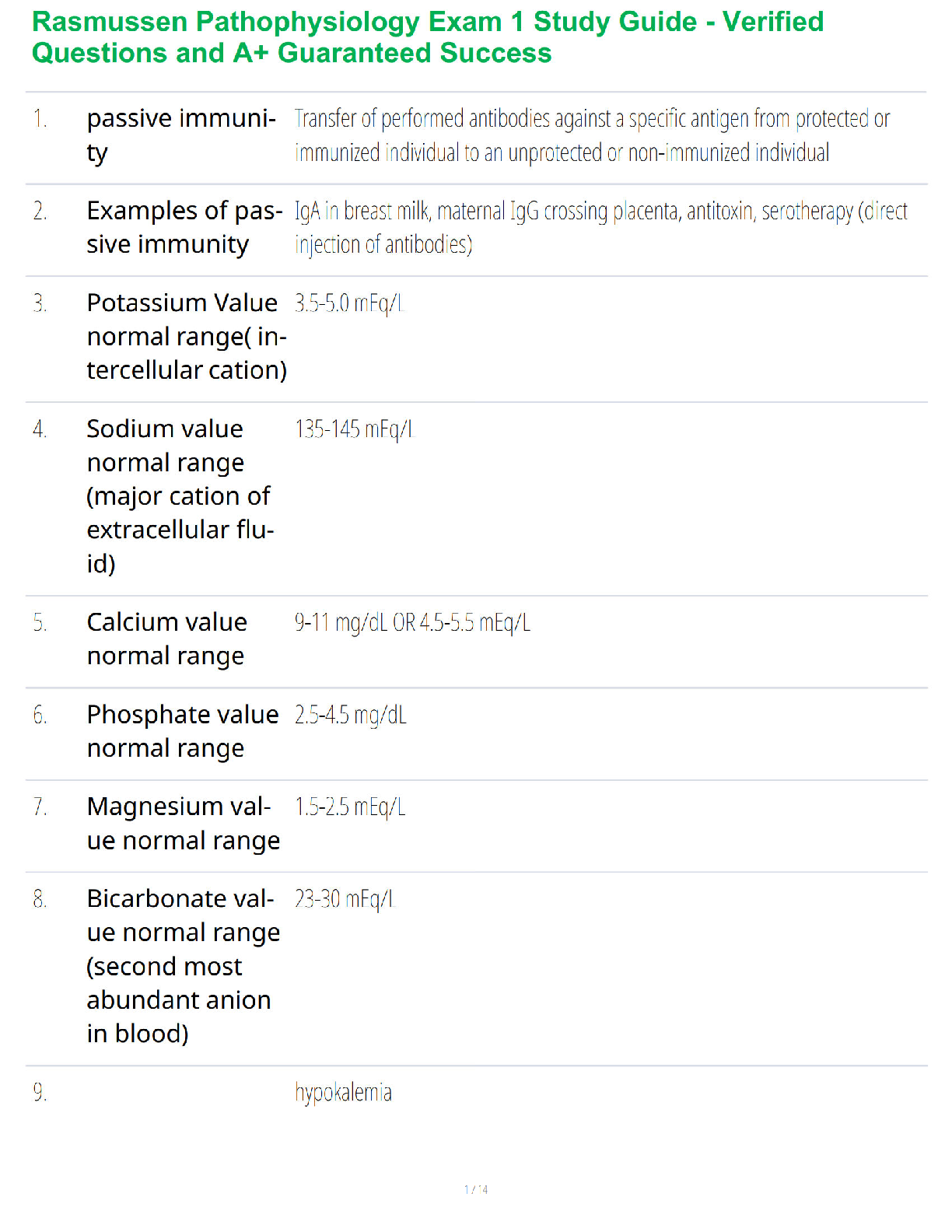
Sodium value: - ANSWER 135-145 mEq/L
Hypernatremia - ANSWER increased sodium levels; thirst, muscle twitching, hyper flex is, seizure
Hyponatremia - ANSWER 1. Headache
2. Seizure
3. Coma
Potassium value - ANSWER 3.5-5.0 mEq/L
Hypokalemia S/S - ANSWER Fatigue, Anorexia, N/V, Muscle weakness, Decreased GI motility, Dysrhythmias, Paresthesia, Flat T waves on ECG
Hyperkalemia S/S - ANSWER Muscle weakness, Bradycardia, Dysrhythmias, Faccid paralysis, Intestinal colic, Tall T waves on ECG
Calcium value - ANSWER 9.0-10.5 mg/dL
Hypercalcemia S/S - ANSWER Muscle weakness, Constipation, Anorexia, N/V, Polyuria, Polydipsia, Neurosis, Dysrhythmias,
Hypocalcemia S/S - ANSWER Diarrhea, Numbness, Tingling of extremities and around mouth, Convulsions, Positive Chvostek sign, Positive Trousseau sign, *Pt at risk for tetany.
Magnesium values - ANSWER 1.5-2.5 mEq/L
Hypomagnesemia S/S - ANSWER Anorexia, Distention, Neuromuscular irritability, Depression, Disorientation
Hypermagnesemia S/S - ANSWER Flushing, Hypotension, Drowsiness, Lethargy, Hypoactive reflexes, Depressed respirations, Bradycardia
Phosphate values - ANSWER 2.4-4.4 mg/dL
Hypophosphatemia symptoms - ANSWER CNS depression, confusion, muscle weakness and pain, dysrhythmias, cardiomyopathy
Hyperphosphatemia symptoms - ANSWER Hypocalcemia• Hyperparathyroidism• Renal osteodystrophy• Ectopic Calcification
Cardinal signs of inflammation - ANSWER redness, swelling, heat, pain, loss of function
Inflammatory response process - ANSWER Tissue damage-vasodilatation-edema-heat-redness-pain
Hypersensitivity - ANSWER an exaggerated response by the immune system to a particular substance
Type 1 hypersensitivity - ANSWER IgE; allergens, anaphylaxis, asthma
Type 2 hypersensitivity - ANSWER cytotoxic, IgG/IgM (erythroblastosis)
Type 3 hypersensitivity - ANSWER immune complex; rheumatoid arthritis, lupus
Type 4 hypersensitivity - ANSWER Delayed cell mediated; transplant, TB test (takes a few days)
Immunosupression - ANSWER reduction in the activity of the body's immune system
HIV/AIDS - ANSWER Virus that destroys the immune system that should protect the body from diseases. The disease is passed from person to person through sexual acts, blood transfusions, used hypodermic needles, or from mother to child during birth.
Cancer - ANSWER disorder in which some of the body's cells lose the ability to control growth
Benign - ANSWER mild, not cancerous; slow progress
malignant - ANSWER cancerous; fast spreading, rapid, fatal
Carcinogenesis - ANSWER development of cancer, initiation, promotion, progression
Verrucae (warts) - ANSWER small, hard skin lesions caused by the human papillomavirus
Herpes Simplex Virus (HSV) - ANSWER viral infection characterized by clusters of small vesicles filled with clear fluid on raised inflammatory bases on the skin or mucosa
herpes zoster (shingles) - ANSWER painful eruption of vesicles that follows a nerve root on one side of the body
Tineas (ringworm) - ANSWER Superficial fungal infection; circular, erythematous, pruritus, burning
Candidasis - ANSWER Fungi known as candida albicans which can be found on the mouth, vagina etc of an infected person
-Also known as a yeast infection, thrush
Impetigo - ANSWER bacterial inflammatory skin disease characterized by vesicles, pustules, and crusted-over lesions; staphylococcus
Lupus - ANSWER when immune system attacks tissues causing redness, pain, swelling, and damage; butterfly rash
Psoriasis - ANSWER chronic, recurrent dermatosis marked by itchy, scaly, red plaques covered by silvery gray scales; *psoriatic arthritis
Atopic Dermatitis (Eczema) - ANSWER chronic inflammation of the skin; rash occurs in face, neck , elbows, knees, and upper trunk of the body along with itching
Scabies - ANSWER contagious, parasitic infection of the skin with intense pruritus
Ticks - ANSWER small gray-brown parasites that bite into tissue and suck blood and transmit several diseases to people, in particular Rocky Mountain spotted fever, Lyme disease, and Tularemia.
Impetigo treatment - ANSWER antibiotics
Shingles treatment - ANSWER antiviral, pain medication
tineas treatment - ANSWER lamisil (terbinafine-HCl cream ... topical); shampoo containing selenium; ketoconazole or itraconazole for initial antimicrobial agent therapy; griseofulvin (oral) for chronic infections
Candidiasis treatment - ANSWER Topical and oral anti-fungal drugs
Herpes simplex treatment - ANSWER topical acyclovir
oral acyclovir
valacyclovir
famicyclovir
Psoriasis treatment - ANSWER Phototherpay, laser theray, MTX, Immunomodulators (Enbrel)
atopic dermatitis treatment - ANSWER -Avoid triggers
-Moisturizing/non-allergen soap (eg; dove white)
-Moisturizers, eg: petrolatum, Aquaphor ointment (not lotion)
-Corticosteroid cream on/off with lesions, if above is ineffective
Eg: Triamcinolone 0.1% cream; Sig: apply to affected area bid, PRN for exacerbations.
Scabies treatment - ANSWER permethrin cream
1st degree burn - ANSWER Only the epidermis (red, painful, and edema)
2nd degree burn - ANSWER epidermis and part of dermis (blistered)
3rd degree burn - ANSWER Full thickness damage through skin into nerves and muscles
Burn complications - ANSWER -*hypovolemic shock*
( phase 1 )
-fluid resuscitation
-*infection*
( phase 2 & 3 )
-*contractures*
-inhalation injury
-scarring
-*curling's ulcer*
-heart & renal failure
-*paralytic ileus*
Skin cancer - ANSWER abnormal growth of skin cells
basal cell carcinoma - ANSWER malignant tumor of the basal cell layer of the epidermis
squamous cell carcinoma - ANSWER a type of rapidly growing cancer that appears as a scaly, reddened patch of skin
Melanoma - ANSWER The most serious form of skin cancer
Degenerative Joint Disease (Osteoarthritis) - ANSWER Progressive degeneration of articular cartilage; most common type of arthritis; overuse
Osteomyelitis - ANSWER infection of the bone tissue
Osteosarcoma - ANSWER bone cancer
Rickets - ANSWER osteomalacia in children; causes bone deformity; vitamin d deficient
Osteomalacia/rickets - ANSWER bones become softer because of a vitamin D deficiency
Types of fractures - ANSWER Simple-transverse, spiral, oblique, compound, comminuted, greenstick, open, closed, compression, incomplete, stress, pathophysiological, impacted
compartment syndrome - ANSWER injury caused when tissues such as blood vessels and nerves are constricted within a space as from swelling or from a tight dressing or cast
Compartment syndrome treatment - ANSWER Fasciotomy: Incision through skin and subcutaneous tissue and fascia of affected compartment, relieves pressure and restores circulation
Compartment Syndrome S/S - ANSWER Pain, Passive stretch(w/hyperextension), Paresthesia, Pallor, Absent/diminished pulses
rheumatoid arthritis (RA) - ANSWER chronic joint condition with inflammation and pain; caused by an autoimmune reaction against joint tissue, particularly the synovial membrane
Osteoarthritis (OA) - ANSWER progressive, degenerative joint disease with loss of articular cartilage and hypertrophy of bone (formation of osteophytes, or bone spurs) at articular surfaces
Psoriatic arthritis - ANSWER An inflammatory arthritis associated with psoriasis of the skin
Psoriatic Arthritis treatment - ANSWER treatment may include medication to reduce inflammation, steroid injections, or joint replacement surgery
Gout - ANSWER hereditary metabolic disease that is a form of acute arthritis, characterized by excessive uric acid in the blood and around the joints
myasthenia gravis (MG) - ANSWER a chronic autoimmune disease that affects the neuromuscular junction and produces serious weakness of voluntary muscles
Fibromyalgia - ANSWER chronic condition with widespread aching and pain in the muscles and fibrous soft tissue
muscular dystrophy - ANSWER group of hereditary diseases characterized by degeneration of muscle and weakness
Sprain - ANSWER An injury in which the ligaments holding bones together are stretched too far and tear.
Strain - ANSWER A condition resulting from damaging a muscle or tendon
[Show More]