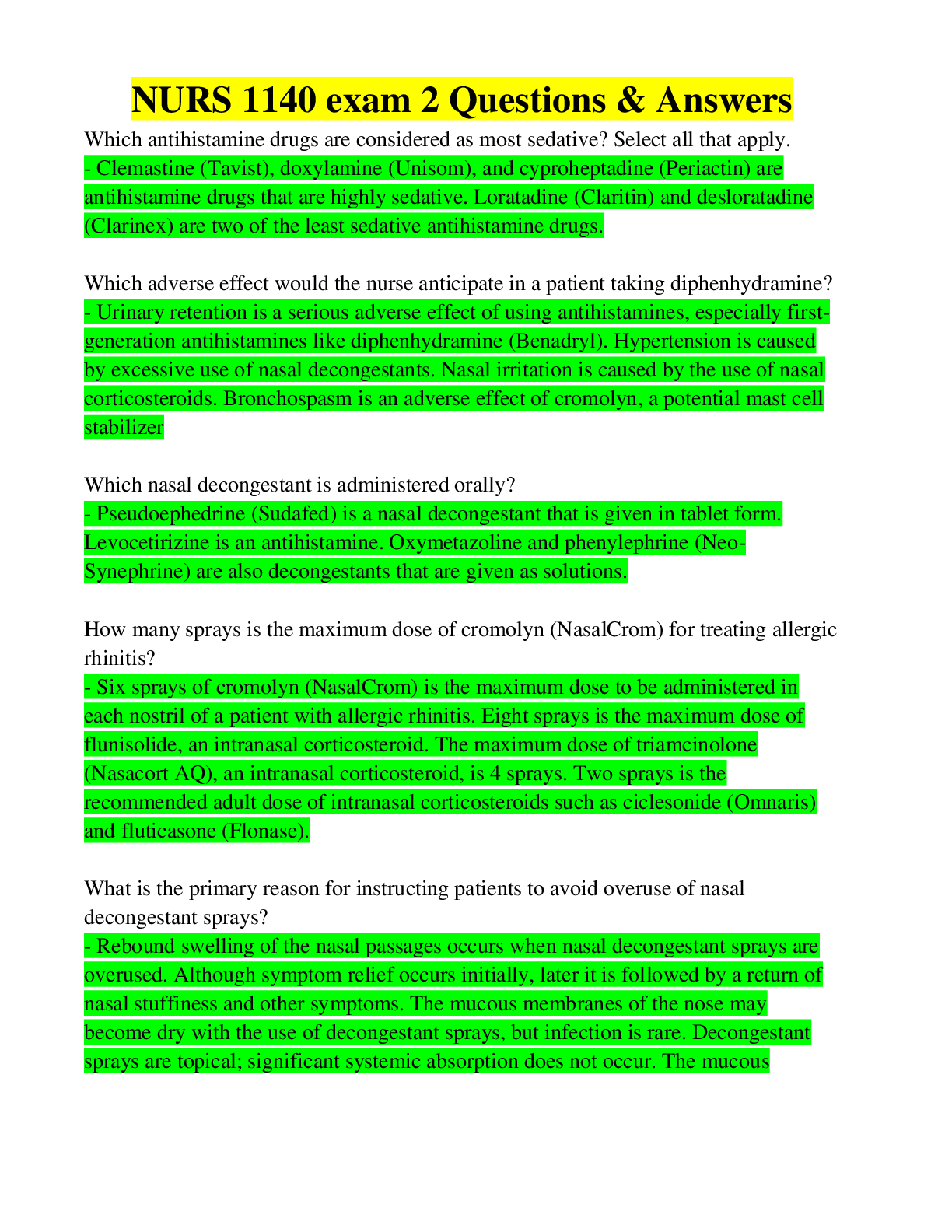
NURS 1140 exam 2 Questions & Answers -Which antihistamine drugs are considered as most sedative? Select all that apply. - Clemastine (Tavist), doxylamine (Unisom), and cyproheptadine (Periactin) are antihistamine drugs
...
NURS 1140 exam 2 Questions & Answers -Which antihistamine drugs are considered as most sedative? Select all that apply. - Clemastine (Tavist), doxylamine (Unisom), and cyproheptadine (Periactin) are antihistamine drugs that are highly sedative. Loratadine (Claritin) and desloratadine (Clarinex) are two of the least sedative antihistamine drugs.
Which adverse effect would the nurse anticipate in a patient taking diphenhydramine? - Urinary retention is a serious adverse effect of using antihistamines, especially firstgeneration antihistamines like diphenhydramine (Benadryl). Hypertension is caused by excessive use of nasal decongestants. Nasal irritation is caused by the use of nasal corticosteroids. Bronchospasm is an adverse effect of cromolyn, a potential mast cell stabilizer
Which nasal decongestant is administered orally?
- Pseudoephedrine (Sudafed) is a nasal decongestant that is given in tablet form. Levocetirizine is an antihistamine. Oxymetazoline and phenylephrine (NeoSynephrine) are also decongestants that are given as solutions.
How many sprays is the maximum dose of cromolyn (NasalCrom) for treating allergic rhinitis?
- Six sprays of cromolyn (NasalCrom) is the maximum dose to be administered in each nostril of a patient with allergic rhinitis. Eight sprays is the maximum dose of flunisolide, an intranasal corticosteroid. The maximum dose of triamcinolone (Nasacort AQ), an intranasal corticosteroid, is 4 sprays. Two sprays is the recommended adult dose of intranasal corticosteroids such as ciclesonide (Omnaris) and fluticasone (Flonase).
What is the primary reason for instructing patients to avoid overuse of nasal decongestant sprays?
- Rebound swelling of the nasal passages occurs when nasal decongestant sprays are overused. Although symptom relief occurs initially, later it is followed by a return of nasal stuffiness and other symptoms. The mucous membranes of the nose may become dry with the use of decongestant sprays, but infection is rare. Decongestant
sprays are topical; significant systemic absorption does not occur. The mucoub. Place the patient on a face mask delivering 100% oxygen. s membranes of the nose may become dry with the use of decongestant sprays, but related problems of significant cracking or bleeding are rare.
Which condition may cause chronic rhinitis?
- A deviated nasal septum may lead to chronic rhinitis; also allergy, nonallergic perennial rhinitis, chronic sinusitis. Bacterial infection, congestion caused by certain drugs, and presence of foreign bodies may cause acute rhinitis that subsides once the causative factor is treated or removed
Which drug inhibits antihypertensive activity when used concurrently with a nasal decongestant?
- When methyldopa (Aldomet) is used concurrently with a nasal decongestant, the antihypertensive activity of methyldopa (Aldomet) is inhibited. Monoamine oxidase inhibitors such as phenelzine (Nardil), isocarboxazid (Marplan), and tranylcypromine (Parnate) enhance the toxic effects of a nasal decongestant and result in hypertension.
What common adverse effect is associated with cromolyn (NasalCrom) and beclomethasone (Beconase AQ) administration?
- Nasal irritation is the common adverse effect associated with the administration of cromolyn (NasalCrom) and beclomethasone (Beconase AQ). Dry mouth and blurred vision are associated with antihistamine drug therapy. Urinary retention is associated with nasal decongestant and antihistamine therapy.
Which antihistamine has the least sedative effect?
- Desloratadine (Clarinex) is an antihistamine drug with the smallest sedative effect. Clemastine (Tavist), promethazine (Phenergan), and diphenhydramine (Benadryl) are highly sedative antihistamines.
Reduction of which symptom is a therapeutic outcome of antihistamine drug therapy?
Select all that apply.
- When antihistamines are administered, symptoms of lacrimation, rhinorrhea, itching, sneezing, and conjunctivitis are reduced. Sneezing is reduced when intranasal corticosteroids are administered. Nasal irritation is an adverse effect associated with
administration of intranasal corticosteroids and decongestants. When nasal
decongestants are used, nasb. Place the patient on a face mask deliveringal congestion is reduced. 100% oxygen.
Which drug is used as a part of the prophylactic management for asthma?
[Show More]