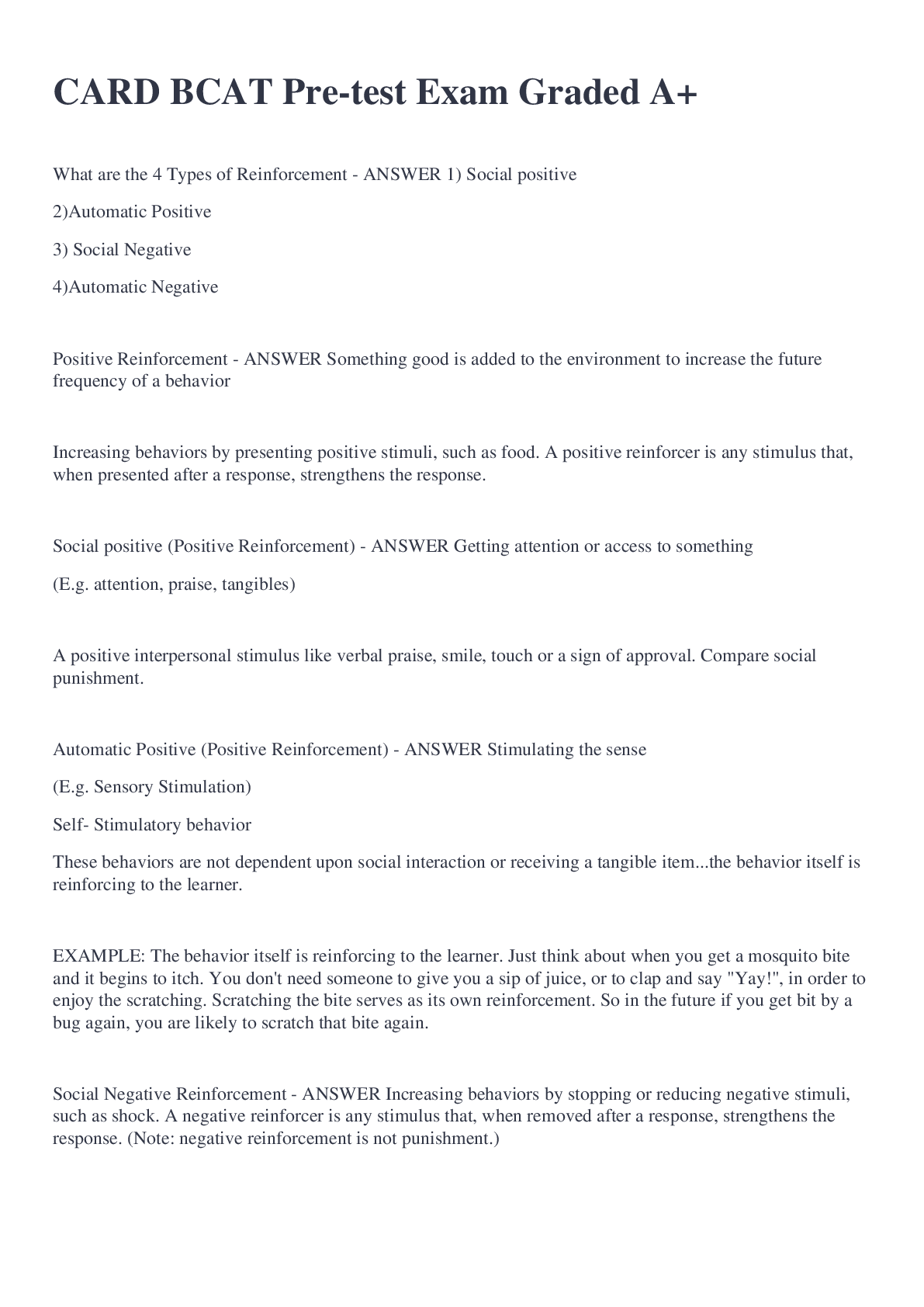
What are the 4 Types of Reinforcement - ANSWER 1) Social positive
2)Automatic Positive
3) Social Negative
4)Automatic Negative
Positive Reinforcement - ANSWER Something good is added to the environment to increase
...
What are the 4 Types of Reinforcement - ANSWER 1) Social positive
2)Automatic Positive
3) Social Negative
4)Automatic Negative
Positive Reinforcement - ANSWER Something good is added to the environment to increase the future frequency of a behavior
Increasing behaviors by presenting positive stimuli, such as food. A positive reinforcer is any stimulus that, when presented after a response, strengthens the response.
Social positive (Positive Reinforcement) - ANSWER Getting attention or access to something
(E.g. attention, praise, tangibles)
A positive interpersonal stimulus like verbal praise, smile, touch or a sign of approval. Compare social punishment.
Automatic Positive (Positive Reinforcement) - ANSWER Stimulating the sense
(E.g. Sensory Stimulation)
Self- Stimulatory behavior
These behaviors are not dependent upon social interaction or receiving a tangible item...the behavior itself is reinforcing to the learner.
EXAMPLE: The behavior itself is reinforcing to the learner. Just think about when you get a mosquito bite and it begins to itch. You don't need someone to give you a sip of juice, or to clap and say "Yay!", in order to enjoy the scratching. Scratching the bite serves as its own reinforcement. So in the future if you get bit by a bug again, you are likely to scratch that bite again.
Social Negative Reinforcement - ANSWER Increasing behaviors by stopping or reducing negative stimuli, such as shock. A negative reinforcer is any stimulus that, when removed after a response, strengthens the response. (Note: negative reinforcement is not punishment.)
Automatic Negative (Negative Reinforcement) - ANSWER occurs when a behavior terminates an aversive stimulus directly and the behavior is strengthened. The aversive stimulus is NOT terminated by another individual.
occurs when a person gets away from something or avoids something as a result of their own behavior (Self Rewarding)
Consequence Manipulation - ANSWER * Provides reinforcers for the desirable behavior
* Eliminates reinforcers for the undesirable behaviors
* Eliminates punishers for the desirable behavior
* Provides punishers for the undesirable behaviors
* Use skills training procedures to teach desirable behaviors
Types of Consequence Manipulations - ANSWER Extinction
Planned Ignoring
Deny Access to Tangible
Response Blocking/Redirection
Response Cost
Overcorrection
Time out
Extinction - ANSWER The withholding of previously occurring reinforcement upon a behavior
*The behavior no longer results in the maintaining reinforcement
*The behavior decreases as a result
What are the 4 types of Extinction - ANSWER 1) Escape Extinction
2)Tangible Extinction
3) Attention Extinction (Planned Ignoring)
4) Sensory Extinction / Response Interruption / Redirection
Escape Extinction - ANSWER Preventing the individual to escape or delay a task as a result of the behavior.
Tangible Extinction - ANSWER Withholding access to a desired item or activity that had previously been given as a consequence of the behavior
Attention Extinction (Planned Ignoring) - ANSWER Withholding attention (positive and/or negative) that had been previously given as a result of the behavior
Sensory Extinction / Response Interruption / Redirection - ANSWER A procedure involving the interruption of a problem behavior and immediate redirection to a high probability behavior
*The problem behavior is interrupted and then the individual is redirected to easy or preferred activities
*Often used to reduce stereotypy
Response Blocking - ANSWER A procedure involving physical intervention by the instructor to interrupt and prevent the problem behavior when it occurs.
*used when a behavior is physically harmful to oneself or others, but may be used for other behaviors
*often used for sensory maintained behaviors
*Response blocking should always involve the LEAST amount of physical contact necessary to block the behavior
*Should only be used when the program supervisor/BCBA has instructed to do so
*Used to address self-injurious behavior
Time Out - ANSWER Removal of access to reinforcement for a specified period of time contingent on the problem behavior.
*The removal of the individual from a reinforcing activity for brief period as a consequence to the behavior
*reduces behavior by resulting in the loss of reinforcement when the behavior occurs
Types of Time-out: Nonexlusionary time-out and exclusionary time-out
Non-exclusionary & Exclusionary - ANSWER
Non-exclusionary (Time out) - ANSWER The individual remains in the location where the behavior occurred but is briefly removed from access to desired reinforcers
Exclusionary (Time out) - ANSWER The individual is briefly removed from the location whee the behavior occurred for a specified period of time.
Token Economy Systems - ANSWER Teaches delayed gratification
*Desired reinforcers may not always be available or practical to deliver in certain settings
* Helps teach waiting skills
*Help in generalizing skills to natural environment
Response Cost - ANSWER Removal of a specified amount of reinforcement contingent on the problem behavior
*Losing a portion of a positive reinforcer as a result of the behavior occurring
*Response cost reduces behavior by resulting in the loss of reinforcement when the behavior occurs
Example: Used to reduce inappropriate body contact with others
Over Correction - ANSWER A procedure in which the individual is required to perform an activity to practice a positive behavior as a consequence of the problem behavior.
Restitutional Overcorrection - ANSWER A procedure in which the individual restores the environment to a state better than it was prior to the occurrence of the problem behavior
Positive Practice Overcorrection - ANSWER A procedure which requires the individual to repeatedly practice an appropriate alternative response as a consequence tot he problem behavior
Topography - ANSWER The physical shape or form of the observable behavior (DESCRIPTION)
Example: Shaking and manipulating objects with her fingers in a repetitive motion, typically within line of vision
Function - ANSWER The reason why the behavior is occurring (THE WHY)
Example:
(Automatic) Feels good, gains pleasure from sensory stimulation (visual movement of object, feel of object moving in her fingers)
What are the common functions of behavior? - ANSWER *Attention
*Tangible
*Escape
*Automatic
Attention Function - ANSWER Getting attention (usually reprimands)
*positive attention - Praise
*Negative attention
*reprimands
*Emotional Reactions
2 types of Individualized Assessments - ANSWER Functional Behavior Assessment
Direct Assessment
Functional Behavior Assessment - ANSWER *An individualized assessment procedure used to determine the function of a behavior
(Involves both indirect and direct assessment procedures)
*Conducted by a qualified professional such as a BCBA
*Direct care staff/ABA technicians or therapists may be asked to assist in these procedures
*Collecting behavioral data and ABA data
Direct Assessment - ANSWER *Observation of the behavior and use of ABC Analysis
Behavior Intervention Plan (BIP) - ANSWER A detailed written description of a problem behavior and the interventions designed to reduce the behavior
Two Goals:
1) Decrease problem behaviors
2) Increase an appropriate alternative response
*BIP is a written description of how to achieve those two goals - Developed by a Behavior Analyst
Which behavior functions are provided by others - ANSWER Attention, Tangible, and Escape from Demand
[Show More]









.png)

-Hesi-Anatomy-and-physiology-(Complete-Answers).png)