NUR 2535 Post-op Pain Management: Cardiac Arrest (2/2)
Sheila Dalton, 52 years old
Primary Concept
Perfusion
Interrelated Concepts (In order of emphasis)
1. Gas Exchange
2. Acid-Base Balance
3. Fluid and El
...
NUR 2535 Post-op Pain Management: Cardiac Arrest (2/2)
Sheila Dalton, 52 years old
Primary Concept
Perfusion
Interrelated Concepts (In order of emphasis)
1. Gas Exchange
2. Acid-Base Balance
3. Fluid and Electrolyte Balance
4. Clinical Judgment
5. Patient Education
6. Communication
7. Collaboration
© 2016 Keith Rischer/www.KeithRN.com
UNFOLDING Reasoning Case Study: STUDENT
Post-op Pain Management 2/2: Cardiac Arrest
History of Present Problem:
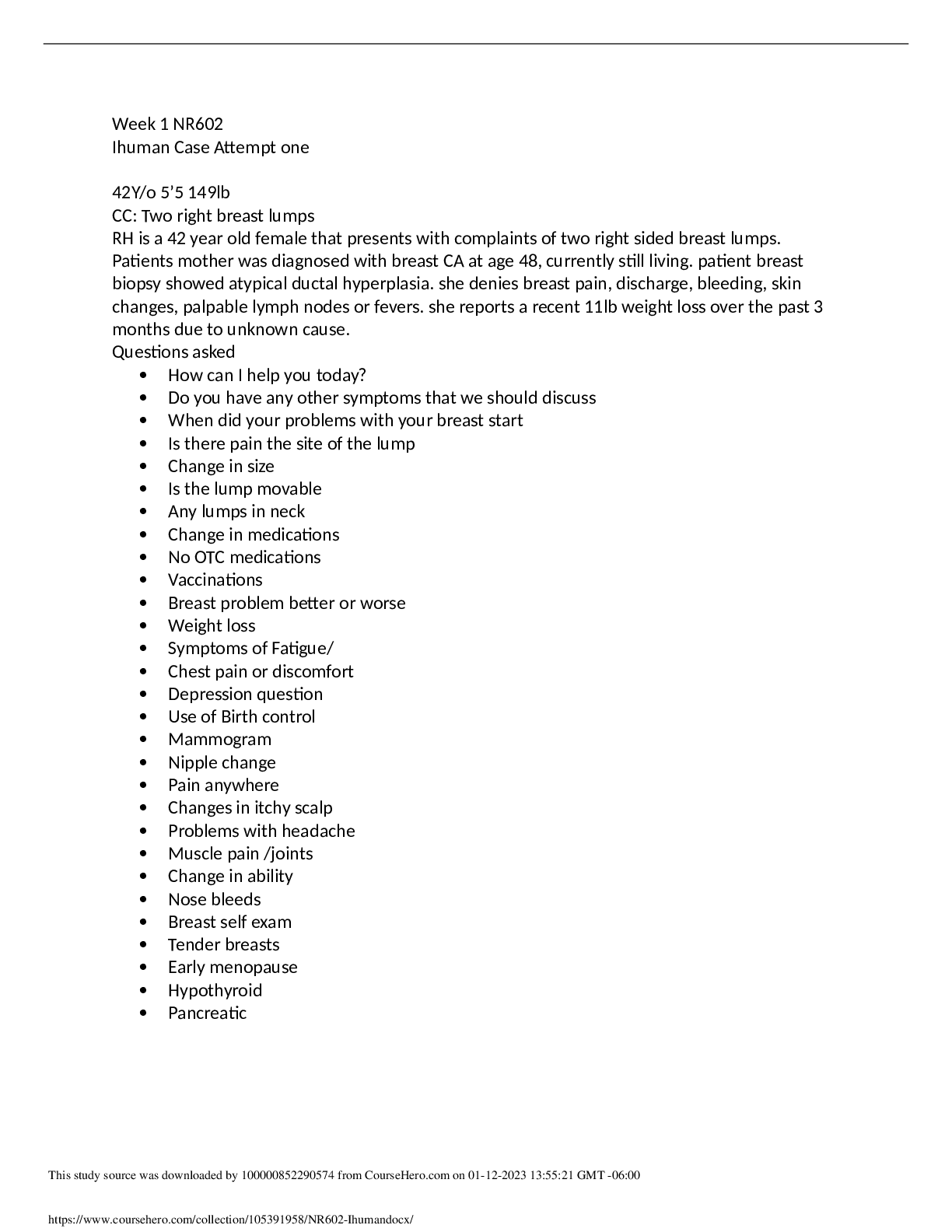
Sheila Dalton is a 52-year-old woman who has a history of chronic low back pain and COPD. She had a posterior spinal fusion of L4-S1 earlier today. Her pain is currently controlled at 2/10 and increases with movement. She was started on a hydromorphone patient-controlled analgesia (PCA) with IV bolus dose that is 0.2 mg and continuous rate of 0.2 mg/hour.
The nurse reported that her nausea has improved after receiving ondansetron IV four hours ago. She was having increased pain despite using the PCA every 10 minutes. Her pain has decreased from 6/10 to 2/10 since the PCA bolus was increased from 0.1 mg to 0.2 mg of hydromorphone IV one hour ago.
.
What data from the history is RELEVANT and has clinical significance to the nurse?
RELEVANT Data from History: Clinical Significance:
Temp 99.8
Respirations 12, O2 89% on 4L NC BP 92/48
Hx of COPD
Hydromorphone PCA bolus 0.2 mg/0.2 mg hrs used Q 10 mins.
Pain decreased from 3/10 to 2/10 Possible infection
Respirations and O2 sats low-due to pain meds? BP low-pain meds? Fluid volume/blood loss?
Pre-existing impact on gas exchange Opiates decrease respirations
Pain is controlled.
Your shift continues…
Thirty minutes later she is feeling more nauseated, and you administer ondansetron 4 mg IV push prn. Five minutes later she puts the call light on again. You are not able to respond immediately because you are helping your other patient get on the commode. Little do you know that Sheila is going to depend on your ability to THINK LIKE A NURSE and clinically reason to save her life. When you arrive in her room you observe the following…
Patient Care Begins:
Current Assessment:
GENERAL
APPEARANCE: Lethargic, unresponsive, ashen pale in color
RESP: Minimal spontaneous respiratory effort present. When you arrive at the bedside you observe that her mouth is full of liquid emesis with chunks of undigested food that is drooling out the
side of her mouth
CARDIAC: Unable to palpate radial pulse, you go straight to the carotid pulse on the neck and note a weak pulse with 2 palpable beats in 5 seconds.
Calculate pulse rate: /minute
NEURO: Unresponsive, does not arouse or awaken to vigorous physical stimuli
GI: Not assessed
GU: Not assessed
SKIN: Not assessed
What assessment data is RELEVANT and must be recognized as clinically significant by the nurse?
RELEVANT Assessment Data: Clinical Significance:
Lethargic, unresponsive, pale Minimal respiratory effort Emesis in mouth
Carotid pulse 24 BPM palpable Unresponsive to stimulus Poor perfusion Inadequete gas exchange
Possible aspiration of emesis
Heart rate decreased-possible damage related to low O2? Low O2 impacting brain/nervous system
Current VS:
T: not assessed
P: 24
R: 4
BP: 72/40
O2 sat: 76% 4 liters n/c
What VS data is RELEVANT and must be recognized as clinically significant by the nurse?
RELEVANT VS Data: Clinical Significance:
1. Respirations 4 1. Impaired gas Exchange (data items 1 and 2)
2. O2 sats 76 on 4L NC 2. Impaired perfusion d/t impaired gas exchange (data items 3 and 4, secondary to 1 and 2)
3. Pulse 24
4. BP 72/40
Clinical Reasoning Begins…
1. What is the primary problem that your patient is most likely presenting with? Acute respiratory failure
2. What is the underlying cause/pathophysiology of the primary problem?
Impaired gas exchange due to aspiration
3. What nursing priority(ies) will guide your plan of care? (if more than one-list in order of PRIORITY)
Call for help. Begin compressions to perfuse patient. Suction patient to remove emesis from airway (in order not to introduce further emesis into lungs). Bag patient with 100% O2, prepare for intubation. Connect patient to cardiac monitor, defibrillate as needed. Administer medications as directed
4. What interventions will you initiate based on this priority?
Nursing Interventions: Rationale: Expected Outcome:
Begin compressions
Perfuse heart, brain, and other tissues
Improved perfusion and circulation, return of heart function.
Suction patient
Bag patient with 100% O2 Prepare for intubation Avoid introduction of further gastric content into lungs
Promote gas exchange and increase efficiency of perfusion
“ “ “ “ “
Cardiac monitor/defibrillate as needed Perfuse heart, brain, and organs
5. What body system(s) will you most thoroughly assess based on the primary/priority concern?
Respiratory and cardiac
6. What is the worst possible/most likely complication to anticipate?
Cessation of cardiac function, death of other organs due to lack of perfusion
7. What nursing assessments will identify this complication EARLY if it develops?
Assess heart rate/rhythm, monitor response to interventions, monitor vital signs for improvement, monitor for return of spontaneous respirations
8. What nursing interventions will you initiate if this complication develops?
Continue resuscitation, administer medications as directed
A crash cart is brought into the room, and the patient is placed on the cardiac monitor/defibrillator. The following rhythm is displayed:
Cardiac Telemetry Strip:
Interpretation:
V fib
Clinical Significance:
Ventricles are fibrillating-not beating properly-decreased perfusion, risk for clotting in ventricles and for movement of clot to other organs.
Medical Management: Rationale for Treatment & Expected Outcomes
I recognize that most students/new nurses have not had ACLS training or exposure to this certification in nursing school. It is important for the new nurse to understand the most common ACLS algorithms as it is relevant to clinical practice. If and when ACLS certification as a registered nurse is taken, this case study will have provided practice of this essential skill! Please recognize that doing this case study does not qualify for ACLS interventions in practice! You must be officially certified to actually intervene with these measures in a code.
Nurses who are BLS certified can have an active part in the code such as chest compressions; pulse check; bag ventilation; and vital sign checks. Nurses should feel that they can work within their scope and certification. So many times, nurses who are not ACLS certified will not even do those things that are taught in the BLS certification course.
But there is a place for a nurse who is not ACLS certified during a code that is an important role…the RECORDER. Every crash cart has a simple 1-2 page form that documents the code and is self-explanatory. Though this role should ultimately be done by a certified ACLS nurse when one arrives, until then begin documentation and remain present in the room so that you as the primary nurse can communicate to the code team and physician the patient’s story and what led up to the code. Once the code team arrives, the role of the primary nurse is to contact physician, family, and pastoral care to update on patient status and assist with care.
Care Provider Orders: Rationale: Expected Outcome:
ACLS Priorities:
Start compressions
Perfuse heart, brain, and other organs Monitor HR and rhythm
Re-establish normal HR
Perfuse heart, brain, and other organs
Permit rapid administration of medications Re-establish normal HR
Vasoconstrictor-aids in perfusion of vital organs Maintain oxygenation/gas exchange
Reestablish normal HR
Perfuse heart, brain, and other organs
antidysrhythmic
Return heart to normal function, maintain perfusion of vital organs
Attach monitor/defibrillator
Provide shock for shockable
rhythm
compressions
establish IV access
shock again as needed
Give Epinephrine
Establish airway
Shock again as needed
Compressions
Give amiodarone
Medication Dosage Calculation:
Medication/Dose: Mechanism of Action: Volume/time frame to
Safely Administer: Nursing Assessment/Considerations:
Epinephrine
1:10,000
1 mg/10 mL IV/IO every 3-5” push Causes vasoconstriction Improves cardiac output by increasing HR, increasing contractility, increases 10 mL syringe Assess HR, RR, lung sounds before and during administration, monitor EKG, monitor for side effects; nervousness, tremors, palpitations.
conductivity through the SA node IV Push: Volume every 15 sec?
1 mg every 3-5 minutes
Medication/Dose: Mechanism of Action: Volume/time frame to
Safely Administer: Nursing Assessment/Considerations:
Amiodarone
300 mg IV push 150 mg/3 mL vial Decreases afterload, prevents and treats dysrhythmias
IV Push: Volume every 15 sec? Assess HR, monitor for bradycardia or increased dysrhythmia.
0.15 ml Q 15 seconds / 6 ml over 10 minutes
TEN minutes post-arrest:
After two doses of epinephrine and amiodarone bolus and the third defibrillatory unsynchronized shock at 360 joules, the following rhythm is present on the monitor:
Cardiac Telemetry Strip:
Interpretation:
Clinical Significance:
Nursing Priority Intervention:
Above is Sinus Tachycardia. Significance-normal heart beat at a rapid rate (140 BPM) Intervention: admininster medications as directed to slow HR
The in-house physician running the code orders a stat ABG right after she is successfully resuscitated and is now intubated. You obtain the following results:
Arterial Blood Gases: Current: High/Low/WNL?
pH (7.35–7.45) 7.15 Low Ph-acidic
pO2 (80–100) 64 low
pCO2 (35–45) 78 High-acidic
HCO3 (18–26) 22 Low end of normal limits
O2 sats (>92%) 90% Low end of normal limits
Oxygen delivery 100%
What lab results are RELEVANT and must be recognized as clinically significant by the nurse?
RELEVANT Lab(s): Clinical Significance:
Ph 7.15
pO2 64
HCO3 22
O2 sats 90% Uncompensated respiratory acidosis
Lab Planning: Creating a Plan of Care with a PRIORITY Lab:
Lab: Normal Value: Why Relevant? Nursing Assessments/Interventions Required:
pH
Value:
7.15
Critical Value:
Acidosis-potential to cause organ/tissue damage if not addressed. 1. Administer O2, improve O2 saturation
Evaluation: ONE minute post-resuscitation:
After determining that her current rhythm also has a pulse, you collect the following assessment data:
Current VS:
T: 99.1 F/37.3 C (oral)
P: 128 (regular)
R: ambu bag rate of 20/minute (physician ordered increased rate)
BP: 128/88
O2 sat: 92% 100% O2
Current Assessment:
GENERAL APPEARANCE: Resting comfortably, appears in no acute distress
RESP: Color slightly improved. Is pale/pink, coarse crackles/rhonchi scattered in both lung fields even after suctioning. No spontaneous resp. effort. Requires ambu bagging
CARDIAC: Pulses 2+ throughout. Strong femoral pulse. No edema in extremities. Heart rate regular–S1S2.
NEURO: Remains unresponsive. Responds to pain stimuli by bringing both hands toward the source of
pain
GI: Abdomen soft, non-tender with active bowel sounds
GU: Foley placed, 30 mL clear, yellow urine present in bag
SKIN: Surgical incision intact, no redness, drainage, or dehiscence present
1. What clinical data is RELEVANT that must be recognized as clinically significant?
RELEVANT VS Data: Clinical Significance:
Pulse 128 regular BP 128/88
Respirations 20-ambu bag O2 sats 92% HR, BP improved, circulation restored Adequete gas exchange but not spontaneous.
RELEVANT Assessment Data: Clinical Significance:
Crackles/rhonchi in both lung fields No spontaneous respirations
Color pale/pink
Pulses 2+, regular heart rate
Unresponsive other than to pain
Probable indicator of aspiration/lung damage Patient will require intubation
Circulation/perfusion adequate
Possible concern for cerebral damage
2. Has the status improved or not as expected to this point?
Status has improved with the exception of respirations. Patient will need to go on ventilator. Unresponsiveness is a concern
3. Does your nursing priority or plan of care need to be modified in any way after this evaluation assessment?
POC should be directed toward maintaining adequate ventilation until spontaneous respirations resume.
4. Based on your current evaluation, what are your nursing priorities and plan of care?
Ventilation and oxygenation
Think ABC’s…
A: AIRWAY–Maintain placement and integrity of endotracheal tube B: BREATHING–Impaired gas exchange
C: CIRCULATION–Maintain adequate blood pressure and stable cardiac rhythm (impaired tissue perfusion)
TEN minutes post-resuscitation:
Medical Management: Rationale for Treatment & Expected Outcomes:
Care Provider Orders: Rationale: Expected Outcome:
ACLS Priorities:
Patient unable to breathe spontaneously. PEEP will help maintain alveoli open to prevent further complications
To rule out damage to the heart muscle or determine need for intervention
Maintain Oxygenation Maintain gas exchange
using ventilator
EKG Maintain circulation
Medication/Dose: Mechanism of Action: Volume/time frame to
Safely Administer: Nursing Assessment/Considerations:
Nalaxone Block effects of opiates Monitor respiratory rate, HR, BP, monitor for signs and symptoms of withdrawal
0.02 mg IV push every 2
minutes
0.4 mg maximum dose
IV Push: Volume every 15 sec?
Give bolus of
0.02 mg over 2 to 3 minutes
The room is now ready and it is now time to transfer to ICU. Effective and concise handoffs are essential to excellent care and if not done well can adversely impact the care of this patient. You have done an excellent job to this point, now finish strong and give the following SBAR report to the nurse who will be caring for this patient:
Situation:
Name/age:
Sheila Dalton, 52 y/o
BRIEF summary of primary problem:
S/P posterior spinal fusion of L4-S1 today. Patient was given IV hydromorphone and ondansetron. Patient went into respiratory failure and required resuscitation. During code, she was given two doses of epinephrine and a bolus of amiodarone. 10 minutes post-code
Day of admission/post-op #: Admission day 1, surgery today
Background:
RELEVANT past medical history: COPD, chronic back pain
Assessment:
Most recent vital signs:
T: 99.1 F/37.3 C (oral)
P: 128 (regular)
R: ambu bag rate of 20/minute (physician ordered increased rate) BP: 128/88
O2 sat: 92% 100% O2
RELEVANT body system nursing assessment data:
Crackles/rhonchi in both lung fields No spontaneous respirations
Color pale/pink
Pulses 2+, regular heart rate Unresponsive other than to pain Foley in place
RELEVANT lab values:
Uncompensated respiratory acidosis
INTERPRETATION of current clinical status (stable/unstable/worsening):
Recommendation:
Suggestions to advance plan of care: Monitor VS; HR, RR, BP, labs
TWENTY minutes post-resuscitation:
Radiology Reports: Portable Chest X-ray
What diagnostic results are RELEVANT and must be recognized as clinically significant by the nurse?
RELEVANT Results: Clinical Significance:
Tip of ET tube 1 cm above the carina.
Heart size normal. ET tube should be 5-7 cm above the carina
Arterial Blood Gases: Current: High/Low/WNL? Prior:
pH (7.35–7.45) 7.29 Low-acidic 7.15
pO2 (80–100) 102 high 64
pCO2 (35–45) 48 High-acidic 78
HCO3 (18–26) 23 Low end of normal-acidic 22
O2 sats (>92%) 100% WNL 90%
Oxygen delivery 100% 100%
What lab results are RELEVANT and must be recognized as clinically significant by the nurse?
RELEVANT Lab(s): Clinical Significance: TREND: Improve/Worsening/Stable:
PH 7.29 Respiratory acidosis Improved from previous ABG’s
PCO2 48
HCO3 23
Complete Blood Count (CBC): Current: High/Low/WNL? Prior:
WBC (4.5–11.0 mm 3) 8.9 WNL 7.8
Hgb (12–16 g/dL) 10.2 Low 11.8
Platelets (150-450 x103/µl) 148 Low 155
Neutrophil % (42–72) 85 High 81
What lab results are RELEVANT and must be recognized as clinically significant by the nurse?
RELEVANT Lab(s): Clinical Significance: TREND: Improve/Worsening/Stable:
HGB 10.2
Platelets 148
Neutrophils 85 Possible blood loss Increased risk of bleeding
Possible indicator of infection worsening
Basic Metabolic Panel (BMP): Current: High/Low/WNL? Prior:
Sodium (135–145 mEq/L) 138 WNL 140
Potassium (3.5–5.0 mEq/L) 4.1 WNL 3.8
CO2 (Bicarb) (21–31 mmol/L) 20 low 22
results are RELEVANT and must be recognized as clinically significant by the nurse?
What lab
RELEVANT Lab(s): Clinical Significance: TREND: Improve/Worsening/Stable:
Glucose 152
Creatinine 1.7
Lactate 2.9
Possibly d/t stress
Possible indicator of kidney damage Acidosis, impaired perfusion worsening
12 Lead EKG:
Interpretation:
SVT
Clinical Significance:
Possible indicator of emerging problem.
Education Priorities/Discharge Planning
1. What will be the most important discharge/education priorities you will reinforce with their medical condition to prevent future readmission with the same problem?
Teach proper use of pain medications and s/s respiratory impairment.
2. What are some practical ways you as the nurse can assess the effectiveness of your teaching with this patient?
Use ‘teach-back” method. Allow patient to ask questions. Caring and the “Art” of Nursing
1. What is the patient and FAMILY likely experiencing/feeling right now in this situation?
To the extent that the patient is aware, she is probably anxious and afraid. Family is no doubt anxious and concerned.
2. What can you do to engage yourself with this patient’s experience and show that he/she matters to you as a person? Speak to patient, explain procedures (even though patient can’t respond). Provide family with information and listen to concerns.
Use Reflection to THINK Like a Nurse
Reflection-IN-action (Tanner, 2006) is the nurse’s ability to accurately interpret the patient’s response to an intervention in the moment as the events are unfolding to make a correct clinical judgment and transfer what is learned to improve nurse thinking and patient care in the future.
1. What did I learn from this scenario?
Gained more knowledge in the assessment and care of a patient in an emergent situation.
2. What would I do differently (if applicable) in this situation to prevent this outcome?
Monitor use of pain meds more closely.
3. How can I use what has been learned from this situation to improve patient care in the future?
As with other case studies, this builds on my knowledge base and provides me with a framework in which to deal with a patient in a similar condition.
[Show More]