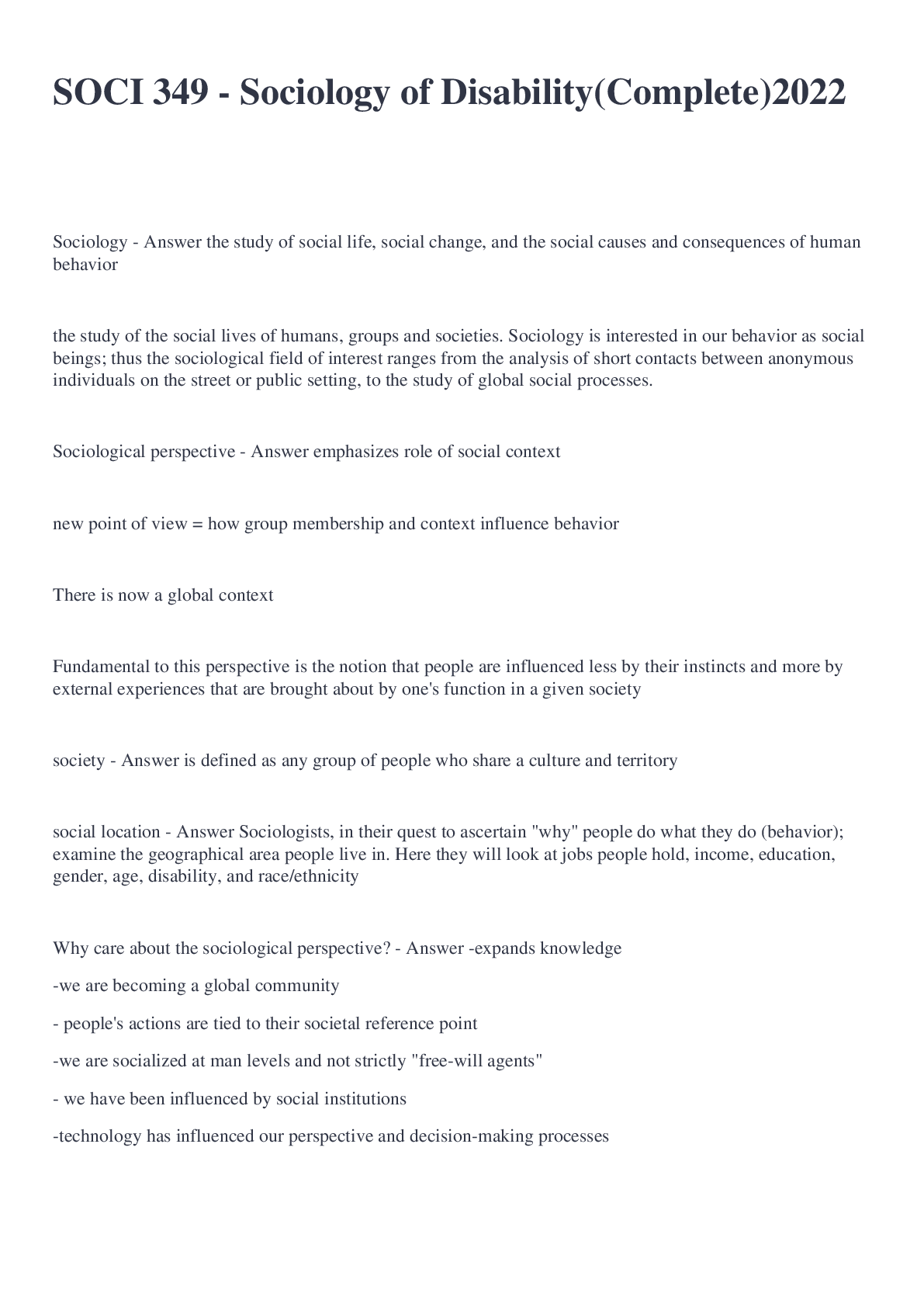
Sociology - Answer the study of social life, social change, and the social causes and consequences of human behavior
the study of the social lives of humans, groups and societies. Sociology is interested in our behavi
...
Sociology - Answer the study of social life, social change, and the social causes and consequences of human behavior
the study of the social lives of humans, groups and societies. Sociology is interested in our behavior as social beings; thus the sociological field of interest ranges from the analysis of short contacts between anonymous individuals on the street or public setting, to the study of global social processes.
Sociological perspective - Answer emphasizes role of social context
new point of view = how group membership and context influence behavior
There is now a global context
Fundamental to this perspective is the notion that people are influenced less by their instincts and more by external experiences that are brought about by one's function in a given society
society - Answer is defined as any group of people who share a culture and territory
social location - Answer Sociologists, in their quest to ascertain "why" people do what they do (behavior); examine the geographical area people live in. Here they will look at jobs people hold, income, education, gender, age, disability, and race/ethnicity
Why care about the sociological perspective? - Answer -expands knowledge
-we are becoming a global community
- people's actions are tied to their societal reference point
-we are socialized at man levels and not strictly "free-will agents"
- we have been influenced by social institutions
-technology has influenced our perspective and decision-making processes
disability - Answer some condition or characteristic that is linked to a particular individual and, therefore, is to some extent embodied
is present when activities that are routinely performed by people (E.g., walking, reading, speaking) are somehow restricted or cannot be done in accustomed ways
culture and disability - Answer How disability is defined, understood and given meaning in any given culture, affects the recognition of the disabled, and determines the extent to which essential services and support are provided, that enable them to live a 'normal' life in society.
culture - Answer a total way of life for a society, its traditions, its habits, or beliefs
a shared organization of ideas that includes the intellectual, moral and aesthetic standards prevalent in a community and meanings of community actions
denotes an historically transmitted pattern of meanings embodied in symbols, a system of inherited conceptions expressed in symbolic forms by means of which men communicate, perpetuate, and develop their attitudes toward life
an identifiable pattern of behavior by people in their environment and the meanings they attach to that encounter and experience
- Answer African American, Latino, and Native American groups represent a disproportionately large percentage of certain disability categories and a disproportionately small percentage of gifted programs
- Answer The concept of disability is defined differently across cultures (Lo, 2005), the potential for cross-cultural miscommunication is extremely high when service providers' cultural frameworks differ from those of the families they serve.
Blue-Banning, et al (2004), fount six central characteristics of effective collaboration between service providers and ethnic/racial minority groups: - Answer (A) Communication--positive, understandable, & respectful;
(B) Commitment to the child and family;
(C) Equal power in decision making/service implementation;
(D) Competence in implementing and achieving goals;
(E) Mutual trust; and
(F) Mutual respect.
Individualized Education Program - Answer IEP
impairment - Answer term used by professionals to refer to some disruption at the system level of a bodily organ (e.g., the brain, an arm, or a leg) that leads to some loss or an observed abnormality (I.e., some deviation from an established norm) that is physiological, psychological, or anatomical in nature
tend to be lasting, if not always permanent.
They m
[Show More]