Physiology  >  ATI  >  Teas 6 Science- Human Anatomy and Physiology (All)

Teas 6 Science- Human Anatomy and Physiology

Document Content and Description Below

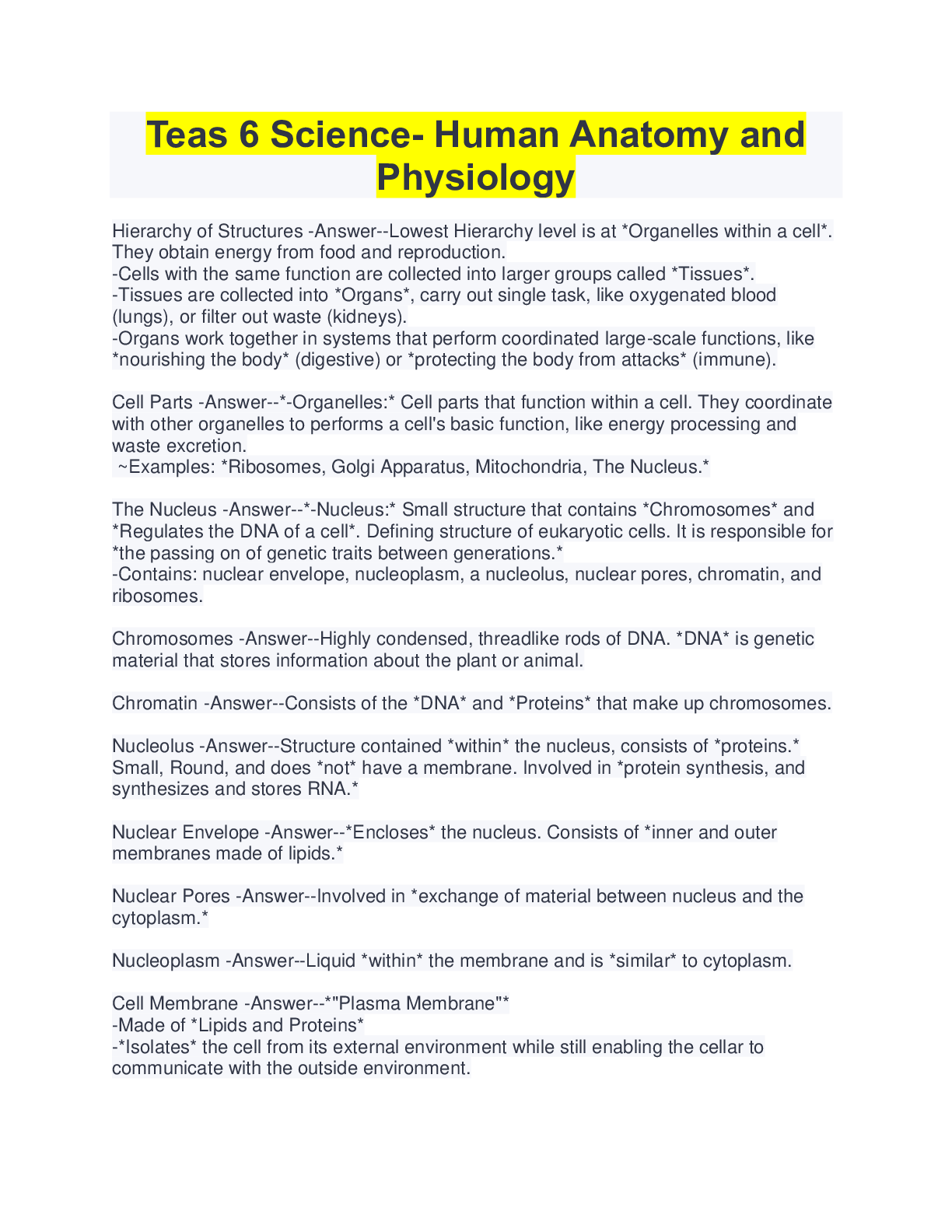
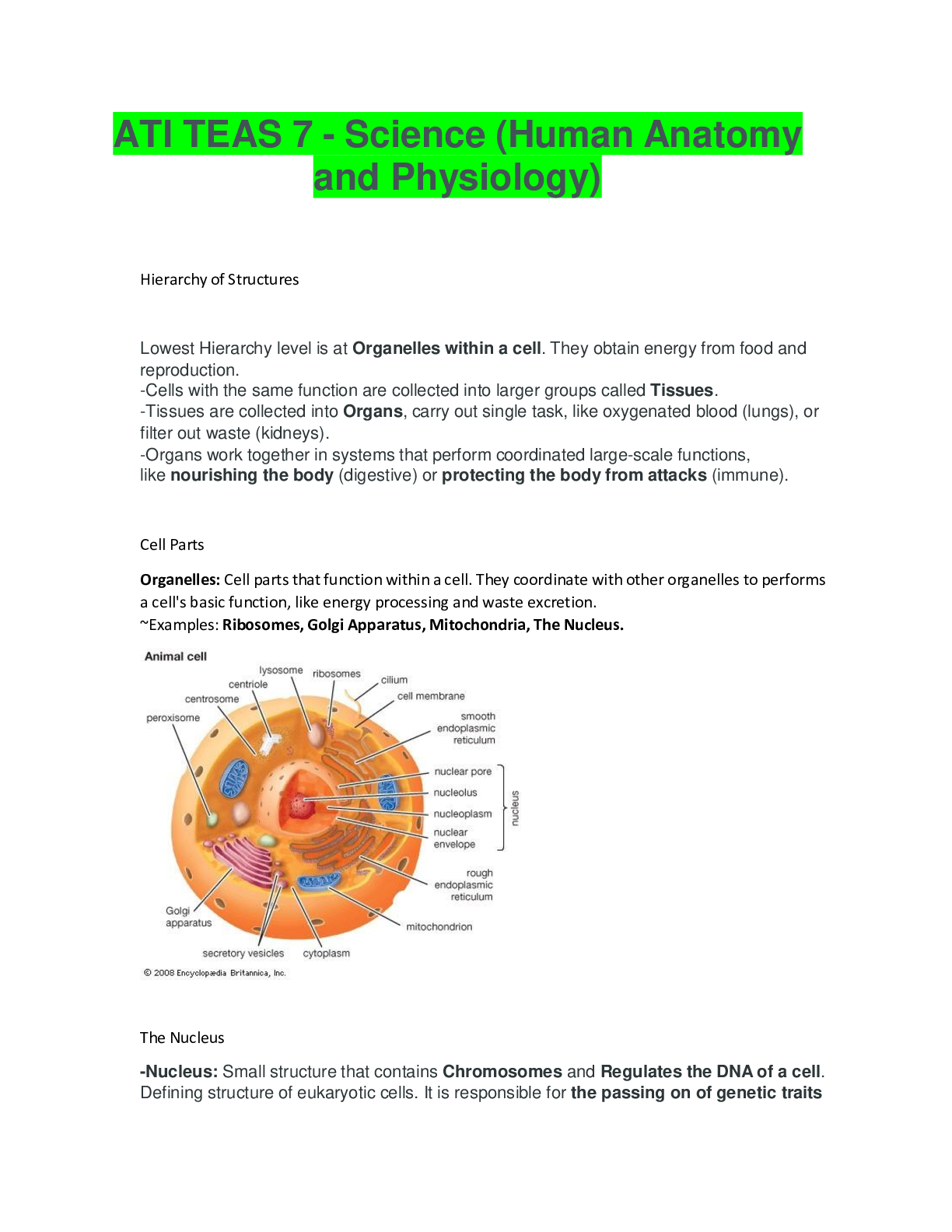
Hierarchy of Structures -Answer--Lowest Hierarchy level is at *Organelles within a cell*. They obtain energy from food and reproduction. -Cells with the same function are collected into larger groups ... called *Tissues*. -Tissues are collected into *Organs*, carry out single task, like oxygenated blood (lungs), or filter out waste (kidneys). -Organs work together in systems that perform coordinated large-scale functions, like *nourishing the body* (digestive) or *protecting the body from attacks* (immune). Cell Parts -Answer--*-Organelles:* Cell parts that function within a cell. They coordinate with other organelles to performs a cell's basic function, like energy processing and waste excretion. ~Examples: *Ribosomes, Golgi Apparatus, Mitochondria, The Nucleus.* The Nucleus -Answer--*-Nucleus:* Small structure that contains *Chromosomes* and *Regulates the DNA of a cell*. Defining structure of eukaryotic cells. It is responsible for *the passing on of genetic traits between generations.* -Contains: nuclear envelope, nucleoplasm, a nucleolus, nuclear pores, chromatin, and ribosomes. Chromosomes -Answer--Highly condensed, threadlike rods of DNA. *DNA* is genetic material that stores information about the plant or animal. Chromatin -Answer--Consists of the *DNA* and *Proteins* that make up chromosomes. Nucleolus -Answer--Structure contained *within* the nucleus, consists of *proteins.* Small, Round, and does *not* have a membrane. Involved in *protein synthesis, and synthesizes and stores RNA.* Nuclear Envelope -Answer--*Encloses* the nucleus. Consists of *inner and outer membranes made of lipids.* Nuclear Pores -Answer--Involved in *exchange of material between nucleus and the cytoplasm.* Nucleoplasm -Answer--Liquid *within* the membrane and is *similar* to cytoplasm. Cell Membrane -Answer--*"Plasma Membrane"* -Made of *Lipids and Proteins* -*Isolates* the cell from its external environment while still enabling the cellar to communicate with the outside environment. -Consists: *Phospholipid bilayer* with the hydrophilic ends of the outer layer facing external environment. *~Cholesterol*: Adds stiffness and flexibility *~Glycolipids*: Help cell to recognize other cells of the organisms. *~Proteins*: Help give cells shape *~Special Proteins:* Helps cell communicate with external environment. *~Other Proteins:* Transport molecules across membrane Selective Permeability -Answer--With regard to size, charge, and solubility. *-Size:* Membrane allows small molecules to diffuse through it. Oxygen and Water molecules are small and can pass through the cells membrane. *-Charge:* Ions on a cells surface either *attracts or repels* ions. Ions with *like* charges are *repelled*, and ions with *opposite* charges are *attracted* to the surface. *-Solubility:* Molecules that are soluble in phospholipids can usually pass through the membrane. Many are *not* able to diffuse the membrane, and if anything they'll have to be moved through by *active transport and vesicles.* Cell Structures -Answer--Inside the cell. Contain: Ribosomes, Golgi Apparatus, Vacuoles, Vesicles, Cytoskeleton, Microtubules, Cytosol, Cytoplasm, Cell Membrane, Endoplasmic Reticulum, Mitochondria Ribosomes -Answer--Involved in *synthesizing proteins from amino acids.* -Make up about a quarter of a cell. -Some are embedded in the *Rough Endoplasmic Reticulum (Rough ER)* Golgi Apparatus -Answer--Involved in *synthesizing materials* like *proteins* that are transported *out* of the cell. ~*Modifies and Packages proteins* secreted from the cell. -Located near the nucleus and has layers of membranes. Vacuoles -Answer--Sacs used for *storage, digestion, and waste removal*. -Plant: Has *one large* vacuole -Animal: Has *small, sometimes numerous* vacuoles. Vesicles -Answer--Small organelle *within* a cell, has a membrane. -Functions: *Moving materials* within a cell. Cytoskeleton -Answer--Consist of *microtubules* that help *shape and support* the cell. Microtubules -Answer--Part of cytoskeleton. -Help *support* the cell. -Made of *proteins* Cytosol -Answer--*Liquid* materials in the cell. Mostly water, also contains floating molecules. [Show More]

Last updated: 3 years ago

Preview 1 out of 30 pages

Buy Now

Instant download

We Accept:

Payment methods accepted on Scholarfriends (We Accept)
Preview image of Teas 6 Science- Human Anatomy and Physiology document

Buy this document to get the full access instantly

Instant Download Access after purchase

Buy Now

Instant download

We Accept:

Payment methods accepted on Scholarfriends (We Accept)

Reviews( 0 )

$12.00

Buy Now

We Accept:

Payment methods accepted on Scholarfriends (We Accept)

Instant download

Can't find what you want? Try our AI powered Search

153
0

Document information


Connected school, study & course


About the document


Uploaded On

Sep 22, 2022

Number of pages

30

Written in

All

Seller


Profile illustration for Kadugu
Kadugu

Member since 3 years

0 Documents Sold

Additional information

This document has been written for:

Uploaded

Sep 22, 2022

Downloads

 0

Views

 153

Document Keyword Tags

Recommended For You

Get more on ATI »

$12.00
What is Scholarfriends

Scholarfriends.com Online Platform by Browsegrades Inc. 651N South Broad St, Middletown DE. United States.

We are here to help

We're available through e-mail, Twitter, and live chat.
 FAQ
 Questions? Leave a message!


Copyright © Scholarfriends · High quality services·