Portage Learning: Microbiology Module
4 Rated A+
What is another name for a liquid growth media, and what are the basic components? ✔✔Growth
media in a liquid form is often referred to as nutrient broth. As the name i
...
Portage Learning: Microbiology Module
4 Rated A+
What is another name for a liquid growth media, and what are the basic components? ✔✔Growth
media in a liquid form is often referred to as nutrient broth. As the name implies its composition
consists primarily of essential 'ingredients' such as a rich source of sugars, amino acids and
vitamins. Together, a nutrient broth provides the microbe with a source of carbon/energy, which,
in turn, encourages its expansion.
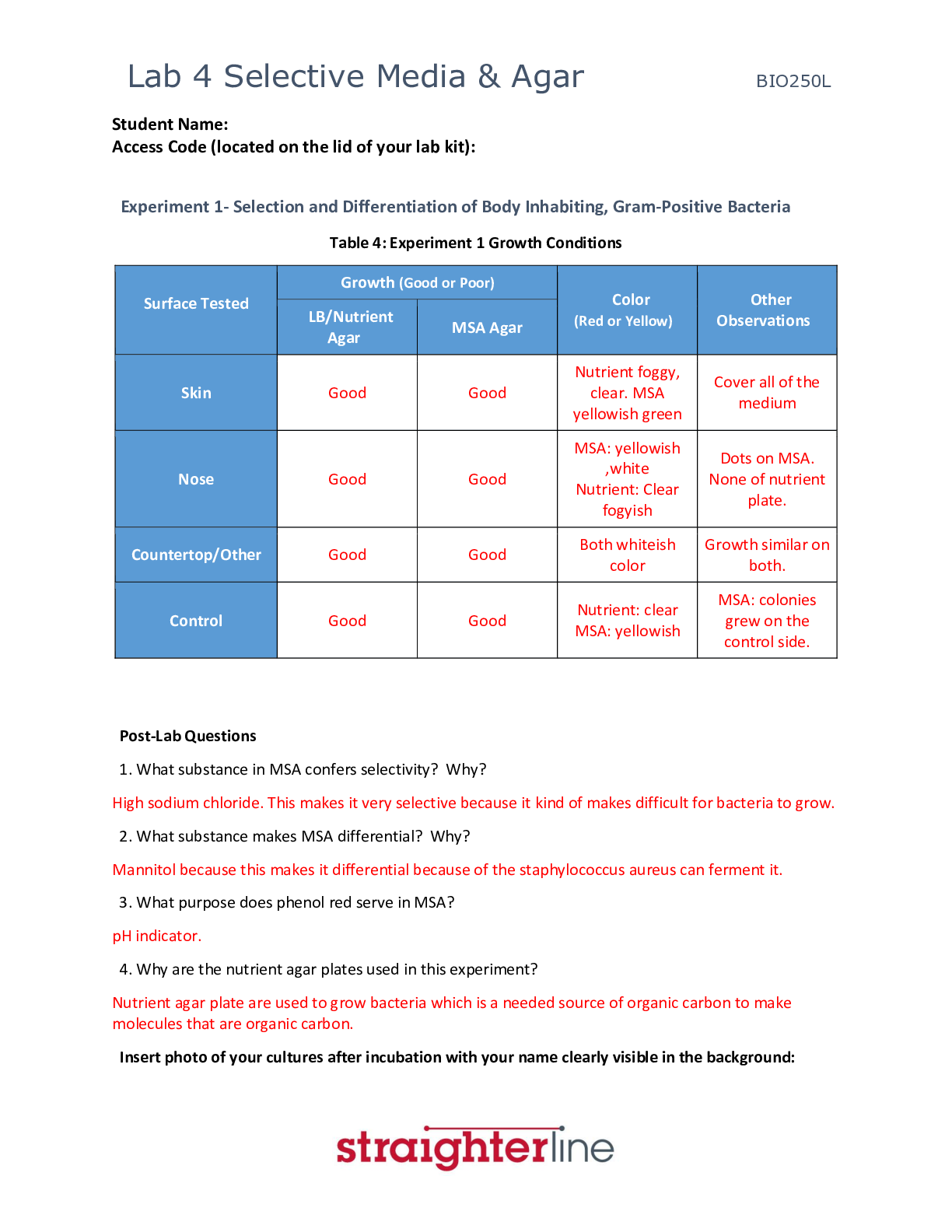
What is selective media? ✔✔Selective media allows for only the growth of certain microbes while
restricting the growth of all others.
What is differential media? ✔✔Differential media is used to distinguish between two (or more)
related microbes.
What are the requirements of a fastidious microbe? ✔✔A fastidious microbe is an organism with
complex growth requirements such that if absent it will not grow. Enriched medias thus contain
these specific and essential nutrients required for the growth of a particular subset of
microorganisms.
What is agar? ✔✔In its simplest form agar is liquid growth media that has had a hardening agent
added to it. Agar is created when a polysaccharide derived from seaweed (algae) extract is added
to growth media. Agar is used to create a solid, smooth surface on which microbes can grow.
True or False: LB agar is classified as a non-selective, differential media. ✔✔False. LB agar is
both a non-selective and non-differential media. LB agar is often used to expand unknown
microbial population because it encourages microbial growth due to the presence of universal
nutrients (non-differential) and absence of restrictive factors (non-selective).
What are the three forms of hemolysis found on blood agar plates? ✔✔Alpha (green), Beta (clear
zones) and Gamma (white/tan). Microbes capable of alpha hemolysis present with greenish-brown
color colonies due to the incomplete (partial) lysis of red blood cells. Beta hemolysis is classified
as the capacity of a microbe to completely lyse red blood cells. The resulting lysis presents as a
distinct zone of clearing around the growing colony. Gamma hemolysis designates the absence or
lack of hemolytic activity and the resulting colonies are often white/tan in color growing on the
red background color of the unaffected blood agar plate.
What is the primary purpose of Columbia CNA agar? ✔✔As it suppresses the growth of Gramnegative bacteria CNA agar is, therefore, used for isolation of Gram-positive microbes.
Name the type of plate derived from BAP that contains lysed red blood cells. ✔✔Lysed red blood
cells (RBCs) are a primary component in the formulation of Chocolate agar.
Define the selective and differential abilities of a MacConkey agar plate. ✔✔MacConkey agar is
selective in that only Gram-negative microbes will grow on the agar—Gram-positive microbes
simply do not grow. MacConkey agar is also considered a differential media as it distinguishes
between microbes capable of fermenting lactose (red colonies) and those that are non-fermenters
(white/tan colonies).
What colors would you expect to see on an EMB plate containing E. coli? ✔✔The EMB plate
itself is red in color while in the presence of E coli, the growing colonies will take on a distinctive
metallic green sheen.
Note: You are responsible for knowing the color and general properties (selective vs differential)
of all of the agar plates described within this module, with a special emphasis on how a particular
agar plate aids in identifying select microbes.
What is the name of the process of spreading a bacterial culture onto a petri dish? ✔✔Plating.
Plating microbes can be done using a sterile loop, a sterile swab, or a sterilized wire loop. Each
device is simply a means of spreading the bacteria, most commonly in a simple back-and-forth
motion, across the plate.
What is the primary advantage of plating a bacterial culture as opposed to having it grow in
solution? ✔✔The primary advantage of plating a bacterial sample onto agar is that cells are held
in place. Unlike in a nutrient broth where bacterial cells can multiply but are free to move around
in solution, bacteria plated onto agar are fixed in such a way as to support the formation and
visualization of colonies.
What is the purpose of the quadrant streak approach? ✔✔The purpose of this method is to generate
an individual colony so that a single (pure) bacterial sample can be picked from the plate.
In a three-phase dilution gradient, which phase most likely contains individual colonies: phase 1
(P1) or phase 3 (P3)? ✔✔Individual colonies are most likely going to appear within the phase 3
streaks. You begin with P1 (highest concentration), dilute during P2 and then further dilute the
sample in P3. However, it is possible to see individual colonies in P2 if only a small portion of P1
was carried over into P2.
[Show More]