The use and release of CFCs and HCFCs has a far reaching effect on ..... - ANSWER: The Stratosphere
EXPLANATION: The introduction of CFCs and HCFCs has dramatically changed our lifestyles. Little did we know that the
...
The use and release of CFCs and HCFCs has a far reaching effect on ..... - ANSWER: The Stratosphere
EXPLANATION: The introduction of CFCs and HCFCs has dramatically changed our lifestyles. Little did we know that the use and release of these compounds into the atmosphere would have far reaching effects on our environment. The greatest effect is in the stratosphere, far removed from the Earth's surface.
Crop loss, eye disease and skin cancer have been attributed to ..... - ANSWER: Depletion of Stratospheric Ozone
EXPLANATION: One of the most serious results from the thinning and damaging of the stratospheric ozone layer is an increase in the rates of skin cancer in humans. (Page 6 ESCO EPA 9TH V2 Edition Prep Manual)
The chlorine in CFCs and HCFCs ..... - ANSWER: Will not dissolve in water.
EXPLANATION: The chlorine in CFCs and HCFCs will neither dissolve in water nor break down into compounds that dissolve in water, so they do not rain out of the atmosphere. (Page 6 ESCO EPA 9TH V2 Edition Prep Manual)
Which of the following refrigerant has a GWP of "1"? A. R-22 - ANSWER: R-1233zd
EXPLANATION: R-1233zd is an HFO with a Global Warming Potential of 1. (Page 6 and 15 ESCO EPA 9TH V2 Edition Prep Manual)
A refrigerant cylinder designed to hold recovered refrigerant has a ..... - ANSWER: Grey body and yellow top.
EXPLANATION: Approved refrigerant recovery cylinders can easily be identified by their colors: yellow tops and grey bodies. (Page 14 ESCO EPA 9TH V2 Edition Prep Manual)
Before shipping any used refrigerant cylinders, what standards should be checked? - ANSWER: Department of Transportation
EXPLANATION: When transporting cylinders containing used refrigerant, a Department of Transportation (DOT) classification tag and label must be attached to the cylinders. (Page 14 ESCO EPA 9TH V2 Edition Prep Manual)
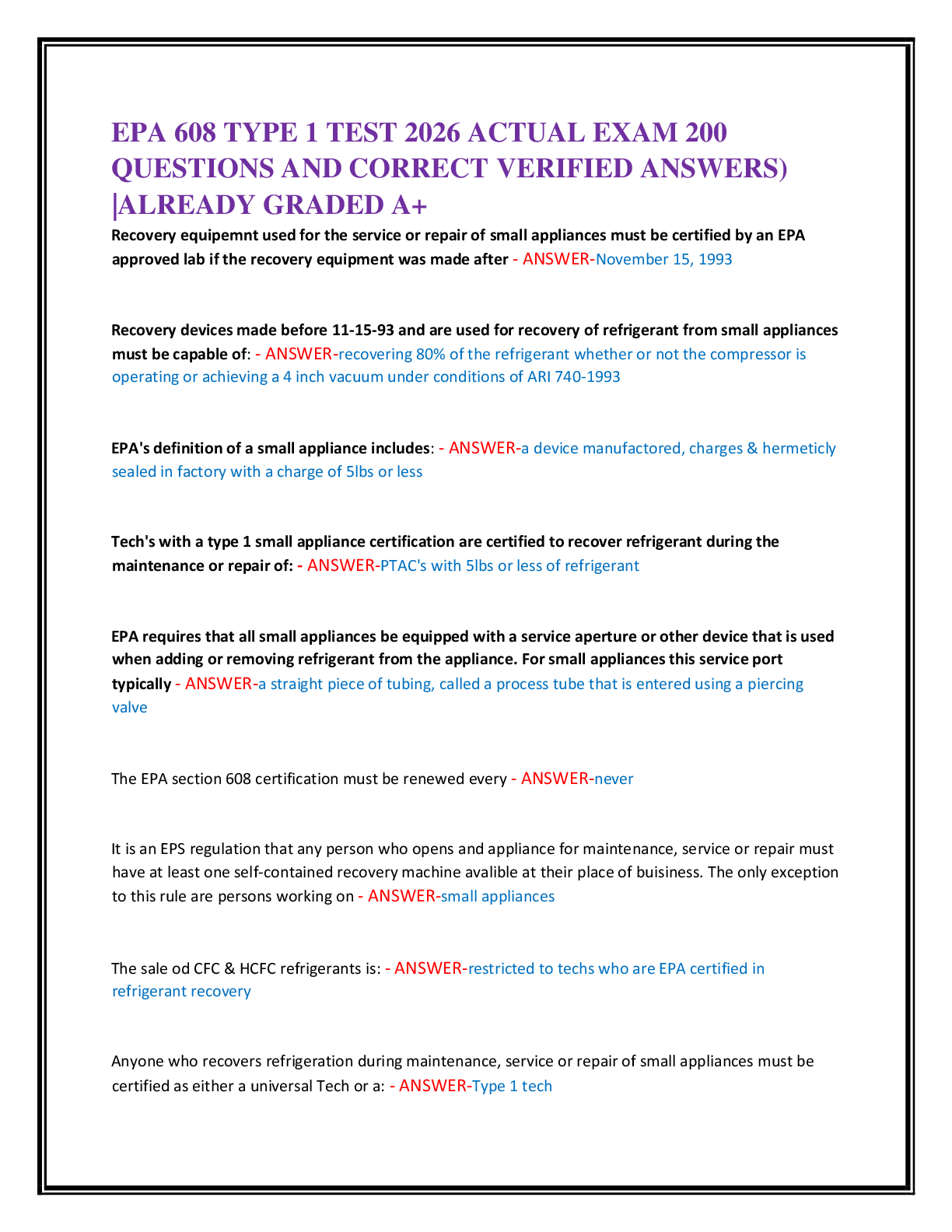
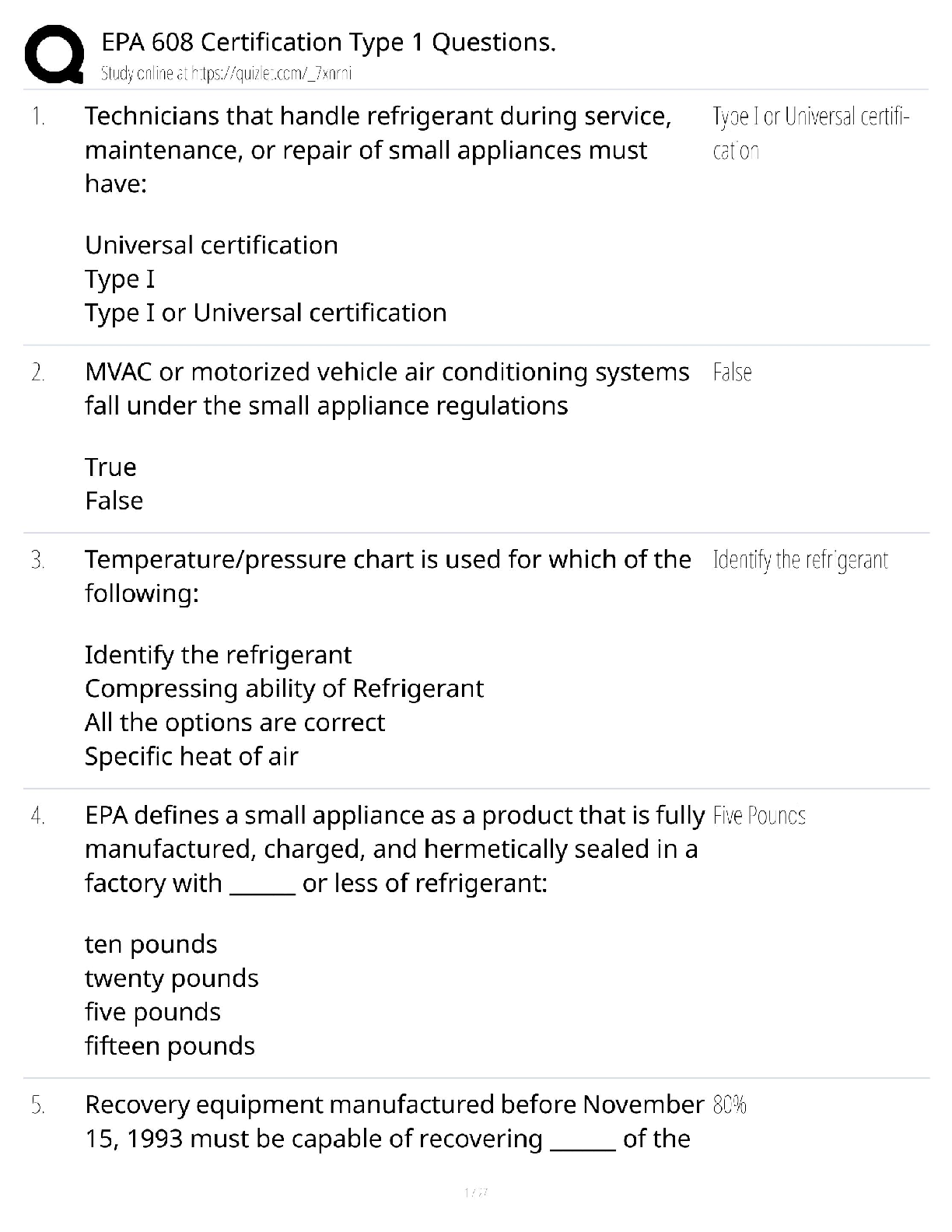
Technicians who perform sealed-system service on small appliances must have ..... - ANSWER: Type I or Universal certification
EXPLANATION: Persons handling refrigerant during maintenance, service or repair of small appliances must be certified as either a Type I Technician or as a Universal Technician. (Page16 ESCO EPA 9TH V2 Edition Prep Manual)
A small appliance is defined by the EPA as ..... - ANSWER: Appliances manufactured, charged, and hermetically sealed in a factory that contain 5 lbs. or less of refrigerant.
EXPLANATION: The EPA definition of a small appliance includes products manufactured, charged, and hermetically sealed in a factory with five pounds of refrigerant or less. (Page16 ESCO EPA 9TH V2 Edition Prep Manual)
Recovery equipment must be ..... - ANSWER: Certified by an EPA-approved testing laboratory.
EXPLANATION: Recovery equipment used during the maintenance, service, or repair of small appliances that use CFCs, HCFCs, and HFCs must be certified by an EPA-approved laboratory. (Page16 ESCO EPA 9TH V2 Edition Prep Manual)
When using a system-dependent recovery system on an appliance that has an operating compressor, the technician should ..... - ANSWER: Run the compressor and recover from the high side of the system only.
EXPLANATION: An appliance with an operating compressor and completely restricted capillary tube or metering device requires only one access valve on the high side of the system. (Page 17 & 18 ESCO EPA 9TH V2 Edition Prep Manual)
After the refrigerant has been recovered, which of the following should be used to flush the system? - ANSWER: Nitrogen
EXPLANATION: When Nitrogen is used to pressurize or blow debris out of the system, the nitrogen may be vented to the ambient air. (Page 18 ESCO EPA 9TH V2 Edition Prep Manual)
When a system is in deep vacuum, you should never ..... - ANSWER: Energize the compressor.
EXPLANATION: You should never energize the compressor. A hermetic compressor's motor winding could be damaged if energized when under a deep vacuum. (Page 22 ESCO EPA 9TH V2 Edition Prep Manual)
Which HC refrigerant is allowed for use in new domestic small appliances? - ANSWER: R-600a
EXPLANATION: Hydrocarbon (HC) R-600a is an approved refrigerant for new household refrigerators, freezers, and combination refrigeration/freezers. (Page 16 ESCO EPA 9TH V2 Edition Prep Manual)
The EPA requirement for repairing leaks on small appliances states that ..... - ANSWER: Leaks should be repaired whenever possible.
EXPLANATION: The EPA does not require leak repair for small appliances, but leaks should be repaired whenever possible. (Page 17 ESCO EPA 9TH V2 Edition Prep Manual)
Leaks must be repaired on industrial process and refrigeration units with a 50-pound charge or greater when the annualized leak rate reaches _____ or more. - ANSWER: 30%
EXPLANATION: EPA regulations require that all commercial and industrial process refrigeration containing more than 50 lbs. of refrigerant must be repaired when the annual leak rate exceeds 30%. (Page19 ESCO EPA 9TH V2 Edition Prep Manual)
EPA regulations state that removal of which component constitutes a "major repair"? - ANSWER: Compressor
EXPLANATION: Under EPA regulations, a "major repair" means any maintenance, service or repair involving the removal of any or all of the following components: compressor, condenser, evaporator or an auxiliary heat exchanger coil. (Page 23 ESCO EPA 9TH V2 Edition Prep Manual)
A high-pressure appliance containing less than 200 lbs. of an HCFC or HFC refrigerant must be evacuated (recovered) to a level of ..... - ANSWER: 0 inches of vacuum
EXPLANATION: A high-pressure appliance containing less than 200 lbs. of an HCFC or HFC refrigerant must be evacuated (recovered) to a level of 0 inches of vacuum. (Page 20 ESCO EPA 9TH V2 Edition Prep Manual)
[Show More]