OSHA
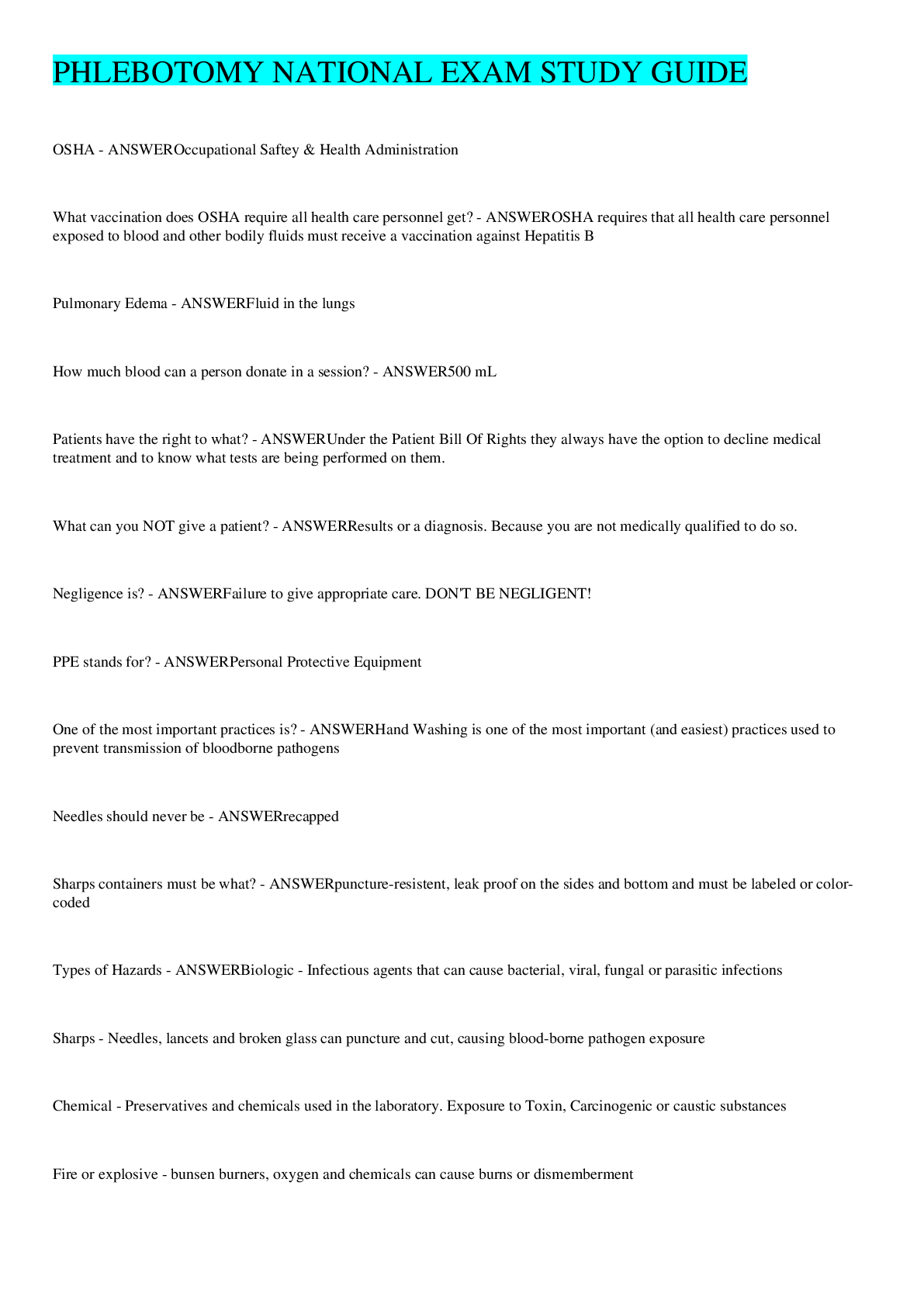
Occupational Saftey & Health Administration
What vaccination does OSHA require all health care personnel get?
OSHA requires that all health care personnel exposed to blood and other bodily fluids must receive
...
OSHA
Occupational Saftey & Health Administration
What vaccination does OSHA require all health care personnel get?
OSHA requires that all health care personnel exposed to blood and other bodily fluids must receive a vaccination against Hepatitis B
Pulmonary Edema
Fluid in the lungs
How much blood can a person donate in a session?
500 mL
Patients have the right to what?
Under the Patient Bill Of Rights they always have the option to decline medical treatment and to know what tests are being performed on them.
What can you NOT give a patient?
Results or a diagnosis. Because you are not medically qualified to do so.
Negligence is?
Failure to give appropriate care. DON'T BE NEGLIGENT!
PPE stands for?
Personal Protective Equipment
One of the most important practices is?
Hand Washing is one of the most important (and easiest) practices used to prevent transmission of bloodborne pathogens
Needles should never be
recapped
Sharps containers must be what?
puncture-resistent, leak proof on the sides and bottom and must be labeled or color-coded
Types of Hazards
Biologic - Infectious agents that can cause bacterial, viral, fungal or parasitic infections
Sharps - Needles, lancets and broken glass can puncture and cut, causing blood-borne pathogen exposure
Chemical - Preservatives and chemicals used in the laboratory. Exposure to Toxin, Carcinogenic or caustic substances
Fire or explosive - bunsen burners, oxygen and chemicals can cause burns or dismemberment
Physical - wet floors, heavy lifting ance cause falls, sprains and strains
ALLERGIC reaction * - Latex sensitivity is a PHYSICAL reaction to care worker allergic reation to the patient
Upgrade to remove ads
Only $35.99/year
In infection control WHO is the agent?
Person
In infection control WHAT is portal of exit?
Needle
In infection control WHAT can we control?
Mode Of Transmission OR exit of infection
In infection control WHAT is a portal of entry?
Mucas membrane
In infection control WHO is a susceptible host?
Person
Mode of Transmission
Specific ways in which microorganisms travel from the reservoir to the suseptible host
Five main types or mode of transmission
contact - direct and indirect (fomite)
Droplet - Cold, Flu and sneezing
Airborne - viral - breath in
common vehicle - person, fomite and not handwashing
vector borne - illness that is transmitted through an invertebrate, such as an insect
Mode of infection
the point in the infection chain where we aim at preventing the spread of infectious disease
Standard precautions do what?
Infection control method designed to prevent direct contact with blood and other body fluids and tissues by using a barrier of protection and work control practices.
What do we assume all patients to be?
Patients are presumed to be infective for blood-borne pathogens
Standard precautions consist of what itmes?
Gloves - when collecting and handling body fluids, or tissue specimen
Face shield - when danger of splashing on mucous membranes
Disposal - dispose of all needles and sharp objests in punture-proof containers, WITH OUT RECAPPING
Disinfectants - clean fluid spills, thus killing pathogenic organisms
Medical Asepsis
This condition is best defined as "the destruction of pathogenic microorganisms after they leave the body". It also involves enviromental hygien measures such as equipment cleaning and disinfection procedures. Methods of medical asepsis are Standard Precautions and Transmission-based Precautions
What are barrier protections?
Masks
Gloves
Face Shields
Resirator
Gloves
How do you remove PPE equipment?
1st - Gloves
2nd - Gown
3rd - Shield
What type of soap should be used?
Non-abrasive, antibacterial soap.
What do you do if blood splashes in the eye or mucous membane?
Flush with warm water (hotter the better) for 15 minutes
Report incident exposure to your supervisor ASAP!
[Show More]