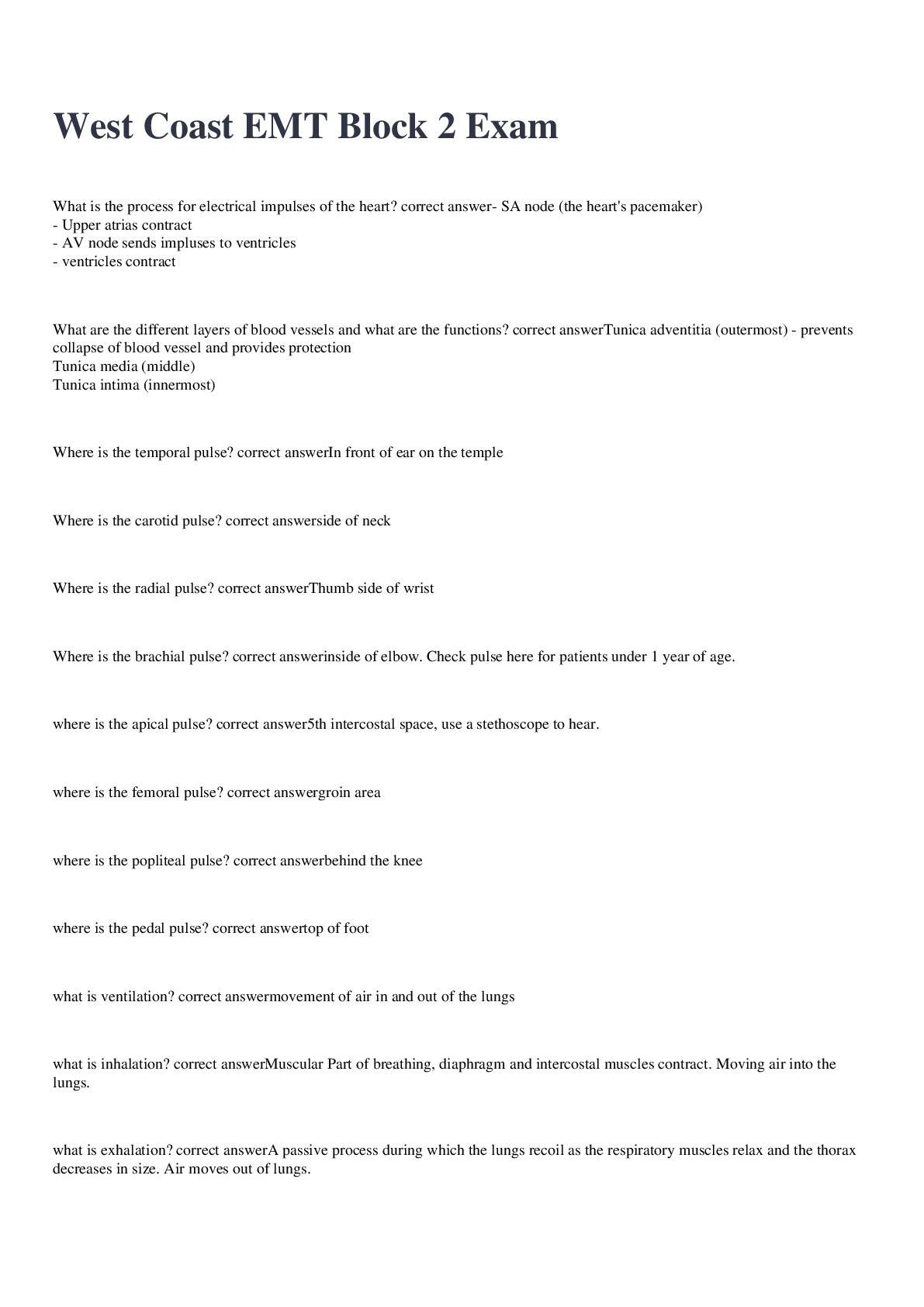
76. Which of these tasks is typically considered
within a phlebotomy technician's scope of
practice? (Choose three.)
(A) Creating peripheral blood smear slides
(B) Drawing blood from an indwelling port
(C) Performin
...
76. Which of these tasks is typically considered
within a phlebotomy technician's scope of
practice? (Choose three.)
(A) Creating peripheral blood smear slides
(B) Drawing blood from an indwelling port
(C) Performing a throat culture
(D) Drawing blood from the dorsal aspect
of the hand using a syringe and transfer
device
(E) Using a microscope to examine blood
smears
(A) Creating peripheral blood smear slides
(C) Performing a throat culture
(D) Drawing blood from the dorsal aspect
of the hand using a syringe and transfer
device
77. Blood pulsing into collection tubes is an indication
that
(A) The needle is placed in the exact center
of the vein
(B) The needle has struck a nerve
(C) The needle has passed entirely through
the vein
(D) The needle has struck an artery
(D) The needle has struck an artery
78. A phlebotomist needs to collect gold, pink,
and green-topped tubes by venipuncture.
Which order is correct?
(A) Gold, green, pink
(B) Green, gold, pink
(C) Pink, green, gold
(D) Gold, pink, green
(A) Gold, green, pink
79. Collection tubes with ___________________
_____________ should not be used for therapeutic
drug testing.
(A) Separator gel
(B) Clot activator
(C) Red tops
(D) Internal vacuum
(A) Separator gel
80. Which of the following will help a phlebotomy
technician avoid having a patient's vein roll
away when the needle is inserted?
(A) Selecting a vein in the hand
(B) Forming an anchoring "window" around
the puncture site with the thumb below
and the index finger above
(C) Anchoring the site from below, using the
thumb to pull toward the wrist
(D) Warming the site for 3-5 minutes prior
to venipuncture
(C) Anchoring the site from below, using the
thumb to pull toward the wrist
81. Facility policy states that no more than 5%
of a patient's blood may be drawn in 30 days.
What is the maximum amount of blood than
can be drawn from an 9-pound infant in a
month?
(A) 12 mL
(B) 16 mL
(C) 20 mL
(D) 24 mL
(B) 16 mL
82. A patient's chart indicates that her veins are
thin, fragile, and frequently collapse. A total
of 5 mL of blood needs to be drawn for various
tests. Which of the following techniques
would be best for drawing blood from this
patient?
(A) Capillary puncture of the third or fourth
finger
(B) Venipuncture using a 23-gauge butterfly
needle and syringe/transfer device
(C) Venipuncture using a 21-gauge straight
multisample needle
(D) Venipuncture using a 23-gauge butterfly
needle and a 5 mL evacuated tube
(B) Venipuncture using a 23-gauge butterfly
needle and syringe/transfer device
83. Which of the following is a significant difference
between midstream and routine urine
specimens?
(A) The area around the urethra is cleaned
before collecting a midstream specimen
(B) A routine urine specimen is collected
first thing in the morning
(C) A midstream urine specimen is collected
at a patient's home
(D) A routine urine specimen is collected in
a sterile container
(A) The area around the urethra is cleaned
before collecting a midstream specimen
84. Hemoconcentration may be caused by
(A) Leaving a tourniquet in place for too long
(B) A patient eating a breakfast rich in fatty
foods
(C) Using too narrow a needle
(D) Probing with the venipuncture needle
(A) Leaving a tourniquet in place for too long
85. A patient begins to experience a seizure during
a blood draw. What should be the phlebotomist's
first response?
(A) To ask the patient if he is OK
(B) To remove and sheathe the needle
(C) To steady the patient's arm so the
tube currently inserted can be filled
completely
(D) To lower the patient to the ground
(B) To remove and sheathe the needle
[Show More]




![Preview of eBook [PDF] Irwin and Rippe's Intensive Care Medicine 1st Edition By Richard S Irwin_ Crai](https://browseimages.nyc3.digitaloceanspaces.com/paper-images/2024/Aug/29/LgDadm8w2024-08-29-09-0966d01095d6f9d.png)
![Preview of eBook [PDF] Applied Therapeutics The Clinical Use of Drugs 12th Edition By Caroline S. Zei](https://browseimages.nyc3.digitaloceanspaces.com/paper-images/2024/Aug/29/gJZkPmEd2024-08-29-10-3866d0258f694bb.png)