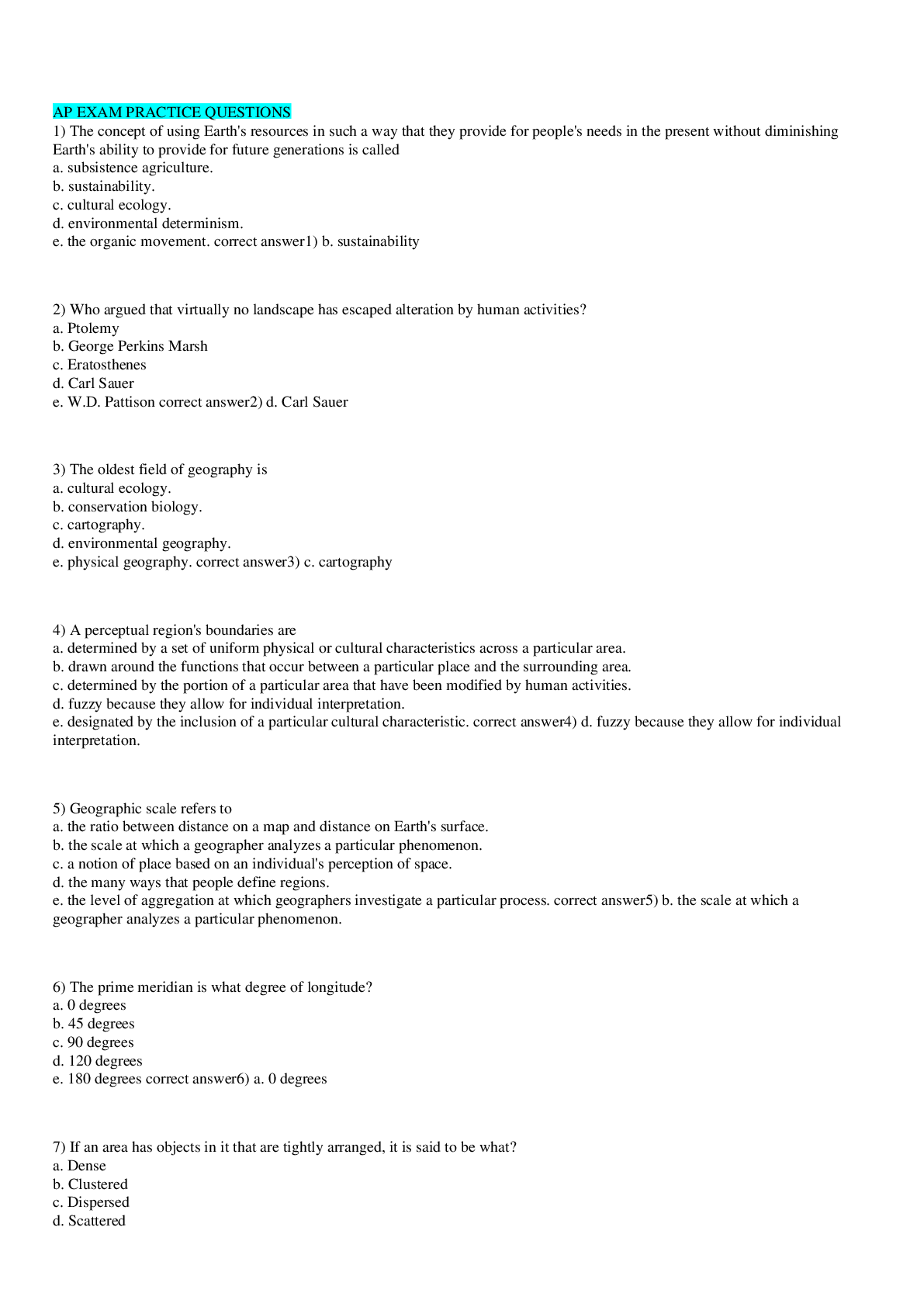
1) The concept of using Earth's resources in such a way that they provide for people's needs in the present without diminishing Earth's ability to provide for future generations is called
a. subsistence agriculture.
b.
...
1) The concept of using Earth's resources in such a way that they provide for people's needs in the present without diminishing Earth's ability to provide for future generations is called
a. subsistence agriculture.
b. sustainability.
c. cultural ecology.
d. environmental determinism.
e. the organic movement.
1) b. sustainability
2) Who argued that virtually no landscape has escaped alteration by human activities?
a. Ptolemy
b. George Perkins Marsh
c. Eratosthenes
d. Carl Sauer
e. W.D. Pattison
2) d. Carl Sauer
3) The oldest field of geography is
a. cultural ecology.
b. conservation biology.
c. cartography.
d. environmental geography.
e. physical geography.
3) c. cartography
4) A perceptual region's boundaries are
a. determined by a set of uniform physical or cultural characteristics across a particular area.
b. drawn around the functions that occur between a particular place and the surrounding area.
c. determined by the portion of a particular area that have been modified by human activities.
d. fuzzy because they allow for individual interpretation.
e. designated by the inclusion of a particular cultural characteristic.
4) d. fuzzy because they allow for individual interpretation.
5) Geographic scale refers to
a. the ratio between distance on a map and distance on Earth's surface.
b. the scale at which a geographer analyzes a particular phenomenon.
c. a notion of place based on an individual's perception of space.
d. the many ways that people define regions.
e. the level of aggregation at which geographers investigate a particular process.
5) b. the scale at which a geographer analyzes a particular phenomenon.
6) The prime meridian is what degree of longitude?
a. 0 degrees
b. 45 degrees
c. 90 degrees
d. 120 degrees
e. 180 degrees
6) a. 0 degrees
[Show More]