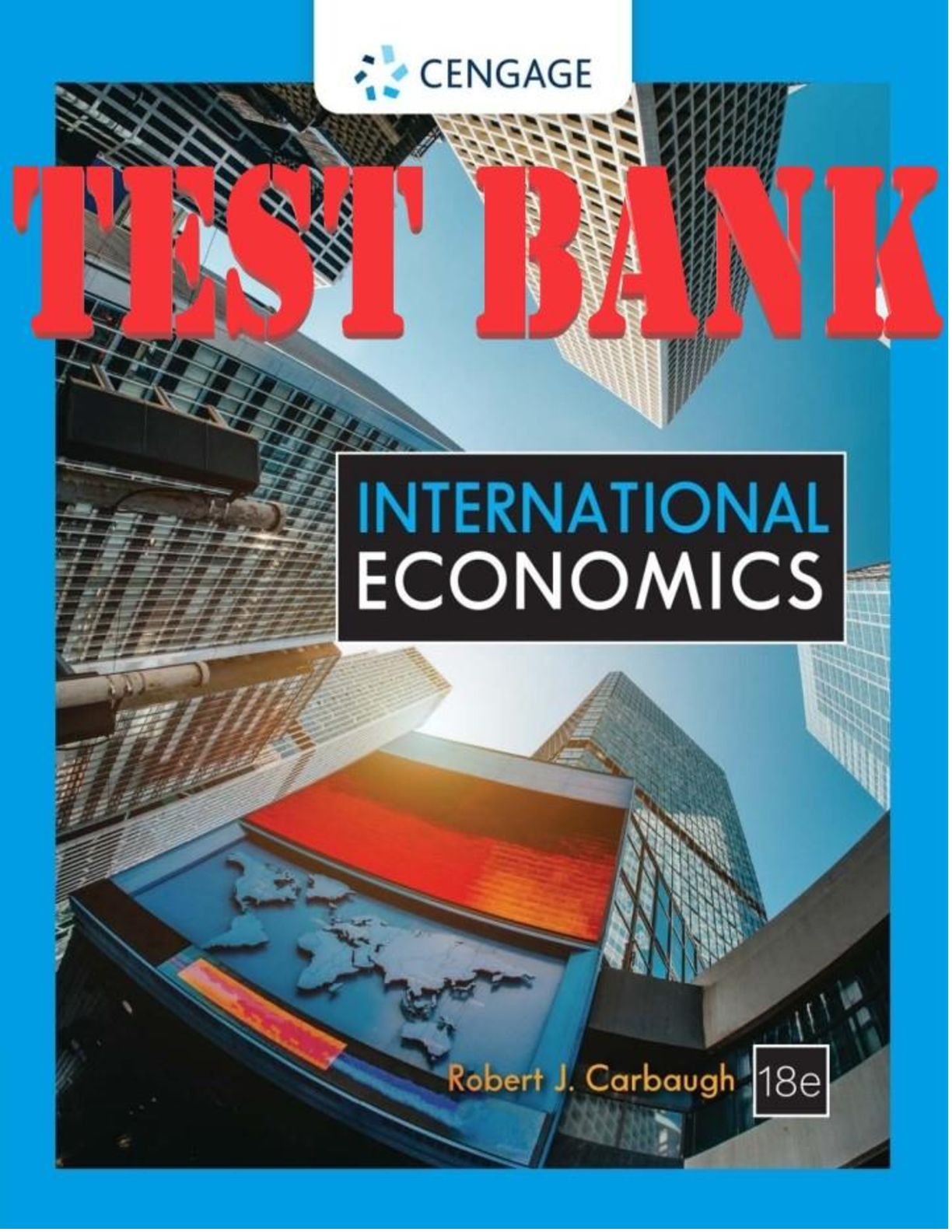
Test Bank for International Economics, 18th Edition by Robert Carbaugh TEST BANK
ISBN-13: 9780357518915
Full chapters included
Chapter 1: The International Economy and Globalization
1-1 Globalization of Economic
...
Test Bank for International Economics, 18th Edition by Robert Carbaugh TEST BANK
ISBN-13: 9780357518915
Full chapters included
Chapter 1: The International Economy and Globalization
1-1 Globalization of Economic Activity
1-2 Waves of Globalization
1-3 The United States as an Open Economy
1-4 Common Fallacies of International Trade
1-5 Is International Trade an Opportunity or a Threat to Workers?
1-6 Has Globalization Gone Too Far?
1-7 The Plan of This Text
Summary
Key Concepts and Terms
Study Questions
Part 1: International Trade Relations
Chapter 2: Foundations of Modern Trade Theory: Comparative Advantage
2-1 Historical Development of Modern Trade Theory
2-2 Production Possibilities Frontiers
2-3 Trading under Constant-Cost Conditions
2-4 Changing Comparative Advantage
2-5 Trading under Increasing-Cost Conditions
2-6 The Impact of Trade on Jobs
2-7 Comparative Advantage Extended to Many Products and Countries
2-8 Factor Mobility, Exit Barriers, and Trade
2-9 Empirical Evidence on Comparative Advantage
2-10 The Case for Free Trade
2-11 Comparative Advantage and Global Supply Chains: Outsourcing
Summary
Key Concepts and Terms
Study Questions
Chapter 3: Sources of Comparative Advantage
3-1 Factor Endowments as a Source of Comparative Advantage
3-2 Economies of Scale and Comparative Advantage
3-3 Overlapping Demands as a Basis for Trade
3-4 Intra-Industry Trade
3-5 Technology as a Source of Comparative Advantage: The Product Cycle Theory
3-6 Dynamic Comparative Advantage: Industrial Policy
3-7 Government Regulatory Policies and Comparative Advantage
3-8 Transportation Costs and Comparative Advantage
Summary
Key Concepts and Terms
Study Questions
Exploring Further
Chapter 4: Tariffs
4-1 The Tariff Concept
4-2 Types of Tariffs
4-3 Effective Rate of Protection
4-4 Tariff Escalation
4-5 Outsourcing and Offshore-Assembly Provision
4-6 Dodging Import Tariffs: Tariff Avoidance and Tariff Evasion
4-7 Postponing Import Tariffs
4-8 Tariff Effects: An Overview
4-9 Tariff Welfare Effects: Consumer Surplus and Producer Surplus
4-10 Tariff Welfare Effects: Small-Nation Model
4-11 Tariff Welfare Effects: Large-Nation Model
4-12 Examples of U.S. Tariffs
4-13 How a Tariff Burdens Exporters
4-14 Tariffs and the Poor: Regressive Tariffs
4-15 Arguments for Trade Restrictions
4-16 The Political Economy of Protectionism
Summary
Key Concepts and Terms
Study Questions
Exploring Further
Chapter 5: Nontariff Trade Barriers
5-1 Absolute Import Quota
5-2 Tariff-Rate Quota: A Two-Tier Tariff
5-3 Export Quotas
5-4 Domestic Content Requirements
5-5 Subsidies
5-6 Dumping
5-7 Antidumping Regulations
5-8 Is Antidumping Law Unfair?
Summary
Key Concepts and Terms
Study Questions
Exploring Further
Chapter 6: Trade Regulations and Industrial Policies
6-1 U.S. Tariff Policies before 1930
6-2 Smoot-Hawley Act
6-3 Reciprocal Trade Agreements Act
6-4 General Agreement on Tariffs and Trade
6-5 World Trade Organization
6-6 Trade Promotion Authority (Fast-Track Authority)
6-7 Safeguards (the Escape Clause): Emergency Protection from Imports
6-8 Countervailing Duties: Protection against Foreign Export Subsidies
6-9 Antidumping Duties: Protection against Foreign Dumping
6-10 Section 301: Protection against Unfair Trading Practices
6-11 Protection of Intellectual Property Rights
6-12 Trade-Adjustment Assistance
6-13 Industrial Policies of the United States
6-14 Strategic Trade Policy
6-15 Economic Sanctions
Summary
Key Concepts and Terms
Study Questions
Exploring Further
Chapter 7: Trade Policies for the Developing Nations
7-1 Developing Nation Trade Characteristics
7-2 Tensions between Developing Nations and Advanced Nations
7-3 Trade Problems of the Developing Nations
7-4 Stabilizing Primary-Product Prices
7-5 The OPEC Oil Cartel
7-6 Aiding the Developing Nations
7-7 Economic Growth Strategies: Import Substitution versus Export-Led Growth
7-8 East Asian Economies
7-9 China's Great Leap Forward
7-10 India: Breaking Out of the Third World
Summary
Key Concepts and Terms
Study Questions
Chapter 8: Regional Trading Arrangements
8-1 Regional Integration versus Multilateralism
8-2 Types of Regional Trading Arrangements
8-3 Impetus for Regionalism
8-4 Effects of a Regional Trading Arrangement
8-5 The European Union
8-6 The Eurozone - Europe's Monetary Union
8-7 North American Free Trade Agreement: United States-Mexico-Canada Agreement
Summary
Key Concepts and Terms
Study Questions
Exploring Further
Chapter 9: International Factor Movements and Multinational Enterprises
9-1 The Multinational Enterprise
9-2 Motives for Foreign Direct Investment
9-3 Supplying Products to Foreign Buyers: Whether to Produce Domestically or Abroad
9-4 Country Risk Analysis
9-5 Foreign Auto-Assembly Plants in the United States
9-6 International Joint Ventures
9-7 Multinational Enterprises as a Source of Conflict
9-8 International Labor Mobility: Migration
Summary
Key Concepts and Terms
Study Questions
Part 2: International Monetary Relations
Chapter 10: The Balance of Payments
10-1 Double-Entry Accounting
10-2 Balance-of-Payments Structure
10-3 U.S. Balance of Payments
10-4 What Does a Current Account Deficit (Surplus) Mean?
10-5 Balance of International Indebtedness
10-6 The Dollar as the World's Reserve Currency
Summary
Key Concepts and Terms
Study Questions
Chapter 11: Foreign Exchange
11-1 Foreign-Exchange Market
11-2 Foreign Currency Trading Becomes Automated
11-3 Types of Foreign-Exchange Transactions
11-4 Interbank Trading
11-5 Reading Foreign-Exchange Quotations
11-6 Forward and Futures Markets
11-7 Foreign Currency Options
11-8 Exchange-Rate Determination
11-9 Indexes of the Foreign-Exchange Value of the Dollar: Nominal and Real Exchange Rates
11-10 Interest Arbitrage, Currency Risk, and Hedging
11-11 Foreign-Exchange Market Speculation
11-12 Foreign-Exchange Trading as a Career
Summary
Key Concepts and Terms
Study Questions
Exploring Further
Chapter 12: Exchange-Rate Determination
12-1 What Determines Exchange Rates?
12-2 Determining Long-Run Exchange Rates
12-3 Inflation Rates, Purchasing Power Parity, and Long-Run Exchange Rates
12-4 Determining Short-Run Exchange Rates: The Asset Market Approach
12-5 Exchange Rate Overshooting
12-6 Forecasting Foreign-Exchange Rates
Summary
Key Concepts and Terms
Study Questions
Exploring Further
Chapter 13: Exchange-Rate Adjustments and the Balance of Payments
13-1 Effects of Exchange-Rate Changes on Costs and Prices
13-2 Cost-Cutting Strategies of Manufacturers in Response to Currency Appreciation
13-3 Will Currency Depreciation Reduce a Trade Deficit? The Elasticity Approach
13-4 J-Curve Effect: Time Path of Depreciation
13-5 Exchange-Rate Pass-Through
13-6 The Absorption Approach to Currency Depreciation
13-7 The Monetary Approach to Currency Depreciation
Summary
Key Concepts and Terms
Study Questions
Exploring Further
Chapter 14: Exchange-Rate Systems and Currency Crises
14-1 Exchange-Rate Practices
14-2 Choosing an Exchange-Rate System: Constraints Imposed by Free Capital Flows
14-3 Fixed Exchange-Rate System
14-4 Floating Exchange Rates
14-5 Managed Floating Rates
14-6 The Crawling Peg
14-7 Currency Manipulation and Currency Wars
14-8 Capital Controls
14-9 Increasing the Credibility of Fixed Exchange
Summary
Key Concepts and Terms
Study Questions
Chapter 15: Macroeconomic Policy in an Open Economy
15-1 Economic Objectives of Nations
15-2 Policy Instruments
15-3 Aggregate Demand and Aggregate Supply: A Brief Review
15-4 Monetary and Fiscal Policies in a Closed Economy
15-5 Monetary and Fiscal Policies in an Open Economy
15-6 Macroeconomic Stability and the Current Account: Policy Agreement versus Policy Conflict
15-7 Inflation with Unemployment
15-8 International Economic Policy Coordination
Summary
[Show More]