Electronic alerts - ANSWER reduces risk.
e.g. hospital is missing admission consent forms so they add an electronic alert to prompt for signatures.
Educate staff - ANSWER minimize incidents and reduce risk.
e.g.
...
Electronic alerts - ANSWER reduces risk.
e.g. hospital is missing admission consent forms so they add an electronic alert to prompt for signatures.
Educate staff - ANSWER minimize incidents and reduce risk.
e.g. care center investigated by OSHA for workplace injuries. so they educate staff on using lifting devices.
e.g. an intake process doesn't inquire about homeopathic remedies/supplements and a negative drug reaction happens as a result. so they educate staff on asking about alternative therapies.
Implied consent - ANSWER person needs treatment and is unconscious.
e.g. a 17-year-old was admitted after car accident. he was unconscious but needed immediate treatment.
Parental consent - ANSWER required for minors
e.g. 12-year-old needs hernia repair. mom forgot something and has to leave while nurse is getting pre-operative info. nurse must wait for mother to return to complete the consent.
Root cause analysis - ANSWER find the cause to reduce risk of recurrence
e.g. nursing services receive three complaints from family members of patients about missing valuables from patient's rooms.
e.g. hospital patient dies during transit. a nurse was supposed to be helping but was too busy. ineffective because staff members are permitted to move patients without support
HIPPA training - ANSWER decreases risk of ethical violations
e.g. celebrity patient is having a procedure. nurse discusses the procedure with un-involved persons and starts getting texts from the press.
Involve HR - ANSWER prevent legal issues
e.g. CEO having intimate relationship with a nurse. nurse applies for a position and wins over a more qualified candidate. the candidate files a report to EEOC.
Training on safe handling and lifting - ANSWER reduce injury risk
e.g. a hospital report shows an increase in work-related employee back injuries
Installing patient lifting equipment - ANSWER reduce injury risk
e.g. hospital having high incidence of worker's compensation claims from back injuries when moving patients around
Avoiding wrongful termination lawsuits - ANSWER 1. consider alternatives to termination
2. document employee training and performance
e.g. family practice fired a medical assistant due to theft of medications
Provide credit monitoring for victims - ANSWER reduce liability risk when involved in financial or identify theft issues
e.g. an employee is found stealing credit card and SSNs
Compare allowable amounts with existing fee structure - ANSWER reduce risk of overcharging
e.g. office manager finds an overcharging doctor
Civil Rights Act - ANSWER prohibits discrimination based on race, color, religion, national origin, or gender
e.g. a qualified applicant applies for a job but was removed from short list because he is too old
Family and Medical Leave Act - ANSWER Allows employees to take up to 12 weeks of unpaid leave in a 12 month period for certain medical and family situations
e.g. a medical coder's spouse receives a serious injury so he asks for 8 weeks times off. employer must oblige his request.
Conduct field visits to assess staff performance - ANSWER reduce risk when expanding services
e.g. hospital recently acquired a new home health agency. employees must now learn new care methods to treat patients in their homes.
Create procedure for storing controlled substances - ANSWER manage risk when dealing with terminal patients at their homes
e.g. a hospice care agency provides in-home medications for terminally ill patients where family members might access
False Claims Act - ANSWER employees can sue employers for fraud against the government.
e.g. while completing an audit, the health info director notices that a treatment was billed as an outpatient instead of an inpatient.
Physician's state licensing standards - ANSWER adherence reduces risk of malpractice litigation
e.g. a surgical tech witnesses a surgeon looking under patient's gowns and making inappropriate comments. tech reports to the director.
Enforcing disciplinary action upon non-compliant employees - ANSWER mitigate risk of legal violations
e.g. risk management supervisor notices that the patient signature policy for releasing medical records is not being followed
Asking patients to identify allergies - ANSWER reduce risks associated with procedures
e.g. patient in ER has to get a CT scan that uses dye injection. CT patient has allergic reaction to the dye.
Increase staff awareness on patient pain control techniques - ANSWER helps to reach performance goals
e.g. patient satisfaction for pain management is below goals
Having departments submit action plans to management - ANSWER enforce compliance
e.g. safety committee observes low rate of compliance regarding timely employee injury reporting.
Proper disposal of bio-hazards - ANSWER Reduce risk of infection
e.g. a nurse notices a full urinary catheter bag in the trash can
Placing patients in isolation - ANSWER reduce infection risk
e.g. a patient who recently returned from another country is admitted to the ER with acute respiratory distress.
Provide regular performance feedback to staff - ANSWER reduce risk of infection
e.g. safety team discovers high level of bacteria on surfaces cleaned by newly hired housekeeping staff. they have already received training.
Increased number of unexpected patient deaths - ANSWER results in medical staff peer reviews of involved physicians.
consequences can be loss of privileges or report to state medical board.
Poor physician bedside manner - ANSWER results in medical staff peer review of involved physicians.
consequences can be colleague-to-colleague intervention
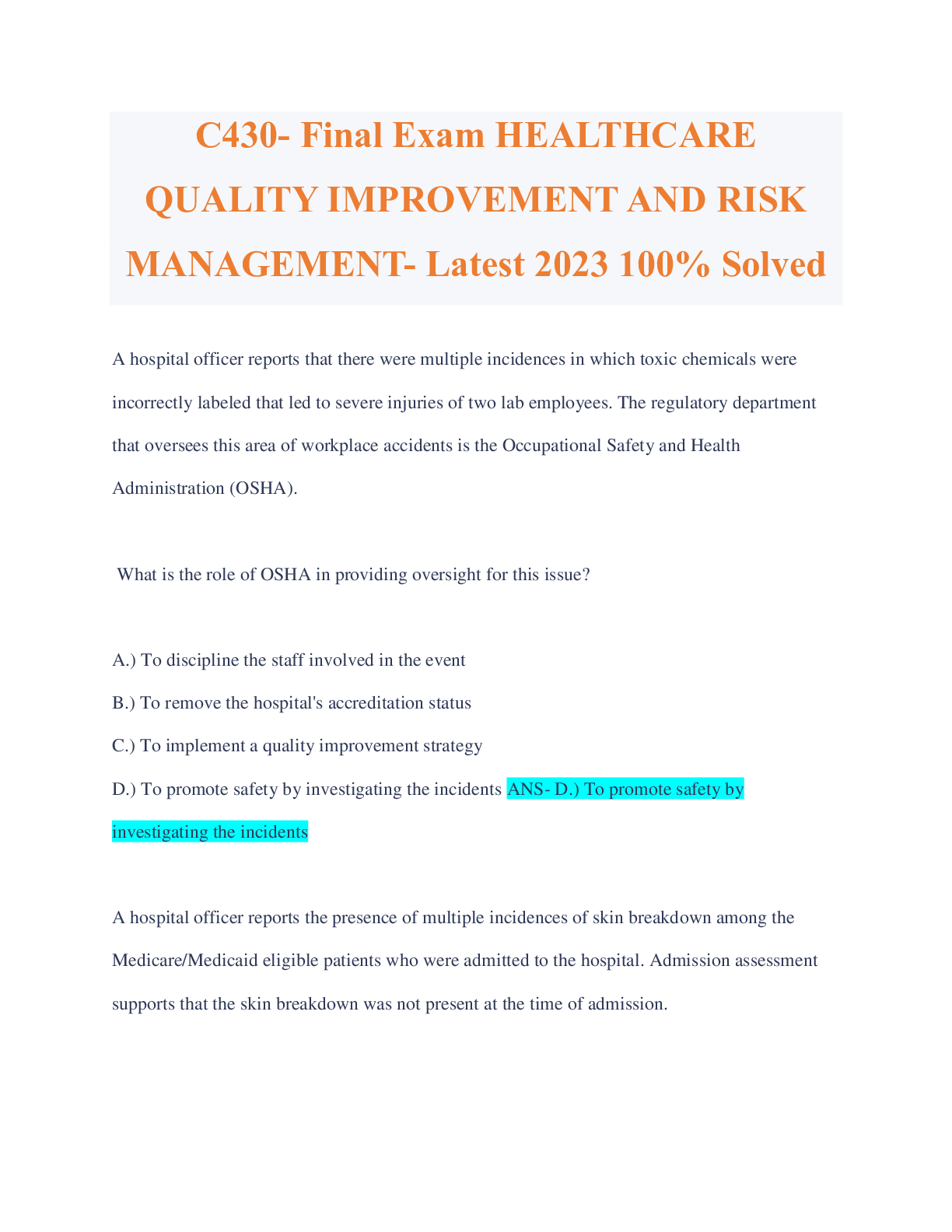
OSHA roles - ANSWER promote safety by investigating workplace incidents.
e.g. hospital officer reports of multiple incidents where toxic chemicals were incorrectly labeled.
respond to improper workplace practices with immediate action
e.g. a facility is not maintaining the bio-hazard sharps container according to standards.
Centers for Medicare and Medicaid Services (CMS) - ANSWER provides oversight over Medicare/Medicaid eligible patients
denies reimbursement to facilities when violation takes place
e.g. hospital officer reports incidents of skin problems among Medicare/Medicaid eligible patients. they did not have these problems when they were admitted.
Business Process Reengineering (BPR) - ANSWER methodology used for analysis and redesign of workflow
e.g. admin wants to implement new survey to track patient satisfaction. needs to integrate the survey into the current workflow
Institute a policy to identify patients most likely to fall, as well as procedures to assist in ambulating - ANSWER resolve issues related to fall prevention
e.g. home health agency experiencing too many falls. organization gets cited by The Joint Commission.
Reduce the number of patients scheduled per time slot - ANSWER increase patient satisfaction
e.g. doctor's office receives results from National Committee for Quality Assurance which indicates that 75% of patients are dissatisfied with long wait times
First steps in quality improvement - ANSWER identify cause of variances from evidence-based interventions.
e.g. improvement team at care center is charged with reducing falls at the facility
gather baseline data
e.g. hospital improvement project aims to reduce time between discharge order and actual discharge
Validating or evaluating an improvement practice - ANSWER determine if the problem is solved
e.g. nursing care residents at care center report cold food. center develops and implements a procedure and the residents report that the food is warmer.
e.g. orders at a care center aren't getting signed within 48 hours as per policy. they implement a procedure and there are fewer missed signed orders.
e.g. a nurse administered the wrong vaccine and the error went wasn't caught. the risk management plan is ineffective because the nurse failed to match the order with the vaccine.
e.g. a hospital has a high incidence of patients with heart failure being re-admitted due to lack of discharge instructions. an initiative is implemented. evaluated by whether patients can explain how their meds should be taken.
e.g. cardiac unit has high number of re-admissions. an initiative is created to improve patient teaching materials. evaluated by whether patient readmission rates decline.
e.g. hospital has increased incidence of falls during night shift. a plan is implemented to improve training. evaluated by percent of patients that fall during night hours.
e.g. nurse fails to administer medication and patient goes to ICU as a result. a plan was implemented to retrain nurse. evaluated by whether there is a decrease in number of medication errors.
Conduct a staff focus group - ANSWER improves struggling risk management plans
e.g. care center makes plan to re-position residents every two hours to prevent skin ulcers. at end of quarter the director reports an increase in skin ulcers.
Check for electronic bracelets at shift change - ANSWER improve effectiveness with high-risk residents
e.g. a high-risk resident wanders away from memory care unit without his locator bracelet on.
Using color wrist bands to identify patient status - ANSWER improve effectiveness in following codes for patients
e.g. nurse finds a patient unresponsive but can't remember if the patient has a DNR order or not.
Disciplining workers - ANSWER sometimes necessary to decrease risks
e.g. hospital has increasing number of patients injured while being moved/transferred. quality team notices that workers aren't using the mechanical lift device.
Conducting infant abduction drills - ANSWER reduce risks and increase safety
e.g. after an event involving a near-miss abduction, a hospital manager needs to update the safety plan.
Sending valuables home with family member - ANSWER reduce risk of liability and litigation
e.g. care center reports that valuables were stolen from a patient's room. nurse needs to make recommendations to risk/safety plans.
Assess nurse's competence for dosage calculations - ANSWER risk management for miscalculated dosages
e.g. nurse gives inaccurate dose to patient who has an adverse reaction.
Include the parent in the patient ID process - ANSWER reduce risk of patient misidentification
e.g. newborn receives circumcision intended for another infant.
Standardize the process - ANSWER e.g. a sponge was accidentally left inside a patient after surgery
solve by: counting sponges in the same manner every time
Use cognitive aids - ANSWER e.g. a sponge was accidentally left inside a patient after surgery
solve by: make use of a final checklist during final sponge counts
Add engineering controls - ANSWER e.g. a sponge was accidentally left inside a patient after surgery
solve by: use radio frequency identification-enabled sponges
Implement double-checks - ANSWER e.g. a sponge was accidentally left inside a patient after surgery
solve by: require two staff members to independently confirm sponge counts
Review physician orders for returning residents to identify medication changes - ANSWER decrease risk of medication errors
e.g. care center patient is using blood thinner prior to discharge. the medication list isn't reconciled and the medicine is inadvertently discontinued
Regular audits of nurse compliance with expected practices - ANSWER improve effectiveness of training plans
e.g. hospital reports high rate of patients developing heel ulcerations. plan is implemented that includes nurse education and protocols. six months later the the ulcerations are slightly higher.
Locking staff member's screen - ANSWER reduce security risks
e.g. staff member notices a co-worker walk away without locking/logging off.
Evaluate equipment for mechanical problems - ANSWER reduce risks of injury
e.g. a stretcher collapsed and the patient's arm is broken as a result
Changing access codes - ANSWER immediate action to reduce security risks
e.g. cafeteria worker needs medication so a coworker gives him the access code for the drug dispensing unit. coworker observes this and reports to manager.
Actions to prevent improper computer usage - ANSWER lock workstations prior to leaving the room
employees must use their own credentials to log in or access
Pulling the fire alarm - ANSWER first action when fire erupts
Improve patient outcomes with medications - ANSWER improve labeling of medications
e.g. hospital is cited by Joint Commission for sound-alike medication errors
Quarterly fire drills - ANSWER the more drills the more reduction of risk
Control procedures - ANSWER reduce errors and improve quality
e.g. nurse only uses patient name as identifier since she is familiar with him. result is risk of medication errors since control procedures aren't followed
Reporting errors - ANSWER enables identification of system problems
e.g. nurse realizes that dosage administered was incorrect but doesn't report it.
Routinely logging observations of how employees use PPE - ANSWER monitor compliance with standards
e.g. manager requires employees to use PPE as per OSHA regulations
Audit employee training records - ANSWER monitor compliance with standards.
e.g. OSHA requires that facilities make employees aware of workplace dangers. employees are trained on this during orientation.
Observe work areas to confirm PPE is available - ANSWER monitor compliance with standards.
e.g. manager requires employees to use PPE as per OSHA regulations
Conduct periodic security risk assessments - ANSWER monitor compliance with standards.
e.g. clinic recently implemented EHRS and manager wants to be sure it meets HIPPA requirements
Monitor reports of password sharing - ANSWER prevent HIPPA breaches
e.g. hospital learns that patient's EMR was accessed without authorization
[Show More]