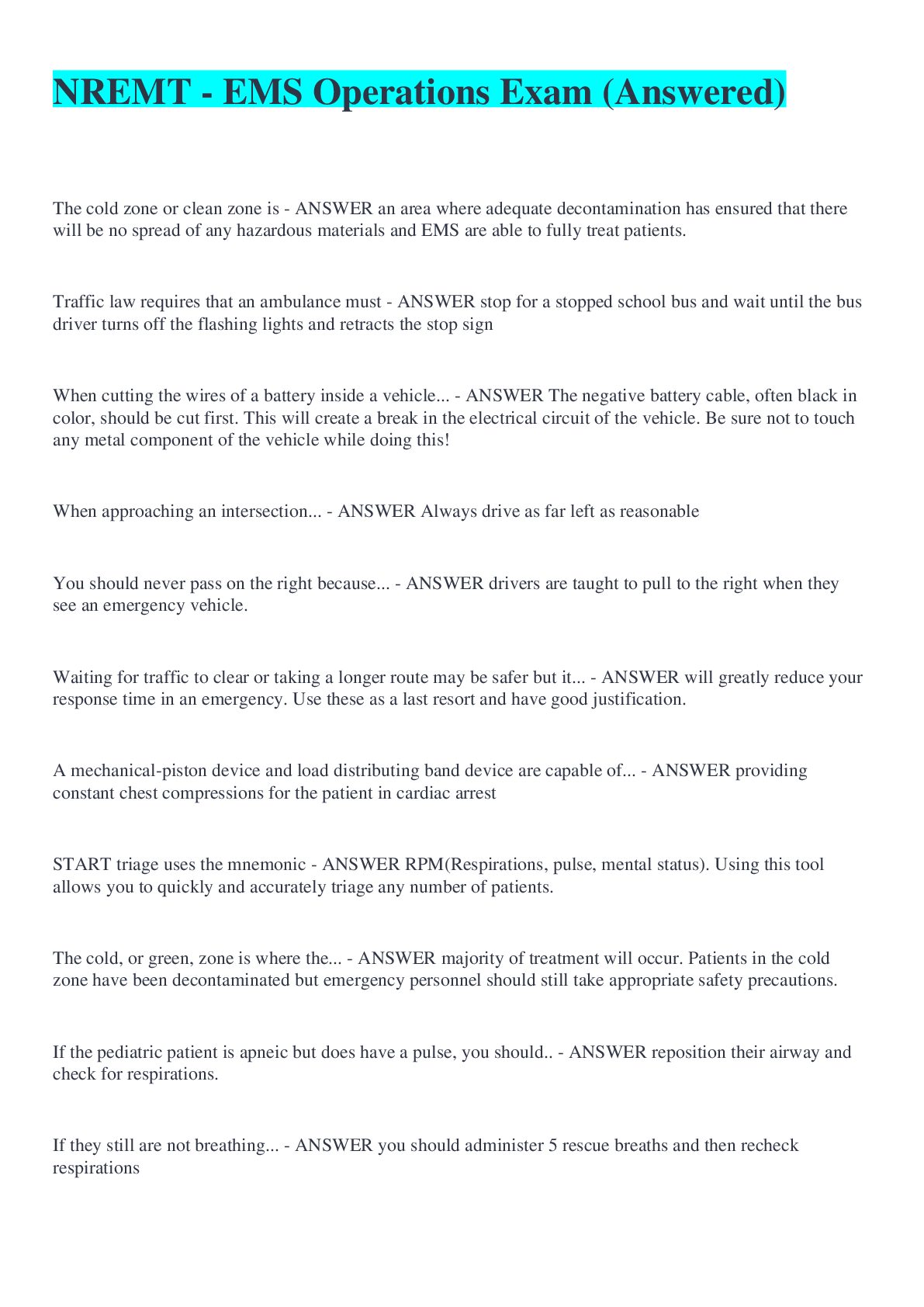
The cold zone or clean zone is - ANSWER an area where adequate decontamination has ensured that there will be no spread of any hazardous materials and EMS are able to fully treat patients.
Traffic law requires that an
...
The cold zone or clean zone is - ANSWER an area where adequate decontamination has ensured that there will be no spread of any hazardous materials and EMS are able to fully treat patients.
Traffic law requires that an ambulance must - ANSWER stop for a stopped school bus and wait until the bus driver turns off the flashing lights and retracts the stop sign
When cutting the wires of a battery inside a vehicle... - ANSWER The negative battery cable, often black in color, should be cut first. This will create a break in the electrical circuit of the vehicle. Be sure not to touch any metal component of the vehicle while doing this!
When approaching an intersection... - ANSWER Always drive as far left as reasonable
You should never pass on the right because... - ANSWER drivers are taught to pull to the right when they see an emergency vehicle.
Waiting for traffic to clear or taking a longer route may be safer but it... - ANSWER will greatly reduce your response time in an emergency. Use these as a last resort and have good justification.
A mechanical-piston device and load distributing band device are capable of... - ANSWER providing constant chest compressions for the patient in cardiac arrest
START triage uses the mnemonic - ANSWER RPM(Respirations, pulse, mental status). Using this tool allows you to quickly and accurately triage any number of patients.
The cold, or green, zone is where the... - ANSWER majority of treatment will occur. Patients in the cold zone have been decontaminated but emergency personnel should still take appropriate safety precautions.
If the pediatric patient is apneic but does have a pulse, you should.. - ANSWER reposition their airway and check for respirations.
If they still are not breathing... - ANSWER you should administer 5 rescue breaths and then recheck respirations
If the patient is still apneic, they should be triaged as.. - ANSWER Deceased
If the pediatric patient is apneic and pulseless, they should be... - ANSWER Deceased
A windshield survey is a - ANSWER quick survey that will help you to form a general impression of the condition of the occupants in the vehicle and the resources you will need to help them.
Command, triage, and transportation are the - ANSWER core of what all activities during a mass casualty incident are based on. Maintaining these three components creates a basic framework to help organize the mass casualty incident.
Autonomy refers - ANSWER to the patient's right to refuse medical care. It also includes the patient's right to choose medical care. Despite having a life-threatening medical condition, you cannot force the patient to allow treatment or transport in this situation.
CHART - ANSWER C- Chief Complaint
H- Patient Medical history and history of incident
A- Patient assesment
R- Treatment
T- Transport
Red tags... - ANSWER (immediate) are used to label those who cannot survive without immediate treatment but who have a chance of survival.
Yellow tags - ANSWER - (observation) for those who require observation (and possible later re-triage). Their condition is stable for the moment and, they are not in immediate danger of death. These victims will still need hospital care and would be treated immediately under normal circumstances.
Green tags - ANSWER - (wait) are reserved for the "walking wounded" who will need medical care at some point, after more critical injuries have been treated.
Mitigation involves - ANSWER early warning to disasters in an effort to try and reduce the destruction of an event.
The six basic components of the incident command system are: - ANSWER command, operations, planning, logistics, finance, and safety.
Decontamination - ANSWER is an important process at any hazardous materials incident and should be performed prior to placing patients in emergency apparatus. It is A process that involves removing, preventing, or reducing the spread of hazardous materials
DUMBELS - ANSWER defecation, urination, miosis, bradycardia, emesis, lacrimation, salivation
A disaster is an incident - ANSWER with 100 or more patients
a MCI can have anywhere from - ANSWER twenty-six to ninety-nine patients
Patients in cardiac arrest are an absolute contraindication - ANSWER for all types of aeromedical transport
Medically stable patients should use - ANSWER ground transport
A DNR or Do Not Resuscitate Order is another name for - ANSWER an advance directive
A GCS of less than 10 may mean - ANSWER that a patient would benefit from aeromedical transport.
HEPA stands for - ANSWER High Efficiency Particulate Air
Hepatitis C is a condition - ANSWER in the liver that can lead to many life threatening conditions as the disease progresses throughout the patient's life. It is primarily spread through blood to blood contact.
Fire Hazard - Red - ANSWER Flash Point-temp to incite air
Scales from 1-4 with increasing deadliness
HEALTH HAZARD - Blue - ANSWER Scales from 1-4 with increasing deadliness
Reactivity (Instability) - Yellow - ANSWER Scales from 1-4 with increasing deadliness
Specific Hazard - White - ANSWER OX or OXY Oxidizer
W (with line through it) Use no water
Alpha radiation is a - ANSWER very weak type of radiation that can be stopped by the skin.
The primary blast injury is - ANSWER caused by the shockwave hitting the body.
Secondary blast injuries are caused - ANSWER by fragments being propelled through the air and striking the body.
Tertiary blast injuries are - ANSWER when the body is projected onto an object (i.e. thrown into a wall), or the object strikes them (i.e. a building collapsing onto someone).
During a technical rescue incident. - ANSWER the safety of the rescue patient comes "last"
When performing safe parking, ensure that you - ANSWER have parked far enough from the scene of the crash so that you have a safe working area as well as a buffer zone in case another vehicle strikes the emergency apparatus.
When parking your emergency vehicle to block oncoming traffic at the scene of a crash... - ANSWER Park at a 45 degree angle to deflect traffic away from the incident if a vehicle does hit the emergency apparatus. If you need to shut down all lanes of the road, don't hesitate to do so. Your safety and the safety of all personnel at the scene is more important than keeping a road open for travel.
Type I ambulances are - ANSWER a box-stylepassenger compartment on a truck chassis.
Type II ambulances are - ANSWER a van chassis with a raised roof in the patient compartment.
Type III ambulances are - ANSWER a box-stlye passenger compartment on a van chassis.
A patient's HIV status is protected healthcare information and therefore should not be - ANSWER shared with the police unless you are presented with a formal subpoena
The Safety Officer is - ANSWER ultimately in charge of deciding whether it is safe to proceed with a rescue operation.
The multiplex system is made up - ANSWER of multiple duplex channels.
Duplex systems - ANSWER send and receive data over the same frequency.
Combining duplex systems allows - ANSWER for multiple tiers of communications to occur at once.
The helicopter crew's first priority is to - ANSWER keep everyone safe. Approaching a helicopter without direction from a crew member is extremely dangerous and should never be done.
A Physician Orders for Life Sustaining Treatment (POLST) form is a - ANSWER document created by you and your doctor that informs emergency care providers what kinds of treatments you want (and don't want) in a medical emergency.
Presence of fluids, airbag deployment, and electrical system components are - ANSWER all categorized as vehicle hazards.
Environmental hazards include - ANSWER time of day, weather, and temperature.
A strike team is - ANSWER organized to include the same kind and type of resource.
Each strike team should havee. - ANSWER a designated leader and have the ability to communicate between all single resources in the team.
A strike team may be - ANSWER a part of a task force
Spinal boards were introduced to EMS in 1968 originally - ANSWER for extrication of patients from diving accidents. Protocols were updated to include widespread use of spinal boards by the DOT in 1984.
On-line medical control is - ANSWER through the use of radio or phone communication. Your standing orders or protocols all work off of off-line medical control. If you called to request additional medicine or something outside of your scope of practice, you are working off of on-line medical control.
Incendiary devices are - ANSWER those that have decreased explosive power but increased heat production and potential to produce burns..
How far do you park from a fire hazard? - ANSWER 100 feet
The street you responded to is not considered confidential - ANSWER True
None of our senses can detect radiation. - ANSWER We must use a radiation detector in order to determine if it is present or not.
In Any distance of 30 nautical miles, or more, from a care facility, - ANSWER the patient would get there faster by air. Thirty nautical miles is equal to 34.5 miles.
Libel and slander are - ANSWER both defamatory statements, but libel is written and slander is spoken.
Battery is - ANSWER unlawful contact.
Malfeasance is a - ANSWER willful and intentional action that injures someone.
Life jackets, or personal floatation devices, should be - ANSWER worn any time you are operating in or around water.
Nonmaleficence requires the - ANSWER paramedic to provide the appropriate treatment to a patient while doing as little harm as possible.
Cribbing is used - ANSWER to stabilize cars involved in motor vehicle crash while extrication is occurring.
The highest level of training for technical rescue is - ANSWER the technician. The technician is trained to recognize a hazard, use specialized equipment, and supervise, perform, or participate in a technical rescue.
Airbag deployment can mimic the classic starring pattern caused by a patient's head hitting the windshield - ANSWER True
You should never leave an elderly suicidal patient - ANSWER alone. You may have to break into a house or room, especially if the patient is unconscious. You should always be prepared that a suicidal person has a weapon that could harm you, and you should call police as necessary.
The type of anthrax that poses the largest threat to the human population is - ANSWER inhalation anthrax
Most bodily fluids or secretions, with the exception of sweat, - ANSWER require standard precautions.
Flashlights (especially white) should not - ANSWER be used while landing a helicopter as it could temporarily blind the pilot. Use of colored lights or traffic wands is preferred if they are available.
The three phases of spinal immobilization of a water rescue patient are: - ANSWER in-water spinal immobilization, C-collar application, and backboarding and extrication of the patient from the water.
Assault is the - ANSWER threat to commit harm to a person.
Battery is - ANSWER actually committing the bodily harm to a person.
If exposed to the actual agent, - ANSWER anthrax can infect people but transmission between one person and another does not occur readily
Simplex radios systems are - ANSWER where only one person can transmit at a time.
A duplex radio system enables - ANSWER both users to transmit and receive at the same time... a cellular phone is an example of a duplex radio system.
The three "T's" of a mass casualty incident. You can be assigned to perform any of these duties. - ANSWER Triage, treatment, and transport
[Show More]