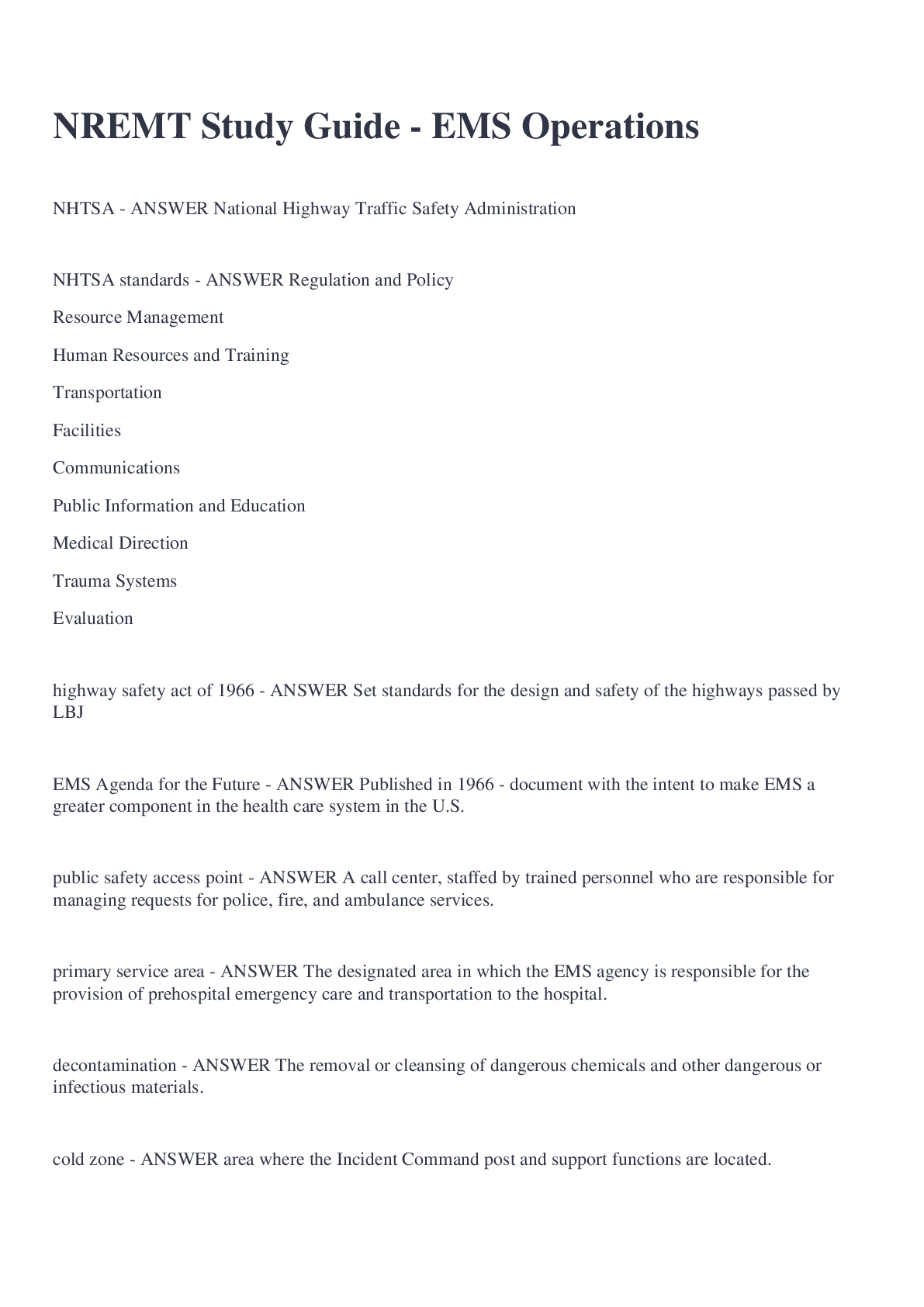
NHTSA - ANSWER National Highway Traffic Safety Administration
NHTSA standards - ANSWER Regulation and Policy
Resource Management
Human Resources and Training
Transportation
Facilities
Communications
Public Infor
...
NHTSA - ANSWER National Highway Traffic Safety Administration
NHTSA standards - ANSWER Regulation and Policy
Resource Management
Human Resources and Training
Transportation
Facilities
Communications
Public Information and Education
Medical Direction
Trauma Systems
Evaluation
highway safety act of 1966 - ANSWER Set standards for the design and safety of the highways passed by LBJ
EMS Agenda for the Future - ANSWER Published in 1966 - document with the intent to make EMS a greater component in the health care system in the U.S.
public safety access point - ANSWER A call center, staffed by trained personnel who are responsible for managing requests for police, fire, and ambulance services.
primary service area - ANSWER The designated area in which the EMS agency is responsible for the provision of prehospital emergency care and transportation to the hospital.
decontamination - ANSWER The removal or cleansing of dangerous chemicals and other dangerous or infectious materials.
cold zone - ANSWER area where the Incident Command post and support functions are located.
command - ANSWER the first on the scene to establish order and initiate the Incident Command System.
hot zone - ANSWER area immediately surrounding a hazmat incident; extends far enough to prevent adverse effects outside the zone
nims - ANSWER National Incident Management System
staging area - ANSWER the area where ambulances are parked and other resources are held until needed
staging supervisor - ANSWER person responsible for overseeing ambulances and ambulance personnel at a multiple-casualty incident.
surge capacity - ANSWER a measurable representation of ability to manage a sudden influx of patients. It is dependent on a well functioning incident management system and the variables of space, supplies, staff, and any special considerations (contaminated or contagious patients, for example). (Source: ACEP, 2011).
triage - ANSWER the medical screening of patients to determine their relative priority of need and the proper place of treatment
warm zone - ANSWER area where personnel and equipment decontamination and zone support take place; it includes control points for the access corridor and thus assists in reducing the spread of contamination.
priority 1 - ANSWER altered mental status or
absent radial pulse or
respirations greater than 30/min
red - ANSWER priority 1
priority 2 - ANSWER alert and
radial pulse present and
respirations less than 30
yellow - ANSWER priority 2
priority 3 - ANSWER alert
no life threat
walking
grean - ANSWER priority 3
priority 4 - ANSWER not breathing with open airway or
no pulseb
black - ANSWER priority 4
expressed consent - ANSWER consent given by adults who are of legal age and mentally competent to make a rational decision in regard to their medical well-being
in loco parentis - ANSWER Refers to the legal responsibility of a person or organization to take on some of the functions and responsibilities of a parent.
informed consent - ANSWER given consent with knowledge of risks and benefits
emergency doctrine - ANSWER The principle of law that permits a health care provider to treat a patient in an emergency situation when the patient is incapable of granting consent because of an altered level of consciousness, disability, the effects of drugs or alcohol, or the patient's age.
emancipated minor - ANSWER Person who is not 18 but has the same legal rights as an adult
Presumptive signs of death - ANSWER -Unresponsiveness to painful stimuli
-Lack of a carotid pulse or heartbeat
-Absence of chest rise and fall
-No deep tendon or corneal reflexes
-Absence of pupillary reactivity
-No systolic blood pressure
-Profound cyanosis
-Lowered or decreased body temperature
definitive signs of death - ANSWER Obvious mortal damage, dependent lividity, rigor mortis, putrefaction.
dependent lividity - ANSWER Blood settling to the lowest point of the body, causing discoloration of the skin.
rigor mortis - ANSWER stiffness of the body that sets in several hours after death
putrefaction - ANSWER the process of decay or rotting in a body or other organic matter
standard of care - ANSWER the degree of care that a reasonably prudent person should exercise under the same or similar circumstances
duty to act - ANSWER A medicolegal term relating to certain personnel who either by statute or by function have a responsibility to provide care.
negligence - ANSWER EMT had duty to act
EMT did not provide standard of care
there was proximate causation
proximate causation - ANSWER damages to patient were result of action or inaction of EMT
res ipsa loquitor - ANSWER the thing speaks for itself
torts - ANSWER Civil (not crimina) offense caused by negligence
abandonment - ANSWER Leaving a patient after care has been initiated and before the patient has been transferred to someone with equal or greater medical training.
assault - ANSWER placing a person in fear of bodily harm
battery - ANSWER causing bodily harm to or restraining a person
kidnapping - ANSWER the unlawful removal or restraint of a person against his or her will
false imprisonment - ANSWER restraining an individual or restricting an individual's freedom
libel - ANSWER A written defamation of a person's character, reputation, business, or property rights.
slander - ANSWER False charges and malicious oral statements about someone
Good Samaritan Law - ANSWER Provides limited protection to someone who voluntarily chooses to provide first aid
gross negligence - ANSWER Conduct that constitutes a willful or reckless disregard for a duty or standard of care.
wheeled ambulance stretcher - ANSWER Specifically designed stretcher that can be rolled along the ground
backboard - ANSWER immobilize patients with possible spinal injury
used to move patients out of awkward places
power lift - ANSWER A lifting technique in which the EMT's back is held upright, with legs bent, and the patient is lifted when the EMT straightens the legs to raise the upper body and arms.
power grip - ANSWER gripping with as much hand surface as possible in contact with the object being lifted, all fingers bent at the same angle, and hands at least 10 inches apart
emergency move - ANSWER A move in which the patient is dragged or pulled from a dangerous scene before assessment and care are provided.
urgent move - ANSWER Required when the patient must be moved quickly for treatment of an immediate threat to life. Performed WITH spinal precautions.
nonurgent move - ANSWER a patient move made when no immediate threat to life exists
bariatrics - ANSWER the branch of medicine concerned with the prevention and control of obesity and associated diseases
scoop stretcher - ANSWER A stretcher that is designed to be split into two or four sections that can be fitted around a patient who is lying on the ground or other relatively flat surface; also called an orthopedic stretcher.
direct ground lift - ANSWER A method of lifting and carrying a patient from ground level to a stretcher in which two or more rescuers kneel, curl the patient to their chests, stand, then reverse the process to lower the patient to the stretcher
extremity lift - ANSWER A method of lifting and carrying a patient during which one rescuer slips hands under the patient's armpits and grasps the wrists, while another rescuer grasps the patient's knees.
No apparent hazards (danger zone) - ANSWER 50 ft
fuel spilled (danger zone) - ANSWER 100ft
vehicle fire (danger zone) - ANSWER 100ft
wires down (danger zone) - ANSWER diameter of wire
hazardous material (danger zone) - ANSWER ERG
Subjective - ANSWER info about the patient
info someone tells you
chief complaint
SAMPLE
Objective - ANSWER info you get from your own observations
age, sex, weight, LOC, ABCs, vitals, general impression, physical assessment
Assessment - ANSWER what you think is wrong with the patient
Plan - ANSWER what you are going to do
treatment and meds
[Show More]












![Preview of THE TEFL ACADEMY LEVEL 5 - ASSIGNMENT C - AUTHENTIC MATERIAL [2026]](https://browseimages.nyc3.digitaloceanspaces.com/paper-images/2026/04/10/HpVkRcWV2026-04-10-11-5769d96426bd64f.png)