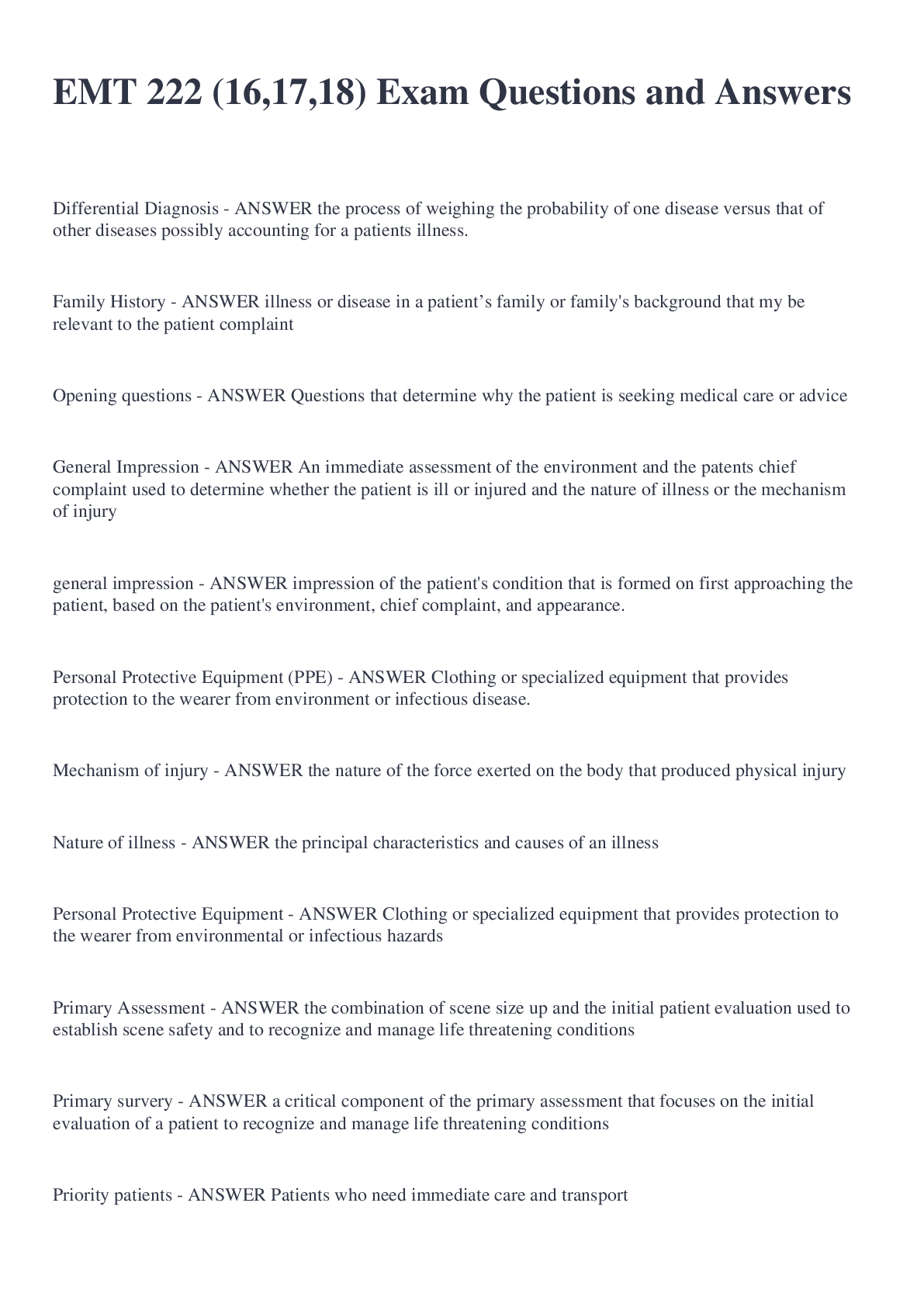
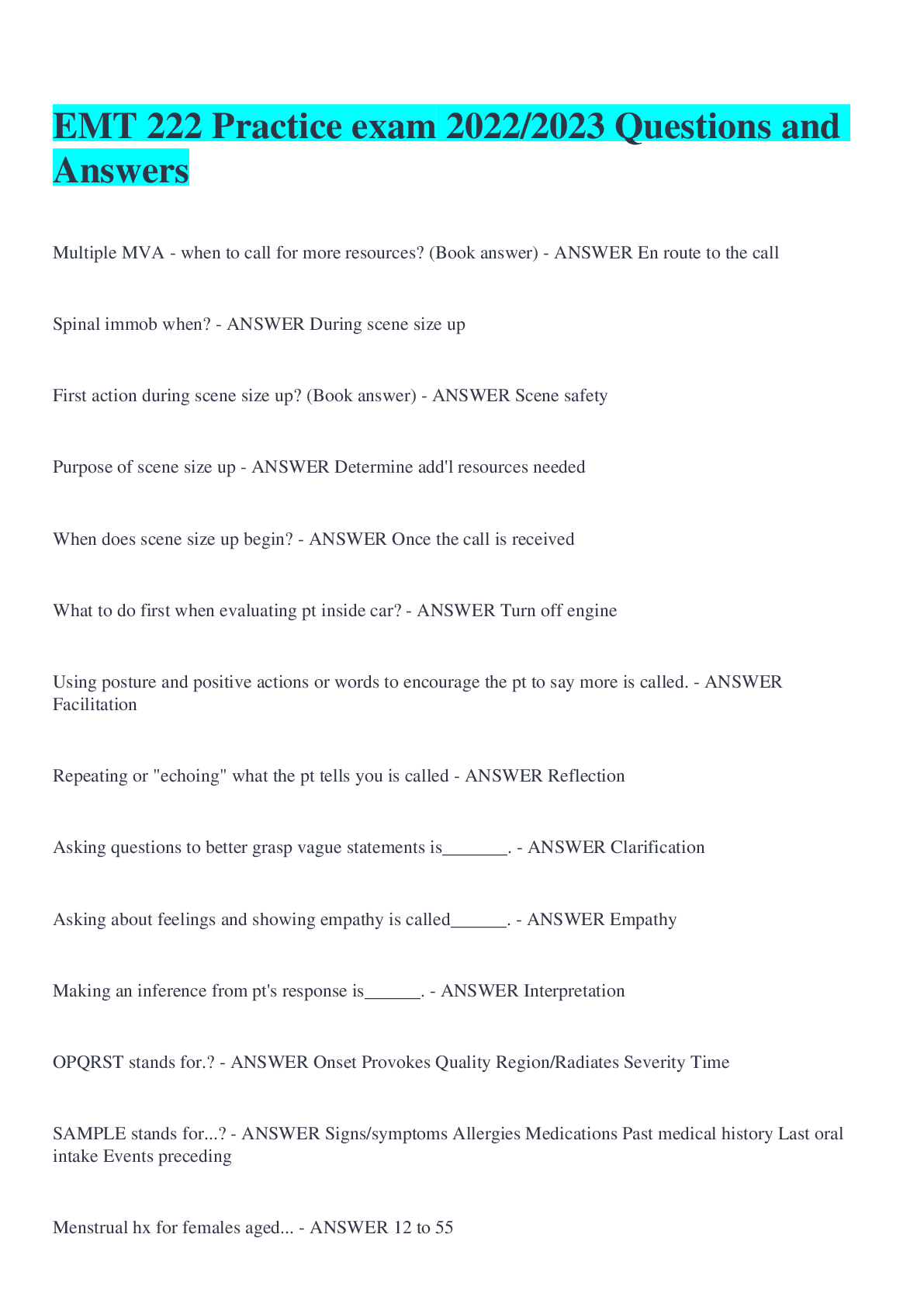
Differential Diagnosis - ANSWER the process of weighing the probability of one disease versus that of other diseases possibly accounting for a patients illness.
Family History - ANSWER illness or disease in a patient’
...
Differential Diagnosis - ANSWER the process of weighing the probability of one disease versus that of other diseases possibly accounting for a patients illness.
Family History - ANSWER illness or disease in a patient’s family or family's background that my be relevant to the patient complaint
Opening questions - ANSWER Questions that determine why the patient is seeking medical care or advice
General Impression - ANSWER An immediate assessment of the environment and the patents chief complaint used to determine whether the patient is ill or injured and the nature of illness or the mechanism of injury
general impression - ANSWER impression of the patient's condition that is formed on first approaching the patient, based on the patient's environment, chief complaint, and appearance.
Personal Protective Equipment (PPE) - ANSWER Clothing or specialized equipment that provides protection to the wearer from environment or infectious disease.
Mechanism of injury - ANSWER the nature of the force exerted on the body that produced physical injury
Nature of illness - ANSWER the principal characteristics and causes of an illness
Personal Protective Equipment - ANSWER Clothing or specialized equipment that provides protection to the wearer from environmental or infectious hazards
Primary Assessment - ANSWER the combination of scene size up and the initial patient evaluation used to establish scene safety and to recognize and manage life threatening conditions
Primary survery - ANSWER a critical component of the primary assessment that focuses on the initial evaluation of a patient to recognize and manage life threatening conditions
Priority patients - ANSWER Patients who need immediate care and transport
Resuscitative measures - ANSWER life saving measures performed immediately such as airway control ventilatory assistance control of severe bleeding and cardiopulmonary resuscitation
Scene hazard - ANSWER Environmental consents and hazards that could affect pt care or safety, bystanders or emergency personal: Weather or extreme temperature, Toxins and gases. Secondary collapses and falls. unstable conditions. Weapons.
Safe staging area - ANSWER an area away from the emergency scene that provides for safety
scene size up - ANSWER an assessment of the scene to promote scene safety for the paramedic crew, patients and bystanders; includes determination of additional resources that may be needed to manage the scene adequately
Scene Management - ANSWER Impact of the environment on patient care. Scene hazards. Violent scene and crime scene preservation. Need for additional/specialized resources. standard precautions. multiple patient situation.
Standard Precautions - ANSWER Include washing the hands wearing a gown, mask, and gloves; and using protective barriers, when indicted.
Major incidents including the following: - ANSWER Highway crashes, air crashes, major fires, train derailments, building collapse, acts of violence or terrorism, search and rescues operations, hazard materials releases, and natural disasters.
Patient Assessment - ANSWER scene size-up
primary assessment
history taking
secondary assessment
reassessment
Situation awareness - ANSWER a state of constant vigilance for changes in the scene or in a patient
Immediate resuscitative measures for medical patients: - ANSWER Airway- breathing- circulation
Immediate resuscitative measures for trauma patients: - ANSWER eXsanguinating hemorrhage- airway- breathing- Circulation
XABC
Factors that help the paramedic form a general impression: - ANSWER Position. Work of breathing. apparent attentiveness. skin color. any obvious wounds notes, any body fluids noted. any odor noted.
Factors that compromise airway: - ANSWER Tongue obstruction, loose teeth or foreign objects, epiglottis, upper airway obstruction from any cause, facial and oral bleeding, vomitus, soft tissue trauma to pts face and neck, facial fractures.
Patients in obvious cardiac arrest according to American heart guidelines - ANSWER the AHA recommences treating pts who are in obvious cardiac arrest with chest compressions. This step followed by an assessment of airway and breaking.
breathing rate - ANSWER too fast (greater than 24) too slow (less than 8 breaths a min)
Respiratory abnormalities discovered during primary surgery that may indicate a potentially life-threatening condition: - ANSWER cyanosis. nasal flaring. accessory muscle use. stridor. respiratory distress with dyspnea or hypoxia. asymmetrical chest wall movement. chest injury (tension pneumothorax, fail segment, open chest wound). tracheal deviation. Distended neck veins.
Pulse
Capillary refil - ANSWER Pulse- normal is 60 to 100. Tachycardia is greater than 100. bradycardia is less than 60. Absent rate is asystole.
Capillary refill most reliable in children younger than 12yrs. filling time more than 2 seconds is bad.
inadequate circulation and impaired cardiovascular function include the following: - ANSWER Altered or decreased level of consciousness. distended neck veins. increased respiratory rate. pale, cool, diaphoretic skin. distant heart sounds. restlessness. thirst.
Neurological Assessment - ANSWER This involves pupil reaction, LOC, speech, motor function.
Anisocoria - ANSWER a condition characterized by unequal pupil size may be congenital or indicative of pathology
Priority patients - ANSWER poor general impression, decreased loc, unresponsive patients, depressed or absent gag or cough reflex, responsive but not following commands, difficulty breathing, shock, sepsis, complicated childbirth, chest pain with BP less than 100systolic, sighs of stroke, uncontrolled bleeding, severe pain anywhere, multiple injuries
Aphasia - ANSWER loss of the ability to understand or express speech
anisocoria - ANSWER a condition in which the pupils are unequal in size
Apical impulse - ANSWER a pulsation of the left ventricle of thre heart that is palpable and sometimes visible at the fifth intercostal space to the left of the midline
ataxia - ANSWER failure of muscle coordination
auscultation - ANSWER a technique that requires the use of a stethoscope and is used to assess body sounds produced by the movement of various fluids or gases in organs or tissues
Bronchial breath sounds - ANSWER breath sounds heard only over the trachea. They are highest in pitch
bronchovesicular breath sounds - ANSWER normal breath sounds heard over the major bronchi or in the posterior chest between the scapula
bruit - ANSWER an abnormal sound or murmur hear while auscultating an artery, organ, or gland
crackle - ANSWER a fine bubbling sound heard on auscultation of the lung. It is produced by air entering distal airways and the alveoli that contain serous secretions
crepitus - ANSWER a grating sound or sensation that my be caused by bone fragments rubbing or other sources, such as a joint with inflammation
deep tendon reflexes - ANSWER reflexes that examine the sensory and motor pathways of a nerve; often associated with muscle stretching
diastolic blood pressure - ANSWER the minimum level of blood pressure measured between contractions of the heart
dyarthria - ANSWER difficult and poorly articulated speech resulting from poor control over the muscles of speech
dysconjugate gaze - ANSWER failure of the eyes to move with synchronized motion; may be diagnostic of a neurologic injury
dysphonia - ANSWER an abnormality in the speaking voice such as hoarseness
epistaxis - ANSWER bleeding from the nose
heart murmurs - ANSWER abnormal heart sounds caused by altered blood flow into the chamber or through a valve
inspection - ANSWER a visual assessment of the patient and surroundings
nystagmus - ANSWER involuntary jerking movements of the eyes
palpation - ANSWER a technique in which an examiner uses the hands and fingers to gather information from a patient by touch
percussion - ANSWER a surface tapping technique used to evaluate the presence of air or fluid in body tissues
pericardial friction rub - ANSWER a dry grating sound heard with a stethoscope during auscultation suggestive of pericarditis
PERRL - ANSWER acronym that indicates that the pupils are equal, round and reactive to light
physical examination - ANSWER an assessment of a patient that includes examination techniques measurement of vital signs an assessment of height and weight and the skillful use of examination equipment
pleural friction rub - ANSWER a rubbing or grating sound that occurs as one layer of the plueral membrane slides over the other during breathing
pronator drift test - ANSWER a test to evaluate balance and upper extremity weakness, performed by having the patient close the eyes and hold both arms out from the body
pulse deficit - ANSWER a condition that exists when the radial pulse is less than the ventricular rate; it indicates a lack of peripheral perfusion
reassessment - ANSWER the ongoing assessment that follows the paramedics initial evaluation of the patient
rhonchi - ANSWER abnormal, coarse rattling respiratory sounds, usually caused by secretions in bronchial airways, muscular spasm, neoplasm, or external pressure
romburg test - ANSWER a test to evaluate stance and balance; performed by having the patient stand erect with eyes closed, feet together and arms at the sides
secondary assessment - ANSWER an assessment that consists of physical examination techniques, measurement of vital signs, an assessment of body systems and the skillful use of examination equipment
six cardinal fields of gaze - ANSWER an assessment that consists of physical examination techniques, measurement of vital signs, an assessment of body systems, and the skillful use of examination equipment.
stridor - ANSWER an abnormal high pitched musical sound caused by obstruction in the trachea or larynx
subcutaneous emphysema - ANSWER the presence of air in the subcutaneous tissues
superficial reflexes - ANSWER reflexes elicited by sensory afferents from skin
systolic blood pressure - ANSWER the blood pressure measured during the period of ventricular contraction
thrills - ANSWER fine vibrations felt by an examiners hands over the site of aneurysm or on the pericardium
tidal volume - ANSWER the volume of air inspired or expired in a single resting breath
tympany - ANSWER a hollow drumlike sound produced when a gas containing cavity is percussed
vesicular breath sounds - ANSWER breath sounds heard over most of the lung fields; the major normal breath sound
wheeze - ANSWER a form of rhonchus characterized by high pitched musical quality. It is caused by high velocity airflow through narrowed airways.
Secondary Assessment - ANSWER Consists of physical examination techniques, measurement of vital signs, an assessment of body systems, and the skillful use of examination equipment.
Examination Techniques - ANSWER Inspection
Palpation
Percussion
Auscultation
Measurement of vital signs - ANSWER pulse
respirations
blood pressure
temperature especially in children
Manual assessment equipment - ANSWER blood pressure cuff
ophthalmoscope otoscope
Appropriate assessment of the patient depends on: - ANSWER Stability of the patient. complaint and history. patients ability to communicate. potential for unrecognized illness.
Secondary Assessment - ANSWER Consists of physical examination techniques, measurement of vital signs, an assessment of body systems, and the skillful use of examination equipment.
Examination Techniques - ANSWER Inspection
Palpation
Percussion
Auscultation
Measurement of vital signs - ANSWER
Secondary Assessment - ANSWER Consists of physical examination techniques, measurement of vital signs, an assessment of body systems, and the skillful use of examination equipment.
Examination Techniques - ANSWER Inspection
Palpation
Percussion
Auscultation
Measurement of vital signs - ANSWER
Secondary Assessment - ANSWER Consists of physical examination techniques, measurement of vital signs, an assessment of body systems, and the skillful use of examination equipment.
Examination Techniques - ANSWER Inspection
Palpation
Percussion
Auscultation
Secondary Assessment - ANSWER Consists of physical examination techniques, measurement of vital signs, an assessment of body systems, and the skillful use of examination equipment.
Secondary Assessment - ANSWER Consists of physical examination techniques, measurement of vital signs, an assessment of body systems, and the skillful use of examination equipment.
Secondary Assessment - ANSWER Consists of physical examination techniques, measurement of vital signs, an assessment of body systems, and the skillful use of examination equipment.
Secondary Assessment - ANSWER Consists of physical examination techniques, measurement of vital signs, an assessment of body systems, and the skillful use of examination equipment.
[Show More]