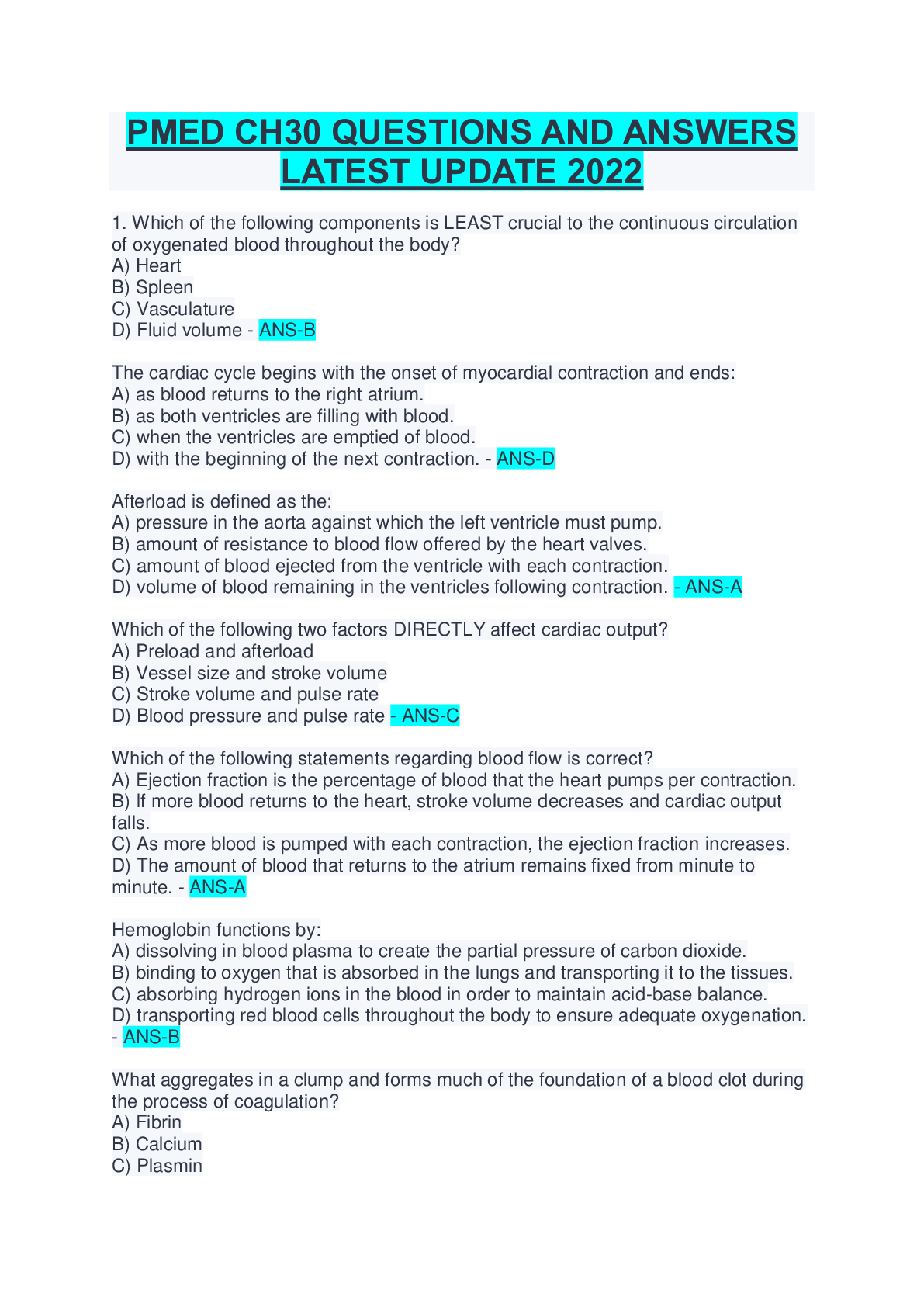
PMED CH30 QUESTIONS AND ANSWERS LATEST UPDATE 2022
Document Content and Description Below
PMED CH30 QUESTIONS AND ANSWERS
LATEST UPDATE 2022
1. Which of the following components is LEAST crucial to the continuous circulation
of oxygenated blood throughout the body?
A) Heart
B) Spleen
C) Vasculature
D
...
[Show More]
Last updated: 4 years ago
Preview 1 out of 7 pages
Instant download
Buy this Document to get the Full Access Instantly
Provided by Students Who Aced it
We Verify Document Content to Gurantee Accuracy
Reviews( 0 )
Document information
Connected school, study & course
About the document
Uploaded On
Sep 26, 2022
Number of pages
7
Written in
All

Additional information
This document has been written for:
Uploaded
Sep 26, 2022
Downloads
0
Views
64
Topic Tags
Recommended For You
Get more on EXAM »
$19.5
149 Pages
NURSING HEALTH ASS APEA TB 2 Exam Questions and Answers 100%co...
$16
38 Pages
NCLEX- Pediatrics Questions And Answers Latest Update 2022/202...

$14.5
69 Pages
ATI Predictor (180 Q&As)Test BEST EXAM SOLUTION SATISFACTION G...
$25.5
31 Pages
RN VATI EXAM QUESTIONS & ANSWERS BEST EXAM SOLUTION SATISFACT...
$25
220 Pages
RNSG 2231 HESI Extra Credit Module 3 Exam Mental Health Concep...
$31
435 Pages
FULL - Elaborated Test Bank for Essentials of Pediatric Nursin...

$20
466 Pages
Test Bank for Understanding Medical-Surgical Nursing 5th Editi...
$12
219 Pages
Edelman: Health Promotion Throughout the Life Span, 8th Editio...
.png)
$11.5
783 Pages
TEST BANK For Principles of Pediatric Nursing Caring for Child...

$13
254 Pages
Test bank Med/Surg HESI Practice Questions with accurate RATI...
$5
34 Pages
State Farm Estimates Review Practice Exercise Answer Key New U...
$14
103 Pages
NUR MISCMaternity (Practice) HESI (1 Q & As BEST SOLUTION SATI...

$14.5
11 Pages
Rn ATI capstone Fundamentals Focused Review Management Care (1...
$15
21 Pages
NUR 307 Study Guide Exam 3 Pediatrics Spring 2021 Exam 3 Modul...


More related documents below