PMED CH2 EXAM REVIEW 2022
QUESTIONS AND ANSWERS
Which of the following is NOT a component of well-being that is essential for a
healthy life?
A) Mental
B) Physical
C) Financial
D) Emotional - ANS-C
If health car
...
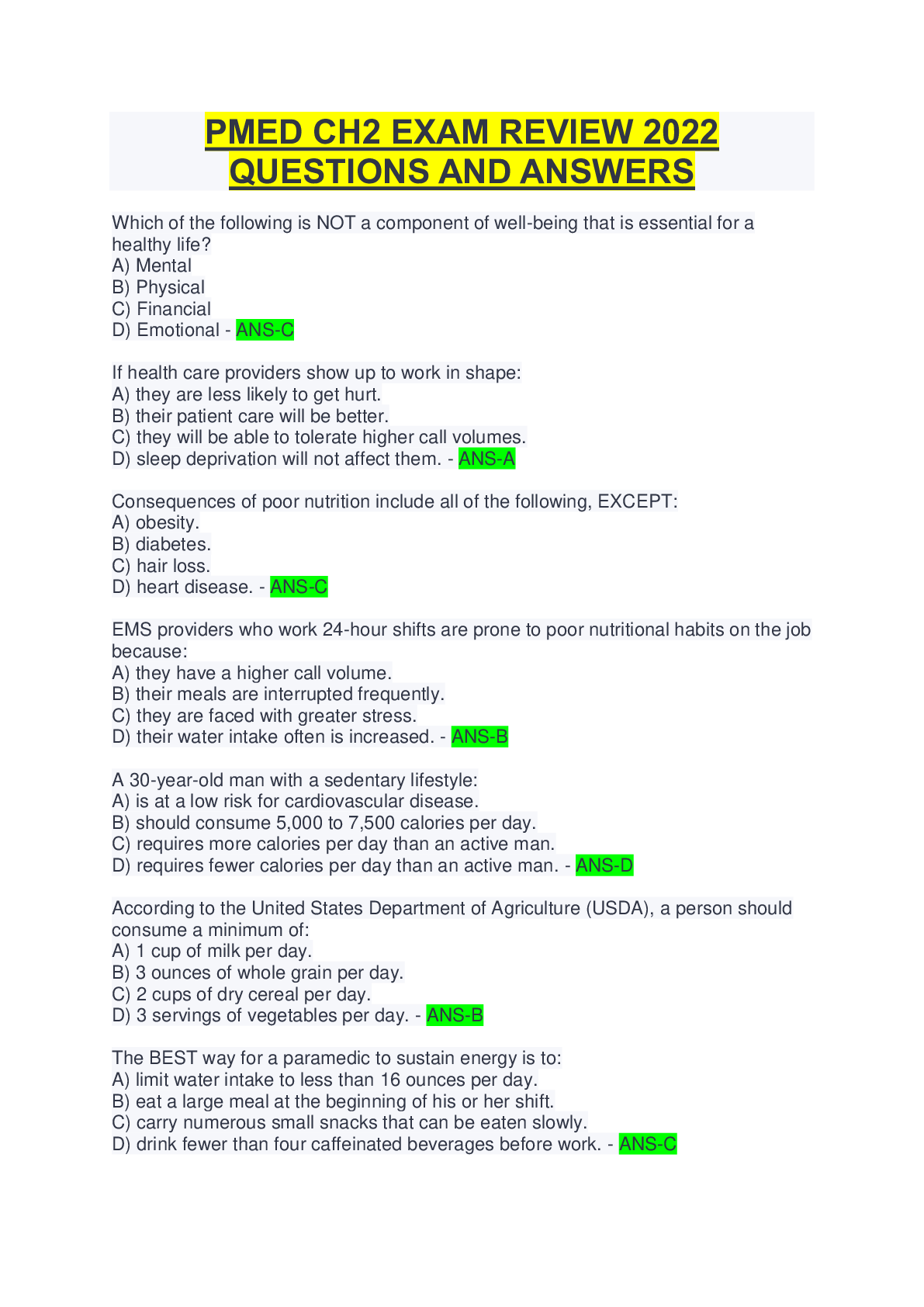
PMED CH2 EXAM REVIEW 2022
QUESTIONS AND ANSWERS
Which of the following is NOT a component of well-being that is essential for a
healthy life?
A) Mental
B) Physical
C) Financial
D) Emotional - ANS-C
If health care providers show up to work in shape:
A) they are less likely to get hurt.
B) their patient care will be better.
C) they will be able to tolerate higher call volumes.
D) sleep deprivation will not affect them. - ANS-A
Consequences of poor nutrition include all of the following, EXCEPT:
A) obesity.
B) diabetes.
C) hair loss.
D) heart disease. - ANS-C
EMS providers who work 24-hour shifts are prone to poor nutritional habits on the job
because:
A) they have a higher call volume.
B) their meals are interrupted frequently.
C) they are faced with greater stress.
D) their water intake often is increased. - ANS-B
A 30-year-old man with a sedentary lifestyle:
A) is at a low risk for cardiovascular disease.
B) should consume 5,000 to 7,500 calories per day.
C) requires more calories per day than an active man.
D) requires fewer calories per day than an active man. - ANS-D
According to the United States Department of Agriculture (USDA), a person should
consume a minimum of:
A) 1 cup of milk per day.
B) 3 ounces of whole grain per day.
C) 2 cups of dry cereal per day.
D) 3 servings of vegetables per day. - ANS-B
The BEST way for a paramedic to sustain energy is to:
A) limit water intake to less than 16 ounces per day.
B) eat a large meal at the beginning of his or her shift.
C) carry numerous small snacks that can be eaten slowly.
D) drink fewer than four caffeinated beverages before work. - ANS-C
Patterns of living that you develop in your youth:
A) are hard to modify in later life.
B) usually are caused by genetics.
C) cannot be modified later in life.
D) typically are outgrown in later life. - ANS-A
According to the 2010 Dietary Guidelines, the keys to controlling body weight
include:
A) exercising more and increasing your caloric intake.
B) drinking less water per day and exercising regularly.
C) consuming more calories and eating fewer vegetables.
D) eating fewer calories while increasing physical activity. - ANS-D
Which of the following is MOST closely linked to your body weight, nutritional status,
and hydration?
A) A diet high in calories
B) At least 8 hours of sleep
C) Adequate calcium intake
D) Regular vigorous exercise - ANS-D
An exercise program should be targeted at maintaining or improving:
A) respiratory efficiency, muscle strength, and mental health.
B) cardiovascular endurance, flexibility, and physical strength.
C) body weight, muscle flexibility, and a strong bone structure.
D) blood pressure, resting heart rate, and respiratory efficiency. - ANS-B
What is the recommended exercise routine for most adults?
A) At least 30 minutes a day of moderate to vigorous exercise
B) No more than 2 hours of vigorous exercise every other day
C) At least 1 hour a day of mild to moderate physical activity
D) At least 20 minutes a day of moderate to vigorous exercise - ANS-A
You should know your target heart rate and:
A) surpass it by 50% every time you exercise.
B) achieve at least half of it when you exercise.
C) attempt to achieve it every time you exercise.
D) avoid reaching it because it may injure the heart. - ANS-C
To estimate your maximum heart rate, you should:
A) subtract your age from 220.
B) double your age and add 220.
C) divide your age by two and add 100.
D) multiply your age by 2 and subtract 10%. - ANS-A
What is the target heart rate for a 35-year-old man with a resting heart rate of 75
beats per minute?
A) 138 beats/min
B) 146 beats/min
C) 152 beats/min
D) 159 beats/min - ANS-C
If a 30-year-old man has a resting heart rate of 60 beats/min and a maximum heart
rate of 190 beats/min, his target heart rate is ____ beats/min.
A) 139
B) 143
C) 147
D) 151 - ANS-D
If you are a smoker who is trying to quit, you must FIRST understand that:
A) second-hand cigarette smoke is a health hazard to others.
B) smoking is a true addiction and quitting may not be easy.
C) smoking cessation medications are usually the most effective.
D) you will need the guidance of a physician or psychotherapist. - ANS-B
Ignoring one's circadian rhythms may result in all of the following, EXCEPT:
A) decreased physical coordination.
B) enhanced social functioning.
C) persistent difficulty with sleep.
D) impairment of higher thought function. - ANS-B
Regardless of a paramedic's circadian rhythms, he or she should:
A) not overlook the need for rest.
B) vary his or her sleep schedule.
C) only consume minimal caffeine.
D) eat at different times of the day. - ANS-A
The MOST common of all hereditary risk factors are:
A) cancer and mental illness.
B) hypertension and stroke.
C) heart disease and cancer.
D) stroke and Alzheimer's disease. - ANS-C
Which of the following habits will increase your exposure to injury from lifting your
maximum weight?
A) Ensuring that the patient is aware that he or she is about to be lifted
B) Routinely lowering the ambulance stretcher all the way to the ground
C) Removing all unnecessary equipment from the cot before loading it
D) Utilizing a second person to help lift the foot end of the cot if needed - ANS-B
To protect your back when lifting, you should:
A) spread your legs approximately 6" apart whenever you lift.
B) maintain a slight curvature of your back whenever you lift a patient.
C) use the powerful muscles of your lower back to help support weight.
D) keep your back in a straight, upright position and lift without twisting. - ANS-D
Any time you need to move a patient who cannot or should not walk, it is MOST
important to consider:
A) the need for extra help.
B) why the patient cannot walk.
C) the type of moving device needed.
D) how far the patient must be moved. - ANS-A
The fight-or-flight response is characterized by all of the following physiologic
responses, EXCEPT:
A) an increased flow of blood to the skeletal muscles.
B) decreased sympathetic tone and pupil constriction.
C) mobilization of glucose and an increased heart rate.
D) shunting of blood away from the gastrointestinal tract. - ANS-B
When lifting, the paramedic should spread his or her legs_____________ apart.
A) shoulder-width
B) at least 20"
C) between 6" and 12"
D) no more than 6" - ANS-A
As a part of your personal health assessment, you should:
A) see your personal physician at least every 6 months.
B) have your cholesterol checked every 3 or 4 months.
C) consider hereditary factors that can impact your health.
D) have a routine colonoscopy beginning at age 25 years. - ANS-C
The ability to remain calm and think clearly when everything else is in disarray is a
trait of:
A) empathy.
B) competence.
C) compassion.
D) professionalism. - ANS-D
If you are approached by a coworker who has noticed a negative change in your
behavior, you should:
A) request to speak to a psychologist as soon as possible.
B) keep an open mind regarding what the coworker has noticed.
C) thank your coworker, but let him or her know you are okay.
D) ask your supervisor to be moved to a different station. - ANS-B
Which of the following statements regarding stress is correct?
A) Eustress is the leading cause of suicide among EMS, fire, and law enforcement
personnel.
B) By itself, any kind of stress has a negative effect on the human body and should
be avoided.
C) The human stress reaction is exclusive to physical demands that are placed on
the body.
D) The way one person reacts to stress may differ significantly from another person's
reaction. - ANS-D
Biologic stress is MOST accurately defined as:
A) a predictable sequence of physiologic events caused by a stressor.
B) the nonspecific response of the body to any demand made upon it.
C) stress that most often occurs following a positive event or situation.
D) a prolonged and severe discharge of the sympathetic nervous system. - ANS-B
CONTINUES...
[Show More]